
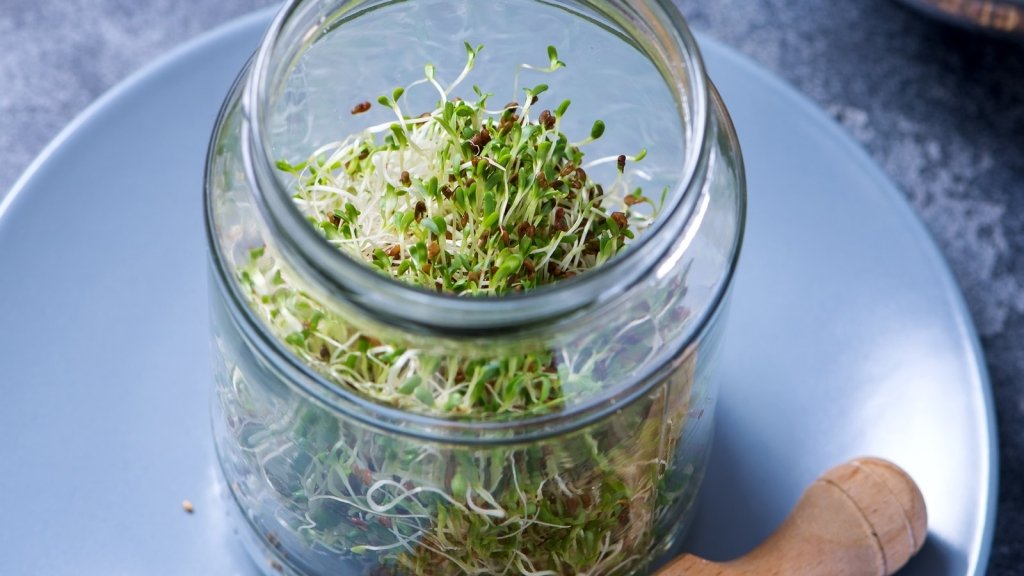
The short version: Rinse a spoonful of sprouting seed in a wide mouth jar, soak it for about eight hours or overnight, then drain hard and stand the jar mouth down on a slope. Rinse and drain twice a day, three times in hot weather, out of direct sun at room temperature. Most seeds are ready in three to six days and keep a few days in the fridge once rinsed and dried.
A jar of sprouts is the fastest crop in the house. No soil, no waiting on the weather, and a tablespoon of broccoli seed started on a Monday night can be crisp sprouts on a sandwich by Thursday. It is the plain jar method: clean seed, honest draining, and a rinse rhythm you keep.

What sprouting actually is
Sprouting is germination that you eat. Seed is woken with water, grown in air rather than soil, and eaten whole while still a shoot, so the softened seed, the first leaves and the little white root go on the plate together.
Microgreens are the next stage along, and a different job. They are sown into a growing medium, given good light, then cut above it at the first true leaves, which leaves seed and roots behind. Sprouts are quicker and need no light, while microgreens give more leaf for a longer wait, and that method is in our guide to growing microgreens at home.
The kit: a jar, a mesh lid, and something to lean on
Four ordinary things do the whole job.
- A wide mouth jar of about one litre, glass so you can see inside.
- A lid that breathes: stainless mesh, flywire, or two layers of muslin under a band.
- A bowl or a dish rack to hold the jar mouth down on a slope.
- A clean tea towel, kept for this job and washed often.
The angle matters more than any gadget on the shelf. Sprouting seed wants to be damp, not wet: the film of water clinging to each seed coat keeps germination going, while water pooling in the base of a jar sits still, warms up and feeds bacteria. A jar propped mouth down at roughly 45 degrees keeps draining long after you walk away, ticking quietly as the drips slow, and pulls fresh air past the mesh as the water leaves.

The method, step by step
The method is four moves: rinse, soak, drain hard, then rinse and drain twice a day until they are the length you want.
- Rinse the dry seed. Use one to two tablespoons of small seed such as alfalfa or broccoli, or half a cup of mung beans, and rinse until the water runs clear. Dry seed rattling against glass is the last quiet moment.
- Soak. Cover the seed with three or four times its volume of cool water. Use water you would happily drink, and go by the seed. Alfalfa and broccoli want about eight hours or overnight, and mung beans about twelve. A big bean takes longer to drink its fill than a small seed. Seed can double in volume, so allow room.
- Drain hard. Tip the soak water out through the mesh, refill, swirl and tip again, then invert the jar into the bowl or rack. Standing water at this stage is a common cause of a batch that turns.
- Rinse morning and night. Half fill with cool water, swirl so every seed gets wet, pour it off and put the jar back on its slope. The rinse water runs cloudy at first and clears as loose seed coats wash free.
- Add a third rinse when it is hot. Above about 25°C the jar warms, the sprouts work faster and any bacteria get the same encouragement. Commercial bean sprout rooms are watered every one to two hours, so a midday rinse in summer is not fussiness.
Keep the jar out of direct sun at ordinary room temperature. Alfalfa (Medicago sativa) is grown commercially in rooms held at 18 to 21°C, and a bench away from the window is close enough. A sunny windowsill cooks a jar from the glass inwards.

How you know they are ready
They are ready when the shoot has the length and flavour you want, which is a decision, not a deadline. Alfalfa and broccoli (Brassica oleracea var. italica) are usually grown over three to six days, while mung beans (Vigna radiata) run from 24 to 48 hours for the crunchy style to five or six days for a long shoot.
A short sprout still tastes of the seed: a young mung bean is dense, starchy and sweet, closer to a fresh pea than to the pale shoots in a stir fry. A long sprout tastes greener and lighter, more stem than bean, which is what you want raw in a salad. Alfalfa stays mild at any length, while broccoli and fenugreek (Trigonella foenum-graecum) keep a peppery edge, and fenugreek turns bitter if it runs long.
Fine white fuzz around the roots is almost always root hairs, not mould, and it lies flat at the next rinse.
Harvest, seed coats and the fridge
Harvest is a rinse, a float and a dry. Tip the sprouts into a bowl of cool water and swirl them: the loosened seed coats drift up like confetti and pour off with the water. They are harmless, but they go slimy first.
Drying is the step people skip. Drain well, spread the sprouts on a clean tea towel and leave them until the surface feels dry rather than damp. Wet sprouts packed into a container turn to a grey mat within a day.
Store them loosely in a container lined with paper towel and keep the fridge cold: packed sprouts are held below 5°C in the commercial chain. Eat them within a few days.

Keeping home grown sprouts safe to eat
Sprouts are the one home crop where hygiene counts as much as method. The warmth, moisture and nutrients that wake a seed up suit Salmonella, Listeria and pathogenic E. coli equally well, which is why sprouts are treated as higher risk produce than other salad crops. Wash your hands, use a jar and lid washed in hot soapy water, and do the evening rinse even when you cannot be bothered. It is worth knowing that commercial growers decontaminate the seed before it is ever soaked, and test their water, which is a step no jar on a bench can copy. That is why the advice below is firm rather than fussy.

The NSW Food Authority advice on sprouts is that people with low immunity, children under five, people over 70 with underlying conditions and pregnant women should avoid raw and lightly cooked sprouts, and that even the most hygienic conditions cannot guarantee bacteria free sprouts. Cooked right through, rather than warmed on top of a stir fry, is the reliable answer for those groups.
Across Australia's climate zones
Sprouting happens indoors, so the zone question is bench temperature, rinse frequency and how fast a jar spoils. In the Tropical zone (northern WA, the NT Top End and far north QLD) a jar runs hot and quick: Darwin averages a daily maximum of 31.8°C in January and still 30.7°C in July, so rinse three times a day all year and pick young. Subtropical kitchens (south east QLD and northern NSW) do the same in summer, twice a day in winter.
In the Arid and semi-arid zone (inland NSW, SA, WA and central QLD) dry air pulls moisture from a jar between rinses, and Alice Springs averages a daily maximum of 36.6°C in January. Rinse three times a day from spring to early autumn and twice in winter, and keep the jar out of the draught from an evaporative cooler. Temperate kitchens (coastal and eastern NSW, VIC) sit closest to the 18 to 21°C that suits sprouts, and two rinses a day covers the year, though Melbourne, the cold end of temperate, runs slower in winter. Mediterranean kitchens (Perth and southern WA, Adelaide and southern SA) keep the same rhythm, with a third rinse through summer.
In the Cool and alpine zone (TAS, the southern tablelands, the Victorian high country, and Canberra and the ACT) slowness is the problem rather than spoilage. Hobart averages a daily maximum of 21.8°C in January but only 11.8°C in July, so a winter jar on a cold bench sits and sulks. Move it near the kettle.
Once the rhythm is in your hands, sprouting becomes something you do while the kettle boils. Our sprouting seed range is the place to start: Alfalfa Sprouts Seeds for the mild fine sprout everyone knows, Broccoli Sprout Seeds for a peppery bite, Mung Bean Seeds (Sprout) for a stir fry, and Fenugreek Seeds (Sprout) once the method is second nature. For a weekly habit, the bulk sprouting seed packs are sized for it.
Frequently asked questions
How long do sprouts take in a jar?
Alfalfa is usually grown over four to seven days from soaking to harvest and broccoli over three to five, while mung beans give a short crunchy sprout at 24 to 48 hours. Warm kitchens run faster than cool ones, so judge by the sprout rather than the calendar.
Do sprouts need light?
No. Sprouts live on the food stored inside the seed, so they grow well in a shaded corner of the bench. Avoid direct sun, because a glass jar heats quickly and warm water spoils a batch.
Can I sprout seed from my garden packets?
Use seed sold for sprouting. Garden lines may be treated with fungicide and are not handled as a food. Seed sold for sprouting is untreated and cleaned for the job, although no seed from anyone can be guaranteed free of bacteria.
How often should I rinse in summer?
Twice a day is the standard rhythm. Once the kitchen runs above about 25°C, add a third rinse at midday with cool water. Heat speeds the sprouts and any bacteria alike. The extra rinse cools the jar and washes out waste and loose seed coats, which slows spoilage. It does not make sprouts safe to eat.
How long do sprouts keep in the fridge?
A few days, provided they are rinsed, dried on a tea towel and stored loosely in a cold fridge. Commercial sprouts are kept below 5°C and a home batch deserves the same. Throw out anything darkened or musty.
Are home grown sprouts safer than bought ones?
No. Commercial producers work to a food safety standard, with seed decontamination, audits and water testing that a kitchen cannot copy. Clean hands and a clean jar stop you adding to the problem, but bacteria can arrive on the seed itself and no rinse removes what is already inside a sprout. People who are pregnant, children under five, people over 70 and anyone immunocompromised should eat sprouts cooked through.