
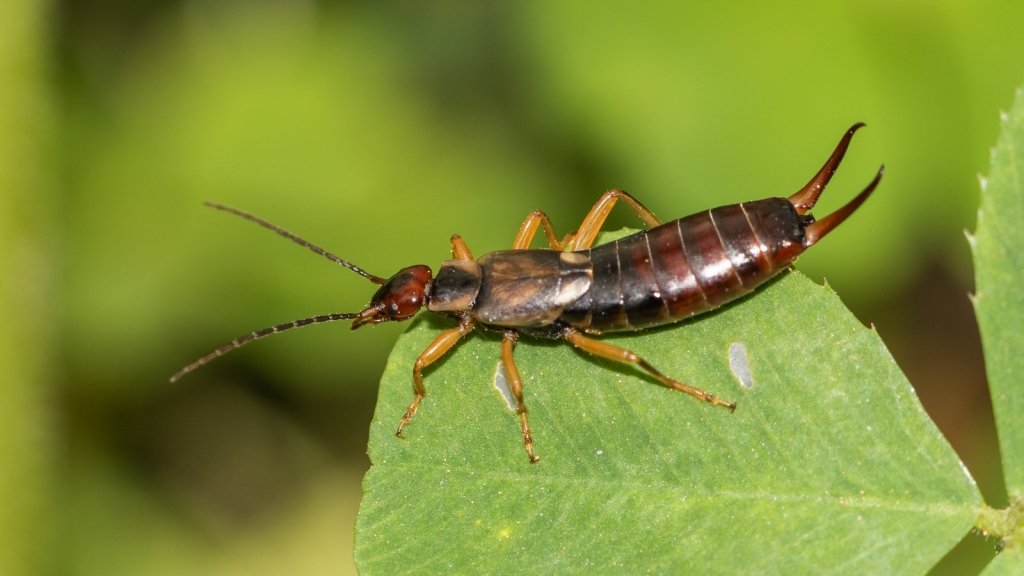
The short version: Not every earwig is a pest. Native Australian earwigs are mostly helpful, eating aphids and decaying matter, while the introduced European earwig is the one that chews seedlings, soft flowers and ripe fruit overnight. The tell is ragged holes with no slime trail, and the easiest control is overnight traps, a rolled damp newspaper or a low tin of oil, emptied each morning. Decide whether they are actually doing harm before you act.
Earwigs have an image problem. The pincers look alarming, the name is the stuff of playground myth, and a bed of seedlings chewed to stumps overnight does little for their reputation.
The truth is more useful than the folklore. Most earwigs in an Australian garden are working for you, and only one is a real nuisance.
Friend or foe?
Australia has about 85 species of earwig, and the great majority are native and largely beneficial. They prey on aphids, mites and small caterpillars, and they help break down decaying matter. The common brown earwig (Labidura truncata) is one of these, and it carries a distinctive orange triangle on its back.
The pest to know is the European earwig (Forficula auricularia), introduced and now well established across southern Australia. It is a uniform glossy brown with pale, yellowish legs, shoulders and pincers, and unlike the solitary natives it gathers in groups. Even the European earwig has a good side, since it eats aphids and other small pests, so the honest answer is that earwigs are a case-by-case call. Work out whether they are doing real damage in your garden before reaching for a control.
How to know earwigs are the culprit
Earwigs feed at night and hide by day, so you usually see the damage before the insect. Look for ragged, irregular holes in seedlings, soft leaves, petals and soft fruit, appearing overnight.
The key point of difference is that earwigs leave no slime trail, which separates their damage from that of slugs and snails, whose silvery mucus is the giveaway. If you suspect earwigs, go out after dark with a torch, and you will often catch them in the act. By day they shelter in dark, damp crevices: under pots and boards, in mulch, bark and leaf litter, and around woodpiles.
What they damage, and what they help
The plants most at risk are seedlings, lettuce and other leafy greens, dahlias, zinnias, roses and similar soft flowers, strawberries, ripening stone fruit and corn silks. A hungry group can strip a bed of seedlings in a single night, which is what earns the European earwig its bad name.
Against that, earwigs prey on aphids, mealybugs, mites and small caterpillars, and they feed birds, lizards and frogs in turn. In a bed where aphids are the bigger problem, earwigs may be doing more good than harm.
How to control earwigs organically
Once you have decided they are a genuine pest, simple traps do most of the work, because earwigs reliably seek out dark, snug hiding places at dawn.
- Set overnight traps and empty them each morning. A loosely rolled, dampened newspaper or a length of corrugated cardboard, an upturned pot stuffed with straw or newspaper, or a shallow tin of vegetable or linseed oil with a dash of soy sauce as a lure will all gather earwigs overnight. Tip the catch out each morning.
- Take away daytime shelter near seedlings. Pull mulch back from young stems, clear away boards, debris and weeds, and keep woodpiles away from the beds.
- Protect vulnerable seedlings with collars or cloches, and hand-collect by torchlight if numbers are high.
- Encourage the predators that eat them, including birds, lizards and frogs, and backyard poultry where you keep them.
It is just as important to know what to avoid. Do not blanket-spray broad-spectrum insecticides, and do not use agricultural earwig baits meant for broadacre crops in a home garden, since both kill native earwigs, ladybirds and pollinators along with the target. Open sticky traps are best avoided too, as they catch beneficial insects. The Western Australian guide to managing European earwig sets out the same trap-and-tidy approach.
Earwigs across Australia's climate zones
The European earwig is essentially a pest of the cooler, southern parts of the country, so the picture changes a good deal by region.
- Tropical (Darwin, Cairns): the European earwig is not established, and the native earwigs present are mostly beneficial, so they rarely need control.
- Subtropical (Brisbane, northern NSW): native species predominate, with only occasional minor nibbling of seedlings or soft fruit.
- Arid and semi-arid (Alice Springs, Mildura): dryness limits earwigs generally, and they concentrate in irrigated, mulched beds.
- Temperate (Sydney, Melbourne, Canberra): the European earwig is established, so watch seedlings in spring. This is a main pest zone.
- Mediterranean (Perth, southern WA and Adelaide): the European earwig is a recognised, notable pest, and dry summers push it into watered gardens, with seedling damage peaking in spring.
- Cool and alpine (Tasmanian highlands, the tablelands): cool, damp conditions suit it, and numbers can build in a damp year.
Frequently asked questions
Are earwigs good or bad for the garden?
Both, depending on the species. Many, especially the natives, prey on aphids and small caterpillars and help recycle decaying matter. The introduced European earwig can also chew seedlings, petals and soft fruit, so judge by the damage in your own garden before acting.
Do earwigs really crawl into your ears?
No, that is a myth. They do not crawl into ears or brains, and the name most likely comes from the ear-shaped hind wing. They cannot sting, and only rarely give a harmless little pinch.
How do I tell earwig damage from slug or snail damage?
Earwigs leave ragged, irregular holes and shredded tips overnight, with no slime trail. Slugs and snails leave a silvery mucus trail. A night check with a torch will usually settle it.
How do I tell a European earwig from a native one?
European earwigs are a uniform glossy brown with pale legs and pincers, and they gather in groups. Native earwigs are usually found singly, and the common brown earwig has an orange triangle on its back.
What is the easiest way to control them?
Overnight traps: a rolled damp newspaper, a straw-stuffed upturned pot, or a low tin of oil, set near the affected plants and emptied each morning. Pull mulch back from seedlings, and let birds and lizards help.
When are earwigs worst?
In the warmer months, with seedling damage usually peaking in spring and soft-fruit damage in summer. Numbers build in damp, cool conditions and wherever there is dark, moist shelter.
Watch what is actually being eaten, trap the culprits if the damage is real, and you can let the earwigs that are quietly eating your aphids get on with the job.
Related growing guides
- Organic pest control in Australia
- Damping off: what it is and how to prevent it
- What is actually in a beneficial bug mix
Ready to plant? Browse our vegetable seeds, lettuce seeds and flower seeds.