
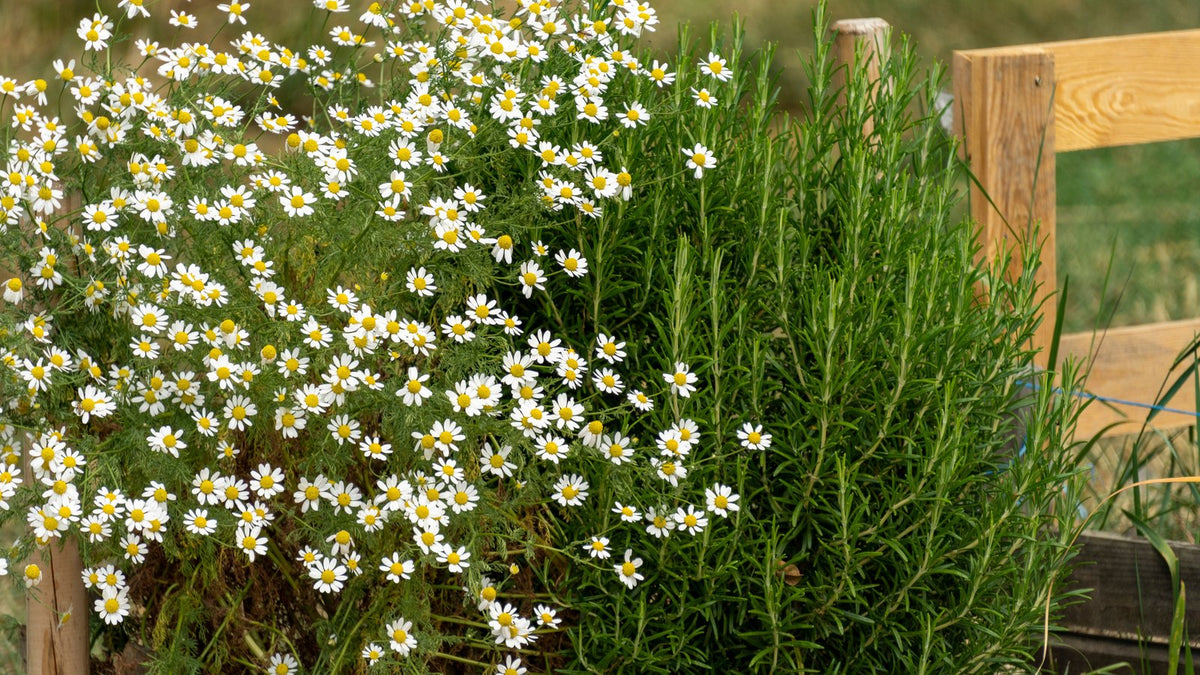

The short version: Nine herbs sold as seed will stock a teapot: German chamomile for its flowers; lemon balm, tulsi, anise hyssop, lemon mint and spearmint for leaves; lemongrass for leaf and stem; jiaogulan for a usually sweet leaf off a climber; and rosella for its red calyx, with calendula petals for colour. Pick on a dry morning once the dew has gone, dry in shade with air moving, and store whole in labelled jars out of the light. Comfrey is for the compost heap, not the cup.
A tea garden starts small and quietly takes over the kitchen bench. Three pots by the back door are enough to start with, and the first cup of something you grew and dried yourself tastes better than it has any right to.
This guide is about flavour and the small ritual of the pot, not remedies.
Nine tea herbs you can grow from seed
Start with two or three; most are perennials that pick for years from one packet.
- German chamomile (Matricaria recutita, also listed as M. chamomilla): an upright annual to about 60 cm, grown for the flowers. Pick the heads once the white petals sit fully open and flat, before they fold back; picking every few days brings on more buds. Roman chamomile, an apple-scented perennial mat, flowers less and brews more bitter; golden chamomile (Anthemis tinctoria) is a dye daisy, not a tea plant.
- Lemon balm (Melissa officinalis): a clump-forming perennial, 30 to 90 cm, for sun or part shade. The leaves brew lemony, fresh or dried. Cut the flower stems before they set seed, or you will be weeding lemon balm out of every path.
- Tulsi, or holy basil (Ocimum tenuiflorum): clove-scented leaves for the pot. A warm-season perennial where frost stays away, a summer annual further south. Pick young tips to keep it bushy.
- Anise hyssop (Agastache foeniculum): a short-lived perennial with sweet aniseed leaves and purple flower spikes, both for the pot. It takes light frost once established.
- Lemon mint, or bergamot (Monarda citriodora), no relation to the citrus bergamot in Earl Grey: a self-seeding annual, not a true mint, with lemon-scented leaves and whorls of pink to lavender flowers. Pick both.
- Spearmint (Mentha spicata): the mint to grow from seed, because peppermint is a sterile hybrid normally grown from cuttings. Mint seed does not come true to type, so keep the best-smelling seedling and grow the rest from its cuttings. Mints spread by runners, so this one lives in a pot.
- Lemongrass (Cymbopogon flexuosus): a perennial clump. The swollen stem bases go to the kitchen; the tough upper leaves are the tea, cut into lengths. Wear gloves when you cut it, and cut the seed heads before they shed.
- Jiaogulan, the sweet tea vine (Gynostemma pentaphyllum): a perennial climber in the cucumber family whose leaves usually brew sweet, though some plants run bitter; the tops die back in winter and regrow. The seed is slow and erratic, so sow it as a project rather than a promise.
- Rosella (Hibiscus sabdariffa): a tall, frost-tender annual grown for the fleshy red calyx left behind after each flower drops. Snap the calyces off about three weeks after flowering, slip out the seed pod and dry the red part for a tart, deep red brew.
Calendula (Calendula officinalis) petals add colour rather than flavour, and the plant flowers through the cool months when the tea bed is resting.

Sowing by climate zone
These windows follow each plant's own habits rather than any one tea garden calendar, and your own frosts set the edges. The fine seeds (chamomile, tulsi, anise hyssop, lemon mint, mint) are surface sown for light; the packet gives the depth for the rest.
- Tropical (Darwin and Katherine, Northern Territory; Cairns and Townsville, north Queensland; Broome, Western Australia): April to July is the window for chamomile, lemon balm, anise hyssop, mint and calendula. Tulsi sows in any month, lemongrass in the build-up, rosella October to December on a raised bed.
- Subtropical (Brisbane and south-east Queensland, with Lismore and Coffs Harbour in northern New South Wales): chamomile and calendula March to September, lemon balm August to October, and tulsi, lemongrass and rosella from September once nights warm. Humid summers finish chamomile and bring mildew to the mints.
- Arid and semi-arid (Alice Springs, Northern Territory; Broken Hill and Dubbo, New South Wales; Mildura, Victoria; Kalgoorlie, Western Australia): chamomile and anise hyssop in autumn or late winter, lemon balm in trays through the frosty months, and tulsi, lemongrass and rosella out after the last frost, September to December. Afternoon shade, mulch and steady water carry the lot through summer.
- Temperate (Sydney, Newcastle and Wollongong on the coast of New South Wales; Melbourne and Geelong, Victoria): chamomile August to November and again in March and April; lemon balm and mint August to December, the early sowings in trays; tulsi September to December, planted out once nights stay above 15°C, later around Melbourne. Rosella sows in October and November and suits Sydney better than Melbourne.
- Mediterranean (Perth and the south-west of Western Australia; Adelaide, South Australia): autumn sowings of chamomile and anise hyssop ride the winter rain; lemon balm, mint, tulsi and lemongrass go in from September to November, before the dry heat, and pots want afternoon shade through summer.
- Cool and alpine (Tasmania; Canberra, ACT; Ballarat, Victoria; Orange and Armidale on the tablelands of New South Wales): start everything under cover and plant out after the last frost, often around Melbourne Cup weekend. Chamomile sows September to March. Tulsi and jiaogulan want a heat mat and a pot that can come under cover, lemongrass stays in a pot, and rosella seldom ripens before frost.
Where a zone leaves a plant out, follow the one it grows like: anise hyssop and lemon mint with chamomile, mint with lemon balm, lemongrass and jiaogulan with tulsi, calendula with the autumn chamomile sowing. In the tropics jiaogulan goes in from March to August. These zones are broad groupings. A gardener between two of them does better to watch the local cues, the last frost in spring and the first in autumn, than the map.
Picking and drying for the pot
Pick on a dry morning once the dew has gone, when the leaves hold the most scent. For leaf herbs, cut just before the flowers open; for chamomile and calendula, take the open flowers; for rosella, the firm calyx. Label each batch as you pick it, because dried herbs look alike. Rinse it in cool water, shake it dry, and leave out anything sprayed, bruised or soiled.
Dry in shade with air moving, under a verandah or in a spare room. Hang small bunches, or spread flowers and single leaves in one layer on a mesh rack. Direct sun fades the colour and cooks off the oils. Mint and lemon balm hold a lot of water and go mouldy in a thick bunch, so keep those bunches thin or use a dehydrator. In dry weather about ten days does it.

Leaves are done when they are brittle and the stems snap, petals when they feel papery, and thick flower heads and calyces when the middle is dry, not just the edge. Let them cool, then store them whole, not crushed, in airtight glass in a dark cupboard, dated. A clear jar shows condensation: tip that batch out, throw away anything mouldy, and dry the rest again. Count on six months to a year of flavour.
For a 250 mL cup, start with a teaspoon of dried herb or a tablespoon of fresh leaves or flowers, pour boiling water over, cover, and leave it five to ten minutes. Strain, taste, and adjust next time. A brew that turns bitter wants less time, not less herb.

What is not for the teapot
Comfrey is a fine compost plant and a bad idea in a cup. The Australia New Zealand Food Standards Code lists three comfrey species in Schedule 23 as prohibited plants in food, and the Therapeutic Goods Administration keeps oral comfrey preparations that are not food in Schedule 10 of the Poisons Standard because of its pyrrolizidine alkaloids, which damage the liver. Its 2023 decision on comfrey sets out the evidence. Cut comfrey for the heap and the liquid feed, and do not drink it. Borage (Borago officinalis) carries pyrrolizidine alkaloids too, in leaf and flower, so it is a bee plant rather than a tea plant. Pennyroyal (Mentha pulegium) is sold as a mint, but leaf and oil carry pulegone, which is highly toxic to the liver, so it is not for eating or drinking at all. Tansy (Tanacetum vulgare), rue (Ruta graveolens) and wormwood (Artemisia absinthium) sit in the same herb collections and are garden plants, not tea plants. Food Standards Australia New Zealand notes that pyrrolizidine alkaloids have turned up in some teas and herbs, one more reason to brew from plants you can name with certainty, and nothing else.
If you are pregnant or breastfeeding, taking medication, allergic to daisies, which include chamomile and calendula, or brewing for a child, ask a health professional about the herb before you brew it.
Frequently asked questions
Which of these are perennial?
Lemon balm, spearmint, anise hyssop, lemongrass and jiaogulan come back each year, though lemongrass needs a frost-free spot or a pot. German chamomile, lemon mint and rosella are annuals, and tulsi behaves as one wherever frost falls.
Can I grow a tea garden in pots on a balcony?
Yes. The mints belong in pots anyway, and lemon balm, tulsi, chamomile and anise hyssop suit a 30 cm pot; lemongrass and jiaogulan want about 40 cm, and every pot wants a daily check in summer.
Why does my home-dried tea taste of hay?
Most often it dried too hot or in the sun. The scented oils go off with the steam, so dry in shade and keep any oven under 40°C with the door ajar. Good colour in the jar is a sign the flavour is still there.
Do I have to dry the herbs at all?
No. Lemon balm, mint, tulsi and chamomile can go straight from the plant into the pot, about a tablespoon of fresh leaf or flowers per cup. Drying is for the months when the bed is bare.
Start with a pot of spearmint and a row of chamomile, and let the rest of the bed follow your taste.
Related growing guides
- Roman or German chamomile: which one to sow
- How tulsi grows in Australian gardens
- Harvesting, drying and storing herbs so the summer flush lasts
- Rosella from spring seed to crimson jam
Seed for the tea herbs above sits in our herb seeds collection, with rosella among the vegetables and calendula among the flowers, and the Traditional Herb seeds collection gathers chamomile, lemon balm and jiaogulan in one place.