
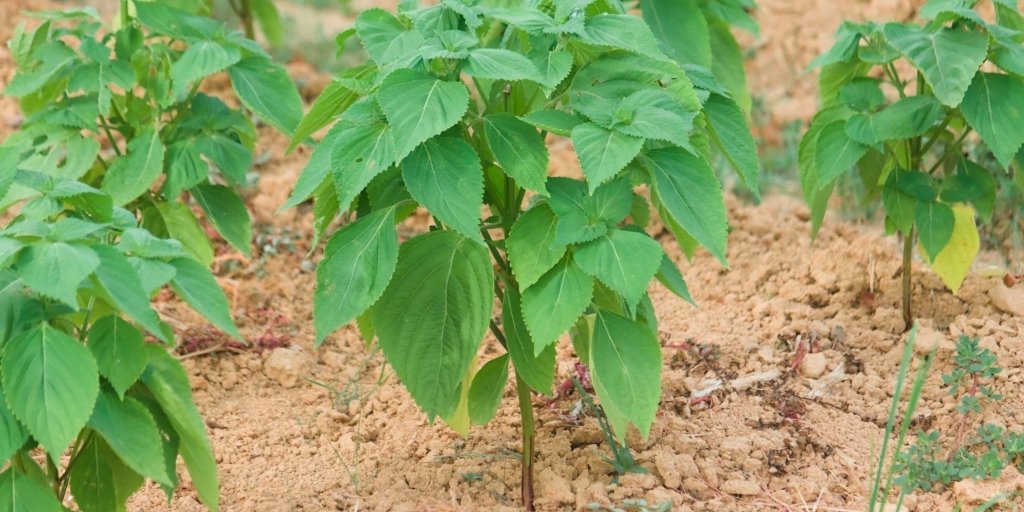
What Egyptian spinach is
Corchorus olitorius answers to many names: Egyptian spinach, molokhia, mulukhiyah, jute mallow, saluyot and nalta jute. It belongs to the family Malvaceae, alongside hibiscus and okra, and it is grown as a summer leafy green across Africa, the Middle East and South and Southeast Asia. The young leaves are usually cooked and thicken a soup or stew much as okra does, while the tenderest tips can go into a salad.
It is a fast, upright annual that reaches 1.2 to 1.8m if it is left uncut, so it needs room, warmth and a frost free run. Our Egyptian spinach seeds sit alongside the rest of the spinach seeds collection.

Eat the leaves only
The leaves and young shoots are the edible part of this plant. The seeds and the seed pods contain cardiac glycosides and must not be eaten. Strip any pods off before a bunch comes into the kitchen, and store saved seed where children and pets cannot reach it.
When to sow
Egyptian spinach is a heat lover and frost kills it outright. Wait until the frosts have finished and the soil is properly warm, about 20°C or above, because seed sown into cold ground sits and rots. The timing is the same as for beans.
- Tropical (Darwin, Cairns, Townsville and the Top End): Sep-Feb, and in practice almost any warm month.
- Subtropical (Brisbane, the Gold and Sunshine coasts, Bundaberg and the NSW north coast): Sep-Feb.
- Arid and semi-arid (Alice Springs, Broken Hill, Kalgoorlie, Mildura and most of the inland): late Sep to Dec, once the last frost has passed. It takes the heat but needs steady water.
- Temperate (Sydney, Melbourne, Newcastle, Geelong and coastal southern Australia): Oct-Dec.
- Mediterranean (Perth, Adelaide, the south west of Western Australia and the South Australian gulf country): the same months as temperate, with heavy mulch and steady water through the dry summer.
- Cool and alpine (Hobart, Canberra, Ballarat, Armidale, the tablelands and alpine districts): Nov-Dec only, in the warmest, most sheltered corner or a large pot against a north facing wall. Plants may not reach full size.
These are broad groupings, so gardeners between two zones should lean on their own local frost dates.
Starting the seed
The seed has a hard coat and germinates unevenly without a little help. Either soak it overnight in water, or pour water at about 80°C over it, leave it to stand for ten minutes and sow straight away. Rubbing the seed lightly between two sheets of sandpaper does the same job. Sow no deeper than 5mm: light is not needed, only warmth and even moisture. In warm soil the seedlings appear in three to seven days.
Seed can go straight into the bed or be raised in punnets and planted out at two or three true leaves. Water gently, because a heavy spray washes shallow sown seed out of place.
Soil and spacing
Fork the bed over to about 25cm and work in a 7 to 10cm layer of compost or aged manure, with coir on sandy ground. Give the plants full sun and free drainage, and thin or plant out to 30 to 40cm apart with 50 to 60cm between rows, because crowded plants run straight up and carry fewer side shoots. This is a leaf crop, so a side dressing of pelletised poultry manure part way through the season keeps new growth coming.
Pinching and branching
Left alone, the plant makes one tall stem. Pinch out the growing tip once it reaches about 30cm and it will branch, and every harvest after that does the same job. Keep picking to delay flowering, because once the plant sets pods the leaves toughen and it winds down. In a windy spot a tall plant is worth staking.
Water and harvest
Even moisture gives the best leaves. A dry spell pushes the plant into early flowering and turns the leaves bitter and tough, while waterlogged soil stunts it, so mulch and give it a deep soak once or twice a week.
Start picking when the plant is about 30cm tall. Take the top 15 to 20cm of each shoot, leaves and all, and it will branch and come again. Individual leaves are 5 to 7cm long and the youngest are the best in the pot, and whole plants can be cut at the end of the season. The stems are the source of jute fibre, the other crop this plant is grown for, and they are not eaten.
Flowers, pods and seed
Small yellow flowers open from the leaf axils and pods follow soon after. The pods are long and narrow, divided into five sections and filled with angular seeds ranging from bluish grey to dark green or brown, and the plant dies once they have turned tan and dried.
Egyptian spinach self seeds readily and has naturalised in parts of northern Australia, where it is a recognised weed of cropping country. If you garden in Queensland or the Northern Territory, pick the pods off before they dry and do not let it escape into a creek line or a paddock. Further south the seedlings pull out easily, but it still pays to stay on top of them.

Related growing guides
- Growing Vegetables in the Subtropics and Tropics: What Works
- Cut-and-come-again: months of greens from a single planting
- When the heat sets in: vegetables that thrive in an Australian summer
Ready to plant? Browse our spinach seeds.