
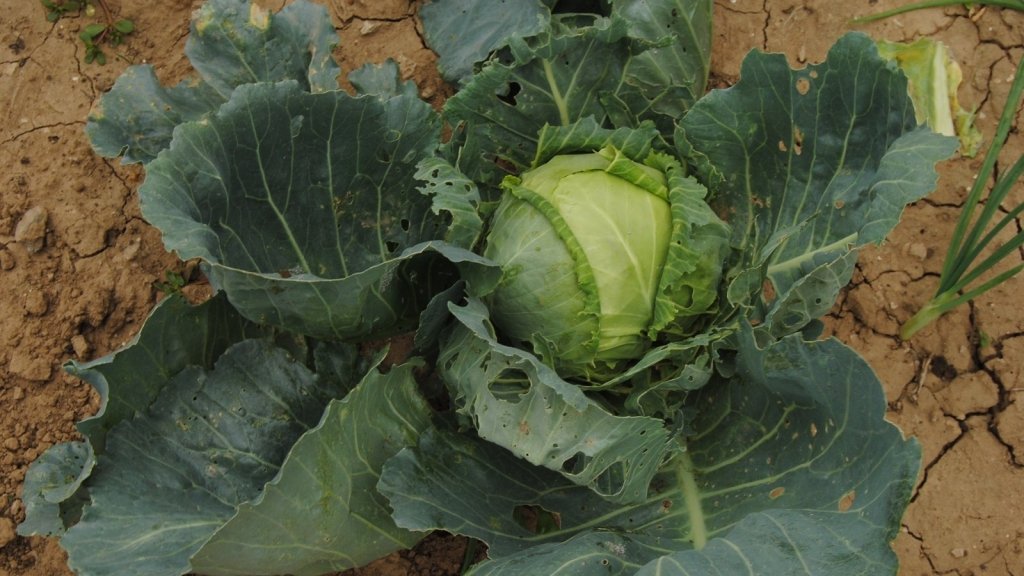
The short version: A cabbage that is all leaf and no heart has usually been sown at the wrong time, crowded, starved, stressed by heat, cold or uneven water, or attacked hard enough to lose its leaf frame. Cabbage is a cool-season crop that needs roughly two to four months after planting out, steady water, plenty of nitrogen early on and about 30 to 60 cm of elbow room. Sort out timing and spacing first, feed and water evenly, protect the leaves from caterpillars, and most beds that failed this year will head up next time. If the plants were stunted and the roots are lumpy, suspect clubroot and rest that bed from brassicas for several years.
Few garden disappointments are as public as a row of enormous, healthy-looking cabbages with nothing in the middle. The plants can be a metre across, the leaves glossy and blue-green, and still there is no heart to cut. The good news is that the causes are few and mostly fixable, and a plant that has not headed is often not dead, just delayed.

How a cabbage builds a head
Cabbage (Brassica oleracea, Capitata Group) spends its first weeks building an open rosette of large outer leaves. Only once that frame is big enough does the growing point start producing leaves that curl inward instead of outward, and those inner leaves pack tighter and tighter to form the head. Everything about a good cabbage flows from that sequence. The plant needs enough time, enough leaf, enough food and steady conditions to reach the heading stage, and then cool weather to fill the head slowly and firmly. Australian growing guides put the run from planting out to harvest at anywhere between about 60 and 160 days depending on the variety, most everyday types in the 60 to 120 range, with the head-forming stage often starting two to three months in. That is a long time for something to go wrong.
Ten reasons cabbages stay open
1. It was sown for the wrong season
Cabbage is a cool-season crop. Plants that reach the heading stage in real heat tend to stop hearting and instead throw a flower stalk, a response gardeners call bolting. In most of Australia the main sowing is late summer to autumn so that heads fill through the cool months. Spring sowings work in cool districts, but in warm areas they run into summer just when the plant wants to pack its heart. Check the sowing window for your zone in the list further down, and if you are in a humid subtropical climate, wait until the worst of the heat and the caterpillar pressure have eased before sowing.
2. A cold snap hit at the wrong moment
Mature cabbages shrug off frost, and a light frost even sweetens them. Young plants are different. A run of unseasonable cold while the plant is still small can trigger a stress response in which it forms a tiny, loose head far too early, known as buttoning, or stalls altogether. There is no undoing it once it has happened, so in frost-prone districts plant out sturdy, well hardened seedlings rather than tiny ones, and avoid planting into a forecast cold snap.

3. It has not had long enough
Impatience explains more "failed" cabbages than any disease. A late-maturing drumhead or savoy sown in March may not have a firm heart until August. Look up the days to maturity for the variety on the packet, count from planting out rather than from sowing, and add a few weeks for a cold or shaded site before you decide the crop has failed. If the centre leaves are starting to cup inward, leave it alone and keep watering.
4. The plants are too close together
Crowded cabbages compete for light, water and nitrogen, and the loser stays small and open. Australian guides recommend between about 30 and 60 cm between plants depending on the size of the variety, with mini and early types at the close end and big winter drumheads at the wide end. It always looks like too much space when the seedlings go in. It is not.
5. Thirsty, or drowning
Cabbage has a broad, shallow root system and a huge leaf area, so it wilts fast in dry soil and sulks just as badly in a waterlogged bed, where the roots suffocate and rot sets in. The plant needs even moisture right through, and the swing from bone dry to soaking is the worst of both worlds: it is also widely blamed for heads that split open just before harvest. Water deeply and less often rather than a little every day, mulch the bed, and improve drainage before planting if the bed puddles after rain. Our guide to deep watering explains the method.

6. Hungry soil
Brassicas are heavy feeders and cabbage is the hungriest of them. It builds that big leaf frame from nitrogen, and a plant that yellows from the bottom up, stays small and never seems to get going is usually short of it. Prepare the bed with compost and well-rotted manure, then feed with a liquid vegetable fertiliser or a side dressing of pelletised manure every one to two weeks while the frame is growing. Keep the feed steady right through the season, and go easy only on big late doses of nitrogen once the head is forming, which some growers find push loose, leafy growth rather than a dense heart.
7. Something is eating the frame
A cabbage cannot head without leaves to feed the head. Cabbage white and diamondback caterpillars can strip young plants to ribs in a week, aphids cluster in the crinkled inner leaves and stunt growth, and snails and slugs graze seedlings down to stumps. Cover the bed with fine insect netting from planting day, check under the leaves twice a week, and deal with what you find early. Our guide to cabbage white and diamondback caterpillars covers the options.
8. Clubroot
If the plants were stunted, wilted on warm afternoons and recovered overnight, and the roots are swollen into lumpy clubs when you pull them, the bed has clubroot. It is caused by the soil organism Plasmodiophora brassicae, it affects every brassica from cabbage and cauliflower to bok choy and radish, and it favours warm, wet, acidic soil. There is no cure once it is in the ground. The Royal Horticultural Society notes the resting spores can persist for up to 20 years, so the strategy is management: rest the bed from all brassicas for several years, raise the soil pH with garden lime, improve drainage, bag and bin infected roots rather than composting them, never move soil or tools from an infected bed to a clean one, and grow brassicas in fresh potting mix in pots or a new bed in the meantime. AUSVEG's clubroot notes for growers are worth reading if you suspect it.

9. A rough start
Seedlings that sat too long in the punnet, went in leggy, dried out in the tray or had their roots torn at planting often never build a proper frame. Plant out once seedlings have several true leaves and stand about 7 to 10 cm tall, water the punnet an hour before, bury the stem to just below the lowest leaves so the plant sits firmly, and water in with a seaweed solution. A seedling that goes in healthy on a mild day catches up fast; one that stalls for a fortnight may miss its heading window.
10. A damaged growing point
The head grows from a single central bud. If that bud is chewed by a caterpillar or snail, snapped off in a storm or crushed under a foot, the plant cannot form a heart. A young plant that loses its tip will often push out several small side shoots instead, which can be eaten as loose greens but will never make a proper cabbage; only a mature plant cut back deliberately after harvest tends to regrow small, usable heads. Netting and careful handling are the only protection.
Fixing a bed that has already failed
First, decide whether the plants are late or finished. If the weather is still cool and the centres show any sign of cupping, feed, water and wait. If the plants have bolted, pull them and eat the young flower shoots, which cook like broccoli. If they are healthy but hopeless, the outer leaves make good coleslaw and stir-fry material, and a plant cut just above the lowest leaves will often push out several small heads from the stump. Then work back through the list above and change one thing at a time for the next sowing: usually the timing, then the spacing, then the feeding.
Cabbage sowing seasons across Australia's climate zones
- Tropical (Cairns and far north Queensland, Darwin and the Top End of the Northern Territory, the Kimberley in Western Australia): sow in the dry season, roughly April to July, and choose quick, heat-tolerant varieties. The wet season is too hot and humid for hearting cabbage.
- Subtropical (Brisbane and coastal Queensland, Coffs Harbour and northern New South Wales): sow from about mid March through to August so heads fill in the mild, dry winter. Earlier sowings meet heat and heavy caterpillar pressure.
- Arid and semi-arid (inland Queensland, Broken Hill and Dubbo in New South Wales, Mildura in Victoria, inland South Australia and Western Australia, Alice Springs in the Northern Territory): the safest window everywhere in the zone is late winter, roughly July to August, for a spring crop; the milder inland districts also sow in autumn, March to April, for heads through winter. Summer heat rules out late spring sowings.
- Temperate (Sydney and New South Wales, Melbourne and Victoria): the main sowing is February to April for winter heads, with a second window in August and September for a late spring crop. Choose faster varieties for the spring sowing so they beat the heat.
- Mediterranean (Perth and southern Western Australia, Adelaide and the Adelaide Plains in South Australia): sow in autumn, about March to May, and grow through the wet, mild winter. Spring sowings run into the dry heat.
- Cool and alpine (Hobart and Tasmania, Canberra and the ACT, Ballarat in Victoria, Orange and Armidale on the New South Wales tablelands, and the alpine country of the Snowy Mountains and the Victorian high country): sow under cover from late winter and through spring, roughly August to November, for summer and autumn heads, and in January or February in the milder cool districts for plants that stand through winter. In the coldest mountain gardens, raise seedlings in trays in late winter and plant out once the soil warms. Summers are mild enough for cabbage to head in most years.
These are broad windows. A frost pocket, a coastal breeze or a shaded bed can shift them by weeks, so keep a note of what worked in your own garden.
Frequently asked questions
My cabbages are huge but have no heart. Are they finished?
Not necessarily. If it is still cool and the centre leaves are starting to curl inward, keep feeding and watering. If the plant has thrown a flower stalk, it is done, but the outer leaves and the flowering shoots are still good to eat.
Why did my cabbage form a tiny head and then flower?
That is buttoning, a stress response most often caused by a cold snap or a check to growth while the plant was young. Plant out sturdier seedlings, avoid cold snaps and keep water and feed even.
Why did my cabbage heads split?
The usual explanation is that a heavy soak after a dry spell makes the inner leaves grow faster than the outer ones can stretch. Keep watering even, mulch, and harvest as soon as a head is firm rather than leaving it in the bed.
Can I grow cabbages in a bed that had clubroot?
Not for several years, and even then only after liming and improving drainage. Grow brassicas in pots of fresh mix or a different bed in the meantime, and clean tools and boots between beds.
Cabbage is a forgiving crop once its two non-negotiables, cool weather and steady feeding, are met. Most open-hearted disappointments come down to timing, and the calendar is the cheapest fix in the garden. For the disease side of the story, AUSVEG's clubroot management notes set out how the industry keeps it in check.
Related growing guides
- Cabbage White and Diamondback Caterpillars: Protecting Your Brassicas
- What to grow in winter: cool-season vegetables across Australia
- Soil pH explained: why it matters and how to nudge it
Pick a variety sized for your bed and your season: browse our cabbage seeds, broccoli seeds and the full range of vegetable seeds.