
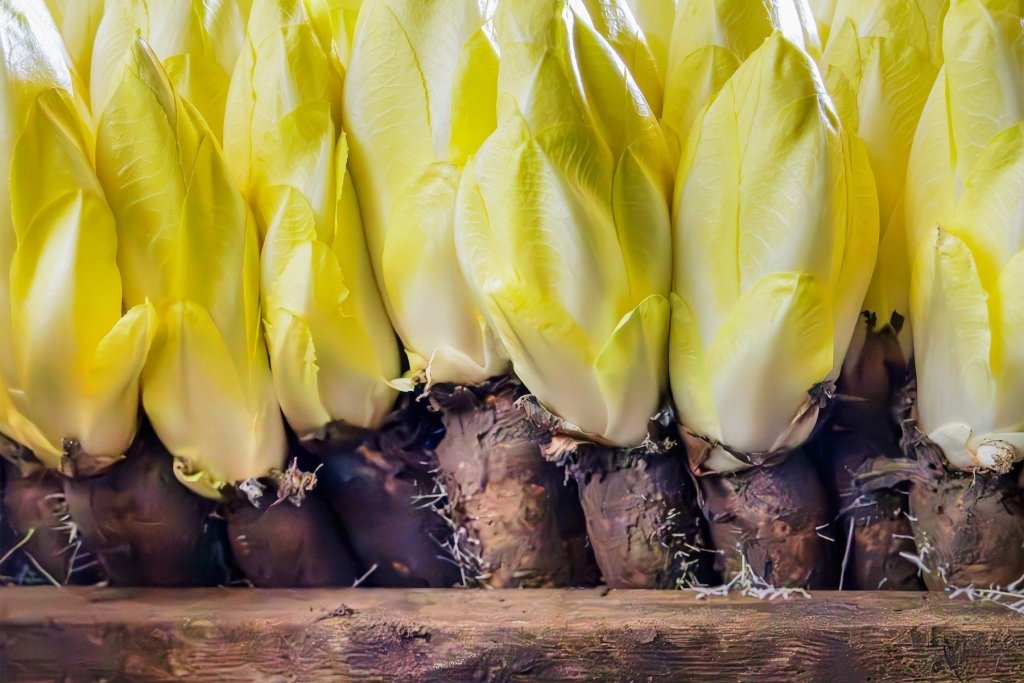
Witloof, sold as Belgian endive, is not really endive at all. It is chicory (Cichorium intybus) grown in two stages: a long cool-season crop in the ground to build a fat root, then a few weeks of forcing that root in the dark to grow the pale, tight bud you eat. The whole chicory family is bitter by nature, and that bitterness is the point. Grow it through the cooler months in most Australian gardens, with the tropical north best treated as a dry-season experiment, and treat the forcing as the fun part.
There is a small confusion the supermarket label glosses over. Those neat torpedoes of pale, faintly bitter leaves sold as Belgian endive are not true endive at all. They are forced chicory, and you can grow them in a suburban backyard with a bucket and a dark cupboard. That gap between the fancy name and the humble plant is half the pleasure. The other half is the flavour, which is honestly bitter and all the better for it.

So what exactly is witloof, and why is it called Belgian endive?
Witloof is chicory, the same species (Cichorium intybus) that gives us radicchio, sugarloaf and the blue-flowered roadside weed you have probably driven past without a second look. True endive is a different species again (Cichorium endivia), so the supermarket label muddies things, but the names have tangled together for so long that it is a forgivable mix-up.
The name witloof is Dutch for white leaf, which tells you most of what you need to know. You grow the plant for its root, then force that root in darkness so it pushes out a tight, pale, blanched bud. That bud is the chicon, the part on your plate. In Australia you will most often see it written witlof, and either spelling is correct.
It belongs to a generous family worth knowing as a group. Radicchio gives you those deep red, tennis-ball hearts. Sugarloaf forms a tall, pale, lettuce-like head and is the gentlest of the lot. Witloof is the one you force. They share a parent and they share a personality: cool-season, leafy, and unapologetically bitter.

Let us talk about the bitterness, because it is the whole point
Chicory is bitter, and if that is a deal-breaker, this is not your vegetable. There is no growing trick that turns it sweet, and anyone who promises one is selling something.
What you can do is manage it. Forcing witloof in the dark is itself a bitterness-reducing move, because leaves grown without light stay pale and milder than green ones. Radicchio mellows with a frost or two and with cooking, and across the family a cold snap, a slow braise or a sharp dressing all take the edge off.
The honest pitch is this. Chicory is the vegetable equivalent of a strong coffee or a good olive: bitter on purpose, and all the better for it. It wakes up a plate of soft winter greens and pairs beautifully with sweet, fat or salty things. If your household runs on iceberg lettuce, start with sugarloaf and work up; bitterness is a taste you grow into, like the first time coffee stopped needing three sugars.

How witloof actually works: the two-stage method
Witloof is grown in two stages, and the idea matters more than any exact measurement. Stage one is a normal, if long, cool-season crop: you sow chicory and let it grow for several months, feeding a thick taproot rather than a head. Stage two is the forcing, where you lift those roots and grow them on in the dark to push out the pale chicon. Here is the shape of it, kept to the level of an idea rather than a recipe.
- The first stage is patience: the plant spends a long, unhurried cool season storing energy in a fat taproot rather than a head.
- For the second stage, the best roots are lifted and settled upright in a deep container of moist sand or potting mix, with the leafy tops cut well back.
- That container then goes somewhere completely dark, cool and frost-free: a cupboard, a shed corner, even a second bucket inverted over the top.
- In the dark, each root pushes up a pale, tight bud over a few weeks, and that chicon is what you harvest.
The single most important rule is darkness. Light is what turns a sweet, pale chicon green and harshly bitter, so any stray gap that lets the daylight in will cost you. Treat it like developing a photograph: the magic only happens when the lid stays on.

Growing chicory across the Australian climate zones
Chicory is best treated as a cool-season crop right across Australia, so the trick is timing it to your zone rather than asking whether you can grow it at all. As a rule, sow from late summer through autumn so the plants do their main growing as the weather cools.
- Temperate (Sydney, Melbourne, Canberra): the classic home for chicory. Sow in autumn, grow through the cool months, and force witloof roots over winter. Radicchio and sugarloaf are happy in the cooling soil.
- Cool and alpine (Ballarat, Orange, the southern tablelands, Tasmanian highlands): a fine fit, with frost actively helping radicchio sweeten. Get autumn sowings in early enough that plants have size before the cold really bites.
- Mediterranean (Perth and southern WA, Adelaide): excellent chicory country. The mild, wet winters suit the whole family, and the long cool window is ideal for fattening witloof roots. Sow as the summer heat eases.
- Subtropical (Brisbane, Gold Coast, Coffs Harbour): grow it through the dry, mild winter, which is your real cool season. Sow in autumn and keep these plants out of humid summer heat, which they dislike.
- Arid and semi-arid (Mildura, Alice Springs, Broken Hill): workable in the cooler months, though cold nights and dry air mean steady watering matters. Aim for the autumn-to-winter window between the temperature extremes.
- Tropical (Darwin, Cairns, Townsville): the hardest ask. Treat the dry season as your only real window and keep expectations modest, since chicory genuinely wants cool weather and will bolt or sulk in the heat.
The thread through all six zones is the same. Chicory grows while it is cool and bolts to flower when it is hot, so you are always working backwards from the warm months. Think of the autumn sowing as a note to your winter self, scribbled on the packet and tucked in the shed. For a wider sense of cool-season leaf crops, the same patient, autumn-sown rhythm carries across most leafy greens.

Caring for the crop, and the mistakes that catch people out
The day-to-day care is undemanding, which is part of the appeal. Give chicory an open, sunny spot, soil that has had some compost worked through it, and steady moisture so the roots swell evenly. A mulch helps keep the bed from drying into a biscuit between waterings.
On feeding, go gentle. Chicory is a leaf and root crop, not a hungry fruiter, so a balanced approach beats heavy nitrogen, and a fat, steady root is what you are after rather than a flush of leaf. An occasional drink of a fish and seaweed blend through the season is often enough in a well-prepared bed, supporting steady growth without pushing a rush of soft leaves. You can browse our range of chicory and radicchio seeds if you want to try a few types side by side.
A few honest pitfalls, because every gardener meets them.
- Sowing too late is the common one. Plants that have not bulked up before warm weather arrives tend to make undersized roots, and a chicory that runs to a tall blue flower has finished as a vegetable. Chicory has naturalised in parts of Australia, so if a plant bolts and you do not want volunteers, cut it before it sets seed, especially near bushland or paddocks.
- Letting light reach forcing witloof turns the chicons green and savagely bitter. Check your dark spot is genuinely dark.
- Expecting a quick crop. Witloof in particular is a slow burn, months in the ground before the few exciting weeks of forcing.
Get those three right and the rest of the season is usually straightforward. There is a quiet satisfaction in lifting roots in the grey of winter and pulling perfect pale chicons out of a dark bucket weeks later, when the rest of the garden has gone to sleep.

A note on the roots, coffee and eating well
Beyond the leaves, chicory has a second life worth a mention. The roasted, ground root of certain chicory types has long been used as a coffee substitute or extender for its rich, slightly bitter flavour and dark colour, which is why it turned up in old wartime coffee blends when beans were scarce. The root also contains inulin, a soluble fibre, though the coffee use is really about that roasted flavour rather than any fibre claim.
For most home gardeners, though, the leaves and chicons are the prize. Chicory and its relatives are a wholesome addition to a winter plate, but as with any food, how you prepare it matters more than any health claim, and individual tolerance to bitter or high-inulin foods varies. If you are curious about the broader food side of garden crops, Food Standards Australia New Zealand is the authority on what is recognised as food here. Treat this as friendly garden encouragement rather than dietary or medical advice.

Witloof asks for patience and rewards you with something the supermarket charges a small fortune for, grown from a humble root in a dark cupboard. If you have a spare bucket and a cool, dark corner this winter, it is one of the most quietly satisfying crops you can try. For more cool-season leafy ideas, our guide to growing spinach at home is a gentle companion to this one.
Frequently asked questions
Is witloof the same as Belgian endive?
Yes. Witloof, witlof, Belgian endive and chicon are all names for the same thing: the pale, forced bud of chicory (Cichorium intybus). Despite the name, it is not true endive, which is a different species (Cichorium endivia).
Why is my chicory so bitter?
Bitterness is natural to chicory and cannot be removed entirely. Forcing witloof in the dark keeps it pale and milder, a frost can sweeten radicchio, and cooking or a sharp dressing tames the rest. If you want the gentlest of the family, grow sugarloaf chicory.
Do I really have to force witloof in the dark?
Yes, if you want the classic pale chicon. The plant builds a root over a long cool season, then you lift it and grow it on in complete darkness for a few weeks. Any light reaching it turns the bud green and harshly bitter.
When should I sow chicory in Australia?
Sow from late summer through autumn in most zones, so plants do their main growing as the weather cools. Chicory is a cool-season crop and will bolt to flower in summer heat, so timing it before the warm months is the key.
Can I grow chicory in a warm or subtropical climate?
Yes, in the cooler part of the year. In subtropical zones grow it through the mild, dry winter, and in the tropics treat the dry season as your only real window. It genuinely dislikes humid summer heat anywhere.
What is the difference between witloof, radicchio and sugarloaf?
All three are forms of chicory. Witloof is grown for a root that you force into a pale chicon, radicchio forms a red or red-streaked head, and sugarloaf makes a tall, pale, lettuce-like head and is the mildest. They grow in much the same cool-season way.
Can you really use chicory for coffee?
The roasted, ground root of some chicory types has long been used as a coffee substitute or extender. It is a different use from the leaf and witloof crops most gardeners grow, and it needs the right root type and roasting rather than the salad leaves.
Related growing guides
- Unusual Vegetables You Can Grow from Seed in Australia
- How to Grow Salsify and Other Unusual Root Vegetables
- Growing Capsicum in Australia: From Seed to Harvest
Ready to plant? Browse our Endive seeds.