
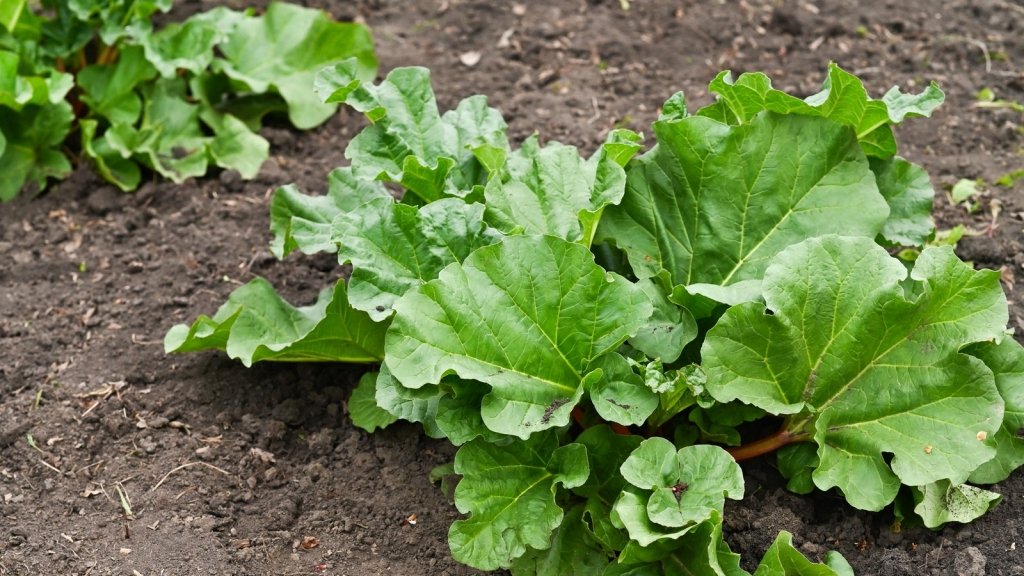

Almost every rhubarb guide tells you to buy a crown, and for good reason. A crown is a division lifted from an established plant, so it is a clone with known stalk colour, known vigour and a first light picking in its second season. Seed is the other road: cheaper, a whole batch of plants instead of one, and a longer wait with some culling along the way.
Sowing is a late winter and early spring job, while planting crowns and dividing clumps are winter jobs, which is why rhubarb turns up on the cool-season list twice.
Is rhubarb from seed worth it?
It is worth it if you want several plants for the price of one packet and you can wait about three years for a proper harvest. It is the wrong choice if you want one named plant producing predictable red stalks next season.
The Royal Horticultural Society sets out the trade-off plainly: seed is the cheapest way to produce a lot of plants, but seed-raised rhubarb establishes more slowly than a bought crown and is more variable in quality, because a bought crown is an exact clone of its parent. University of Maine Extension gives the reason. Rhubarb is open pollinated and rarely self pollinated outside controlled conditions, so there is very little control over what a seedling turns out to be.
Time is the other cost. University of Minnesota Extension advises waiting until the second season to harvest a bought plant, and until the third season if you started from seed.
Victoria, Glaskins Perpetual, and one claim worth checking
The two rhubarb lines sold as seed at Happy Valley Seeds are the two long raised that way, Victoria and Glaskins Perpetual, and both sit in the rhubarb seed collection. Both are open pollinated, so both give a spread of seedlings rather than one repeated plant.
Glaskins Perpetual carries a reputation for low oxalic acid and for being pickable in its first year, so it is worth separating what an independent source supports from what seed catalogues repeat. The RHS entry for Rheum x hybridum "Glaskin's Perpetual" describes a vigorous variety with green stems flushed red at the base, and says that because the cultivar does not increase in acidity it can be harvested into late summer and sometimes early autumn. That supports the long season. It does not compare measured oxalic acid against other varieties, and it says nothing about a first-year harvest. Treat the first-year claim as a light taste at most: a stalk or two will not ruin a strong seedling, but the plant is building root reserves that decide the next ten years.
Stalk colour tells the same story. The RHS calls Glaskins Perpetual green flushed red at the base, while several seed catalogues call it bright red. From seed you will get a range whatever the packet says, and a green-stemmed seedling is not a failure. University of Minnesota Extension states that colour does not cause any specific flavours, and that greener varieties are generally more vigorous with longer stalks than red ones. Red simply looks better once it is cooked.

Sowing the seed
Rhubarb seed is easy to handle. The fruit is a dry, three-sided achene with winged sides, as Wisconsin Horticulture describes it, papery and big enough to place one at a time rather than sprinkle.
Sow from late winter into early spring. The RHS suggests sowing indoors in late winter about 2.5 cm deep into modules, or outdoors into a prepared seedbed in spring at the same depth. University of Minnesota Extension covers the seed lightly indoors, keeps it moist, supplies bottom heat, and notes that seedlings can take two or three weeks to appear. Steady warmth and steady moisture matter more than the last few millimetres of depth.
Two pieces of advice circulate every season: soak the seed overnight, and chill it in the fridge to break dormancy. Neither the RHS nor University of Minnesota Extension asks for either step, and we did not find a published trial on culinary rhubarb that supports them. Follow your packet if it gives a soaking or chilling instruction. Otherwise sow fresh into warm, moist mix, and sow more than you need, because having spares to choose from is the whole point of using seed.
Raising the seedlings, and choosing which to keep
Give each seedling room early. The RHS thins seedbed sowings to 15 cm apart before the young plants move on to their final spacing. Seedlings raised in modules can be potted into 10 cm to 15 cm pots once they have two or three true leaves, grown on somewhere bright and sheltered, then hardened off for at least a week before they go into the garden.
The culling is where seed growing is won. Grow the batch on for a season and watch it properly. Keep the seedlings with thick fleshy stalks, broad leaves and obvious vigour, and discard the thin and stringy ones, the sulky slow ones, and any seedling that throws a flower stalk in its first year. The RHS notes that seed-raised rhubarb may be more likely to flower, and an early bolter is telling you something useful before you give it a permanent bed. You do not need many keepers either: University of Minnesota Extension points out that a single rhubarb plant usually provides enough for a family, so two or three good ones is a generous supply and a spare.
Planting out, spacing and feeding
Rhubarb is large, hungry and long-lived, so prepare the spot properly once rather than patch it later. University of Minnesota Extension advises forking or digging to about 60 cm so new plants root easily, and working in plenty of compost or composted manure. Sustainable Gardening Australia asks for a deep loam rich in organic matter at a pH of about 5.5 to 6.5, prefers animal manure in the preparation, and suggests liquid feeds of seaweed extract once growth is underway. Pelletised chicken manure or aged manure in late winter, then a fish and seaweed blend through the growing season, suits the same brief.
Space plants 75 cm to 90 cm apart, because a mature clump can spread well over a metre. Set each one so the crown, the point where the leaves emerge, sits at or just above the soil surface, then water in well. Each spring, mulch with about 7 cm of well rotted organic matter, kept clear of the crown itself, which can rot if it is buried.
The first harvest, and how to pick
Take nothing in the first year, a few stalks in the second, and a real harvest from the third. That is the RHS sequence for a planted crown, and University of Minnesota Extension pushes the start out to the third season for anything raised from seed. The first two seasons of leaf are not wasted, because they are what builds the root.
When you do pick, take a portion and leave the rest. The RHS suggests about a third of the stems at any one time, so the plant keeps enough leaf to stay in active growth, and University of Maine Extension puts the season-long limit at no more than half the stalks on any one plant, warning that the plant may weaken and die otherwise. Do not strip a clump bare, however good it looks.
To pick, hold a stalk low at the base and pull with a gentle twist so it eases away cleanly, much like taking a stick of celery off a bunch. Does the twist actually matter? The reasons are practical rather than dramatic. The RHS warns that cutting leaves a stump prone to rotting, and University of Minnesota Extension adds that a knife can carry disease from plant to plant and that the stub is an entry point for pests. University of Maine Extension treats cutting right above the base as an acceptable alternative. Twist where you can, and if a stubborn stalk will not budge, cut it low and clean. Trim the leaf off straight away, because leaving it attached speeds up wilting of the stalk.

Flower stalks, and why plants bolt
Cut a flower stalk out at the base as soon as you notice it. A thick, knobbly stem rising from the centre of the clump is the plant spending energy on seed instead of leaf, and University of Minnesota Extension is blunt that this energy is used up unnecessarily.
The RHS lists the usual reasons a clump bolts: some varieties flower more readily, seed-raised plants may be more prone to it, a wet summer or an overused high-nitrogen feed can bring it on, and old plants that have not been divided for many years flower more. Age and stress are the recurring themes, and both have a fix further down this page.
Dormancy, and what a dormant crown looks like
In cold districts, rhubarb shuts down for winter. The leaves yellow, flop and die back until there is nothing above ground at all, leaving a knuckled crown at soil level with fat pink or white buds on it. That is a healthy plant resting, not a dead one, which is worth knowing before you dig up a perfectly good crown in July. The RHS advises letting the leaves die back naturally in autumn, then cutting or pulling them away so the growing points are exposed to winter cold, because that cold is what triggers new growth in spring. It is also the cold-zone window for forcing, where a strong plant is covered in midwinter to grow pale, sweeter stalks in the dark, four to eight weeks later. The RHS advises against forcing the same plant two years running.
Warm districts behave differently. ABC Organic Gardener reports that plants in warm climates do not go through winter dormancy, get exhausted more easily and have shorter lifespans, and that in hot areas rhubarb can be grown as an annual and replanted once plants weaken after the first season. In the subtropics that is a sensible way to run it rather than a sign you have done something wrong.
Dividing a crown in winter
Division is the standard way to multiply a rhubarb plant, and the answer to the variability that comes with seed. Once one of your seedlings proves itself over a few seasons, every division you take from it is a copy of that plant.
Lift the whole clump while it is dormant in winter. The RHS suggests dividing about every five years, and University of Maine Extension puts it at every four to five years, or whenever a plant starts producing many small stalks instead of fewer large ones. Slice the clump with a spade or an old knife into sections, each carrying a portion of the thick underground stem and at least one growing point, ideally two or three. Sections from the outer part of an old clump beat the tired centre. Discard anything soft or decayed and replant straight away.
Sustainable Gardening Australia describes the same job as cutting through the crown and making sure eyes are present on each division, and notes that crowns can be planted during winter across Australia. If you have not split a perennial clump before, our guide to dividing perennials covers the tools and the timing.

Rhubarb across the six Australian climate zones
Rhubarb is a cool and temperate crop, and it is fairer to say so than to promise every garden a crop. These zones are broad groupings, so if you sit between two of them, lean on local cues rather than the label, especially your own first and last frost dates. The Bureau of Meteorology potential frost day maps are a reasonable starting point, and they note that frost is localised and varies with elevation and site.
- Tropical (Darwin and the Top End of the Northern Territory, and Cairns and Townsville in far north Queensland): the hardest ask. Plants do not get the winter cold that triggers strong regrowth, and wet season heat and humidity are against them. If you want to try, treat it as a short-term plant through the dry season in the coolest, shadiest spot you have, and expect to replace it.
- Subtropical (south east Queensland including Brisbane, the Gold Coast and Sunshine Coast, northern New South Wales around Coffs Harbour, with Toowoomba cooler again on the range): workable. Sustainable Gardening Australia says rhubarb does reasonably well in Queensland subtropical conditions. Give it afternoon shade, keep air moving around the clump because humid weather favours fungal leaf problems, and plan to replace plants every few years.
- Arid and semi-arid (inland Australia, including Alice Springs in the Northern Territory, Broken Hill in western New South Wales, Mildura in north west Victoria and Kalgoorlie in Western Australia): winter is not the problem here, summer is. The RHS notes that growth slows and can stop when conditions are too hot and dry. Give the clump afternoon shade, mulch deeply, water reliably rather than occasionally, and shelter it from hot dry wind.
- Temperate (Sydney and Newcastle in New South Wales, and Melbourne and Geelong in Victoria): good rhubarb country. Full sun suits most gardens, with afternoon shade worth having in hotter inland pockets. Sow in late winter, plant and divide crowns in winter, and expect at least a partial die-back in the colder spots.
- Mediterranean (Perth and southern Western Australia, and Adelaide and the settled parts of South Australia): mild wet winters suit the plant and dry summers do not. Sow in late winter, and plant and divide crowns in winter. Through summer, mulch heavily, water deeply, and accept that growth will slow through the hottest stretch before picking up again in autumn.
- Cool and alpine (Tasmania, including Hobart and the highlands, Ballarat in Victoria, Orange and Bathurst on the central tablelands of New South Wales, Armidale on the northern tablelands, Stanthorpe in Queensland, and Canberra, the Australian Capital Territory and the southern tablelands of New South Wales): the classic rhubarb ground, with full dormancy and strong spring regrowth. The main risk is a late frost catching young spring shoots, and the RHS suggests covering plants with straw or biodegradable fleece when freezing temperatures are forecast. Sustainable Gardening Australia notes that below -3°C growth above ground is temporarily damaged, although crowns may recover.
The leaves are not eaten, including the compost question
The leaf blades are not food. The Queensland Poisons Information Centre states that oxalates occur in all parts of the plant but are especially concentrated in the leaves. Eating leaves or uncooked stems can cause a burning sensation in the mouth, nausea, abdominal pain, vomiting, weakness and drowsiness. Blood clotting may be impaired, and contact dermatitis may occur. The stems are edible once cooked. NSW Department of Primary Industries Primefact 359 (2006, archived copy hosted by Griffith City Council) lists the leaf blades as the poisonous part, with the leaf stalk edible when cooked, and names nausea, vomiting and diarrhoea. NSW Health's poisonous or harmful plants factsheet puts it the same way: rhubarb leaves contain oxalate, but the stems are safe to eat after cooking. University of Minnesota Extension puts it in one line: rhubarb leaves are toxic, do not eat them. If a leaf has been eaten, ring the Poisons Information Centre on 13 11 26.
Two related worries come up every season, and both have a factual answer. The first is whether the plant turns toxic as summer goes on. University of Minnesota Extension calls the idea that the whole plant becomes toxic later in summer a common myth and says it is not true. The RHS makes the same point from the other direction: the build-up through the season is mostly in the leaves, which are not eaten, and the amount in the stems is not enough to have a toxic effect. Late-picked stalks are tougher, not dangerous.
The second is the compost heap, usually argued as folklore. The RHS answers it directly: faded rhubarb leaves can go into the compost bin, because the oxalic acid they contain breaks down during decomposition. Chop them up so they rot faster and bury them in the middle of the heap rather than leaving them sitting on top.
Two questions that still come up
Can I grow rhubarb in a pot?
Yes, if the pot is big enough. The RHS suggests a container at least 50 cm deep and wide with plenty of drainage holes, and warns that potted rhubarb needs watering regularly through the growing season because the mix dries out much faster than garden soil.
Can I save seed from my own plant?
You can, but it will not come true. The seedlings will be a fresh spread of plants rather than copies of the parent, for the open-pollination reasons University of Maine Extension gives. If you want another plant exactly like the one you have, divide it instead.
What to do next
If you want rhubarb on the plate this year, a crown is the shorter road and nobody will think less of you for taking it. If you want several plants, do not mind the wait, and like the idea of picking out your own best seedling and then cloning it by division, seed is the better value. Sow in late winter, grow the batch on through the season, plant the keepers out with room and good soil, and be patient until the third summer.
Rhubarb seed is in the rhubarb seed collection. If you are building a bed of plants that earn their keep year after year, our guide to perennial vegetables is a useful companion read.