
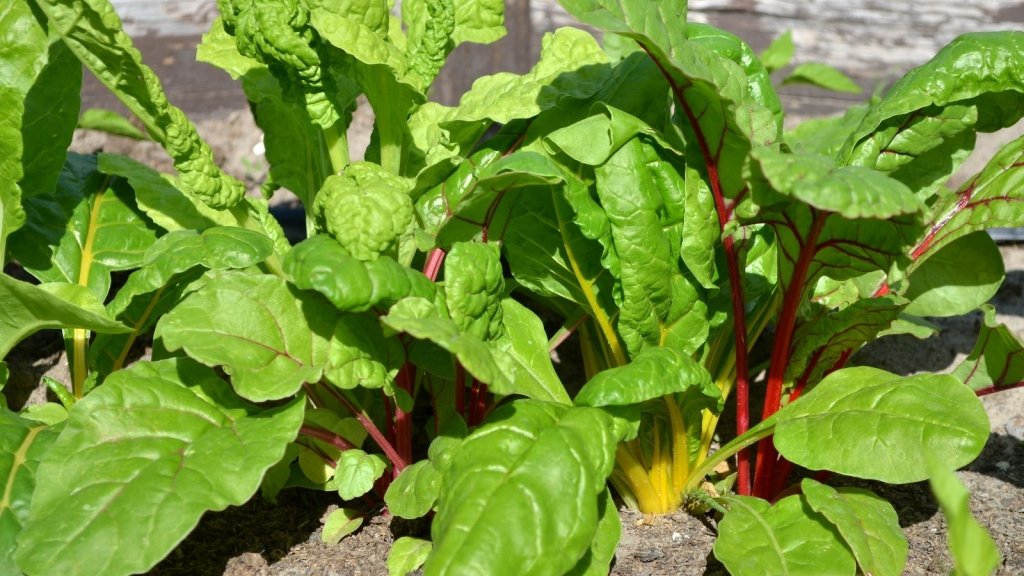

The short version: Silverbeet, Beta vulgaris (Cicla Group), keeps making leaves in the conditions that send spinach to seed, which is why it carries so many Australian gardens through winter. Sow it about 1 to 1.5cm deep, thin the clump that comes up from each seed cluster, feed it for leaf, and take the outer leaves rather than the whole plant. One sowing can be picked for four to six months before it runs to flower.
Silverbeet is the plant that keeps a winter garden honest. The lettuce has gone to slime, the basil is a memory, and in the corner stands a plant with stalks like celery and leaves the size of a dinner plate, still making dinner in July. It is also the crop most of us grow slightly wrong: sown too thickly, picked too hard, then blamed for bolting.
What silverbeet actually is, and why that matters
Silverbeet is a leaf form of the beet, the same species as the beetroot in the next bed. The NSW silver beet growing guide lists it as Beta vulgaris L. Cicla group, also known as Swiss chard or seakale beet, and grown in Australia as a leaf vegetable. Three useful things follow.
- Rotation. Silverbeet, beetroot, sugar beet and spinach share diseases, so do not follow beetroot with silverbeet. The Queensland guidance for Cercospora leaf spot is to rotate beet crops with non-host vegetables and keep weeds down, since the fungus survives on beet residues and related weeds.
- The seed. What you sow is usually not one seed. As the Canadian Food Inspection Agency biology document for Beta vulgaris puts it, a multigerm seed is an aggregation of two or more flowers, each fruit holding a single seed. The Western Australian growing guide puts it from the grower's end: several plants often arise from each seed, and they must be thinned.
- Seed saving. Beet pollen travels on the wind and the plants are strongly self-sterile, so cross-pollination is how seed is normally set. A silverbeet flowering beside a bolted beetroot will cross with it, and that seed will not come true.
Sowing: direct in the bed, or a tray on the bench
Sow straight into the ground where the plants are to grow. Sustainable Gardening Australia suggests soaking the seed for a few hours first and sowing about 12mm deep, and the Northern Territory Government sowing calendar for Darwin and Katherine gives 10 to 15mm.
The soak is not a superstition. The corky fruit wall carries water soluble compounds that hold germination back, which is why commercial seed is polished and washed before pelleting, according to a 2019 review in Planta. Soak, then sow the same day. Do not soak treated seed. Some lines, including Silverton, are sold with a fungicide coating, and the packet says so: sow those dry, as directed.
Soil temperature decides more than the date does. The germination table published by Oregon State University Extension from J. F. Harrington's University of California work lists beet and chard as germinating from about 4°C, best between about 10°C and 29°C, with an upper limit near 35°C. Seedlings take about 10 to 14 days.
Unlike beetroot, silverbeet transplants well, and the Western Australian guide notes that transplant use has been increasing. That is the better route in the tropical wet season, since the Northern Territory calendar warns that heavy December to February rain washes small seed out of a bed.
Spacing and thinning

Give each plant room to make a big leaf. Sustainable Gardening Australia suggests about 250mm between plants in rows about 500mm apart, and the Northern Territory calendar gives 30 to 40cm both ways. For a home bed, 25 to 30cm between plants is a fair target, and in a pot allow one plant to a container at least 30cm deep and wide.
Because each sowing point can throw up a small tuft, thinning is the step that decides the crop. Wait for the first true leaves, then keep the strongest seedling at each station. The spares need not go on the compost: silverbeet lifts and replants far better than root crops do, so ease them out with a fork and plant them at the end of the row. Our guide to why thinning is the step everyone skips makes the case for it.
Water and feeding, which here means nitrogen
Silverbeet is grown for leaf, and leaf runs on steady water and steady nitrogen. The Western Australian guide gives commercial crops weekly topdressings of nitrogen and potassium, and says plants must be kept well watered, with summer crops needing enough water to prevent wilting and leaf burn.
In a garden bed that means a feed every two to four weeks. A fish and seaweed blend, worm casting tea or aged chook manure tea all suit a leafy crop, and light and regular beats one heavy dose. Mulch between the plants, and water at the base in the morning rather than over the leaves at dusk.
Picking: outer leaves, and how many to take

Take the outer leaves and leave the middle of the plant alone. The Western Australian guide gives the commercial version, which is a good rule for a garden row too: the outer two or three leaves are twisted off at the base of the stem, leaving five or six leaves on the plant.
Twisting the stalk sideways and down separates it cleanly. Cutting halfway up leaves a stub that rots, and cutting into the crown removes the growing point the method depends on. Our guide to cut-and-come-again greens covers the technique across the other leafy crops.
Picked that way, a crop can be taken for four to six months. Towards the end the stems go bare at the bottom, the leaves come smaller and more plants bolt, which is the signal to pull the row and sow again rather than feed it harder. Keep the stalks, which the same guide notes are sometimes eaten cooked, and give them a head start in the pan.
Why silverbeet outlasts spinach
True spinach, Spinacia oleracea, is a different genus with a different trigger. As Oregon State University sets out, long days and increasing temperature predispose spinach to bolting, which is why a spinach bed can go from perfect to flowering in a fortnight once spring is under way.
Silverbeet is in less of a hurry. In Perth it is grown through the year and produces fairly well over summer provided it is watered. Spinach is a crop measured in weeks; silverbeet is measured in months. See our guide to growing spinach at home, then grow both and let them take different parts of the year.
When to sow, zone by zone
These are broad groupings rather than boundaries. If you garden between two zones, on a range or in a frost pocket, lean on local cues such as your first and last frost dates rather than the label.
- Tropical (Darwin, Katherine and the Top End of the Northern Territory, Cairns and Townsville in north Queensland, and Broome in the Kimberley of Western Australia): April to July, in the dry season. The Northern Territory sowing calendar marks silverbeet across those four months, and Sustainable Gardening Australia names the same window. Wet season sowings are the hard ones.
- Subtropical (Brisbane, the Gold and Sunshine Coasts and Bundaberg in south east Queensland, and Coffs Harbour and the northern New South Wales coast): roughly March to September. It grows outside that window, but warm, showery weather is what leaf spot favours, so the cooler months give the easier crop.
- Arid and semi-arid (Alice Springs in the Northern Territory, Broken Hill in New South Wales, Kalgoorlie in Western Australia, Mildura in Victoria, Longreach in Queensland, Port Augusta in South Australia and most of the inland): sow either side of the extremes, roughly March to May, then August to September once hard frosts ease, which works around the germination range above. Water repellent soils are common inland, so a wetting agent and mulch help. Your state or territory department guide will have local months.
- Temperate (Sydney and Newcastle in New South Wales, Melbourne and Geelong in Victoria, and most of the coastal south east): September to May, with February to April the sowing that carries a bed through winter. Mid-summer is the weak spot, since germination suffers in hot soil, as ABC Organic Gardener notes for warm temperate gardens.
- Mediterranean (Perth, Adelaide, the south west of Western Australia and the South Australian gulf country): close to year round. The Western Australian growing guide says plantings may be made at any time in the year, with December, March and July sowings giving good results. December sowings need water on them all summer.
- Cool and alpine (Tasmania, including Hobart and Launceston; Canberra and the Australian Capital Territory; Ballarat and the Victorian highlands; Orange, Bathurst and Armidale on the New South Wales tablelands; and Stanthorpe on the Queensland Granite Belt): September to March. Have plants well grown by late autumn, because growth slows in the cold and seed in cold soil is slow to appear. A cold winter is also what pushes second year plants into flower come spring.
Bolting, and what to do when it happens
Silverbeet is biennial. In the wild, as the Western Australian guide describes it, the plant flowers and seeds after the winter of the second year, and in cultivation it is treated as an annual and harvested before it bolts. The same guide notes that cold winter conditions can cause plants to run to seed in spring.
So the pattern is no mystery. A plant sown in autumn feeds you through winter, spring and often summer, sits through its second winter, then sends up a flower stem in its second spring. You will see it coming: the centre lifts and thickens, the new leaves come smaller and more pointed, and the stalk in the middle starts to climb.
Keep taking the small tender leaves for a week or two, then pull the plant and sow a fresh row. If you want seed, leave one plant to flower, but remember the wind pollination point above. A replacement row each autumn is what stops a gap opening up.
Coloured stems: Ruby Red, Fordhook Giant, Barese and the rest

Stem colour is mostly about how the bed looks. The Western Australian guide is blunt: red, pink, yellow and orange stemmed varieties are available, are less popular commercially than white stemmed types, and are often grown as ornamental vegetables. The cultivars it names there are big white stemmed ones such as Fordhook Giant, with dark green, heavily blistered leaves.
Evidence that colour itself changes flavour or hardiness is thin, so treat claims in either direction carefully. What you notice in the kitchen comes from leaf type and maturity: a baby leaf variety at about five weeks is mild and tender, while a full sized plant of any colour has a thicker midrib and a stronger, earthier taste. That is the useful way to choose among the lines in our silverbeet seeds range.
- Big white stemmed workhorses such as Fordhook Giant and Lucullus, for thick stalks, large crinkled leaves and a long season.
- Baby leaf types such as Barese and Magenta, selected for small, smooth, quick leaves rather than a full sized bunching plant.
- Coloured stems such as Ruby Red, Orange Fantasia, Golden Sunrise, Yellow Canary and the rainbow mixes, which crop like the rest and look good at the front of a bed.
Silverton sits outside those groups: the listing describes an upright, uniform plant for bunching rather than a colour.
The two problems worth knowing
Leaf miner
Pale, wandering tunnels between the two surfaces of a leaf are fly larvae feeding inside it. The exotic species that matters here is serpentine leafminer, Liriomyza huidobrensis, which arrived in 2020 and whose hosts include beet and spinach, according to the AusVeg factsheet. That factsheet makes a point garden advice often skips: it is very hard to tell from native leafminer species, and confirming it usually needs specialist diagnostics. Vegetable leafminer, Liriomyza sativae, is a different insect, recorded on the mainland only from the tip of Cape York Peninsula, detected there in 2015.
For a garden the answer is the same whichever fly it is. Pick off and bin mined leaves, since the larvae sit inside the leaf out of reach, and keep the plants growing strongly, because a silverbeet in full leaf absorbs a few losses. Growers and nurseries who suspect an exotic leafminer are asked to report it to their state department or the Exotic Plant Pest Hotline, 1800 084 881.
Leaf spot, and downy mildew in damp weather
Cercospora leaf spot, caused by Cercospora beticola, is the disease most likely to mark silverbeet leaves here, and a survey of bunching vegetable crops led by the Victorian Department of Primary Industries recorded it on silver beet in the Horticulture Australia bunching vegetables project. The Business Queensland leaf spot page describes what to look for: small brown flecks with a reddish border that expand to circular spots about 4mm wide with an ashy grey centre, after which the tissue turns thin and brittle and often drops out, leaving a ragged hole.
The same page gives the conditions and the commercial controls. Leaf spot is favoured by warm, wet weather, and severe outbreaks generally need a run of showery days. The fungus survives on undecomposed beet residues, on weed hosts and on beet seed, so rotate beet crops with non-host vegetables, control weeds, particularly fat hen and its relatives, start with good seed, and clear infected crops promptly once picking is finished. In a garden, add the hygiene that stands in for a spray program: space the plants, water at the base, and take infected leaves out of the bed.
Downy mildew can also appear in cool, damp, still weather, as pale patches on the upper leaf with a greyish fuzz underneath. It is a different organism needing a different response, which we cover in our guide to spotting and managing downy mildew.
Oxalates, stated plainly
Silverbeet leaves contain oxalates, some soluble in water and some not. In a New Zealand study in the Journal of Agricultural and Food Chemistry, Simpson and colleagues found the soluble fraction ran from 58 per cent of total oxalate in mature silver beet leaves up to 89 per cent in regrowth tissue, which carried the highest soluble levels measured.
Cooking moves the numbers. Comparing cooking methods, Chai and Liebman found boiling reduced soluble oxalate by 30 to 87 per cent across the vegetables tested, against 5 to 53 per cent for steaming, and the oxalate turned up in the cooking water. In other words, boil it and tip the water out rather than reducing the pan dry.
Where to start
If you have a spare metre of bed this autumn, silverbeet is the most forgiving thing you can put in it. Sow a short row, thin it once, feed it every few weeks, and take the outer leaves as the kitchen needs them. It will still be making dinner long after the rest of the bed has given up.