


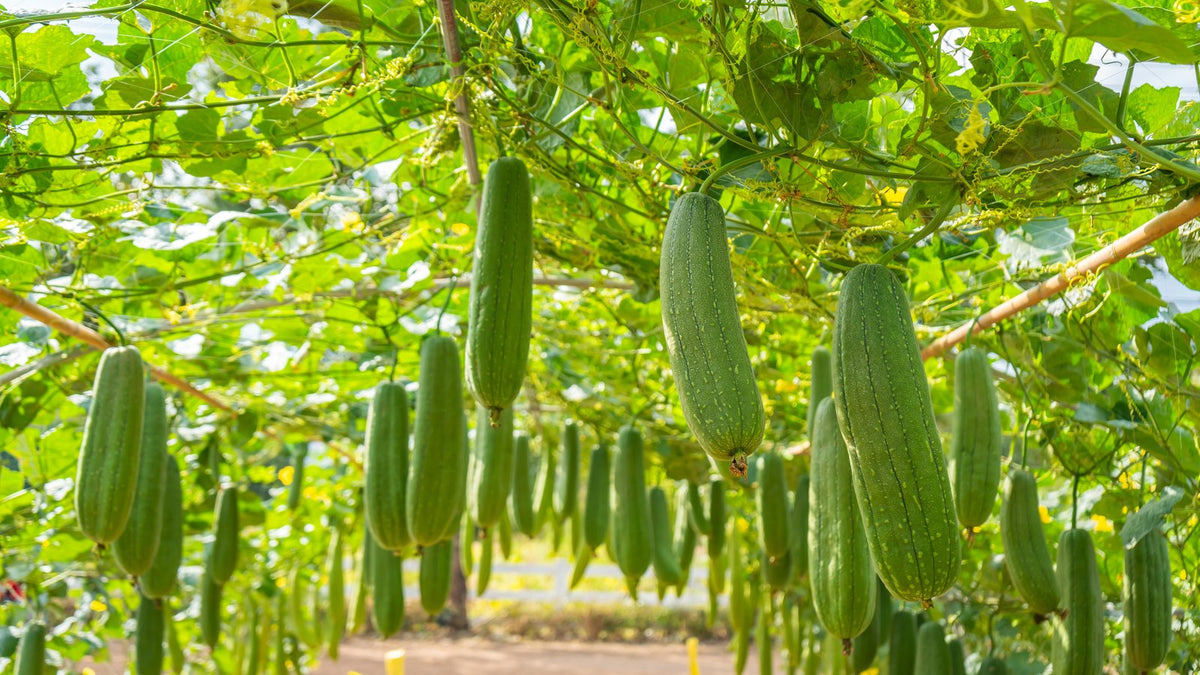

The short version: Luffa is a frost-tender climber in the cucumber family, and one vine gives two crops. Pick the fruit young and cook it like zucchini, or leave it hanging until the skin browns, the fruit turns light and the seeds rattle, about four to five months after it sets, then peel it for a sponge. Grow smooth luffa, sow into warm soil after frost, build a strong frame first, and throw out any fruit that tastes bitter.
Few plants hand you dinner and the dish scrubber from the same vine. Left alone, a tender green luffa slowly becomes a bundle of tough fibre inside a papery brown shell.
The catch is time, and a frame that can carry heavy fruit. This article follows the sponge; soil, feeding and pests are in our gourd grow guide.
Smooth or angled: choose the right luffa
For sponges, grow smooth luffa (Luffa aegyptiaca, also labelled Luffa cylindrica), sold under names such as Sponge Gourd and Smooth Extra Long. Angled luffa (Luffa acutangula), sold as Long Green, Bonanza and the hybrid Buab Liam F1, has hard ridges and is grown mainly to eat. It dries too, but a University of California extension guide rates it a poorer sponge.
Both are eaten young, so the decision is made fruit by fruit: dinner, or the bathroom.
Give it the longest season you can
Luffa is slow. The Northern Territory Government's fact sheet on Asian melons has the first flowers six to ten weeks after planting and full maturity four to five months after fruit set: more than five warm months from sowing to sponge.
- Wait for warm soil. Sow 20 to 25 mm deep and about 1 metre apart after frost, into soil of about 20°C, as our gourd guide advises.
- Soak the seed. The coat is hard. Iowa State University Extension suggests overnight or up to 24 hours; a University of California Master Gardener guide warns a longer soak can rot the seed.
- Start early where spring is short. Sow in biodegradable pots three to four weeks before planting out, since the vines resent root disturbance. Harden them off for a few days, then plant out as soon as frost danger passes.
Seedlings can take one to three weeks to show, so a quiet pot is not yet a failed one.
Build the frame before you sow
A smooth luffa vine starts slowly, then can run to 6 metres or more. Its heavy fruit rots on damp ground, so Gardening Australia suggests a pergola, where the fruit hangs down, and says to pinch out the tip once the vine reaches the top. Hanging fruit also grows straighter. Our guide to supports for climbing vegetables covers building and anchoring one. Luffa is not drought tolerant, yet suffers in waterlogged ground, so water deeply and keep the bed free draining.
Flowers, bees and a soft brush
A female flower sits on a tiny fruit; a male stands on a bare stalk. The first flowers are mostly male, and the females follow, so a young vine with no fruit is normal. Bees usually do the rest.
If small fruit shrivel, take a fresh male flower, peel back its petals and dab its pollen on the female's centre, or use a soft paintbrush. Smooth luffa opens in the morning; angled luffa opens at dusk, so pollinate it in the evening. Our zucchini hand pollination lesson walks through the method.
Picking luffa to eat
- Smooth luffa: pick at about 10 to 15 cm, the size Gardening Australia's luffa profile gives, because older fruit turns bitter.
- Angled luffa: NSW DPI says to pick it immature, 15 to 40 cm long, before it turns fibrous and tough, and to take the hard ridges off with a potato peeler.
Cook it as you would zucchini, in stir-fries and soups, after the taste check below.
Leaving fruit for sponges
A sponge fruit stays on the vine until the skin turns from green to yellow and then brown, the fruit feels light, and the seeds rattle when shaken. The first fruit to set has the longest run before the weather cools, so leave those and eat later ones young. Ease off the watering as they colour, and bring dry fruit in before wet weather stains them.
Frost damages fruit that has not matured, so before the first frost cut the rest with some stem and finish them somewhere warm and airy; a fruit with no fibre yet will not make a sponge. A mature green fruit can still give a sponge once a gentle squeeze shows the skin has started to separate from the fibre, though NC State Extension notes the peeling and washing take time.

From gourd to scrubber
- Peel. Crack a dry, brown fruit at the flower end and pull the skin away in strips. If it clings, NC State Extension suggests warm water for 5 to 20 minutes until it strips off easily.
- Shake out the seeds. Trimming the ends can help. Keep the dark, ripe ones for sowing.
- Rinse the sponge in clean water to wash out sap and pulp.
- Dry it completely in the sun or an airy spot before storing or using it.
Bleaching is optional. Clemson University and NC State extension guides use roughly one part household bleach to nine or ten parts water for 30 minutes to about an hour, no longer, to lift stains and lighten the colour. Wear gloves, follow the safety directions on the bottle, then rinse well and dry fully.

Saving luffa seed
- Take ripe seed. Mature seed is usually dark. Dry it on paper out of the sun, then store it somewhere cool and dry.
- Skip the hybrid. Seed from an F1 such as Buab Liam F1 does not come true.
- Grow one kind. Smooth and angled luffa can cross, and their crosses are reported to be bitter and unfit to eat. Varieties within a species cross too, even between gardens, so bag a few male and female flowers before they open, hand pollinate them, then bag the female again.
Luffa across Australia's climate zones
These windows follow our gourd grow guide and Gardening Australia's vegie guide, which uses five climates rather than these six, so let frost and soil warmth decide.
- Tropical (Darwin in the Northern Territory, Cairns and Townsville in Queensland): plenty of season for sponges. The Northern Territory Government says luffa does best in the dry season; sow from about April to June.
- Subtropical (Brisbane and south-east Queensland, northern New South Wales): sow from September to January; spring sowings give sponge fruit the longest run.
- Arid and semi-arid (Alice Springs in the Northern Territory, Kalgoorlie in Western Australia, Mildura in Victoria, Broken Hill in New South Wales): sow from about September to December after the last frost, with sponge crops in early so the fruit matures before autumn frost. Water deeply through the heat.
- Temperate (Sydney and the New South Wales coast, Melbourne in Victoria): Sydney sows from September. Melbourne, at the cool end of the zone, plants out potted seedlings around Melbourne Cup weekend, and young fruit is likely to be more reliable there than a ripe sponge.
- Mediterranean (Adelaide in South Australia, Perth and southern Western Australia): sow from about September to December once the soil is warm, then mulch deeply and water steadily through the long dry summer.
- Cool and alpine (Canberra and the ACT, Tasmania, Ballarat in Victoria, Armidale and Orange on the New South Wales tablelands, Stanthorpe in Queensland): the frost-free run is short for a crop needing more than five months, so a sponge is a project, not a promise. Start seed indoors in October, plant out after frost against a sunny brick or stone wall, which holds heat into the night, and eat the fruit young if time runs out. Gardening Australia suggests a glasshouse in Tasmania.
These zones are broad groupings. Between two of them, at altitude or in a frost hollow, go by your own frost dates and soil temperature.
Food safety: do not eat a bitter luffa
Fruit of the cucumber family can occasionally build up cucurbitacins, natural toxins that taste bitter. Hong Kong's Centre for Food Safety names angled loofah among the cucurbits that can form them, and says enough can cause nausea, stomach cramps and diarrhoea. Australia's Food Safety Information Council reports that bitter zucchini, which carry the same family of toxins, have caused vomiting, stomach cramps, diarrhoea and collapse.
- Taste a small raw piece of each fruit before cooking. If it is bitter, spit it out and discard the whole fruit.
- Do not try to cook the bitterness out: cooking does not destroy cucurbitacins.
- Take extra care with fruit from saved seed, since a cross can bear bitter fruit.
- If anyone has eaten bitter luffa, call the Poisons Information Centre on 13 11 26, at any hour, without waiting for symptoms. If someone collapses, has a seizure or stops breathing, call 000.
Frequently asked questions
Can you eat luffa?
Yes, while it is young and tender. A fibrous fruit is a sponge, not a vegetable, and a bitter one goes in the bin.
How long does a luffa take to become a sponge?
About four to five months after the fruit sets, on top of the six to ten weeks the vine takes to flower. It is ready when the skin is brown, the fruit is light and the seeds rattle.
Why is my luffa flowering but not fruiting?
Early flowers are mostly male, and the females follow. If small fruit shrivel, hand pollinate: mornings for smooth luffa, dusk for angled.
Can I grow luffa sponges in Melbourne, Canberra or Tasmania?
Possibly, with a head start: seedlings raised indoors, your warmest spot after frost, and the first fruit kept for sponges. In Tasmania a glasshouse gives the best chance.
Let the first fruit hang, eat the rest young, and a good season pays you twice: once in the pan and once at the sink.
Related growing guides
- Growing luffa from seed: a vegetable, a sponge and a very long vine
- Bitter melon, snake beans and okra from seed
- An Indian vegetable garden, gourds included
- Summer crops for a short, cool season
- Seed saving for beginners
Find smooth and angled luffa among our gourd seeds, and more for the trellis in our climbing vegetable seeds.