


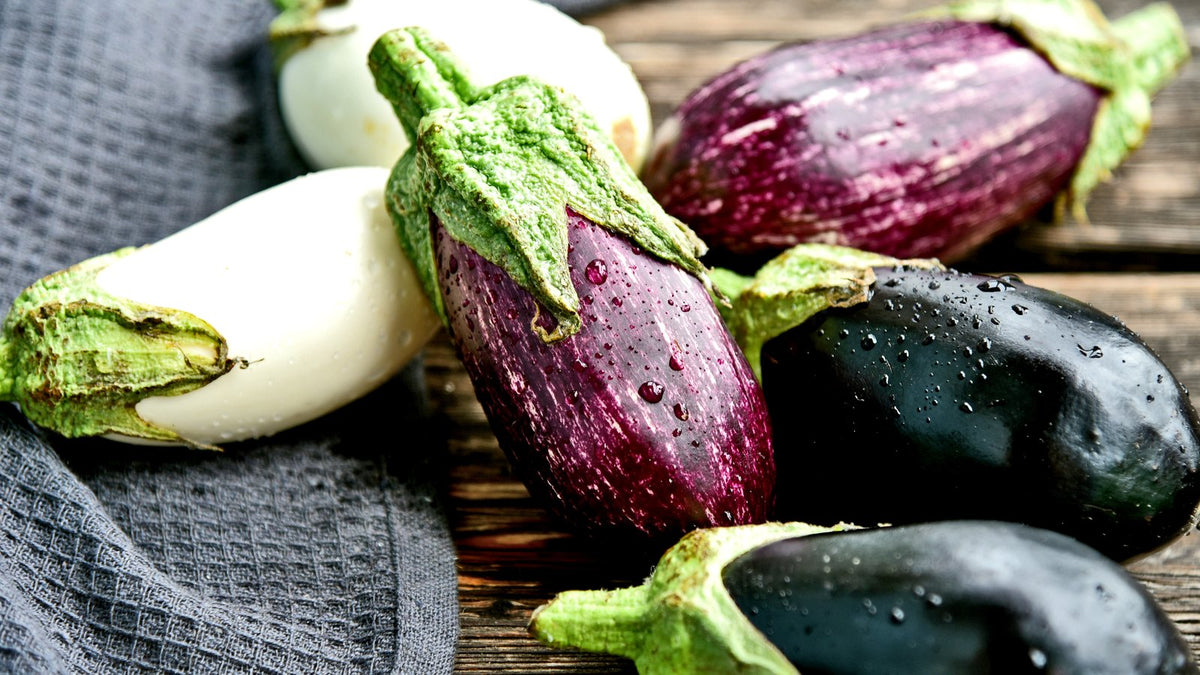

The short version: Eggplants fall into a few groups. Big globe or Italian types give thick slices and need a stake. Long, slim Lebanese and Asian types tend to have thinner skin and pick sooner, and suit the grill and pots. Small round Thai types suit curries, and white, striped and egg-shaped types add colour. For a short, cool summer, grow slim or small-fruited types. Eat the fruit only: the leaves are not food.
Walk past a good market stall in late summer and the eggplants hardly look related: glossy globes that fill a hand, long purple wands, pale green golf balls, and white ones so egg-like that the name finally makes sense. Most are one species, Solanum melongena, a nightshade grown for its fruit, like tomato and capsicum.
Shape is a useful clue to how a plant behaves: slim and small-fruited types tend to crop sooner, some fit a pot, and each group has its dishes. Sowing and raising them is covered in our guide to growing eggplant from seed.

Globe and Italian eggplants: the big ones
These are the eggplants most people picture. Black Beauty, the old standard, carries blocky oval fruit to about 16 cm with medium to thick skin on a spreading bush up to 80 cm, and its listing says it does well in southern areas. Florida Market gives teardrops of 22 to 25 cm and is listed for hot, humid regions, and Market Supreme is a shorter teardrop, about 16 by 11 cm.
Heavy fruit can make a bush lean, so put a stake in at planting, and wear gloves to pick, because NSW DPI notes small spines on the calyx and leaves. These are the ones for thick slices, moussaka, parmigiana and stuffing. Sustainable Gardening Australia says only the bigger purple fruit need salting, particularly ones left to go wrinkly. An overgrown, dull fruit turns seedy and bitter, so pick while the skin still shines.
Lebanese, Japanese and other long, slim eggplants
A Lebanese eggplant is not a small version of the big round one but a slim, straight fruit. Midnight F1, a Lebanese type with a strong upright habit, gives fruit 15 to 18 cm long and 3 to 4 cm across with a spineless calyx, the green cap at the stem end. Midnight F1 seed is treated with a fungicide: its listing says not to eat it or feed it to animals, to keep it from children and animals, and to wear gloves and wash with soap and water after handling it. Compact Mini Lebanese bears clusters of finger-like fruit up to 8 cm, chosen for pots and small gardens.
Slim fruit tends to have thinner skin and fewer seeds than the big blocky types, as the organic Long Purple listing puts it, and Sustainable Gardening Australia says Lebanese types are quicker to harvest, which suits shorter summers.

The long Asian types stretch the shape further: Japanese Pickling reaches about 40 cm, Ping Tung Long is another very long one, Little Fingers bears clusters best picked at about 10 cm, and Thai Long Green and Louisiana are long and green. Slice them lengthways for the grill or toss them into a stir-fry, and pick them young: older fruit turns spongy.
Thai and other round eggplants
Thai Purple Ball, deep purple and up to 5 cm across, sets fruit 40 to 50 days after transplanting by its listing, and Round Purple, up to 7 cm, is listed as maturing in 50 to 55 days, where Black Beauty's listing gives 72 to 85: a plus where summer is short. Thai Round Green is pale green with white stripes, about 5 cm across. The small rounds go into curries, stews and stir-fries, and in an Indian vegetable garden they are brinjal, like every other eggplant.
Japan adds its own rounds, from bite-sized Konasu to flat-bottomed Kamo of up to 200 g, a traditional Kyoto vegetable.

White, striped and egg-shaped eggplants
White types include Casper, with mild flesh on a compact plant, Snowy, listed as creamy and early maturing, and the longer Oriental White F1. Pick them while they are still white, because Gardening Australia notes that eggplants going yellow are past their best. Kaberi F1 is egg-sized: dark purple, oval-round fruit of 50 to 60 g, on a compact plant bred for containers and thornless unless stressed.
For stripes, Listada de Gandia is thin-skinned and Tsakoniki is an early striped cylinder. Turkish Orange, which its listing calls an African species, sets striped fruit the size of tennis balls and is best picked as it turns from green to cream, well before it earns its name. Togo, sold as an African type also called garden eggs, bears clusters of small striped orange and yellow fruit.
Which type suits your garden and climate
Every type needs warmth, so your climate zone mostly decides which types are the safer bet.
- Tropical (Darwin in the Northern Territory, Cairns and Townsville in Queensland): the Northern Territory eggplant Agnote says eggplant can be planted all year, but wet-season plants grow leafy and yield less, so grow the main crop through the dry months.
- Subtropical (Brisbane and south-east Queensland, northern New South Wales): Gardening Australia notes eggplants do well in humid parts of the country, and the long warm season gives every group time to crop. Wet, windy weather spreads anthracnose, sunken spots on ripening fruit, so bin spotted fruit; in northern New South Wales, see the devil's fig note below.
- Arid and semi-arid (Alice Springs in the Northern Territory, Mildura in Victoria, Broken Hill in New South Wales, Kalgoorlie in Western Australia): Gardening Australia's arid-zone planting guides list eggplant from August to March, but plant out after the last frost and, where autumn brings frost, sow by November. Very hot spells can cut flowering, so rig afternoon shade in a heatwave; Listada de Gandia is listed as preferring hot weather.
- Temperate (Sydney and the New South Wales coast, Melbourne in Victoria): NSW DPI gives early October to late December for transplanting in the Sydney Basin. Melbourne is the cool end of the zone, where slim and early types are the safer bet.
- Mediterranean (Adelaide in South Australia, Perth and southern Western Australia): long, dry summers give a full season if the water is steady, as NSW DPI notes that dry spells shed flowers and developing fruit. Perth's school garden guide from the WA Waste Authority plants eggplant seedlings September to December.
- Cool and alpine (Tasmania, Canberra in the ACT, Orange and Armidale in New South Wales, Ballarat in Victoria, Stanthorpe in Queensland): Gardening Australia notes eggplants tend to be sluggish in cooler areas, so start seed indoors at the end of winter, favour early, slim or small types, and keep a pot type such as Kaberi F1 to move under shelter in a cold spell.
These are broad groupings. If your town sits on a zone boundary or high above the nearest city, go by your own last frost date and how warm your summer nights run. The growing guide linked above has sowing months by zone.
Eggplant leaves, wild relatives and pea eggplant
Eat the fruit, not the plant. North Carolina State University Extension lists eggplant fruit and seeds as edible and the rest of the plant as poisonous, and the University of Florida says the leaves and flowers are poisonous, as in other members of the nightshade family.
Blackberry nightshade (Solanum nigrum), a weedy relative, needs the same care: the Queensland Poisons Information Centre says the whole plant is considered toxic, although ripe berries are usually harmless, and green berries may cause headache, nausea and mild stomach upset. If someone eats part of a plant and you are worried, call the Poisons Information Centre on 13 11 26, at any hour, from anywhere in Australia.
Thai pea eggplant is a different species, Solanum torvum, also called devil's fig, and a weed in parts of Australia. The NSW Government's WeedWise page on devil's fig says "This plant should not be sold in parts of NSW" and lists North Coast council areas where it is targeted for eradication or containment. It also warns that toxin levels in the fruit vary greatly and that, in extreme cases, a small amount has caused severe poisoning. Brisbane City Council says the plant is regarded as an environmental weed in Queensland and lists it as pest vegetation under its local law. Rules differ between states and councils, so check your state and council weed lists before growing any wild eggplant relative. None of the varieties above is devil's fig.
Frequently asked questions
What is the difference between Lebanese eggplant and normal eggplant?
Shape, skin and speed. A Lebanese eggplant is long and slim, 15 to 18 cm by 3 to 4 cm in Midnight F1, while a globe such as Black Beauty is a blocky oval with medium to thick skin. Sustainable Gardening Australia says Lebanese types are quicker to harvest, and only the bigger purple eggplants need salting.
Can I grow eggplant in a pot?
Yes. Kaberi F1 was bred for containers, and Mini Lebanese and Turkish Orange are described as suited to them. Use a pot about 40 cm wide per plant and check it for water every day.
Why is my white eggplant turning yellow?
It is getting old. Gardening Australia notes that eggplants going yellow are past their best for eating, so pick white types while the skin is still white and glossy.
Is Thai eggplant the same as pea eggplant?
No. Thai round eggplants such as Thai Round Green are about 5 cm across, while pea eggplant is a separate species, Solanum torvum or devil's fig, a weed in parts of New South Wales and Queensland whose fruit can contain toxins. Check your state and council rules before growing it.
Choose by the dish you cook most and the length of your summer, and let the colours be the bonus.
Related growing guides
- How to Grow Eggplant from Seed in Australia
- Growing an Indian Vegetable Garden in the Australian Climate
- Growing Capsicum in Australia: From Seed to Harvest Without the Guesswork
- A Beginner's Guide to Vegetable Plant Families
Browse the full eggplant seed range, from big globes and Lebanese types to the little round Thai ones.