
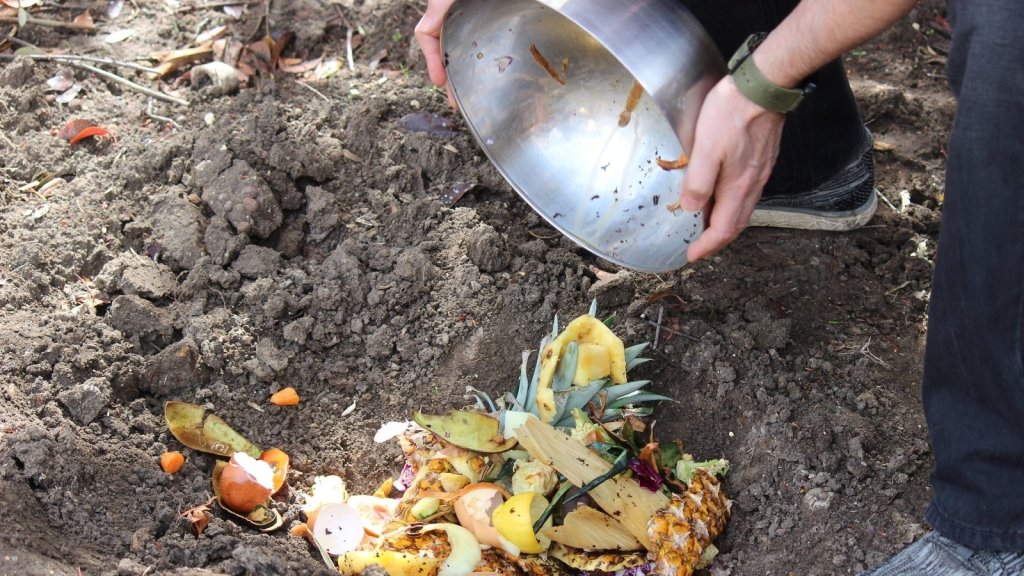
The short version: Dig and drop composting skips the heap altogether. You dig a hole about a spade deep in a garden bed, drop in a few days' worth of kitchen scraps, cover them with the soil you removed, and move on to a new spot next time. The soil life does the rest over a few months. Keep meat, dairy and cooked food out, dig deep enough that little can smell it, and you get the benefits of compost with almost no work.
Some gardens never get a compost heap, and it is not for lack of good intentions. There is no spare corner, or the yard is all established beds, or managing a heap is one job too many. The scraps still pile up on the bench. Compost holes are the answer for that garden: the small-scale cousin of trench composting, and it fits around plants that are already growing.

How dig and drop works
You bury small amounts of organic waste, often, in holes dotted around the garden, and let the soil compost it in place. There is no turning, no watering a heap, no barrowing finished compost around, and nothing sitting in the open to smell or attract flies. Each hole quietly improves the soil where it sits, and over a year or two the holes can join up into a bed that is often richer and holds water better all over.
The trade-off is that a covered hole never gets hot, so it breaks down more slowly than a well-managed heap and it cannot kill weed seed or disease. Feed it clean ingredients and it usually works well.
Digging the hole
- Pick a spot in a bed, between plants or along an edge. Keep a fair distance from the trunks of shrubs and trees, since most of their feeder roots sit in the top 20 to 30 cm of soil, and chopping through them does harm.
- Dig about a spade deep, roughly 35 cm in most soils and about 25 cm in heavy clay, and only a little wider than the spade. Keep the soil beside the hole.
- If the ground is dry, water the bottom of the hole.
- Drop in a few days of kitchen scraps, or the results of one pruning session, in a layer no thicker than about 10 cm, and press it down gently. Chopping bulky scraps first speeds things along.
- Refill with the soil you removed, firm it lightly, water it, and cover the spot with mulch.
- Push a stick or a peg in to mark the hole, so you know where you have been and where you can plant later.
Next time, dig the next hole a little further along. A raised bed, a strip beside a path or a spare edge of lawn can all take a run of holes over a season.

What to drop, and what to keep out
Fruit and vegetable scraps, coffee grounds, tea leaves, crushed eggshells, paper towel, brown paper bags, small prunings, spent annuals and soft weeds that have not set seed all go in. A thin sprinkle of aged manure or half-finished compost on top of the scraps helps get the microbes started.
Keep out meat, fish, bones, dairy, cooked food and fats, which draw rats and foxes and rot slowly and badly underground. Australian composting guidance excludes them outright, whatever the depth, and the old idea that burying meat deeply makes it safe does not hold up. Also leave out dog and cat droppings, diseased plant material, seeded weeds, and anything that regrows from a scrap of root or runner, such as couch, kikuyu, nutgrass and oxalis. Citrus and onion in ordinary kitchen amounts are usually fine in the soil, even though worm farms need extra care with them.

Planting over a compost hole
Seeds and small seedlings can go into the covering layer of soil straight away, because their roots will not reach the buried material until it has largely broken down. Give the spot a few months before you plant anything deeper-rooted or hungry over it, such as a tomato or a shrub.
The reason is nitrogen drawdown. Soil microbes breaking down carbon-rich material borrow nitrogen from the soil around them for a while, so plants rooted straight into a fresh hole can look pale and slow until the process passes. Kitchen scraps cause less of this than paper and straw. Marking each hole with its date takes the guesswork out.
Worms, and the worm tower option
Compost holes are worm feeders. The ordinary garden earthworms that live in your soil often find buried scraps within a week or two and do much of the work, which is one reason the method suits beds that already have good soil life.
A neat variation is the in-ground worm tower: a length of wide pipe or a large pot with the base removed and holes drilled through the lower two-thirds, buried with just the lid showing at soil level. You feed scraps in through the top, worms move in and out through the holes, and the castings and liquid go straight into the surrounding bed. It is a permanent compost hole you never have to re-dig, and in hot inland areas gardeners find a shaded tower copes with summer better than an above-ground worm farm. Composting worms sold for worm farms live in rich organic matter rather than open soil, so a tower stocked with them needs feeding regularly to keep them there.

Keeping it tidy and pest-free
Depth and cover are the main defence. A hole that is too shallow, or scraps left poking through the surface, are what let rats, mice and foxes smell dinner and dig for it. Dig to a spade depth, cover every scrap completely, firm the soil and mulch over the top. Keep the excluded foods out and a compost hole gives rodents little to find. Ants moving in usually means the spot is too dry, so water it.
Two safety notes. Wear gloves and a mask, dampen dry soil and compost before you disturb it, avoid breathing the dust, and wash your hands before you eat or drink, because garden soil and compost can carry Legionella longbeachae, the cause of a form of Legionnaires' disease. And before digging deep or near the house, remember that a spade can reach buried services. The free Before You Dig Australia service can tell you what utility lines run under your yard, though not private lines such as irrigation, so dig carefully. Gardeners in South East Queensland's fire ant biosecurity zones should check the National Fire Ant Eradication Program's rules on fireants.org.au before moving soil, compost or mulch off their property.

Compost holes across Australia's climate zones
- Tropical (Cairns and far north Queensland, Darwin and the Top End of the Northern Territory, the Kimberley in Western Australia): breakdown is fast, but in the wet season holes can fill with water and turn sour. Dig on the higher, better-drained side of a bed and keep holes small.
- Subtropical (Brisbane and coastal Queensland, Coffs Harbour and northern New South Wales): a fast, forgiving zone all year. Check fire ant zone rules before moving soil in South East Queensland.
- Arid and semi-arid (inland Queensland, Broken Hill and Dubbo in New South Wales, Mildura in Victoria, inland South Australia and Western Australia, Alice Springs in the Northern Territory): dry soil barely composts. Water the hole when you fill it, mulch the surface, and consider a shaded worm tower.
- Temperate (Sydney and New South Wales, Melbourne and Victoria): a few months from hole to planting through the warmer half of the year, longer over winter.
- Mediterranean (Perth and southern Western Australia, and Adelaide and the Adelaide Plains in South Australia): buried scraps are one of the best things you can do for water-repellent sand. Keep holes watered through the dry summer.
- Cool and alpine (Hobart and Tasmania, Canberra and the ACT, Ballarat in Victoria, Orange and Armidale on the New South Wales tablelands): breakdown almost stops in winter. Holes dug in autumn are usually ready for spring planting.
Frequently asked questions
How deep should a compost hole be?
About a spade deep, roughly 35 cm in loamy soil and 25 cm in heavy clay. Shallower holes are the ones animals dig up.
How much can I put in one hole?
A few days of kitchen scraps, or one session of prunings, in a layer of no more than about 10 cm. Small and often beats one big pit.
Can I plant straight over the hole?
Seeds and small seedlings in the covering soil, yes. Wait a few months for hungry or deep-rooted plants, so the material has broken down and the nitrogen drawdown has passed.
Will it attract rats?
Not if you leave out meat, fish, dairy, cooked food and fats, dig to a spade depth and cover everything completely. Rodents follow smell and shallow cover, so those rules matter more than anything else.
Do I need special worms?
No. The earthworms already in your soil will find the scraps. Composting worms are only worth buying for an enclosed worm farm or a worm tower that you feed regularly.
A spade, a bowl of scraps and two minutes in the garden after dinner. Repeat, and the soil quietly gets better under your feet. ABC Gardening Australia's dig and bury compost guide is a good companion read, and if rodents are already a problem, our guide to rats and mice in the garden covers humane, wildlife-safe control.
Related growing guides
- Trench composting: bury your scraps and let the soil do the work
- Composting in a small garden: bins, tumblers, worm farms and bokashi
- Rats and mice in the garden
Something to plant over the holes? Browse our vegetable seeds and herb seeds.