
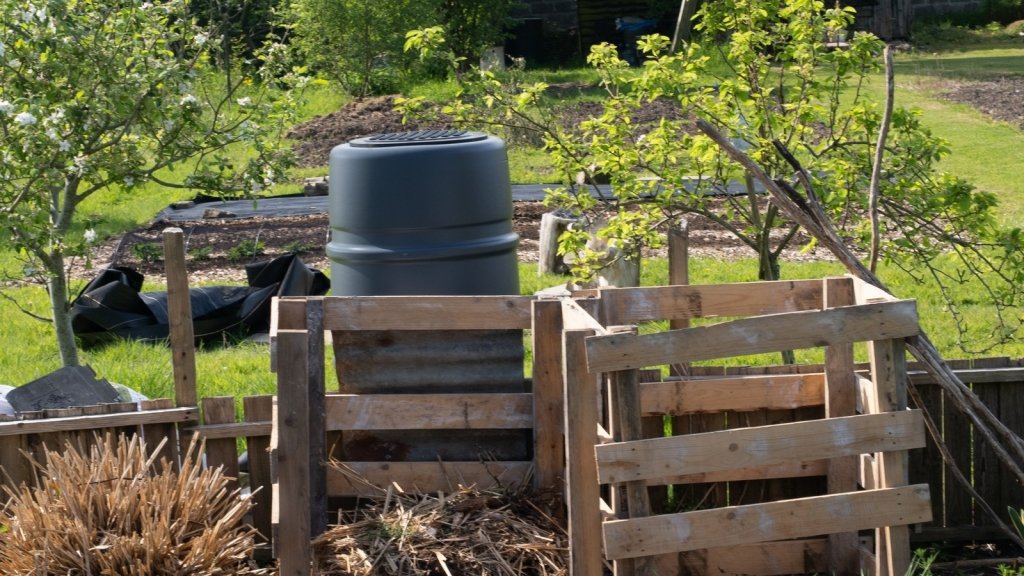
The short version: A small garden can compost everything a big one can, it just needs a compact system. A bottomless bin on a square metre of soil, a tumbler on the paving, a worm farm in the shade or a sealed bokashi bucket under the sink each turn scraps into soil food, and many households run two of them together. Choose by how much you throw out, how much sun and soil you have, and how much attention you want to give it.
The kitchen does not care how big the garden is. A household still produces a few kilograms of food scraps a week, and the choice is between sending them to landfill, where they rot without air and give off methane, or turning them into something that feeds a courtyard bed or a row of pots. Small gardens actually have an advantage here: compact systems are easier to look after than a big heap, and the finished compost never has far to travel.

Start with what you throw out
Match the system to the scraps. A household that mostly produces vegetable peelings, coffee grounds and the odd bunch of prunings is well served by a bin, a tumbler or a worm farm. A household that also wants to deal with meat, dairy and cooked leftovers needs a bokashi bucket, because those foods do not belong in an open system. Most small gardens end up with a pair, such as a worm farm for the daily peelings and a compost bin for the garden waste.
Bottomless bin
The familiar black cone. It needs about a square metre of bare soil, ideally in part shade, and it works as a slow cold heap that you add to from the top and empty from a hatch at the bottom. It takes the widest range of garden waste, costs little, and many councils subsidise them.
The weak point is the open base, which lets rats dig in from underneath. Set the bin on a sheet of galvanised vermin mesh, cut about 10 cm larger than the base and folded up around the edge, and keep meat, dairy and cooked food out. Chicken wire is not enough, since rats chew through it. Balance wet scraps with dry browns such as shredded paper and leaves, and give it a stir with a compost aerator or a stake now and then.

Compost tumbler
A tumbler is a drum on a frame that you rotate instead of turning with a fork. Because it sits clear of the ground, it is one of the few home systems that is genuinely rodent-proof, along with a sealed bokashi bucket, which makes it the pick for paved courtyards, rental yards and anywhere rats are a worry. Turning takes seconds, and a full drum can finish in a couple of months in warm weather.
The trade-off is that a tumbler works best in batches. Keep adding fresh scraps and the mix never quite finishes, so a two-chamber model, or a second bin to hold the overflow, solves that. Tumblers also dry out in full sun and turn sloppy if they get too many greens, so shade it and keep a bag of browns beside it.
Worm farm
A worm farm is the quiet workhorse of small-space composting. It takes daily kitchen scraps in a stack of trays or a bath-sized box, produces castings that are among the best soil foods you can buy, and fits on a shady balcony or beside the back door. It uses composting worms, the red wigglers and tiger worms sold for the purpose, not the earthworms from your garden, which will not survive in a farm.
- Keep it shaded and between roughly 15 and 25 degrees. Worms stress above 30 degrees, so summer shade is essential, and a frozen water bottle on top helps on a scorching day.
- Feed a little and often, roughly half the worms' weight in scraps a day, and only when the last feed is nearly gone. Overfeeding is what makes a farm smell.
- Go easy on citrus and onion, and leave out meat, dairy, oil and large amounts of bread.
- Keep the bedding damp and covered with a hessian sack or damp newspaper.
The liquid that drains from the tap is often called worm tea, but it is really leachate that has not passed through the worms and can carry unwanted bacteria. Dilute it heavily and use it on ornamentals or the soil, never on salad leaves. The castings themselves are the prize.

Bokashi bucket
Bokashi is not composting so much as pickling. Scraps go into a sealed bucket with a sprinkle of bran inoculated with fermenting microbes, and over two to four weeks they ferment rather than rot. Because it is sealed and anaerobic, bokashi happily takes meat, fish, dairy, cooked food and citrus, and it lives under the sink or on a balcony without smell or flies. Most people run two buckets, one filling while the other ferments.
The catch is that fermented bokashi is not finished. It has to be buried 20 to 30 cm deep in a bed or a large pot, or added to a compost bin, for a further two to four weeks before you plant into it. The liquid that drains off can be diluted about one part to a hundred as a feed, or poured neat down the drain as a cleaner. For a unit with a single courtyard bed, bokashi paired with a dig-and-drop hole is a complete system.

In-ground worm tower
A worm tower is a length of wide pipe or a bottomless pot with holes drilled around the lower half, buried in a garden bed with the lid at soil level. Scraps go in the top, worms move through the holes, and the castings and moisture feed the surrounding plants directly. It takes no floor space at all, suits a raised bed perfectly, and in hot inland areas a shaded tower often copes with summer better than an above-ground farm. Our guide to dig and drop compost holes covers the same idea without the pipe.
No garden at all?
A balcony can hold a small worm farm or a bokashi bucket, with the fermented waste going into a large pot of soil that becomes potting mix for next season. Beyond that, most councils now run a food and garden organics bin, community gardens often welcome scraps, and neighbourhood sharing schemes connect households with scraps to people with compost. Many councils also subsidise worm farms, bokashi kits and bins through programs such as Compost Revolution, so check yours before you buy.
The small-space problems, and their fixes
- Rats and mice: mesh under the bin, no meat, dairy or cooked food, and scraps always covered.
- Clouds of vinegar flies: bury fresh scraps under browns or a scoop of finished compost, and keep lids closed and caddies shaded.
- Ants: the system is too dry. Water it and add wet greens.
- Smell: too wet, too many greens or no air. Add shredded paper or leaves and turn or stir it. In a worm farm, feed less.
- Nothing happening in winter: normal in cool zones. Keep feeding lightly and wait for spring.
Wear a mask and gloves, and wet compost, castings or potting mix down before handling to settle the dust. Wash your hands afterwards, since these can carry the bacterium Legionella longbeachae.

Small-space composting across Australia's climate zones
- Tropical (Cairns and far north Queensland, Darwin and the Top End of the Northern Territory, the Kimberley in Western Australia): heat is the enemy of worm farms. Deep shade, an in-ground tower, or bokashi indoors are the reliable choices.
- Subtropical (Brisbane and coastal Queensland, Coffs Harbour and northern New South Wales): everything works, but shade the worm farm through summer and watch the flies.
- Arid and semi-arid (inland Queensland, Broken Hill and Dubbo in New South Wales, Mildura in Victoria, inland South Australia and Western Australia, Alice Springs in the Northern Territory): tumblers and bins dry out fast and worm farms cook in the sun. Shade, lids, and a buried worm tower or bokashi are the answers.
- Temperate (Sydney and New South Wales, Melbourne and Victoria): every system suits. Shade the worm farm in summer and expect a slow patch in winter.
- Mediterranean (Perth and southern Western Australia, and Adelaide and the Adelaide Plains in South Australia): shade and moisture through the long dry summer, then an easy winter. Castings and bokashi are especially valuable on sandy soil.
- Cool and alpine (Hobart and Tasmania, Canberra and the ACT, Ballarat in Victoria, Orange and Armidale on the New South Wales tablelands): worm farms slow right down below about 10 degrees, so insulate them or move them into a shed, and lean on bokashi through winter.
Frequently asked questions
Which system is best for a courtyard?
A worm farm for kitchen scraps plus a tumbler for garden waste covers most courtyards. If rats are a worry, the tumbler is the safest choice, and bokashi handles the leftovers nothing else can.
Can I compost on a balcony?
Yes, with a small worm farm in the shade or a bokashi bucket. Bury the finished bokashi in a large pot of soil, and use the castings and that soil for your pots.
Can I use garden earthworms in a worm farm?
No. Worm farms need composting worms, sold as red wigglers or tiger worms, which live in rich organic matter. Garden earthworms burrow in soil and will not survive in a farm.
Why does my worm farm smell?
Almost always overfeeding, or too much wet material. Stop feeding until the scraps are gone, add shredded paper, and check the drain is not blocked.
Does bokashi smell?
A working bucket has a sour, pickled smell when you open the lid and no smell when it is closed. A rotten smell means the seal has failed or too much liquid has built up.
Pick the system that suits your scraps and your shade, and a small garden can feed itself from the kitchen bench outwards. For the growing side, our guide to small-space food gardening shows what a courtyard or balcony can produce. The NSW Government's Love Food Hate Waste program has more on how much food the average household throws away, and what it costs.
Related growing guides
- Composting for beginners
- Balcony and courtyard veg: what to grow in pots in Australia
- Small-space food gardening: big harvests from a balcony or courtyard
Castings ready for the pots? Browse our herb seeds and vegetable seeds for small spaces.