
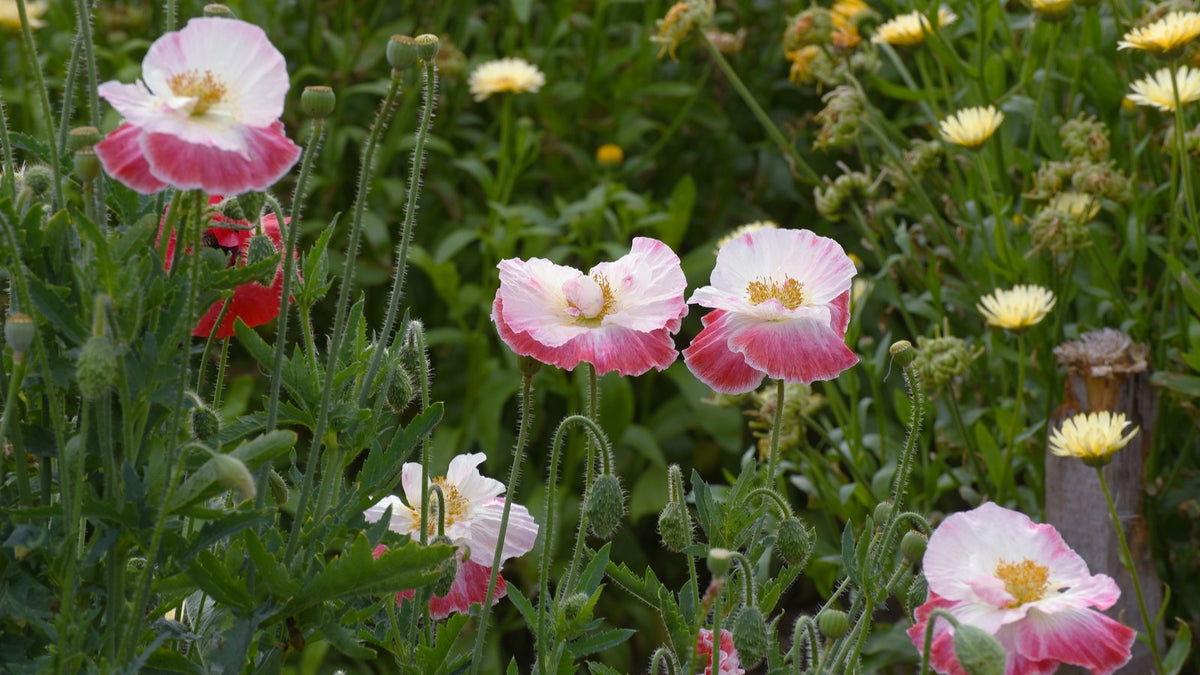

The short version: Poppies, Californian poppies, larkspur and nigella grow a taproot that sulks when it is moved, so sow them where they are to flower. Sweet peas, sunflowers and zinnias also do best sown in place, and cornflower, calendula, cosmos and nasturtium grow well that way too. Sow the hardy, cool-season group in autumn and the frost-tender group once spring soil warms, or both in the dry season in the tropics. Barely cover fine seed, push big seed deeper, mark the patch, and thin early.
A punnet of seedlings feels like a head start. For a handful of favourite annuals it is closer to a detour: the move sets them back, and seed sown straight into the bed the same week can catch them up.
The trick is knowing which flowers those are, which season each wants, and how to sow them so they come up.
Why some flowers resent the move
The usual culprit is a taproot, one main root that heads straight down from the first weeks. Damage it at planting time and the seedling takes a setback. The University of Wisconsin says love-in-a-mist (Nigella damascena) does not transplant well because of its long taproot, and says the same of the Californian poppy (Eschscholzia californica). The National Gardening Association says larkspur makes a deep taproot early and resents being moved. Field and Shirley poppies (Papaver rhoeas) belong in the same group.
Gardening Australia notes that sweet peas quickly form deep roots that dislike disturbance, and that sunflowers have a deep taproot and are sown straight into the bed. ABC Organic Gardener says zinnias hate root disturbance, with moved seedlings stalling long enough for direct-sown ones to catch up.
Cornflower, calendula, cosmos and nasturtium can be raised in trays while the bed is not ready, but they also grow well sown in place and skip the move.
Cool-season or warm-season: sow each in its own season
- Cool-season hardy annuals survive frost. Sown in autumn, they build roots over winter and bloom from late winter into spring, earlier than a spring sowing would. Poppies, larkspur, nigella, cornflower, calendula and sweet peas belong here.
- Warm-season annuals are frost tender and want warm soil. Sunflowers, zinnias and cosmos wait until the frosts are over. The store's listings give 22 to 25°C as best for zinnia germination and 21 to 28°C for sunflower: ideals, not minimums, but a cold bed in early spring is still a waste of good seed.
Nasturtium and Californian poppy sit between the two: sow them in the cooler months in the Tropical and Subtropical zones and with the warm-season group elsewhere, plus autumn in Mediterranean gardens and, for Californian poppy, on the New South Wales coast.
| Flower | Group | Depth | What to watch | Store lines, as examples |
|---|---|---|---|---|
| Field and Shirley poppy | Cool, autumn | Barely covered, 3 mm at most | Taproot; fine seed; self-sows | Single Red Flanders Remembrance, Shirley Double Flower Mix |
| Californian poppy | In between, see above | About 3 mm | Taproot; a weed risk (see below) | Golden West, Aurantiaca Orange |
| Larkspur | Cool, autumn | About 6 mm, covered | Taproot; germinates in darkness; poisonous | Imperial Mix |
| Nigella | Cool, autumn | About 3 mm | Long taproot; self-sows | Miss Jekyll Indigo Blue, Persian Jewels Mixed |
| Cornflower | Cool, autumn | 3 to 5 mm | Remove spent flowers to keep it going | Blue Boy, Tom Pouce Mixed |
| Calendula | Cool, autumn | About 15 mm | Self-sows if not deadheaded | Balls Improved Orange, Pacific Beauty Mix |
| Sweet pea | Cool, autumn | 1 to 2.5 cm | Deep roots; poisonous seed; supports first for climbers | Spencer Mixed, Little Sweetheart |
| Sunflower | Warm, spring | About twice the seed's width | Deep taproot; warm soil | Giant Single, Dwarf Sunsation |
| Zinnia | Warm, spring | 5 to 7 mm | Stalls when moved; dislikes cold | Persian Carpet Mixed, Scabiosa Flowered Mixed |
| Cosmos | Warm, spring | 5 to 6 mm | Sow after frost; can self-sow | Bright Lights Mix, Dwarf Sensation Mixed |
| Nasturtium | In between, see above | About 12 mm | Soak overnight; a weed risk (see below) | Empress of India, Alaska Mixed |
Depths follow the store's listings where they give one; the packet has the final word.
How to sow them so they come up
- Prepare a fine bed. Choose a sunny, well-drained spot, pull the weeds, loosen compacted soil, and rake until the surface is crumbly and level.
- Sow fine seed shallow. Poppy seed is dust-fine. Gardening Australia shakes it in a jar with sand or compost, sprinkles the mix over the raked bed and rakes it in gently.
- Cover the seed that wants darkness. Larkspur germinates better in the dark, so bury it properly. The University of Wisconsin says nasturtium needs darkness too.
- Push big seed deeper. Sunflower, sweet pea, nasturtium and calendula seed goes about 1 to 2.5 cm down, at the packet spacing.
- Water with a fine rose and keep the bed moist, not soggy, until the seedlings are well rooted. Seed near the surface dries out quickly.

Mark the patch
Young flower seedlings and young weeds look much alike, and one keen weeding session can clear a whole sowing. The Royal Horticultural Society suggests sowing in drills, shallow grooves in the soil, because seedlings in a line are easier to tell from weeds. Outline each patch with a trickle of sand and push in a label with the name and date.
Thin early
Thin while the seedlings are small, so the keepers are barely disturbed: take out every second or third one until the rest sit at the packet spacing. For taprooted flowers, snipping the extras at soil level with scissors avoids tugging at the roots you want to keep.

Self-sowers, garden escapes and poisonous seed
Poppies, nigella, calendula and cornflower often seed themselves and return the next season. Let a few seed heads ripen in the spots where you want more, and deadhead the rest.
Two need a firmer hand. Californian poppy is sometimes regarded as an environmental weed in Western Australia, New South Wales and Victoria, and if unchecked can spread from roadsides into nearby bushland. Nasturtium is counted as an environmental weed in five states, Queensland, New South Wales, Victoria, South Australia and Western Australia, and turns up along creeks and in urban bushland. Near bush, a creek or a reserve, remove spent flowers before seed ripens, never dump old plants over the back fence, and ask your council which garden plants are a local problem. Weeds Australia's advice for gardeners, from the Centre for Invasive Species Solutions, explains how to find out.
Every part of larkspur, the seed in particular, is poisonous if eaten, and the sap can irritate skin and eyes, so wear gloves when sowing. Sweet pea seeds and pods are not food either. Keep both away from children and pets, and store the seed apart from edible peas. The Poisons Information Centre is on 13 11 26; for a pet, go straight to a vet.

When to sow in each climate zone
These months span each group in the store's sowing calendars and are a guide only; one flower's window can be shorter. The zones are broad groupings, so between two, lean on your local frost dates.
- Tropical (Darwin, Northern Territory; Cairns and Townsville, Queensland): both groups in the dry season, about April to June for the cool-season flowers and a little longer for the warm-season ones. Larkspur struggles where nights stay warm.
- Subtropical (Brisbane and south-east Queensland; the northern coast of New South Wales): the cool-season group about March to June, once summer heat breaks; the warm-season group from about August, over a long window.
- Arid and semi-arid (Alice Springs, Northern Territory; Broken Hill, New South Wales; Mildura, Victoria; Kalgoorlie, Western Australia): the cool-season group about March to May; the warm-season group about September to November, after the last frost. Avoid sowing into summer heat.
- Temperate (Sydney and coastal New South Wales; Melbourne, Victoria): the cool-season group about February to May, with cornflower, larkspur and calendula again in late winter or spring; the warm-season group about September to January.
- Mediterranean (Perth and the rest of south-west Western Australia; Adelaide, South Australia): the cool-season group about March to May as autumn cools; the warm-season group about September to December, watered through the dry summer.
- Cool and alpine (Tasmania; Canberra, ACT; Ballarat, Victoria; Orange and Armidale, New South Wales; Stanthorpe, Queensland): the cool-season group about February to April, or about August to November where winter is hard; the warm-season group about October to December.
Frequently asked questions
Can I start poppies or larkspur in punnets anyway?
You can, but it is a gamble. Sow into small single cells and plant out while the seedling is tiny, before its root fills the cell. Very young seedlings move with far less setback.
Why did my larkspur not come up?
Usually the seed was left uncovered, the soil dried out, or the soil was too warm. Larkspur wants covering, steady moisture and cool soil, about 10 to 18°C, and it can take several weeks, so wait before resowing.
Do I need to soak the seed first?
It helps nasturtium: the store's listings suggest an overnight soak, about 12 hours, to ease the seedling through the tough outer shell. The sweet pea guide below covers hard sweet pea seed, and poppy seed simply goes out mixed with sand.
Can I sow cool-season flowers in spring instead?
Yes, and in cold districts it can be the safer choice, since autumn sowings there may need protection from hard frosts. Spring-sown plants start flowering later than autumn-sown ones.
Give a direct-sown patch a fine bed, the right season and a label, and the seedlings will do most of the rest themselves.
Related growing guides
- Which crops to sow in place, and the soil temperature test
- The sand trick for dust-fine seed
- Flowers that reseed themselves, and the ones to watch
- Sweet peas: sowing, supports and scent
Choose your patch from our flower seeds, or start with nigella seeds, one of the easiest taprooted annuals to sow where it is to flower.