
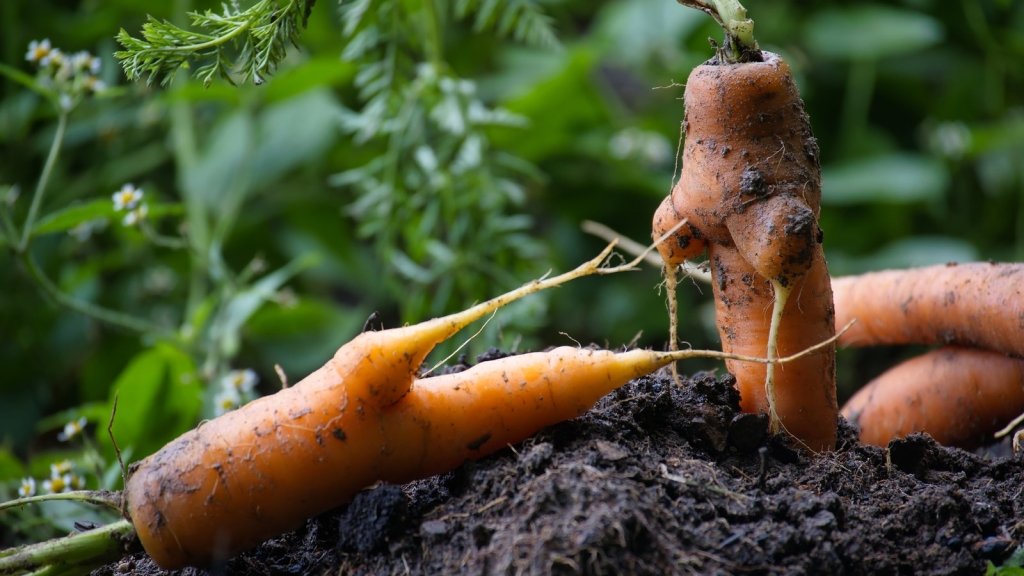
The short version: Carrots fail in predictable ways. Seed that never comes up dried out or crusted over during its three-week germination. Forked and twisted roots met a stone, a clod, fresh manure or a neighbour. Hairy roots with a woody core had too much nitrogen. Green shoulders pushed into the light. Splits followed a soak after a dry spell. Bolting followed a cold snap or a hot spell, and pale, spindly roots were crowded or shaded. The fixes are the same handful every time: deep, loose, stone-free soil with no fresh manure, a seed bed kept moist until every seedling is up, hard early thinning to 3 to 5 cm, even water, and sowing in the cool months for your zone.
Carrots are cheap to sow and slow to reward, which is why a bed of twisted, hairy or missing roots at harvest stings more than most garden failures. The good news is that every one of the faults below has a clear cause, and most of them are decided in the first month, when the soil is prepared and the seed is sown.

1. The seed did not come up
Carrot seed is tiny, sown only about 6 mm deep, and can take up to three weeks to germinate. In that time the surface of the bed must stay moist and must not crust, or the seedlings die before you ever see them. Water the bed before sowing, sow into a fine tilth, cover the seed with a light layer of seed-raising mix or sieved compost, and water gently once or twice a day in warm weather until the row is up. Many gardeners lay a board, a strip of hessian or a sheet of shade cloth over the row and lift it as soon as the first seedlings appear, which keeps the surface damp without daily watering. Old seed is the other common cause; carrot seed loses vigour after two or three years.
2. Forked, twisted and stumpy roots
A carrot root grows straight down until something stops it. A stone, a hard clod of clay, a compacted layer, a lump of undecomposed manure or the root of a neighbouring carrot all make the tip divide or bend, and the result is a fork, a twist or a stump. Dig the bed deeply, at least 20 to 30 cm, break up clods and pick out stones. Never dig fresh manure in before sowing; use compost, and save the manure for a leafy crop the season before. Thin early and thoroughly so roots are not tangling around each other, and in heavy or shallow soil grow the short, stump-rooted varieties or a raised bed of lighter soil.

3. Hairy roots with a woody core
A root covered in fine side roots, often with a tough centre, has been fed too much nitrogen. The plant responds to rich soil by putting out feeding roots instead of one storage root. Fresh manure and high-nitrogen liquid feeds are the usual sources, and carrots sown straight after peas or beans get a dose from the legumes' roots. Cut the fertiliser, prepare with compost only, and put carrots after a hungry leaf crop in your rotation.
4. Green shoulders
When the top of the root pushes above the soil and sees light, it turns green and tastes bitter. Unlike a green potato, a green carrot shoulder is not harmful, just unpleasant. As the roots swell, hill a little soil or mulch over the exposed tops, and sow at the right depth to start with.
5. Split roots
A carrot that sat in dry soil and then received a heavy watering or a downpour swells faster inside than its skin can stretch, and cracks. Keep the bed evenly moist, water deeply rather than in short bursts, mulch once the seedlings are established, and harvest promptly after heavy rain.

6. Bolting
A carrot that throws a flower stalk has been pushed to reproduce early. Young plants that meet a cold snap in early spring are the classic case, and at the other extreme, sustained soil temperatures of about 25 degrees or more can stunt roots and trigger bolting. Once a carrot flowers the root turns woody and bitter. Sow in the cool months for your zone, avoid the earliest spring sowings in frosty districts, and pull carrots before they get old; the flowering plants can be left for the beneficial insects, which love the white umbels.
7. Bitter, woody or tough roots
Roots left in the ground long past maturity, especially through dry weather, turn woody and lose their sweetness. Most varieties are at their best somewhere between 12 and 20 weeks from sowing, and baby carrots at 8 to 12. Sow short rows every three or four weeks so there is always a young row coming on instead of one big row ageing in the ground.
8. Pale, thin and spindly roots
Carrots that stay thin and pale were crowded, shaded, or grown through prolonged cold and cloud. Thin to 3 to 5 cm in the row when the seedlings are a few centimetres tall, keep rows 10 to 30 cm apart, keep the bed weeded, and give carrots the sunniest bed you have. Our guide to thinning root crops covers the technique.

9. Pests and diseases that damage carrots in Australia
Overseas guides, and some Australian ones, blame tunnelled roots on the carrot rust fly, but AUSVEG lists that pest as exotic to Australia and it is not established here. Tunnelling, galls and collapsing rows in Australian beds have other causes. Root-knot nematode leaves small knots and galls on the roots and forks and stunts them, and is best managed by rotation away from root crops, building organic matter and never replanting carrots into an infested bed; our guide to root-knot nematode explains the signs. Cutworms chew through seedlings at soil level overnight; a collar cut from a plastic cup or pot, pushed into the soil and standing at least 6 cm proud, stops them. Slugs and snails graze young rows, and wireworm and weevil larvae can chew holes in roots in old pasture soil. Leaf blights can mark the foliage in humid weather without much effect on the roots. Our guide to carrot fly and carrot pests in Australia sorts out what really damages Australian carrots.
Preparing a carrot bed properly
Because so many carrot faults are decided before sowing, the preparation is most of the job. Choose full sun. Dig or fork to at least 20 to 30 cm, removing stones and breaking clods to a fine, crumbly tilth. Add mature compost but no fresh manure. Rake level, water the bed, then sow thinly in rows about 6 mm deep and keep the surface moist until the seedlings are up. In sandy soil, extra compost holds the water carrots need; in clay, a raised bed or a stump-rooted variety saves a lot of disappointment.
Carrot sowing across Australia's climate zones
- Tropical (Cairns and far north Queensland, Darwin and the Top End of the Northern Territory, the Kimberley in Western Australia): sow through the dry season, roughly April to August, and choose quick, short varieties.
- Subtropical (Brisbane and coastal Queensland, Coffs Harbour and northern New South Wales): sow from about March to September. Summer sowings meet heat, bolting and heavy pest pressure.
- Arid and semi-arid (inland Queensland, Broken Hill and Dubbo in New South Wales, Mildura in Victoria, inland South Australia and Western Australia, Alice Springs in the Northern Territory): sow in autumn and late winter, about March to May and August to September, and keep the seed bed shaded and moist.
- Temperate (Sydney and New South Wales, Melbourne and Victoria): sow from about August to April in Sydney and September to March further south, with the best roots from spring and late summer sowings.
- Mediterranean (Perth and southern Western Australia, Adelaide and the Adelaide Plains in South Australia): sow from about March to October, avoiding the hottest months unless the bed is shaded and watered daily.
- Cool and alpine (Hobart and Tasmania, Canberra and the ACT, Ballarat in Victoria, Orange and Armidale on the New South Wales tablelands, and the alpine country of the Snowy Mountains and the Victorian high country): sow September to February, and leave late sowings in the ground through autumn and early winter, where they sweeten.
Successive short sowings inside those windows beat one long row every time.
Frequently asked questions
Can I transplant carrot seedlings?
Not successfully. Almost any disturbance to the young taproot forks it. Sow direct, thin, and resow gaps.
Are forked or green-shouldered carrots safe to eat?
Yes. Forks are only a shape problem, and green shoulders are bitter but harmless. Wash carrots well before eating them raw, especially if the bed was ever manured, and peel them for young children.
Why do my carrots take so long to come up?
Carrot seed can take up to 21 days, longer in cold soil. Keep the surface moist the whole time and sow a few radish seeds in the row to mark it and break the crust.
Do carrots need fertiliser?
Rarely. A bed prepared with compost has enough. Extra nitrogen is the commonest cause of hairy, leafy carrots; forking comes from stones, clods, fresh manure and compaction, not nitrogen.
Deep loose soil, patience at germination, hard thinning and even water are the whole recipe. Yates' carrot growing guide gives depths, spacings and harvest times for Australian conditions.
Related growing guides
- Carrot Fly and Carrot Pests in Australia: What Really Damages Your Carrots
- Why thinning is the step everyone skips
- Root-Knot Nematode: The Hidden Cause of Wilting and Forked Roots
Try a stump-rooted variety in heavy soil and a long type in sand: browse our carrot seeds, beetroot seeds and the full range of vegetable seeds.