
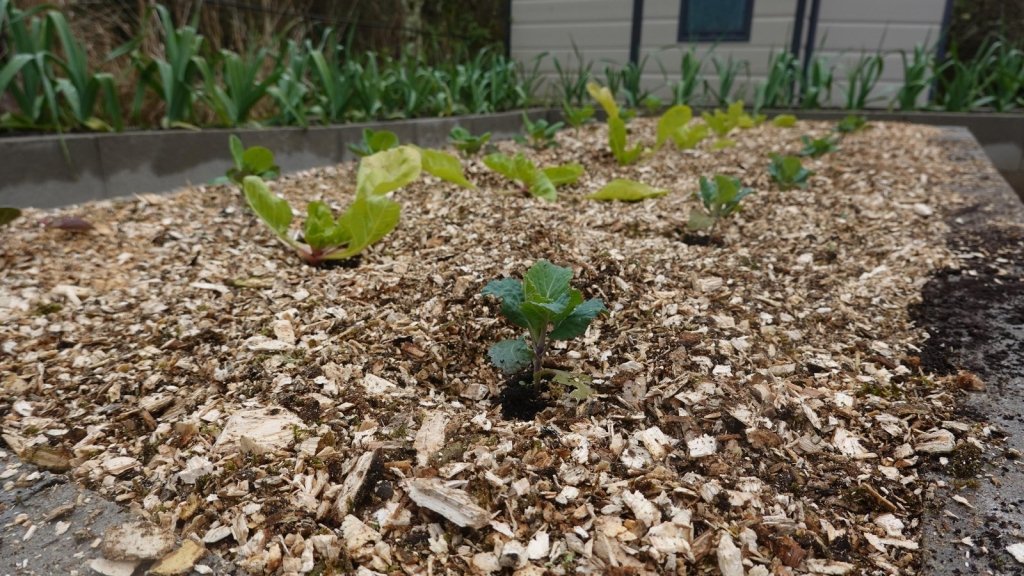
The short version: Nitrogen drawdown is what happens when fresh, woody mulch such as woodchip, sawdust or bark starts to rot: the soil microbes doing the work borrow nitrogen from the soil beneath, and shallow-rooted plants go pale and stall. It is temporary and easy to avoid. Keep woody mulch on the surface rather than digging it in, put a thin layer of manure, pellets or compost under it, use straw or lucerne around vegetables, and feed anything that yellows with a nitrogen-rich liquid.
It usually goes like this. A load of fresh chip arrives, the beds get a generous blanket and a good forking through, the garden looks tidy for the first time in years, and a month later the silverbeet is a sickly yellow and the seedlings have stopped growing. Nothing has eaten them and they are not dry. The mulch is feeding on the soil before the plants can. Chip forked through the top of a bed, sawdust, or fresh chip laid over soil that was already low in nitrogen is where it usually shows. A surface layer on healthy soil rarely does more than slow things a little.

What nitrogen drawdown actually is
Woody material is nearly all carbon and almost no nitrogen. When it meets soil, bacteria and fungi multiply to break it down, and to build their own cells they need nitrogen in a ratio the wood cannot supply, so they take it from the soil around them. For a while there is less nitrogen available to plant roots than there was before the mulch went on. Gardeners call it drawdown; soil scientists call it immobilisation.
Two things make it worse. The first is how much carbon the material carries relative to nitrogen. Sawdust and fresh chip sit at ratios of well over a hundred parts carbon to one of nitrogen, against the thirty or so that microbes work best at, so they pull hard. The second is contact. Mulch lying on the surface only affects the soil right at the interface, but the same material dug into a bed touches soil on every side and can lock nitrogen up through the whole root zone. The nitrogen is not lost. Once the microbes finish and die, it is released again, but by then a season's crop may have missed out.

Which mulches cause it, and which do not
- Most likely to draw down: fresh woodchip, sawdust, shavings, and fresh pine or hardwood bark. Aged or composted chip has already done much of its rotting in the pile and pulls far less.
- Middle of the road: sugar cane mulch and cereal straw. They carry a little nitrogen, break down over a season, and rarely cause visible trouble on the surface.
- Least likely: pea straw and lucerne, the legume mulches. They break down quickly and release nitrogen rather than borrowing it, which is why they are the classic choice around vegetables.
- Cannot draw down at all: gravel, scoria and other inorganic mulches. They cannot draw down because they do not rot, though they feed nothing either, and pale ones bounce heat back onto plants.
Woody mulch is not the villain. Under trees, shrubs and established perennials with deep roots it is the best mulch there is, lasting for years and building a fungal, forest-floor soil. The problem only arises where shallow-rooted plants meet fresh chip.

How to use woody mulch without starving the bed
- Keep it on top. Never dig fresh chip or sawdust into a vegetable bed. Surface mulch only touches the top centimetre of soil.
- Put a buffer underneath. Spread 1 to 2 cm of compost or aged manure on the soil first, or a handful of pelletised chicken manure per square metre, then 5 to 7 cm of chip on top. The nitrogen-rich layer feeds the microbes so the soil does not have to.
- Age it first. A pile of fresh chip left to sit for a few months, turned once or twice and kept damp, arrives on the garden with much of its appetite gone.
- Do not overdo the depth. Around 5 to 7 cm suits most beds; deeper layers keep light rain from reaching the soil. Keep it clear of stems and trunks, since mulch against bark invites collar rot.
- Match the mulch to the bed. Pea straw, lucerne or sugar cane for the vegetable patch and annual flowers, woody chip for paths, trees, shrubs and perennials.
Our guide to autumn leaves covers the free mulch that behaves much like straw.

Spotting it, and fixing it fast
Drawdown looks like nitrogen shortage because that is what it is. The oldest, lowest leaves turn pale yellow first, since the plant moves what nitrogen it has to the new growth. Growth slows, leaves stay small, and fruiting crops set less. If the yellowing arrived a few weeks after a fresh mulch went on, and the soil under the mulch is damp, drawdown is the likely cause.
The fix is to feed the soil, not the mulch. Pull the mulch back from around the plants, water a nitrogen-rich liquid such as fish emulsion or a fish and seaweed blend onto the soil, or scatter pelletised chicken manure or blood and bone on the soil surface and water it in, then put the mulch back. Dogs find blood and bone very appetising, so water it in well, cover it with the mulch, and keep the bag out of reach. Plants usually green up within a couple of weeks, and the microbes finish their work in the meantime. Feeding over the top of thick chip mostly feeds the chip.

Three things to check before the mulch arrives
Ask where it came from. Mulch, compost and soil conditioners sold in Australia can be made to the AS 4454 standard, which sets limits on contaminants, weed seed and stability, and a bagged product carrying it is a safer bet than an anonymous trailer load. Chipped street trees and tree-lopper loads are often excellent and cheap, but ask that they contain no treated timber or diseased wood, and let them age.
Ask about spray history too. Hay, straw and manure can carry residues of persistent herbicides that survive composting and the passage through an animal, and they show up months later as cupped, twisted new growth on tomatoes, beans, peas, potatoes and lettuce. Legume straws such as pea straw and lucerne are the safest bet, since those crops are not sprayed with them.
And in South East Queensland, in a growing area of that state, and in movement control areas in northern New South Wales, moving mulch, soil, manure, hay or potted plants around is covered by fire ant biosecurity rules. Inside a zone you must take reasonable steps not to spread fire ants, and moving some materials out of a zone needs a permit. The rules and the zone boundaries change, so check the National Fire Ant Eradication Program's current zone map before you accept or move a load. Put a mask and gloves on before you open a bag of mulch or potting mix, since these products can carry Legionella longbeachae, dampen the contents to keep the dust down, and wash your hands with soap afterwards even though you wore gloves. The risk is higher if you are older, a smoker, or your immune system is weakened.
Mulch and drawdown across Australia's climate zones
- Tropical (Cairns and far north Queensland, Darwin and the Top End of the Northern Territory, the Kimberley in Western Australia): heat and humidity rot chip fast, so drawdown comes and goes quickly and mulch needs topping up often. Sugar cane mulch is the local staple.
- Subtropical (Brisbane and coastal Queensland, Coffs Harbour and northern New South Wales): Brisbane and South East Queensland are the fire ant heartland, and there are movement control areas around the Tweed and the Northern Rivers in New South Wales. Check the zone map before moving mulch, and expect fast breakdown through the warm months.
- Arid and semi-arid (inland Queensland, Broken Hill and Dubbo in New South Wales, Mildura in Victoria, inland South Australia and Western Australia, Alice Springs in the Northern Territory): mulch is worth more here than anywhere for the water it saves. Breakdown and drawdown are both slow in dry soil, and light straws blow away, so use heavier or matted mulches.
- Temperate (Sydney and New South Wales, Melbourne and Victoria): the standard advice applies. Mulch the vegetable beds with straw in spring, chip the paths and perennials.
- Mediterranean (Perth and southern Western Australia, and Adelaide and the Adelaide Plains in South Australia): mulch before the dry summer, when breakdown almost stops, and expect drawdown to show mainly in the wetter, warmer weeks of spring and autumn.
- Cool and alpine (Hobart and Tasmania, Canberra and the ACT, Ballarat in Victoria, Orange and Armidale on the New South Wales tablelands): cold slows the microbes, so drawdown is milder but lingers. Pull mulch back from beds in early spring so the soil can warm.
Frequently asked questions
Can woodchip mulch kill my plants?
Surface mulch rarely does. It can leave shallow-rooted vegetables yellow and stalled for a few weeks. Digging fresh chip or sawdust into a bed is a different matter, and can hold a crop back for a whole season.
How long does nitrogen drawdown last?
Until the microbes have broken down the material, which depends on the mulch, the depth, moisture and warmth. There is no fixed figure. Feeding the soil under the mulch shortens it to a matter of weeks for most plants.
Is sugar cane mulch safe around vegetables?
Yes. It carries a little nitrogen of its own, breaks down over a season and rarely causes visible drawdown on the surface. Lucerne and pea straw are the other vegetable-patch favourites.
Should I feed before mulching?
It is the easiest prevention. A thin layer of compost, aged manure or pelletised manure under a woody mulch feeds the microbes and the plants at the same time.
I already dug fresh chip through my bed. What now?
Rake out what you can, then feed the soil with a nitrogen-rich liquid every couple of weeks while the microbes work through the rest. Plant that bed with a legume or a green manure crop for a season rather than a hungry leafy crop, and it should come good by the following season.
Mulch is one of the best things you can do for a garden, and drawdown is one of the few ways it can go wrong. Keep the woody stuff on the surface and feed underneath it, and the only thing it starves is the weeds. Our guide to sandy, clay and loam soils covers what mulch does for each type, and the Queensland Government's page on restrictions on moving plant material and soil explains the fire ant rules.
Related growing guides
- Autumn leaves: four ways to put a free harvest to work
- Sandy, clay or loam? Understanding and improving your soil type
- Feeding the vegetable garden: what fertiliser does and when to use it
Mulched and fed? Browse our vegetable seeds and cover crop seeds.