
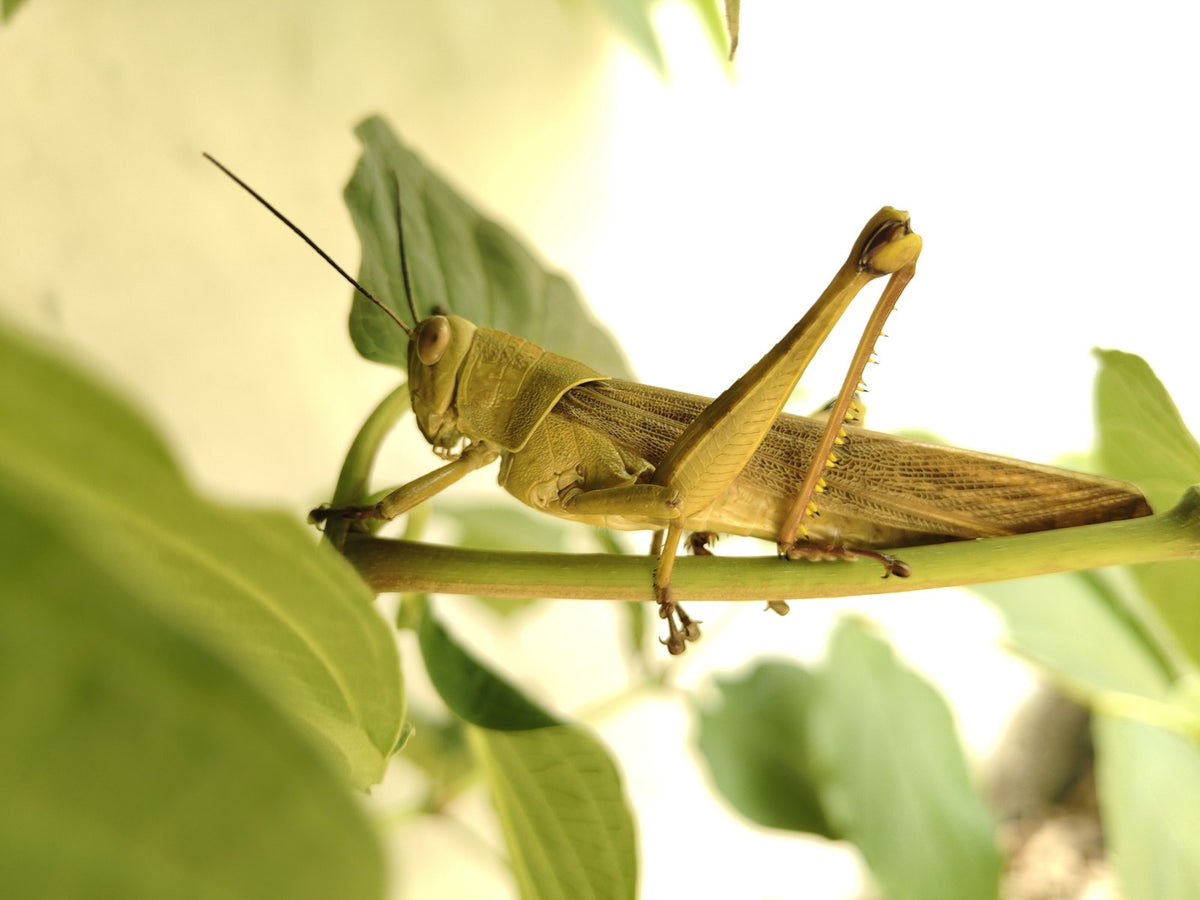
The short version: Grasshoppers and locusts chew and defoliate a wide range of plants, and in a bad outbreak year a swarm can strip a garden fast. The difference between them is behaviour: locusts can switch into a swarming phase, while most grasshoppers stay solitary. For home gardeners the most reliable defence is to cover key plants with fine netting or mesh, keep grass and weeds down, and encourage the birds and poultry that eat them. Most years are quiet; the bad ones are episodic.
In most seasons grasshoppers are a background presence, a few chewed leaves here and there. Every so often, though, good inland rains set off a locust outbreak, and then the story changes and a garden can be stripped in days.
Home options are genuinely limited once a plague is on, so the sensible plan is to protect the plants that matter most and lean on the natural predators, while the broad-scale control is left to the authorities.
How to spot grasshoppers and locusts
A few species matter here. The Australian plague locust (Chortoicetes terminifera) is the main pest locust, native and monitored by the Australian Plague Locust Commission. Its adults are roughly 25 to 42 millimetres, brown to green, with a distinctive dark spot at the wingtip and red hind-leg shanks. The wingless grasshopper (Phaulacridium vittatum) is a smaller southern species, grey to brown, while the spur-throated locust of the north is much larger.
The difference between a locust and a grasshopper is about behaviour rather than a strict split. Locusts are grasshoppers that can switch into a gregarious, swarming phase when crowded, whereas most grasshoppers stay solitary. Otherwise they look and feed alike. The wingless juveniles, called hoppers, band together and march.
Why outbreaks happen
The females lay their eggs in pods in firm, bare soil, and in warm, moist soil the eggs hatch in a couple of weeks, with two or more generations possible in a good season. Outbreaks follow good rains that green up the inland breeding areas, after which swarms migrate long distances. Plagues are episodic, so most years are quiet and the occasional bad year recurs when the conditions line up.
Both grasshoppers and locusts chew and defoliate a very wide range of plants, including grasses, cereals, pasture, vegetables, seedlings and soft leaves, with the worst damage concentrated in those plague years.
How to protect your garden
- Cover key plants with fine mesh. Insect-exclusion netting, mesh cages, cloches or row covers over beds, seedlings and prized plants are the most reliable home defence during an outbreak.
- Hand-pick or net in a normal year. When numbers are low, simply picking or netting them off is enough.
- Keep grass and weeds down around beds. This removes both food and the firm, bare ground they like to lay eggs in.
- Encourage predators. Birds, poultry, which readily eat hoppers, spiders, praying mantises, parasitic flies and wasps, and reptiles all help.
In a true plague, accept that some loss is likely and report major activity to your state agriculture department, which liaises with the Plague Locust Commission. Broad-scale chemical control is a government and farm matter, not a home-garden job, and broad-spectrum sprays in the garden do more harm than good.
How to keep grasshopper damage down
- Have netting on hand so you can cover vulnerable crops quickly when numbers rise.
- Keep the area around beds mown and weeded to reduce egg-laying sites.
- Let chooks range over an empty bed, where they will clean up hoppers.
- Watch the news of locust activity after a good inland season, so you are not caught out.
Grasshoppers and locusts across Australia's climate zones
- Tropical (far north Queensland, the Northern Territory Top End, northern Western Australia): the spur-throated locust swarms in savannah country, and the wet tropics are least affected.
- Subtropical (south-east Queensland, northern New South Wales): migratory and spur-throated locusts breed in southern Queensland, and the plague locust can migrate through.
- Arid and semi-arid (inland Western Australia, South Australia and the Northern Territory, western Queensland and New South Wales): the plague locust heartland and main breeding grounds, where plagues build.
- Mediterranean (southern South Australia and Adelaide, south-west Western Australia and Perth): the wingless grasshopper in the higher-rainfall parts, with plague swarms possible in outbreak years.
- Temperate (southern New South Wales, Victoria, southern South Australia and Western Australia, lowland Tasmania): the wingless grasshopper is the main garden grasshopper, with the plague locust arriving during outbreaks.
- Cool and alpine (highland and alpine New South Wales and Victoria, Tasmania): the wingless grasshopper in the tablelands, with locust plagues only occasional.
Frequently asked questions
What is the difference between a grasshopper and a locust?
They are the same broad group. Locusts can switch into a swarming phase, while grasshoppers generally stay solitary.
Why are there so many this year?
Good inland rains let numbers build over successive generations, and then the swarms move out.
How do I protect my vegetables?
Cover them with fine netting or mesh, which is the most reliable home defence.
Do chooks eat them?
Yes. Poultry readily eat hoppers, so let them into an empty bed, but fence them off your crops.
Will they come back?
Plagues are episodic. Quiet years are normal, and the bad years recur when conditions line up.
Should I report them?
Report large numbers or swarms to your state agriculture department, which coordinates with the Plague Locust Commission.
Keep the netting handy, the grass short and the chooks busy, and an ordinary grasshopper year passes with little more than a few chewed leaves.
Related growing guides
Ready to plant? Browse our vegetable seeds and flower seeds for the season ahead.