
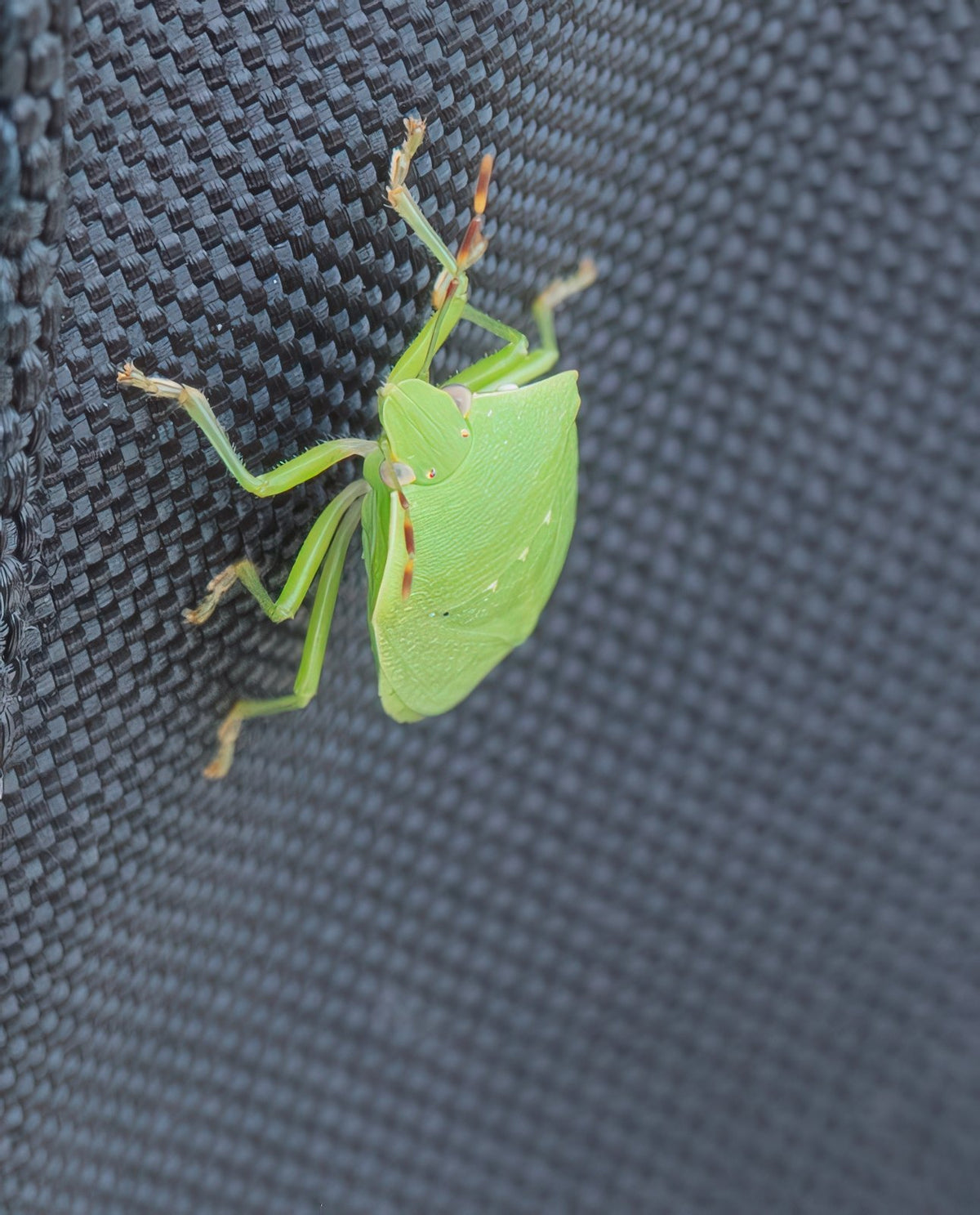
The short version: The green vegetable bug is a bright green, shield-shaped stink bug that sucks sap from beans, tomatoes and many other crops, leaving dimpled, distorted pods and blemished fruit, and giving off a foul smell when handled. The best control is to hand-pick the adults and clustered nymphs early in the morning, crush the egg rafts, and protect the tiny egg-parasitising wasps that are its main natural enemy by avoiding broad sprays.
If you grow beans or tomatoes, you will meet this one. A big, vivid green bug that reeks when you touch it, surrounded by clusters of oddly coloured young, is a green vegetable bug and its brood.
It rewards a bit of hand work in the cool of the morning, and it punishes the gardener who reaches for a broad spray, because that spray takes out the bug's best natural enemy.
How to spot green vegetable bug
The adult green vegetable bug (Nezara viridula) is bright green and shield-shaped, about 13 to 15 millimetres long, with three small white spots in a line between the shoulders. It releases a foul smell when handled, which is its defence, and overwintering adults turn a purple or russet-brown.
The nymphs look nothing like the adults, which trips up a lot of gardeners. They start small, rounded and orange to brown or black, and the later stages are patterned black with white, cream, orange and red, feeding in tight clusters. It is worth knowing that not every green shield bug is a pest: the spined predatory shield bug and the brown soldier shield bug are beneficial hunters of caterpillars and grubs, so confirm before you squash. The damage from green vegetable bug is dimpling, hard corky spots, distorted and shrivelled pods and beans, catfacing and blemishes on tomatoes, and shrivelled corn kernels.
Why they build up
The females lay barrel-shaped eggs in neat honeycomb rafts on the undersides of leaves, cream at first and turning bright orange before they hatch. The nymphs pass through five stages over about a month, and with warmth there are several overlapping generations across the season, so pressure builds and is usually worst from late summer into autumn. In cooler areas the adults overwinter as dormant brown bugs and start again in spring.
They are sap-suckers with piercing mouthparts and toxic saliva, feeding on developing seeds, pods and fruit, and their feeding wounds also let rots in. Beans and other legumes are favourites, but the host list is wide.
How to control green vegetable bug organically
- Hand-pick early in the morning. While they are cool and sluggish, pick or knock the adults and clustered nymphs into a bucket of soapy water. Warm adults are strong fliers, so timing matters.
- Crush the egg rafts. Check leaf undersides and squash the honeycomb rafts before they hatch.
- Exclude and tidy. Insect netting or fruit bags from the seedling and flowering stage keep them off, and removing weed hosts and rotating crops reduces the numbers moving in.
- Spot-treat nymph clusters. If needed, horticultural soap or oil on the clustered nymphs helps, aimed at the young rather than the adults.
The most important thing is to protect the natural enemies. A tiny egg-parasitoid wasp, Trissolcus basalis, is the principal natural control, and a tachinid fly attacks the older nymphs and adults, along with ants, spiders and predatory bugs. When you see a blackened egg raft, that is the wasp at work, so leave it. Broad-spectrum insecticides kill these allies and make the problem worse, so avoid them.
How to keep green vegetable bug down
- Check leaf undersides on beans and tomatoes through the warm months and deal with egg rafts early.
- Keep weeds down, since they harbour the bugs between crops.
- Net vulnerable crops from flowering, when the damage to pods and fruit begins.
- Leave blackened, parasitised egg rafts in place so the wasps keep multiplying.
Green vegetable bug across Australia's climate zones
- Tropical (far north Queensland, the Northern Territory Top End, the Kimberley in Western Australia): the warmest zone, breeding near year round, with the highest and most sustained pressure.
- Subtropical (south-east Queensland, northern New South Wales): a long warm season and several generations, so heavy pressure from spring to autumn.
- Arid and semi-arid (inland Queensland, Broken Hill, outback South Australia, Alice Springs): historically uncommon, but active in irrigated gardens over the warm months.
- Temperate (much of New South Wales, Victoria, south-east South Australia): established through New South Wales and less common further south, overwintering as brown adults, worst from late summer to autumn.
- Mediterranean (Perth and south-west Western Australia, Adelaide and South Australia): uncommon to rare, though hot dry summers allow localised activity.
- Cool and alpine (Tasmania, alpine Victoria and New South Wales): the coolest zone, rare to uncommon, with a short season and the lowest pressure.
Frequently asked questions
Is the green bug that smells the pest?
Yes. A bright green, roughly 15 millimetre shield bug with three white spots that stinks when handled is the green vegetable bug.
What are the coloured bugs clustered on my leaves?
They are its nymphs, patterned black with white, red and orange, not a separate pest.
What does it do to beans and tomatoes?
Its sap-sucking causes shrivelled, deformed pods and beans, and catfacing, hard spots and blemishes on tomatoes.
Do they bite people?
No. They feed only on plants and do not bite or sting. The smell, and the staining, are the only nuisance.
When is the best time to hand-pick them?
Early in the morning, while they are cool and slow and less likely to fly off.
Which wasp helps against them?
Trissolcus basalis, a tiny egg parasitoid. A blackened egg raft means it is working, so leave those rafts in place.
Pick them in the cool of the morning, squash the egg rafts, and protect the little wasp that does the heavy lifting, and the green vegetable bug usually stays manageable.
Related growing guides
- Bronze orange bug on citrus
- Organic pest control in Australia
- What is actually in a beneficial bug mix
Ready to plant? Browse our vegetable seeds, including beans and tomatoes for the warm season.