
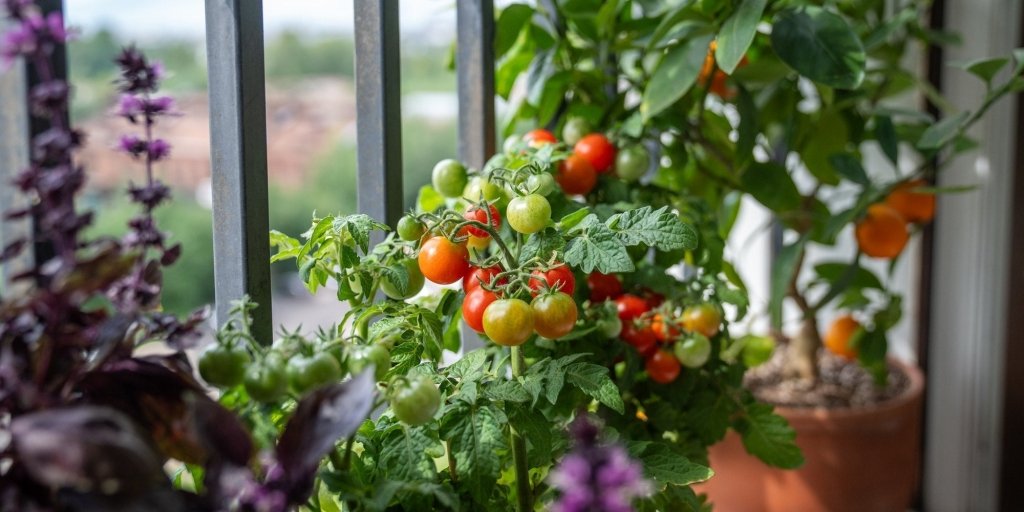

Why grow food in containers
A container garden turns a patio, a balcony, a windowsill or a doorstep into growing space, and it lets you start with fresh potting mix rather than whatever is in the ground, which sidesteps poor soil, nematodes and soil-borne diseases.
Pots are more exposed than garden beds, not less, and they dry out faster, because there is less mix and the sides sit in the air.
Choosing what to grow
Most vegetables, herbs and flowers grow well in a container if the pot is big enough and the light is right. The easiest are the fast leafy and root crops: lettuce, rocket, spinach, silverbeet, radish, beetroot, turnip and Asian greens such as pak choi and bok choy, which cope with a half day of sun and a container about 20cm deep.
Crops grown for their fruit want more light and more room: tomato, capsicum, chilli, eggplant and beans need 6 to 8 hours of direct sun to crop properly. Cucumber, climbing beans, squash, zucchini and pumpkin will grow in pots too, but each needs a deep, wide container of its own and something to climb or sprawl over.
Look for dwarf and compact lines. Tomato Tiny Tim and Tomato Window Box Yellow stay small enough for a large pot, Cucumber Space Saver makes short vines, and Pak Choi Extra Dwarf fills a shallow trough. Trailing crops can be hung in baskets or trained up a trellis or railing.

Containers and potting mix
Use containers whose history you know. Food-grade buckets, terracotta and glazed pots, polystyrene boxes, fabric grow bags, wicking tubs and untreated timber boxes are all fine. Avoid secondhand drums, tins and jerry cans: unless you know what was stored in them they may hold solvent, fuel or chemical residues that washing will not remove. Older timber may be treated with copper chrome arsenate, so line it with heavy plastic before filling.
Herbs, parsley and spring onions grow well in a pot about 25cm deep. Crops with a larger root system, such as eggplant, capsicum and tomato, want a container of at least 20L each.

Every container needs drainage holes in the base of the pot, not in the saucer, and several holes about 1cm to 2cm across are enough. Tip the saucer out after watering, because mix that sits in water sours and roots rot.
Fill with a fresh potting mix, or a seed-raising mix if you are sowing straight into the pot. Garden soil, topsoil and clay are not an option: they are heavy, they compact once confined, and they drain badly.
Watering and feeding
Water until it runs from the drainage holes, then let the surface dry slightly before watering again. In hot weather check daily, water in the morning, and spread a thin mulch of straw or sugar cane to slow evaporation.
Containers need feeding more often than beds, because every watering carries some nutrient out through the drainage holes. A liquid fertiliser diluted as the label directs is the simplest approach, and a slow release granular fertiliser mixed in at planting gives a base. Compost, coir and well-aged animal manure are all useful, as long as they are free of contaminants, weed seed, insect eggs and larvae, and pathogens.
Containers across the Australian zones
- Tropical (the Top End, far north Queensland, the Kimberley): wet-season rain waterlogs pots, so raise them off the ground and use a free-draining mix.
- Subtropical (south-east Queensland, the NSW north coast): humidity favours leaf disease, so space pots for airflow and water the mix, not the leaves.
- Arid and semi-arid (inland NSW, outback SA and WA, central Australia): mix cooks in a dark pot, so use pale or thick-walled containers and shade the sides.
- Temperate (Sydney, Melbourne, coastal NSW and most of Victoria): forgiving for pots, though summer still calls for daily watering.
- Mediterranean (Perth, Adelaide, south-west WA, the SA gulf country): as temperate, but a long dry summer makes shade cloth and wicking tubs worthwhile.
- Cool and alpine (Tasmania, Canberra, the NSW and Victorian tablelands): a pot has no soil to buffer frost, so group pots against a wall or under eaves on cold nights.
These are broad groupings, and gardeners living between two of them should lean on their own local frost dates.
Container seed at Happy Valley Seeds
Our container range covers lettuce, beetroot, radish, pak choi, baby bok choy, spinach, silverbeet and rocket, with pot-sized herbs such as basil, parsley, coriander, chives and dill. The full lists are in pot and container vegetable seeds and pot grow herb seeds.
One thing to check before ordering: Western Australia and Tasmania set their own conditions on incoming seed, and some capsicum, chilli and tomato lines cannot be sent to Western Australia. The product page says whether a variety can travel to your state.
Related growing guides
- The Best Vegetables and Herbs for Containers (and the Pot Sizes They Need)
- Growing Tomatoes in Pots and Containers: The Australian Guide
- Watering Pots in an Australian Summer Without Losing the Crop
Ready to plant? Browse our pot and container vegetable seeds.
1 comment
Amy
I’m interested in growing vegetables in a plastic tub (such as the flexi tubs from Bunnings), but am interested in knowing about leeching of chemicals from the plastic tub into the food. Is this an issue? Would the bunnings tubs be safe?
Thanks!