
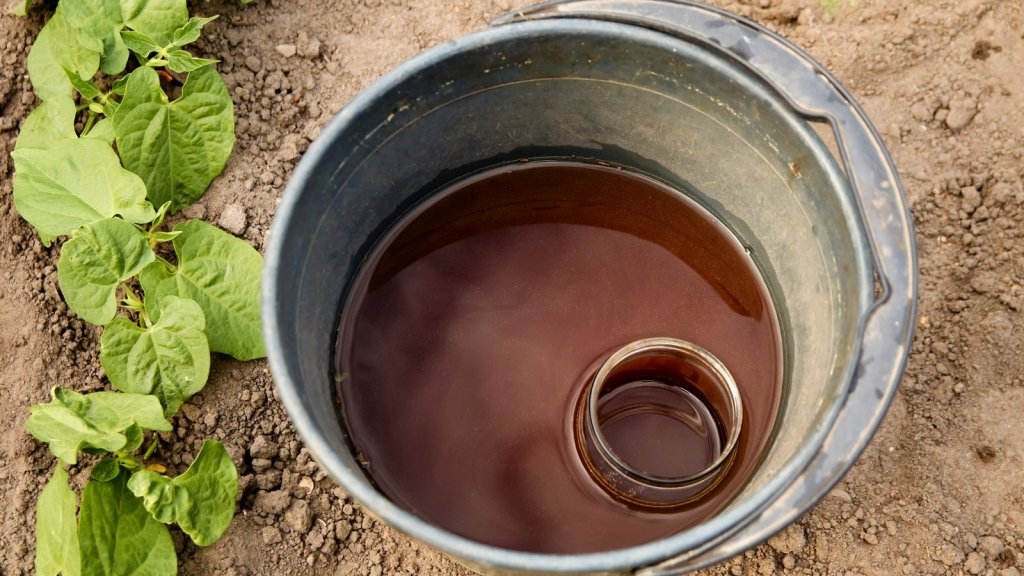
The short version: Compost tea and weed tea are homemade liquid feeds made by steeping weeds, clippings or finished compost in a bucket of water for two to three weeks, then diluting the liquid to the colour of weak tea and watering it onto the soil. It is a thrifty way to get some goodness back from weeds you cannot compost. Keep it off the leaves of anything you will eat raw, keep manure out of any brew for edible crops, and treat it as a gentle top-up rather than a complete fertiliser.
Every weeding session takes something out of the garden. The couch grass, the oxalis, the nutgrass you would never put in the compost heap still carry nutrients they pulled out of your soil, and they usually leave in the green bin. A bucket of water changes that. Drown those weeds for a few weeks and you kill them, recover some of what they took, and end up with a dark liquid you can water back onto the beds. It usually smells unpleasant for a week or two, and it is not a miracle, but it is free.

What compost tea and weed tea actually are
They are the same idea with different ingredients. Weed tea, sometimes called plant tea, is made by steeping soft weeds and green prunings. Compost tea is made by steeping finished compost or worm castings, so that some of their nutrients and microbes end up in the water. Both are the simple, unaerated kind most home gardeners make, which brews slowly and smells strongly.
A word on what they are not. A watered-on tea adds a little soluble nutrient and some microbial life to the soil. It does not build soil structure, which comes from bulk organic matter such as compost and mulch, and the evidence that it protects plants from pests or disease is thin and inconsistent, so do not rely on it for that. Think of it as a light liquid feed, in the same family as a seaweed solution.

What to put in the bucket
- Runner and bulb weeds: couch, kikuyu, nutgrass, oxalis and onion weed. Drown them for a month or two, until they have turned to sludge, before the remains go anywhere near the compost.
- Deep-rooted weeds and herbs: dandelion, nettle and comfrey, if you grow it, are the classic tea plants, valued for roots that are believed to draw minerals up from the subsoil.
- Soft green waste: spent annuals, leafy prunings and a handful of grass clippings.
- Compost or worm castings: a shovelful of finished compost, or a few handfuls of worm castings, makes a milder brew that suits seedlings.
Leave out anything you know to be poisonous, such as oleander. Leave out clippings or hay from lawns and paddocks treated with a broadleaf or residual herbicide in the past several months, because those residues can survive the brew and damage tomatoes, beans and other crops. And leave manure out of any tea destined for the vegetable patch, for the reasons below.
How to brew it
You need a bucket with a lid, water, and something to hold the solids, such as a hessian sack, an old pillowcase or a bundled tea towel. The bag is optional, but without it you get a slimy mess that blocks the watering can.
- Half fill the bag with chopped weeds or compost and tie it off loosely. Weigh it down with a brick, since fresh weeds float.
- Cover it with water. Rainwater is ideal, and tap water left standing in the sun for a day is fine too.
- Put the lid on loosely and stand the bucket somewhere shaded, downwind, and well away from the back door and the neighbours. The smell usually arrives within days and is a sign it is working.
- Stir every few days. After two to three weeks the smell eases and the liquid turns dark brown. In cool weather allow a week or two longer.
- Lift the bag out, let it drain, and add the spent solids to the compost heap. Strain the liquid if you plan to use a watering can with a rose.
Gardeners with an aquarium air pump sometimes brew an aerated version in about three days. It smells sweeter, but it should be used within a few hours of finishing, before it turns anaerobic.

Diluting and applying it
Undiluted tea can burn plants, so always water it down. One part tea to ten parts water is the usual starting point, and one part to twenty is a safe dilution for seedlings and pots. You are aiming for the colour of weak black tea.
Water it onto the soil around the base of plants, early in the morning or in the evening, roughly every two weeks during active growth. Water dry soil lightly first so the feed soaks in rather than running off. Do not apply it before heavy rain, and keep it out of stormwater drains, because nutrient runoff ends up in creeks and bays. Use each batch within a week or two, stored with the lid loose so gases can escape.

The food safety part
This is where home advice often falls short. A bucket of steeping organic matter can carry the same bacteria that make raw manure risky, including E. coli and Salmonella, and a brew that includes manure, garden soil or half-finished compost carries more of them.
Australian fresh produce safety guidelines keep untreated manure and unpasteurised compost at least 90 days away from the harvest of crops that touch the soil and are eaten raw, such as lettuce and herbs, and at least 45 days from tree fruit. Treat manure tea with the same caution as raw manure, including the same waiting period. So the sensible rules for a home garden are simple.
- Do not use manure tea on vegetables or herbs. Keep it for ornamentals, fruit trees well before harvest, or beds resting between crops, and wash the bucket before you brew anything for the vegetable patch.
- Do not spray or splash any tea onto leaves you will eat, especially salad greens and herbs. Water the soil, not the plant.
- Do not add sugar or molasses to a brew. Research shows those boosters can feed the harmful bacteria as well as the useful ones.
- Wear gloves, wash your hands, and wash produce before you eat it. These bacteria are a bigger risk for pregnant women, young children, older people and anyone with a weakened immune system.
- Liquid that drains from a worm farm is not the same as worm casting tea. Dilute it heavily and use it on ornamentals or soil, never on salad leaves.
Plant-only weed teas are the lowest-risk brews, and used on the soil around growing crops they are fine. If you want a liquid feed with a label and a known strength, a seaweed solution, a fish and seaweed blend or a bought worm casting tea does the same job without the guesswork. Sustainable Gardening Australia's guide to compost, worm and weed teas covers the aerated method and the same cautions.

Weed tea across Australia's climate zones
- Tropical (Cairns and far north Queensland, Darwin and the Top End of the Northern Territory, the Kimberley in Western Australia): heat can brew a tea in a week. Keep the lid on, and hold off applying during wet-season downpours, when it simply runs away.
- Subtropical (Brisbane and coastal Queensland, Coffs Harbour and northern New South Wales): fast brewing and fast growth. A fortnightly feed through spring and summer suits leafy crops.
- Arid and semi-arid (inland Queensland, Broken Hill and Dubbo in New South Wales, Mildura in Victoria, inland South Australia and Western Australia, Alice Springs in the Northern Territory): evaporation is the enemy. Keep the bucket shaded and lidded, and top up the water as you go.
- Temperate (Sydney and New South Wales, Melbourne and Victoria): two to three weeks in the warmer months, a month in winter.
- Mediterranean (Perth and southern Western Australia, and Adelaide and the Adelaide Plains in South Australia): on sandy soils, wet the soil before feeding so the tea soaks in rather than beading off the surface.
- Cool and alpine (Hobart and Tasmania, Canberra and the ACT, Ballarat in Victoria, Orange and Armidale on the New South Wales tablelands): brewing slows right down in cold weather. Start a bucket in early spring so it is ready when growth begins.
Frequently asked questions
How strong should compost tea be?
Dilute it until it looks like weak black tea, usually one part tea to ten parts water, and one to twenty for seedlings. Stronger is not better, and undiluted tea can burn roots and leaves.
Can I use weed tea on my vegetables?
Yes, a plant-only tea watered onto the soil is fine. Keep it off the leaves of anything eaten raw, and keep manure out of the brew altogether for the vegetable patch.
Why does it smell so bad?
Because it brews without air, and the bacteria doing the work produce sulphur compounds. The smell usually fades as the brew finishes. Site the bucket away from the house and the fence line.
How long do I drown couch and kikuyu?
A month or two, until the runners have collapsed into sludge and nothing looks alive. Then the remains can go into the compost and the liquid onto the garden.
Is worm farm liquid the same as compost tea?
No. Liquid that drains out of a worm farm has not passed through the worms and can carry unwanted bacteria. Dilute it heavily and use it on ornamentals, or brew a proper tea from the castings instead.
Weed tea will not replace compost, mulch and good soil, but it turns the most annoying weeds in the garden into something useful, and there is a quiet satisfaction in that. For the weeds themselves, our guide to organic weed control covers how to keep them from coming back.
Related growing guides
- Composting for beginners
- Composting in a small garden: bins, tumblers, worm farms and bokashi
- Getting on top of weeds: organic strategies that actually work
Feed the soil, then fill it. Browse our vegetable seeds and herb seeds.