
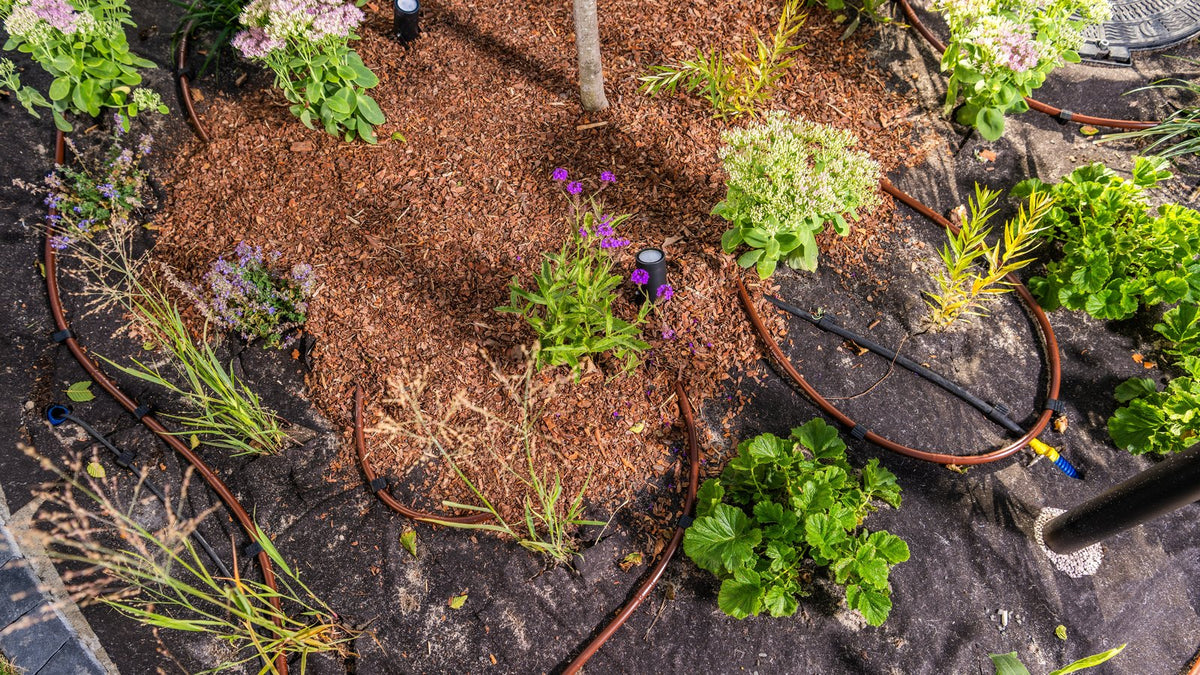

The short version: Under an established tree, the real trouble is usually roots that take the water and food, and a canopy that keeps the rain off. Do not pile soil or build a raised bed over the roots, and leave large roots uncut. Tuck small, tough plants between the roots, top with compost and a coarse mulch 5 to 8 cm deep, water in, then weekly while they settle, and grow herbs and flowers in raised pots.
Most gardens have one: the patch under the big gum, jacaranda or pine where the soil is dust and the shade plant from the nursery quietly died before autumn. The shade usually gets the blame. It is often the smaller half of the problem.
The tree is not being difficult. It was there first, and it has had decades of practice at finding water. The way forward is to garden around its roots, not against them.
Why the ground under a tree stays bare
Roots come first. Colorado State University Extension puts most tree roots in the top 15 to 60 cm of soil, with the fine feeding roots growing up towards the surface, and the whole system spreading two to five times as wide as the crown. Rain comes second: Gardening Australia notes that ground under a dense canopy can miss natural rainfall almost entirely. Light, often the least of the three, still counts: afternoon sun is harsher than morning sun.
Do gum trees and walnuts poison the soil?
Some sources say gums do, and the honest answer is "partly, sometimes". In a 1990 laboratory study in the Australian Journal of Botany, water run through eucalypt litter and bark, and above all rain running down the trunk, held back test plants. A field study of alpine ash in the same journal found the trees held young plants back mainly by drying the soil. And a study of blue gum counted about 8 per cent fewer plant species under its canopy than in the open at Australian sites, against about 51 per cent fewer overseas, so Australian plants seem to cope better.
Walnuts are less clear-cut than their reputation. Black walnut makes juglone, long blamed for stunting tomatoes and potatoes nearby, but a Washington State University Extension review found little field evidence that it harms garden plants. Its advice: water well, and keep sun-loving plants out from under the canopy.
Four things not to do under a tree
- Do not bury the roots. Colorado State says as little as 10 to 15 cm of added soil drastically cuts the air and water reaching them, and the City of Stirling in Western Australia warns that extra soil over roots can cause collar rot in some species. A raised bed counts.
- Do not dig a bed. Digging wounds roots. Spread a few centimetres of compost on top instead: Gardening Australia's Jane Edmanson laid hers over a bed full of loquat roots and left it undug.
- Do not cut large roots. Costa Georgiadis of Gardening Australia warns that a big root helps hold the tree up, and losing one can leave it unstable in the next strong wind. Ask a qualified arborist first.
- Do not heap mulch on the trunk. Keep it clear of the bark and no deeper than about 10 cm, the limit Tablelands Regional Council in Queensland gives under trees.
The City of Stirling's guide to retaining trees during development explains why soil levels and structural roots matter, and the reasoning holds in a backyard too.

How to plant in dry shade
- Let in a little light. Removing a few low branches can brighten the ground. Leave bigger cuts to a qualified arborist and check your council's tree rules first: lopping or topping can weaken a tree and invite fungal infection, Tablelands Regional Council warns.
- Plant small. For planting under gums, Gardening Australia suggests tubestock in a gap between large roots, a hole twice the pot's width and the same depth, from autumn to early spring in Victoria; the zone notes below cover elsewhere. New plants in tough shade can be slow to settle, so give them a season.
- Make a saucer and water in. A shallow dip around each plant lets water pool and soak in, and a thorough first watering settles the soil around the roots.
- Mulch the area with a coarse mulch 5 to 8 cm deep. Our guide to choosing mulch compares the options.
- Water about once a week while plants settle, and more as it warms, Gardening Australia suggests. Soak deeply, because the tree takes shallow water first.
What will grow there
Gardening Australia's Millie Ross looks to plants that evolved in eucalypt woodland, and to tough, strappy ones that bounce back when bark falls on them. Buy these as tubestock:
- Spiny-headed mat-rush (Lomandra longifolia), which grows in full sun or dense shade, and dianella, another strappy survivor.
- Kidney weed (Dichondra repens), a groundcover that carpets dappled shade under trees.
- Silver spurflower (Plectranthus argentatus), silvery, good under gums and up to 2 m wide, though frost tender.
- Native fuchsia (Correa reflexa), which Tino Carnevale planted in dry, dappled shade under a banksia.
Flowers from seed belong at the outer edge, where some sun and the hose both reach. Heartsease and columbine (aquilegia) both suit part shade in moist soil, columbine best where winters are cool, and heartsease self-seeds. Foxglove is often suggested, but it wants moist shade, every part of it is poisonous, and it cannot be sent to Tasmania, where fertile foxgloves are declared pests under the state's Biosecurity Act 2019, as NRE Tasmania explains.
Food is harder. Fruiting crops such as tomatoes need far more sun than a canopy allows, as our guide to vegetables for shady gardens explains. Mint suits part shade, and chervil likes cool conditions and bolts in heat, so both suit a pot at the edge.
Pots, and a chair
Pots sidestep the roots. You choose the mix, control the water and move them as the light shifts through the year. Lift them onto bricks or stands: Leonie Norrington of Gardening Australia warns that roots creep into the drainage holes of pots left on the ground under palms.
And if the spot is truly dark and dusty, the simplest fix is to grow the food in the sun and use the shade for what it does best: a chair, a cup of tea and somewhere cool on a hot afternoon.
Look after the tree as well
- Water it in long dry spells, deeply and over the whole root zone rather than often and lightly, as Colorado State advises. Plants beneath it add to the demand.
- Keep weight off the roots. Parked cars, stacked materials and a well-worn path compact the soil and starve roots of water and air.
Dry shade across the climate zones
These zones are broad groupings, so if you garden between two, go by local signs such as your frost dates and the months your rain arrives. Treat the timings as a guide.
- Tropical (Darwin in the Northern Territory, Cairns and Townsville in Queensland): dry shade is a dry-season problem. Darwin Airport averages under 5 mm of rain a month from June to August, Bureau of Meteorology records show, so plant as the wet arrives and rely on pots through the dry.
- Subtropical (Brisbane and south-east Queensland, northern New South Wales): most rain falls in the warm months, and Brisbane averages about 28 to 33 mm a month from July to September, so plant in late summer or autumn and watch the ground under the canopy through late winter and spring.
- Arid and semi-arid (Alice Springs in the Northern Territory, Broken Hill in New South Wales, Victoria's Mildura, Kalgoorlie in Western Australia): water limits everything, the tree included, so keep plantings few and the surface mulched, within your local water rules.
- Temperate (Sydney and the New South Wales coast, Melbourne in Victoria): the Victorian autumn to early spring window above suits this zone, with steady watering while plants settle.
- Mediterranean (Perth and southern Western Australia, plus Adelaide in South Australia): summer is the dry season, with Perth Airport averaging about 10 to 17 mm a month from December to March. Plant as the winter rains return, and treat sandy soil that sheds water.
- Cool and alpine (Tasmania, the ACT around Canberra, Victoria's Ballarat, Armidale and Orange in New South Wales, Stanthorpe in Queensland): a deciduous tree lets winter sun through, which is why the federal YourHome guide favours deciduous planting in cool climates. That bare-branch season suits heartsease and cool-season herbs.
Frequently asked questions
Can I build a raised garden bed under a tree?
Not over its root zone, where 10 to 15 cm of added soil can starve roots of air and water. Build beyond the roots, or use raised pots.
Can I cover exposed tree roots?
A few centimetres of compost and a coarse mulch, kept clear of the trunk, are fine. A deep layer of soil is not.
What groundcover grows under gum trees?
Kidney weed carpets dappled shade, and lomandra and dianella shrug off dry soil and falling bark. Plant tubestock between the roots in the milder months.
Why do my plants die under the tree even when I water them?
The tree's fine roots sit near the surface and reach the water first, and water that runs off may mean water-repellent soil. Soak deeply about once a week rather than sprinkling often, mulch, and keep the thirstiest plants in raised pots.
Give the tree its roots, give the plants a fighting chance, and give yourself somewhere shady to admire both.
Related growing guides
- Vegetables that cope with a shady garden
- Underplanting fruit trees without starving them
- Fixing water-repellent soil
- Pot sizes for vegetables and herbs
Browse our herb seeds for shaded pots, and our viola seeds for the bright edge of the canopy.