
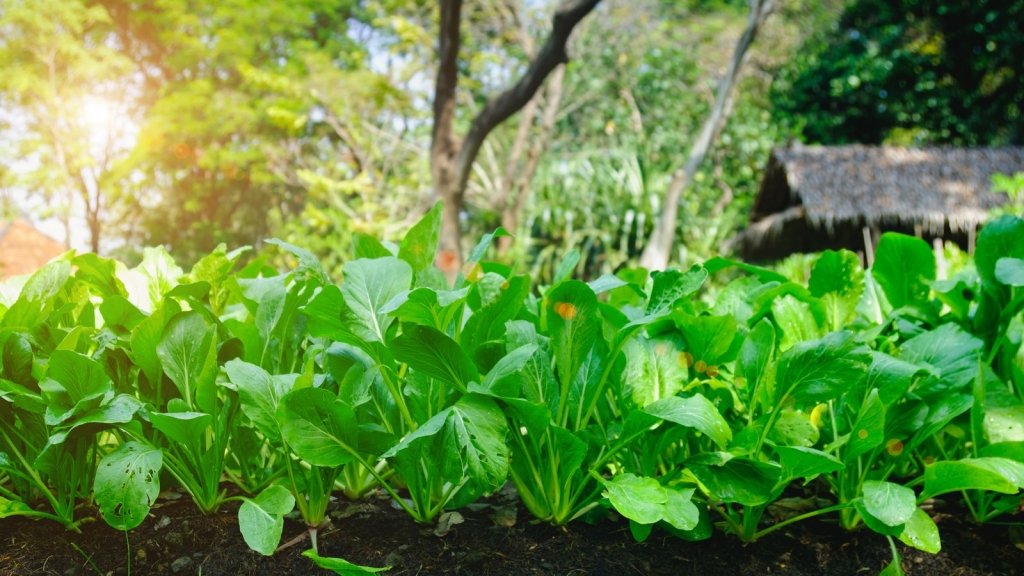
The short version: Most vegetables want six hours or more of direct sun, but a garden with four or five hours can still feed you if you choose crops grown for their leaves and stems rather than their fruit. Lettuce, silverbeet, spinach, kale, rocket, pak choy and the soft herbs cope with part shade, and peas and radishes will give you a smaller crop. Tomatoes, capsicum, cucumbers, pumpkins, beans and sweet corn do not. In an Australian summer, afternoon shade is often a gift rather than a handicap, and the real enemies of a shady bed are still air and damp, not the lack of light itself.
Plenty of Australian backyards spend half the day in the shadow of the house, the fence or the neighbour's gum tree, and the old advice to find a spot with full sun is no help at all. The good news is that the vegetable garden was never an all-or-nothing proposition. It is a matter of matching the crop to the light you have, and of understanding that in most of this country the sun is more likely to be too much than too little.

How much sun vegetables really need
Full sun means around six hours of direct, unfiltered sunlight a day, and fruiting crops want that or more. Sustainable Gardening Australia puts the working minimum for most fruit and vegetables at four to five hours. Below that, growth slows and you are choosing among the crops that tolerate less. Under about two hours of direct sun, with no bright indirect light, expect very little from anything edible.
Hours are only a rough guide, because four hours of January sun in Mildura carries far more energy than four hours of June sun in Hobart. Watch a bed through a day in each season and note when the sun reaches it. For leaves and herbs, morning sun with afternoon shade is the best arrangement a shady garden can have, since the afternoon is when heat, not light, does the damage, though root crops tend to do better the other way round.
The rule that gets you most of the way
Plants grown for their leaves, stems or buds put up with shade far better than plants grown for their fruit or roots. A lettuce only has to make leaves. A tomato has to make leaves, flowers and then ripen fruit, and each step needs energy from the sun.
- Happy in part shade: lettuce, rocket, spinach, silverbeet (including perpetual spinach), kale, pak choy and other Asian greens, endive, mustard greens and rhubarb.
- Tolerate it with a smaller crop: peas, broad beans, broccoli, cabbage, cauliflower, radishes, beetroot, kohlrabi and carrots, and strawberries and blueberries under a light canopy.
- Herbs that prefer it: parsley, mint (in a pot, or it takes the bed), coriander, chervil, Vietnamese mint and sorrel. Coriander in particular tends to bolt more slowly with afternoon shade in summer.
- Full sun or forget it: tomatoes, capsicum, chilli, eggplant, cucumber, zucchini, pumpkin, melons, beans, sweet corn and the whole onion family. Sweet corn fails twice in a sheltered shady corner, once on light and once because it needs open air and a block of plants to pollinate.
Sweet potato is the part exception. In part shade the vine grows happily and the young leaves and tips are a good cooked green, but the tubers stay small, so treat it as a leaf crop unless the bed gets most of the day in sun.

What shade does to a plant
Expect slower growth, softer and larger leaves, and milder flavour. Plants in low light also stretch, throwing long stems and leaf stalks in search of light, so leafy crops in shade need a little more support and earlier picking. Shade cast by a leafy canopy has an extra effect: the light filtering through leaves is rich in the far-red wavelengths that tell a plant it is being crowded, and that can push it to flower and bolt sooner. Open shade from a wall or shade cloth does the opposite, cutting the heat that drives bolting in lettuce and coriander. The two kinds of shade look similar and behave differently.

Making the most of the light you have
- Grow in pots you can move. A tub of lettuce can follow the sun through the year, and shift under cover in a heatwave.
- Use the walls. A pale wall or pale gravel bounces some light back onto a bed, a modest gain that helps most while plants are small. A north- or west-facing wall also stores daytime heat and gives it back at night.
- Face north. In Australia the productive aspect is north, and beds that run north to south shade each other least. In the far north, where the midsummer sun sits almost overhead, aspect matters less than shelter from the wet.
- Map the winter sun. The midday sun sits roughly 47 degrees lower in June than in December everywhere in Australia, and the further south you are the lower it starts, so a fence that casts a half-metre shadow in summer can throw several metres in winter. Check a bed in winter before you commit to it.
- Prune with care, and with permission. Lifting the canopy of a tree lets in a surprising amount of light, but many councils protect trees above a certain size and require an application and a qualified arborist. Check your council before you cut, and never top a tree.
- Feed and space generously. Shaded plants have less energy to spare, so good soil, steady moisture and room to breathe count double.

The real enemies of a shady bed
Damp, still air is what kills plants in shade. Fungal diseases love a shaded corner with no breeze, so space plants wider than you would in the open, water the soil rather than the leaves, and water in the morning so foliage dries before night. Slugs and snails are shade and moisture animals by nature, hiding under boards, pots and mulch by day and grazing seedlings by night. Handpick at dusk with a torch, use an iron-based bait in preference to the older metaldehyde poisons, scattered thinly rather than in heaps, and keep the bed tidy. Copper tape is popular, but garden trials have failed to show it reduces damage, so do not rely on it, and keep dogs and poultry away from baited beds, because iron baits are lower risk rather than harmless. Our guide to slugs and snails covers the rest. Shaded soil also stays cold and wet longer in spring, so sow a little later and go easy on the watering.

Shade across Australia's climate zones
- Tropical (Cairns and far north Queensland, Darwin and the Top End of the Northern Territory, the Kimberley in Western Australia): shade is a tool here. Commercial growers raise Asian greens and cucumbers under shade houses, which take the edge off a very high light load rather than creating real shade, and a shaded bed is often the only one still producing in the build-up. Fungal pressure, not light, is the limit in the wet.
- Subtropical (Brisbane and coastal Queensland, Coffs Harbour and northern New South Wales): afternoon shade keeps lettuce, rocket and coriander going through summer, and becomes a liability in winter. Airflow is everything.
- Arid and semi-arid (inland Queensland, Broken Hill and Dubbo in New South Wales, Mildura in Victoria, inland South Australia and Western Australia, Alice Springs in the Northern Territory): leafy crops need afternoon shade in summer to survive at all, but the same shaded bed gets neither sun nor warmth in a clear, frosty winter. Move with the seasons.
- Temperate (Sydney and New South Wales, Melbourne and Victoria): the four to five hour minimum does its best work here. Deciduous trees are the ideal neighbour, shading in summer and bare in winter.
- Mediterranean (Perth and southern Western Australia, and Adelaide and the Adelaide Plains in South Australia): shade from December to March is a blessing, and a shaded bed in the wet winter is a slug and mildew problem. Perth's pale limestone walls bounce a little useful light.
- Cool and alpine (Hobart and Tasmania, Canberra and the ACT, Ballarat in Victoria, Orange and Armidale on the New South Wales tablelands): shade is mostly a cost. The winter sun sits low, so a fence throws a midday shadow about one and a half times its height in Armidale and Orange and well over twice its height in Hobart. Keep the food garden in the open and use shade only for a few summer greens.
Frequently asked questions
How many hours of sun do vegetables need?
Most sources say six hours or more of direct sun, and Sustainable Gardening Australia says four to five will do for many crops. Leafy greens manage on three or four. Fruiting crops want six to eight, and more is better.
Can I grow tomatoes in part shade?
Not well. Fruiting crops need long hours of sun to ripen. A cherry tomato in four hours of sun is worth a try with low expectations, but a large-fruited variety will disappoint.
What vegetables grow in the shade of a fence?
Lettuce, rocket, spinach, silverbeet, kale, pak choy, parsley, mint and coriander, provided the bed gets three or four hours of sun or bright indirect light. On the permanently shaded south side of a wall, grow something ornamental instead.
Does afternoon shade help in summer?
Yes, across most of Australia. Heat, not light, is what breaks summer crops, and shade in the afternoon can delay bolting in lettuce and coriander and keep leafy crops sweet. It does not stop bolting altogether, since day length plays a part too.
Can I prune a tree to let in more light?
Often, but check your council first. Many trees are protected above a certain size, pruning may need an application, and substantial work should be done by a qualified arborist.
A shady yard narrows the list, it does not close the kitchen. Fill the light you have with leaves and herbs, keep the air moving, and save the tomatoes for a pot in the sunniest corner you can find. Sustainable Gardening Australia's guide to growing veggies in shade is a good companion read, and our guide to garden microclimates shows how to read the sun, shade and frost in your own yard.
Related growing guides
- Working with garden microclimates: sun, shade, wind and frost
- Balcony and courtyard veg: what to grow in pots in Australia
- Slugs and snails: how to control them organically
Leaves for the shade, fruit for the sun. Browse our vegetable seeds, Asian vegetable seeds and herb seeds.