
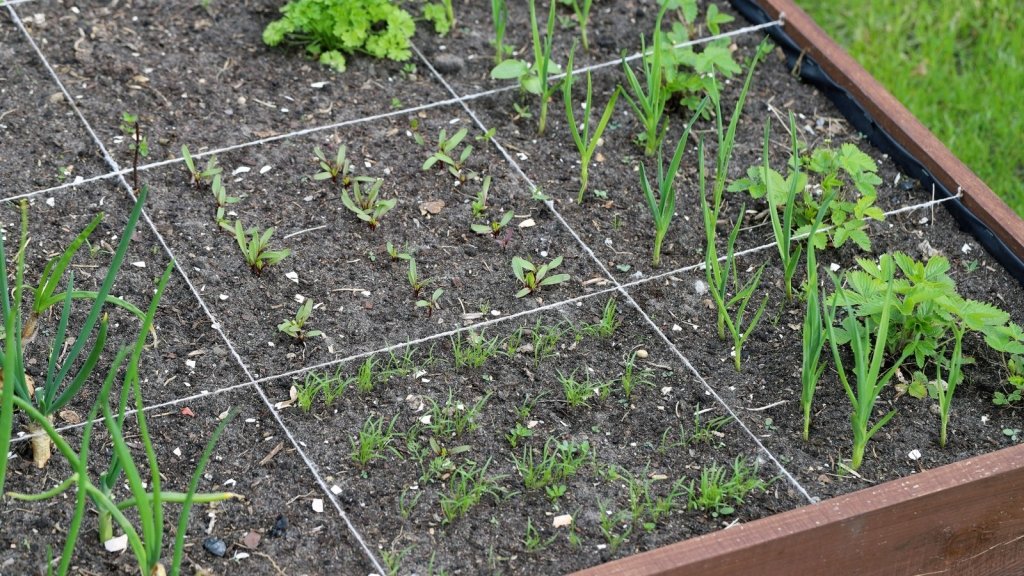
The short version: Square foot gardening is a way of planting a raised bed, usually 1.2 m by 1.2 m, as a grid of 30 cm squares, with one, four, nine or sixteen plants in each square depending on their size. It packs a lot of food into a small space, keeps planting decisions simple and suits courtyards, renters and beginners. The method was created by Mel Bartholomew in the United States, and it needs a few Australian adjustments: a deeper bed and a coir-based mix for our heat, a trellis on the southern side, shade cloth in summer, and honest limits on corn and sprawling crops.
A raised bed with string stretched across it in a grid looks a little fussy until you have planted one. Then the logic arrives. Each square is a small decision: four lettuces here, sixteen carrots there, one capsicum in the corner. Nothing is wasted on paths between rows, nothing gets forgotten, and when a square is harvested it is replanted the same weekend. For a small Australian yard it is one of the more productive ways to garden, once the American assumptions are adjusted for the sun.

Where the method comes from
The square foot method was worked out by Mel Bartholomew, a retired American civil engineer, in 1976, set out in his 1981 book, and it is promoted today by the Square Foot Gardening Foundation he set up. The Foundation describes it in three steps: build a box, fill it with a light soil mix, and lay a grid on top. The Foundation treats Square Foot Gardening and Mel's Mix as its trademarks, so this is our own Australian adaptation of the method rather than the official version, and the Foundation's method page is the place to read the original.
Building the box
The classic box is 1.2 m square, which lets you reach the middle from any side without stepping on the soil. Any timber, corrugated iron or recycled material that will hold soil works, and a bed against a fence is better at 0.6 to 0.9 m wide and as long as you like, so every square is within arm's reach from the open side. Untreated hardwood, cypress or a modern non-arsenic treated pine are common choices; avoid old arsenic-treated timber and railway sleepers soaked in creosote around food.
The original method fills the box only 15 cm deep, on the reasoning that a light, rich mix grows most vegetables in that depth. That is where the first Australian adjustment comes in. In our summers a 15 cm bed can dry out within a single hot day and heats through, and a metal bed wall cooks the root zone from the side. Most Australian raised beds run 30 to 50 cm deep, and a wicking bed, with a water reservoir under 30 cm of mix, turns the square foot idea into something that shrugs off a Perth or Adelaide January.

An Australian mix without the peat
The Foundation's mix is a third coarse vermiculite, a third sphagnum peat and a third blended compost, by volume, and the Foundation says it can last at least ten years if you work a trowel of compost into each square as it is harvested and top the bed back up when the level drops. Peat is the ingredient to change. Australian peatlands are rare and protected, imported peat carries a heavy carbon cost, and the Foundation itself accepts coconut coir as a substitute. Coir comes as compressed bricks that swell in a bucket of water. It rewets far more easily than dry peat, although it holds a little less water overall, so a coir bed may need watering slightly more often, and it sits close to neutral rather than acid like peat, so check the pH occasionally if your tap water is hard.
A practical Australian blend is roughly a third coir, a third compost from several sources, and a third of a free-draining component such as coarse vermiculite, perlite or a good-quality bagged garden mix, with a handful of pelletised manure and a dusting of rock minerals. Coir and vermiculite hold little nutrient of their own, so the compost carries the feeding, and a deeper bed can use a base layer of ordinary garden soil or bagged soil beneath the mix. Put a mask and gloves on before you open the bag, open it away from your face, dampen the contents, and wash your hands with soap afterwards even though you wore gloves, since potting mix and compost dust can carry Legionella longbeachae.

The grid and the counting
Lay a physical grid over the bed, string, thin timber laths or bamboo, dividing it into 30 cm squares. It stays there for the life of the bed and is what makes the method work, because a bed without a visible grid quickly turns back into a bed.
The number of plants per square comes from the thinning distance on the seed packet: plants thinned to 30 cm get one per square, 15 cm get four, 10 cm get nine, and 7.5 cm get sixteen.
- One per square: capsicum, eggplant, broccoli, cabbage, cauliflower, kale, a staked tomato, zucchini in the corner squares only.
- Four per square: leaf lettuce, silverbeet, pak choy, celery, parsley, and potatoes in a bed at least 30 cm deep, hilled as they grow.
- Nine per square: beetroot, bush beans, spinach, turnips, leeks.
- Sixteen per square: carrots, small radish varieties, onions, spring onions, chives.
- Climbers: peas and climbing beans at about eight seeds per square along a trellis.
The Foundation lists sweet corn at four per square, but it is the honest exception. It needs a block of plants and open air to pollinate, and four plants in one square rarely fill their cobs. Give corn its own bed or skip it.

Trellis on the south side, and shade in summer
American guides put the trellis on the north side of the bed so it does not shade the rest. In the Southern Hemisphere that is backwards. Put climbing beans, cucumbers and peas on the southern side, or the western side where you want afternoon shelter, so the sun from the north reaches every square. Then check the bed in winter. Everywhere in Australia the midday sun sits about 47 degrees lower in June than in December, and the further south you are the lower it starts, so a 1.5 m trellis that shades nothing in summer can shade half the bed in a Hobart or Ballarat winter.
The dense planting that makes the method productive also makes it thirsty and humid. Water in the early morning, long and slow rather than little and often, keep a coarse mulch over the mix, and use drip lines or a watering can at the base to keep water off the foliage. In a heatwave, 50 percent shade cloth over the bed protects leafy squares, and watering the night before takes the bed into a hot day with a full tank.
Keeping the squares turning over
The method's real advantage is succession. When a square of radishes comes out, a square of lettuce goes in, and no part of the bed sits idle. Keep a few punnets of seedlings coming, top each emptied square with a trowel of compost before replanting, and rotate what goes where so the same family does not return to a square season after season. Our guide to succession planting covers the rhythm.

Pros, cons and who it suits
For its size the method is hard to beat: a lot of food from one bed, easy planning, easy weeding, and a soil you built rather than inherited, which is a real advantage on Perth sand or Melbourne clay. It suits beginners, renters, small yards and anyone who likes order. The Foundation's claims about water and labour savings are its own estimates rather than trial results, so treat them as a direction rather than a promise.
The limits are real too. Sprawling crops such as pumpkins and melons, tall block crops such as corn, and long-lived perennials such as asparagus or rhubarb do not fit a grid of small squares and want their own space. Filling a bed with a bought mix costs real money at the start, and a densely planted bed needs more feeding than the method's originators suggest over a long Australian season. A gardener with a big yard may find rows simpler. A gardener with a courtyard rarely looks back.
Square foot beds across Australia's climate zones
- Tropical (Cairns and far north Queensland, Darwin and the Top End of the Northern Territory, the Kimberley in Western Australia): go 30 cm deep or more, plant at the lower end of each density in the humid build-up, and switch the bed to sweet potato, snake beans and Ceylon spinach through the wet.
- Subtropical (Brisbane and coastal Queensland, Coffs Harbour and northern New South Wales): the best fit for year-round succession. Space for airflow, and keep water off the leaves.
- Arid and semi-arid (inland Queensland, Broken Hill and Dubbo in New South Wales, Mildura in Victoria, inland South Australia and Western Australia, Alice Springs in the Northern Territory): build it as a wicking bed, shade it in summer, and avoid bare metal walls that cook the roots.
- Temperate (Sydney and New South Wales, Melbourne and Victoria): closest to the conditions the method was written for. The 1.2 m box, the grid and the plant counts translate with the least change.
- Mediterranean (Perth and southern Western Australia, and Adelaide and the Adelaide Plains in South Australia): plan two grids, a full one for autumn and winter and a reduced, shaded one for summer. The imported mix is a genuine advantage over sand.
- Cool and alpine (Hobart and Tasmania, Canberra and the ACT, Ballarat in Victoria, Orange and Armidale on the New South Wales tablelands): the box warms earlier in spring than the ground, but a trellis casts a long shadow in June, so check winter sun before siting. Expect two or three plantings per square a year rather than four.
Frequently asked questions
How many plants go in each square?
One, four, nine or sixteen, set by the thinning distance on the packet: 30 cm gives one, 15 cm gives four, 10 cm gives nine and 7.5 cm gives sixteen. Peas and climbing beans go in at about eight per square along a trellis.
How deep should the bed be in Australia?
The original method uses 15 cm of mix. In Australian heat, 30 cm or more holds moisture far better, and a wicking bed with a reservoir underneath is the most drought-proof version.
Which side does the trellis go on?
The southern side in Australia, or the western side if you also want afternoon shade for the bed. Overseas guides say north, which is the wrong side here.
Can I use garden soil instead of a bought mix?
You can fill the lower part of a deep bed with soil and use the light mix in the top 20 to 30 cm. The mix matters most where seeds germinate and roots start.
What does not work in a square foot bed?
Sweet corn, pumpkins, melons and big perennials such as asparagus and rhubarb. Give them their own bed and keep the grid for everything else.
A box, a mix, a grid and a habit of replanting every square the day it empties. That is the method, and with a deeper bed and the trellis on the right side it grows as well in Australia as it does anywhere. Our guide to raised garden beds covers the build in more detail.
Related growing guides
- Raised garden beds in Australia: are they worth it, and how to build one
- Succession planting for a steady harvest
- Small-space food gardening: big harvests from a balcony or courtyard
Sixteen squares to fill? Browse our vegetable seeds, herb seeds and bean seeds.