
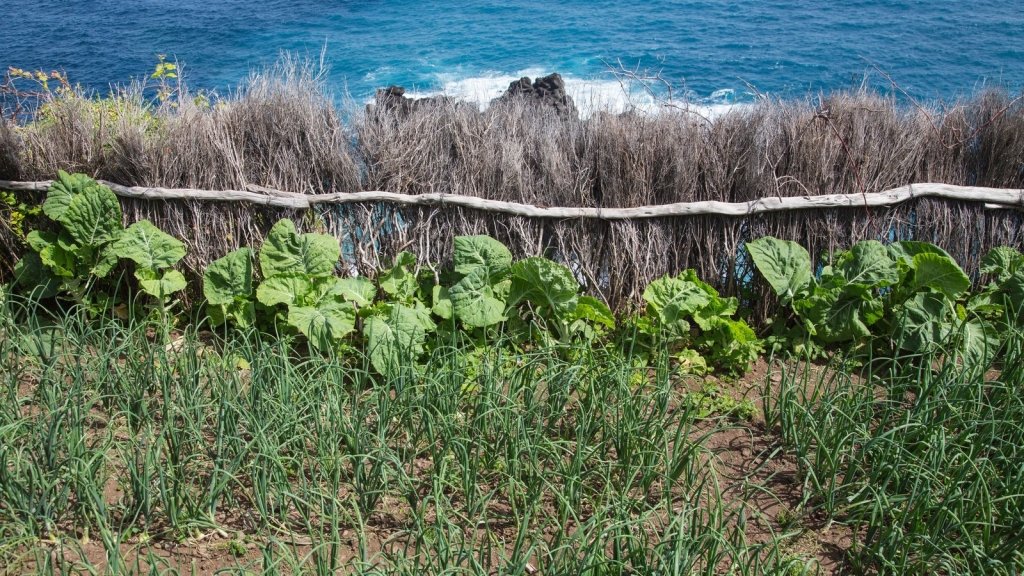
The short version: On an exposed block the wind does most of the damage and salt finishes the job, so put shelter up before you plant. Use a permeable screen that lets about half the wind through: a solid fence throws damaging turbulence onto the side it is meant to protect. Shelter reaches six to ten times the height of the screen above the crop, so a 1.8 metre screen over knee-high plants covers roughly 8 to 13 metres of bed, less in a severe blow. Then build sand up with clay and compost, water deeply, and choose low, tough crops.
The tomato planted in October is the same size in November, the silverbeet is torn into ribbons, and seedlings on the seaward side are brown at the edges while those behind the tank are fine. The garden is being scoured.
The Australian National Windbreaks Program named the main direct wind damage as sandblasting, "which either buries or removes seedlings from the soil or damages the leaves and stems", and leaf tearing and stripping. Salt lands on top of that, in spray off the surf.
Salt burn, wind burn, frost or too much fertiliser
All four scorch leaf edges; the pattern tells you which.
- Salt burn browns the tip and margins and works inward, worst facing the water, and follows a blow rather than a night. Salt on the leaf surface is thought to get in through the stomata and the cuticle, and builds up most after windy storms with little rain.
- Wind damage looks torn or bleached rather than evenly brown, leaves stay small and thick, and lower ones are scoured by airborne sand.
- Frost follows a still, clear night, sits in low parts of the garden rather than exposed ones, and takes whole soft leaves (more).
- Fertiliser burn follows a feed on dry soil and shows on the plants you fed, not the windward row. Fertiliser is a salt too.
Read your own site first
- Stand outside in the wind that does the damage and note the month and direction. Most blocks have one or two.
- Look at plants nearby. Under persistently strong, salt-laden wind, coastal canopies develop "remarkably streamlined canopy surfaces", the NSW coastal dune manual notes, so the way they lean is your reading. The manual also describes the layers sheltering land inland: foredune as wall, shrubs as shutter, trees as roof.
- Find the gaps. Air accelerates through a gap, so a missing paling or the strip under a fence hits harder than open ground.
- Dig a hole: coastal sands are "free draining, have a low water holding capacity and are very low in nutrients".

Shelter that works, and why a solid fence often does not
A leaky barrier beats a solid one. The Australian citrus industry fact sheet puts ideal permeability at 45 to 55 per cent, and says a solid break that lets no wind through "causes damaging turbulence on the side it is meant to protect (better to have no windbreak at all)"; Agriculture Victoria recommends a similar 40 to 60 per cent density. Reach is counted in heights: the citrus sheet puts the strongest reduction out to six times the effective height, counting height above the crop, with some protection to ten times, and DPIRD in Western Australia puts erosion control at 10 to 15 times the height when wind arrives at right angles.
- Set the screen square across the damaging wind: shelter holds within about 30 degrees of square.
- Run it past the ends of the bed, because wind curls around the end and causes turbulence.
- Shade cloth works. In the national program, cloth of 30 per cent optical porosity cut wind speed by about 70 per cent in screens only a metre high, and as a rough guide the reduction matches the density of the cloth, so a cloth about half open gives the 45 to 55 per cent permeability recommended above.
- Expect poor growth within one to three heights of a living hedge, which competes for water and nutrients; on a frosty slope leave a low gap downhill.
- Build it to hold: posts set deep in sand, spaced as the cloth maker specifies, with the cloth tensioned and tied at every eyelet, a cap on any star picket, since SafeWork New South Wales asks for exposed pickets to be capped, and a check of your council's fence rules before anything permanent goes above the boundary fence.
- On a balcony, clip a permeable screen above a solid balustrade and keep heavy pots low and grouped, since wind dries a pot faster than sun (balcony guide).
On a bare block, work in stages: temporary screen first, then a nurse row of sorghum, millet, sunflowers or sweet corn inside it, the garden version of the tall annual grasses orchards use, with a cover crop holding the sand down. Permanent shelter is the job where a shrub beats a seed packet, so ask your council or coastcare group which local species suit your street, and avoid invaders: coast tea-tree is a declared weed in South Australia and an environmental weed in southern Western Australia. Plant the fussy crops last, in the middle.
Making sand hold water and food
Adding clay-rich subsoil to sandy topsoil, Western Australia's DPIRD notes, "increases soil water holding capacity, reduces wind erosion risk" as well as fixing water repellence. In a bed that means a few buckets of clay soil or bentonite plus compost through the top 100 to 150 millimetres, over a season or two. Our guides to soil types and water-repellent soil have the method, and coarse chip stays put better than straw (mulch).
Water deeply and less often so salts keep moving below the roots. Rain and irrigation percolating through coastal sand reduce salt levels, and sand drains freely, so leaching is easy; nutrients leave with the water, so feed little and often (water-wise habits). After a salty blow with no rain behind it, hosing the foliage with fresh water is sensible, since dry windy storms are what leave salt on leaves. We found no Australian trial testing it, so treat it as practice rather than proof.

What to grow from seed on an exposed block
Salt in the soil and salt on leaves are different questions, and only the first has real data. The FAO crop salt tolerance tables rate beans, carrots and bulb onions sensitive, with yield loss from about 1.0 to 1.2 dS/m, while red beet is moderately tolerant at 4.0, zucchini at 4.9 and asparagus tolerant at 4.1. Those figures are for salt in the root zone under irrigation, not spray on leaves, and we found no Australian table for spray, so the list below is judgement.
- Tough in wind, and low: beetroot, which that table rates moderately tolerant, and its relative silverbeet, plus kale, spring onions, leeks, radish, rocket and thyme. Onions and radish are rated salt sensitive at the root in that table, so give them the leached, well watered sand described above.
- Worth a sheltered pocket: tomatoes, capsicum, basil, cucumber and zucchini, whose soft leaves tear.
- Kept short: bush beans ahead of climbers (supports), and annual flowers sown thickly so they hold each other up.
- Warrigal greens, a native, is "widespread in coastal areas and inland salt marshes" and grows easily from seed, with leaves that need blanching, as our bush food guide explains.
Dunes and reserves: check before you clear or plant
The strip between your fence and the beach is usually public land, rules differ by state, and the first call is the land manager, usually the council.
- New South Wales: clearing native vegetation in urban or environmental conservation zones may need a council permit or development consent.
- Victoria: works on marine and coastal Crown land need consent under the Marine and Coastal Act 2018.
- Queensland: the Queensland Government says major disturbances to coastal dunes on freehold and leasehold land are "subject to development assessment and approval".
- Western Australia: a permit is needed to clear native vegetation unless an exemption applies.
- South Australia: clearance needs Native Vegetation Council approval.
- Tasmania, the Northern Territory and the ACT: follow your own coastal and vegetation authority.
Coastal and exposed gardens across Australia's climate zones
- Tropical (Darwin in the Northern Territory, Cairns and Townsville in Queensland): cyclone season runs 1 November to 30 April, so use shelter you can drop; wet season rain rinses leaves.
- Subtropical (Brisbane and south-east Queensland, northern New South Wales): onshore easterlies and summer storms do the damage, and beach sand holds little water.
- Arid and semi-arid (Alice Springs in the Northern Territory, Broken Hill in New South Wales, Mildura in Victoria, Kalgoorlie in Western Australia): the wind is hot and dry rather than salty, so check soil and bore water before blaming the sea.
- Temperate (Sydney and the New South Wales coast, Melbourne in Victoria): the southerly buster arrives above 54 kilometres per hour with a 5 degree drop inside three hours, so tie plants early.
- Mediterranean (Perth and south-west Western Australia, Adelaide in South Australia): the Fremantle Doctor blows in from the south-west on summer afternoons, so shelter western sides and water early.
- Cool and alpine (Tasmania, especially the west coast, Ballarat in Victoria, Orange in New South Wales, Canberra and the ACT): the roaring forties westerlies off the Southern Ocean reach north-west Tasmania with nothing in the way, and cold wind slows growth as much as it tears leaves. Exposed inland ridges, including those around Canberra, get the same drying gusts without the salt, so shelter still pays.
These zones are broad groupings. Between two of them, lean on local cues such as your first and last frosts, and the way the neighbourhood shrubs lean.
Frequently asked questions
Is a solid fence or a permeable screen better?
A permeable barrier, roughly 45 to 55 per cent open. A solid break causes damaging turbulence on the side it protects, which is why a new paling fence can make a garden worse.
How do I tell salt burn from wind burn?
Salt burn browns tips and margins and works inward, worst facing the water and after a dry blow. Wind damage looks torn or bleached. Gardens near the sea have both.
Can I plant a windbreak on the dune in front of my place?
Usually not without approval. Start with the council or land manager, and join a dune care group to improve that shelter.
Exposed gardens are slow to start and then surprisingly generous, partly because the wind that shreds leaves keeps fungal disease down. Get shelter up, feed the sand, and the rest follows.
Related growing guides
Start with tough, low growers from our vegetable seeds and herb seeds, plus native seeds for salt and sand.