


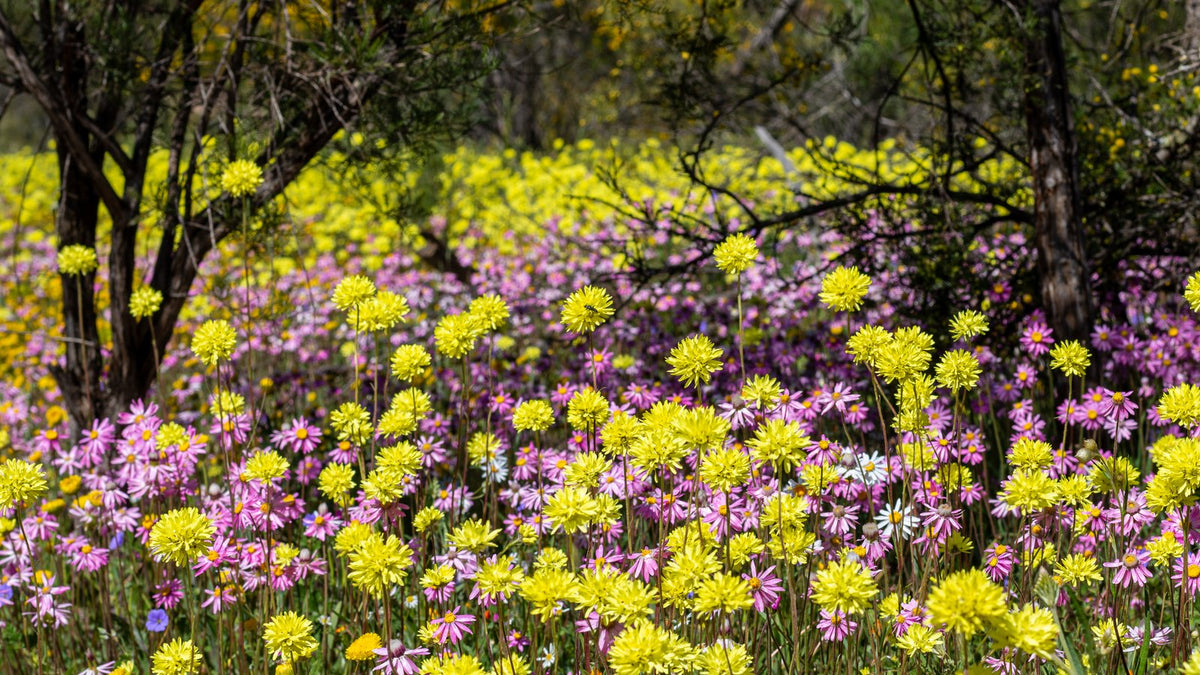

The short version: A meadow patch is annual flowers on bare, lean, sunny ground, not seed shaken over a lawn. Clear every runner of couch and kikuyu first, rake a fine seedbed, and build your own blend from single packets of everlasting daisies and the cottage annuals. Mix the seed with sand, sow it thin, press or barely cover it and keep it damp until it is up. Let the plants set seed, cut them down once the seed has dropped, carry the hay away and leave bare soil for the next generation.
Garden pages love the meadow look, and when an attempt fails it is usually for one of four reasons: the seed went into grass, the soil was too rich, there was no bare ground for the seedlings, and the mower arrived before the seed had dropped.
Get those four right and the patch does most of the rest itself; a weed check, water while it establishes and a top-up packet each year are what remain.
What a meadow patch is, and is not
The Botanic Gardens of Sydney describe a meadow as grasses and flowering plants growing together to feed and shelter pollinators. The home version is a bed of annual flowers that grow, flower, drop seed and come again, with native grasses such as kangaroo grass (Themeda triandra) as the matrix if a native nursery can supply them. It is not a lawn with seed thrown over it: the Royal Horticultural Society is blunt that seed sown into turf rarely gets anywhere, because the seedlings cannot compete with the grass.
Choose the ground: sun, drainage, no running grass
Full sun first. Kings Park in Perth asks for sandy soil in full sun for the pink paper daisy, and the Australian National Botanic Gardens note that rosy everlastings grown in shade go spindly and stay small on heavy clay, so on clay raise the bed and fill it with a free-draining mix.
Lean does not mean starved. Do not feed the cottage annuals: the RHS warns that rich soil pushes hardy annuals to leaf rather than flower. Paper daisies are the exception: the beds at the Australian Botanic Garden Mount Annan are built with plenty of washed river sand and given a liquid feed every three weeks once the plants reach 10 to 15 cm, so give them their own drift if you mean to feed them. Last season's lush vegetable bed is the wrong bed; the sunny strip of ordinary ground along a fence is the right one.
Running grass has to go first, completely. Couch and kikuyu spread by rhizomes, stolons and stem fragments, so a strip of lawn skimmed off with a spade comes straight back through the daisies. The Australian Wine Research Institute rates solarisation, clear plastic over the grass for 8 to 12 weeks of hot weather, a reasonable control with regrowth still to deal with; our guides to organic weed control and no-dig beds cover the methods. Allow a season, not a weekend.
Build your own blend from single packets
Single packets carry a botanical name you can check against a weed list; a ready-made mix may not list every species in it, and an imported pack sold at Floriade in 1995 was withdrawn when St John's wort, a prohibited import, turned up in it (the ACT Hansard holds the record). Two families of plants do the work.
- Australian everlastings. The pink and white carpets of the famous displays are the rosy everlasting (Rhodanthe chlorocephala subsp. rosea) and the yellow showy everlasting (Schoenia filifolia): annuals from the Western Australian sandplains, sown in autumn, sold by native seed suppliers. The golden everlasting or strawflower (Xerochrysum bracteatum), the everlasting in our native range, has annual forms bred in yellows, reds, purples and oranges; the seed needs no treatment and is surface sown; the packet says spring, which suits the frosty districts; Sustainable Gardening Australia lists it among the everlastings sown in autumn too, so elsewhere it can join the autumn blend. Swan River daisy (Brachyscome iberidifolia), a low Western Australian annual, and billy buttons (Pycnosorus globosus), a native perennial, fit the same bed. Skip smoke water: Kings Park research found it suppresses paper daisy germination.
- Cottage annuals that self-seed. Cornflower (Centaurea cyanus), Flanders and Shirley poppies (Papaver rhoeas), nigella (Nigella damascena), larkspur (Consolida ajacis) and calendula (Calendula officinalis) are the hardy annuals the RHS lists for autumn sowing because they survive frost; sweet alyssum (Lobularia maritima) is the low edging to add, except near coastal dunes or in Tasmania, where it has escaped gardens and is counted an environmental weed. Garden cosmos (Cosmos bipinnatus) is the warm-season partner, sown after the frosts; Queensland records it and sulphur cosmos (Cosmos sulphureus) as naturalised, and sulphur cosmos has naturalised in the Kimberley too, so in a self-seeding patch near bush in the north leave cosmos out. Larkspur is poisonous if eaten, so leave it out where young children or dogs play.

Sow it: the seedbed, the sand and the rate
- Clear, then wait. Dig out perennial weeds with their roots, fork, firm by treading, and give the bed four to six weeks, watered if the weather stays dry, for buried weed seed to sprout. Scrape those seedlings off without turning the soil, then rake the surface fine and level.
- Mix the seed with sand. Paper daisy seed leaves on the first breeze, so pick a calm day. The Botanic Gardens mix each packet with about half a bucket of sand or potting mix per square metre, which shows where you have been.
- Sow thin. The Mount Annan rate is 3 grams of paper daisy seed per square metre, less if the seed is clean, and 1 gram for Swan River daisy. For the cottage annuals follow the packet; the RHS guide is a seed about every half centimetre, with crowded clumps thinned once they have a few leaves. Sow half the mix one way and the rest at right angles.
- Press, do not bury. Sow in two batches: everlastings, billy buttons and alyssum sit on the surface, pressed in with the flat of a rake; cornflower, poppies, nigella and calendula take a few millimetres of cover. Poppies and nigella resent transplanting, so sow them where they will flower.
- Keep it damp until it is up. Water with a fine rose until the seedlings show, usually one to three weeks for paper daisies, then steadily while they establish, and ease off once they are away. Bait for snails as the first green appears, with an APVMA-registered bait used as its label directs: iron-based baits are the lower-risk choice and still poison dogs, so scatter the pellets thinly, never in heaps, keep pets off the bed, and store the box out of their reach.

When to sow, zone by zone
The sources read for this guide give no six-zone wildflower calendar, so treat these climate zones as broad groupings and read your own frosts and rain; a gardener between two zones can lean on the first and last frost.
- Tropical (the Northern Territory around Darwin; Cairns and Townsville in north Queensland): no source read for this guide gives a sowing month for paper daisies here, so treat the patch as a dry-season trial in a raised, sharply drained bed and follow the Northern Territory or Queensland planting guide. The cottage annuals are cool-season flowers here; Sustainable Gardening Australia lists cornflower for April across its warm areas, which take in the tropical north.
- Subtropical (Brisbane and the south-east of Queensland; the northern rivers of New South Wales): sow in autumn; Burke's Backyard notes that in warm, humid places such as Brisbane the Kings Park daisies may flower from late winter. Raise the bed and expect the patch to fade as summer humidity builds.
- Arid and semi-arid (Alice Springs in the Northern Territory; Broken Hill in far western New South Wales; Mildura on the Victorian Murray; Kalgoorlie in Western Australia): home ground for the everlastings, which carpet the wild sandplains after winter rain. Sow in autumn and water the seed up if the rain does not.
- Temperate (Sydney and the coast of New South Wales; Melbourne in Victoria): autumn is the main window. The Botanic Gardens of Sydney name autumn and spring, with spring better for planting grasses, and direct sow paper daisies as the soil cools; cornflower and calendula go in through April on the Sustainable Gardening Australia list.
- Mediterranean (Perth and the south of Western Australia; Adelaide in South Australia): Kings Park says sow in May; the plants root through the mild, wet winter and flower in spring.
- Cool and alpine (Tasmania; the ACT around Canberra; Ballarat in Victoria; the tablelands of New South Wales at Orange and Armidale; Stanthorpe in Queensland): the hardy cottage annuals go in during autumn (cornflower is on the April list for cool-to-cold areas), though hard frosts thin autumn seedlings. Frost damages paper daisy seedlings, so raise those in trays under cover from late winter and plant out, hardened off, at about 30 mm once the frosts have passed, which the Bureau of Meteorology puts at late October for Canberra.
The meadow year: flower, seed, cut, bare ground
An autumn-sown paper daisy bed at Mount Annan flowers from September into November, with the cottage annuals following on. Leave most of the heads to dry and shed where they stand. The tidy gardener's clean-up, every browning stem into the green bin before the heads have shed, cancels next year's meadow.
Once the seed has dropped, in the south usually by mid to late summer, cut the annuals down, leaving any perennial crowns and grasses standing. The RHS method for an annual patch is to shake the cut plants over the bed, or in a bigger patch leave them a week so the last seed falls, then rake them up and take them away: removing the hay keeps the fertility down. Leave bare, lightly scratched soil for the seed to land on; a deep bark mulch is where a self-sown meadow goes to die. Add a packet or two each year; the RHS notes that extra sowings may be needed.
What goes wrong
- Grass came through. The couch or kikuyu was skimmed rather than killed. Clear it properly and start again.
- All leaf, few flowers, or a mat that flopped. Rich soil, a fed bed, or seed sown too thick. Stop feeding the cottage annuals, remove the hay, thin the crowded clumps, and next season sow less seed in the same amount of sand.
- Nothing came back, or the seedlings vanished. The patch was cut or mulched before the seed dropped, or slugs and snails, which Kings Park and Mount Annan both warn about, ate the seedlings. Bait at germination.
Keep it out of the bush
Every species in a self-seeding patch must be one that is welcome outside your fence, so do not sow anything listed as a weed in your state or territory. Each state and territory keeps its own declared weed list, and in Western Australia the state's primary industries department, DPIRD, says a landholder is obliged to control a declared plant on their property. Check every botanical name in your blend against the Weeds Australia weed profiles and your state or council list, and near bush, a creek line or the coast, pull seedlings that cross the boundary.
Frequently asked questions
Can I sow a wildflower meadow into my lawn?
Not with any confidence: the RHS says seed sown into turf rarely succeeds. Remove the grass first and sow onto bare soil.
Do I need a wildflower seed mix?
No. Single packets give you a botanical name to check against the weed lists and let you set your own proportions.
How much seed do I need per square metre?
Mount Annan sows paper daisies at about 3 grams per square metre, less if the seed is clean, and Swan River daisy at 1 gram, each as a bed of its own, so in a blend give every packet its share of the area. For the cottage annuals follow the packet and err on the thin side.
Will the meadow come back next year?
Often, if you let the seed drop, remove the hay and leave bare soil, but not reliably. Rosy everlastings frequently return from last season's seed; keep a packet in reserve for the gaps.
Scatter the sand, step back, and let the patch make a few of its own decisions.
Related growing guides
- Flowers that sow themselves and return each season
- Growing everlasting daisies from seed
- Scatter sowing, and when broadcasting seed works best
- Organic ways to get on top of weeds
Build your blend from our flower seeds and the everlasting daisies and billy buttons in our native seeds.