

The short version: When English spinach and lettuce bolt in spring, switch to greens that thrive in heat: Warrigal greens, Ceylon spinach, Egyptian spinach, kang kong, leaf amaranth, purslane and perpetual spinach. Most go in once the soil holds 18 to 20°C and frost has passed, so October suits much of the country; cool districts wait until November. Blanch Warrigal greens and tip the water away, cook sweet potato leaves, and grow kang kong in a container, away from waterways.
It usually happens in the first properly warm week. The winter spinach throws up a stalk, the lettuce turns bitter, and the salad bed starts looking like a seed crop.
That is not the end of home-grown greens. A different set of leafy plants starts in warm soil and crops through the heat, and some climb, sprawl or float in ways winter greens do not.
Why spinach bolts as the days lengthen
English spinach reads long, warming spring days as its cue to flower, and dry soil hurries it. See our guide to why vegetables bolt.
Summer greens at a glance
| Green | How it grows | Sow when | First picking |
|---|---|---|---|
| Warrigal greens | Sprawling ground cover | After the last frost | About 10 weeks after planting out seedlings |
| Ceylon spinach | Climbing vine | Warm soil, frost finished | From about 50 cm tall |
| Egyptian spinach | Tall upright bush | Soil about 20°C | At about 30 cm tall |
| Kang kong | Trailing, loves wet feet | Soil 20°C | From about 4 weeks |
| Leaf amaranth | Upright bush | Soil 18°C | 4 to 8 weeks |
| Purslane | Low succulent | Soil 18°C | About 8 weeks |
| Perpetual spinach | Leafy clump | Soil 10 to 30°C | 8 to 10 weeks |
Warrigal greens
Warrigal greens (Tetragonia tetragonioides) are an Australian native found wild on dunes and estuaries, spreading to about 1.5 m. Soak the thick seed overnight in warm water and sow 5 to 10 mm deep; seedlings take 10 to 20 days. Keep the shallow roots moist. Stems root where they touch soil and plants self-seed, so give them room or a pot. Warrigal greens seeds.
Ceylon spinach
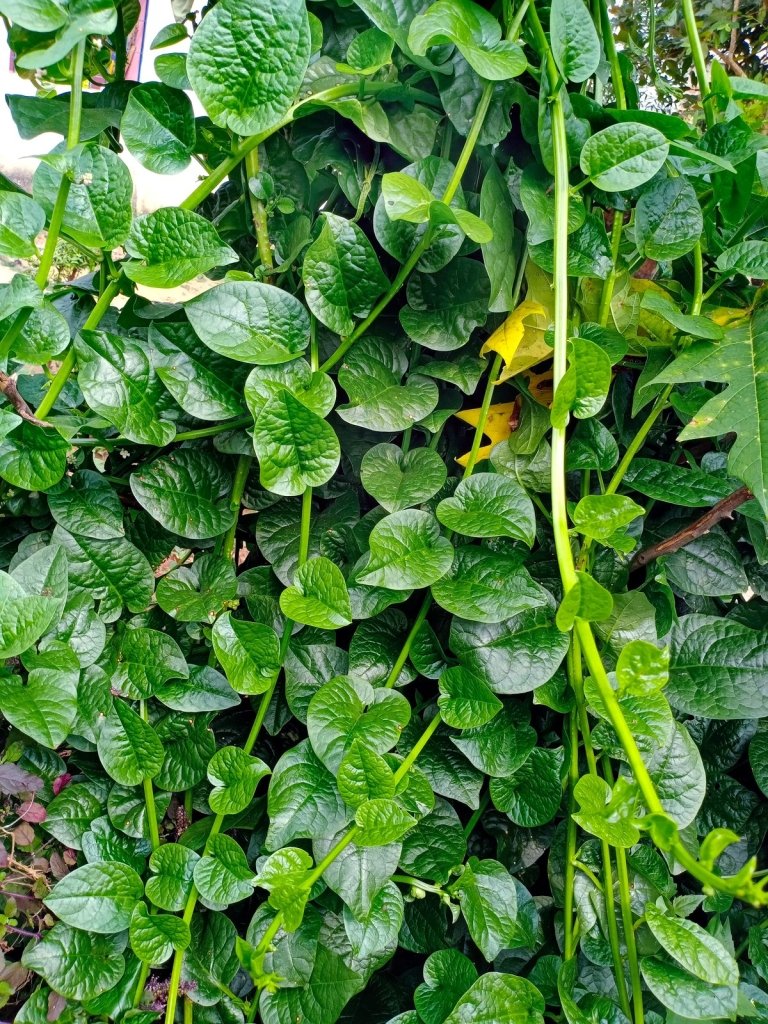
Ceylon or Malabar spinach (Basella alba) is a vine that needs a trellis from the start. Soak the seed overnight, sow it about 5 mm deep beside the trellis and space plants 30 cm apart. In warm soil it germinates in two to three weeks, and frost kills it, so outside the tropics treat it as a summer annual. The thick leaves turn slightly slippery when cooked, good for soups and stir-fries. Choose green-stemmed Ceylon spinach or the showier red-stemmed Ceylon spinach.

Egyptian spinach
Egyptian spinach, also called molokhia or jute mallow (Corchorus olitorius), is a fast upright annual, 1.2 to 1.8 m tall if left alone. Sow it no deeper than 5 mm, then pinch the tip at 30 cm so it branches. See our Egyptian spinach guide and Egyptian spinach seeds.
Kang kong
Kang kong, or water spinach (Ipomoea aquatica), is a semi-aquatic trailer with hollow stems. Soak the seed for a day and sow 5 to 10 mm deep in trays of moist mix. Plant out at 10 to 15 cm tall into a container of potting mix with no drainage holes, flooded just above the surface. Cut stems at about 20 cm and they reshoot. Kang kong seeds.
Leaf amaranth
Leaf amaranth (Amaranthus tricolor), often sold as Chinese spinach, thrives in heat. Sow 3 to 6 mm deep, thin to 15 cm and keep it evenly moist. Young leaves can go into a salad; cook larger servings. Amaranth seeds.
Purslane
Purslane (Portulaca oleracea) is a low, crunchy succulent with a sharp, lemony taste. Press the seed onto the surface or cover it by no more than 3 mm. It copes with heat and dry spells, but tender leaves need regular water. Pick stem tips before the flowers open. It holds oxalates, so keep servings modest, raw or cooked. Choose green or golden purslane.
Perpetual spinach
Perpetual spinach is a silverbeet type (Beta vulgaris) grown for its spinach-like leaves, and it rarely runs to seed in its first season. Sow 12 to 15 mm deep and thin to one plant every 30 cm. Perpetual spinach seeds.
Sweet potato leaves: a green from a tuber crop
Sweet potato (Ipomoea batatas) leaves and shoot tips are a cooked green too. Once the vines are growing strongly, pick lightly every week or two; hard stripping cuts the tuber harvest. Our sweet potato recipes include a leaf stir-fry, and the slips guide starts plants from a tuber. Sweet potato tubers cannot be sent to Western Australia, Tasmania or Kangaroo Island.
Picking and feeding for regrowth
On the branching greens, take the top 15 to 20 cm of a shoot and the plant branches below the cut. Pick perpetual spinach by its outer leaves, leaving the centre to grow. Pick often in hot weather; old leaves toughen.
- Check moisture daily in hot spells and keep the soil evenly moist; pots may need daily water. Mulch beds.
- Feed little and often. A fortnightly liquid feed or a side dressing of aged manure keeps soft leaf coming (see our fertiliser basics).
- Pinch off flowers on Ceylon spinach, amaranth and Egyptian spinach unless saving seed.
What to sow in October, zone by zone
The six zones are broad groupings. If you garden between two, lean on local cues such as your last frost.
Tropical (Darwin in the Northern Territory, Cairns and Townsville in Queensland): October is the build-up. Sow amaranth and purslane in raised, free-draining beds, and Egyptian and Ceylon spinach for the wet; our wet-season guide covers Ceylon spinach and kang kong. Kang kong is easiest from cuttings or seedlings raised under cover, and sweet potato goes in as the wet begins.
Subtropical (Brisbane and south-east Queensland, northern New South Wales): everything on the list can go in. October is the last month for perpetual spinach until February; give it afternoon shade. Plant sweet potato slips from September to December.
Arid and semi-arid (Alice Springs in the Northern Territory, Broken Hill in New South Wales, Mildura in Victoria, Kalgoorlie in Western Australia): sow amaranth, purslane, Egyptian spinach and kang kong once the last frost has gone, kang kong in its closed container, topped up often. Mulch deeply.
Temperate (Sydney and the New South Wales coast, Melbourne in Victoria): Sydney can sow amaranth, purslane, kang kong and Egyptian spinach. Melbourne soil warms later, so hold kang kong and amaranth until about November. Perpetual spinach and Warrigal greens suit the whole zone.
Mediterranean (Perth and southern Western Australia, Adelaide in South Australia): sow amaranth, purslane, kang kong and Egyptian spinach as the soil warms, then mulch and water deeply. Perth can sow perpetual spinach in any month. Seed for these greens can be posted to Western Australia.
Cool and alpine (Tasmania, Canberra in the ACT, Ballarat in Victoria, Orange and Armidale in New South Wales, Stanthorpe in Queensland): sow Warrigal greens after the last frost and perpetual spinach once hard frosts ease, though tablelands gardens often wait until November. Start purslane indoors and sow amaranth after the last frost, often November in Canberra. Kang kong and Egyptian spinach suit a pot in the warmest spot from November.
Kitchen and garden safety
- Warrigal greens: the leaves hold oxalic acid, so blanch them in boiling water for one to two minutes, tip that water away and rinse before use. Sustainable Gardening Australia explains this in its Warrigal greens growing notes.
- Sweet potato leaves: cook them, and pick only from unsprayed vines.
- Egyptian spinach: eat the leaves and young shoots only. Seeds and pods are not food: strip pods before cooking and store saved seed away from children and pets. It has naturalised in parts of northern Australia, so in Queensland and the Northern Territory pick pods before they dry.
- Kang kong: it spreads through water. The City of Gold Coast has found it in local wetlands and asks residents to grow it in containers, not in waterways. Check your state or council rules before planting.
Frequently asked questions
Can I eat Warrigal greens raw?
Blanch them first, as above. Once cooled, they can go into a salad.
Which summer green is closest to English spinach?
Warrigal greens cook much like spinach once blanched. Perpetual spinach is the easier swap if you want to skip blanching.
Why is my Ceylon spinach not growing?
Cold soil is the usual reason; it sits still until the weather turns properly warm.
How do I use kang kong?
Stir-fry it quickly; the hollow stems stay crunchy as the leaves wilt. Young tips also suit salads.
A bolting spinach row is not a failure. It is the signal to sow something that enjoys the heat.
Related growing guides
Browse our leafy vegetable seeds and the sweet potato tuber collection.