
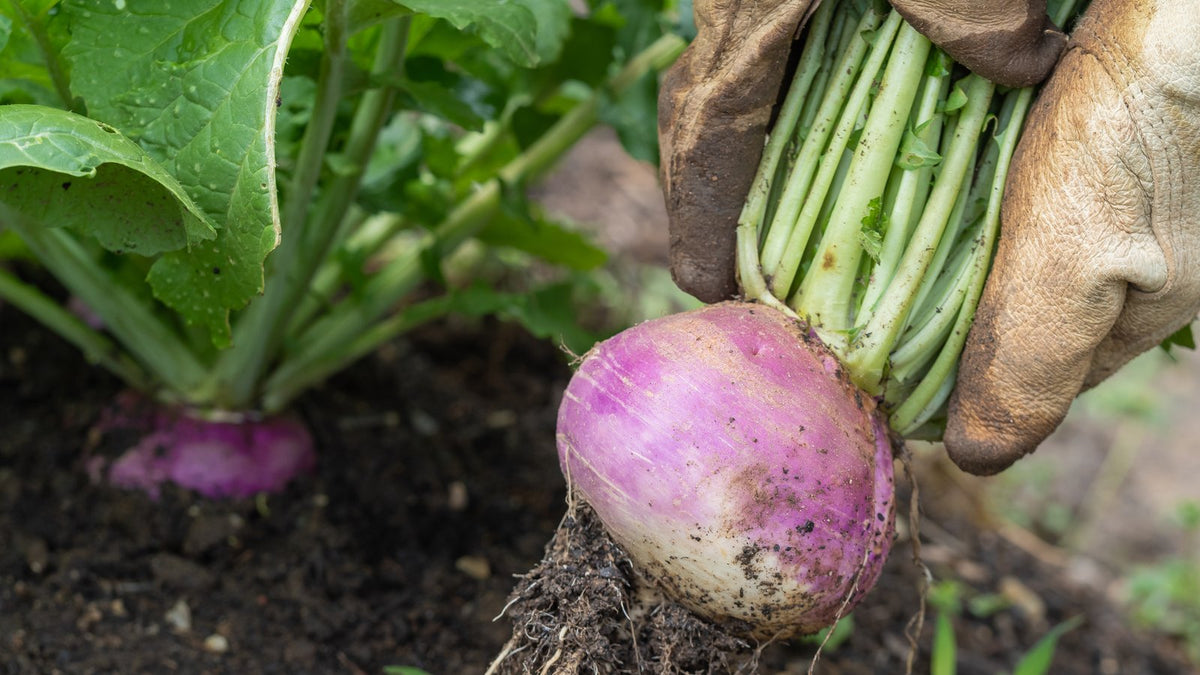

The short version: Turnips and swedes are cool-season brassicas, sown direct 10 to 15 mm deep into loose, compost-fed soil and thinned early. Turnips are the quick crop: pull them small, from about 7 weeks (5 for the Japanese salad types), before heat or age turns them woody. Swedes are the slow keeper: sow in late summer or early autumn, lift from 8 to 10 cm across, sweeter after a frost, and store them cold and humid. Even water, the right window and a timely harvest head off woody, hollow and bolted roots.
The two get muddled in the seed drawer and at the dinner table. A swede is the big one with yellow flesh and a purple shoulder, built for a long winter in the ground; a turnip is smaller, usually white inside, and in a hurry.
Sow a row of either in autumn and forget it for two months, and you find sweet golf balls or something that could prop a door open.
Turnip or swede: which is which
Turnips are Brassica rapa; swedes are Brassica napus var. napobrassica, a natural cross between turnip and cabbage. Agriculture Western Australia's farmnote on the two crops tells a swede by its greyish green, deeply lobed, smooth leaves and the distinct neck between root and leaves, a maturity of 90 to 120 days against 60 to 80 for a turnip, and a root base that is light yellow rather than white.
Champion Purple Top is the swede to look for: yellow roots with deep purple crowns, 10 to 15 cm across. Purple Top White Globe is the classic turnip, best at 5 to 8 cm, and the Japanese salad turnips such as Tokyo Cross F1, ready from about 35 days, carry more moisture than the main varieties, the farmnote says, so they suit eating raw.
Sowing: direct, shallow and thinned early
Sow both where they will grow; the taproot sulks when moved. Prepare a sunny bed to a fine tilth with compost dug in a few weeks ahead and skip fresh manure, because too much nitrogen gives lush tops and misshapen roots. Aim for a pH of 6 to 7, and lime a bed below 5.5 at least three months ahead.
- Sow 10 to 15 mm deep, seed 2 to 3 cm apart, in rows about 30 cm apart for turnips and 30 to 50 cm for swedes. Swede seed germinates best in soil between about 7 and 25°C.
- Keep the row damp until seedlings show in 7 to 10 days, then mulch along the rows with straw.
- Thin at about 5 cm tall: turnips to 10 to 15 cm, swedes to 15 to 20 cm, or, for Tokyo Cross F1 pulled as baby roots, 2.5 cm in rows 15 cm apart. Crowded roots stay small and misshapen.
Thinnings from untreated seed can go into a salad; the guide to thinning carrots, beetroot and radish covers the two-pass method.

When to sow in each climate zone
The windows below combine the Gardening Australia magazine and ABC Organic Gardener planners, Green Adelaide, the Canberra Organic Growers Society and the Western Australian farmnote, none of which uses these six zones, so treat them as a starting point.
- Tropical (the Northern Territory's Top End and Darwin; Cairns and Townsville in tropical Queensland): turnips as a dry-season crop, sown roughly April to June, with the quick Japanese types the better bet. Swedes need cool months the north does not offer; the Gardening Australia magazine planner's April to June swede window is one to try, not to count on.
- Subtropical (Brisbane, south-east Queensland and New South Wales north of Coffs Harbour): turnips from about April to July. Swedes are marginal; sow in March or April so they fill before spring warmth.
- Arid and semi-arid (the Northern Territory around Alice Springs, Broken Hill and the New South Wales far west, Mildura in Victoria's Mallee, Kalgoorlie in Western Australia): turnips from about March to May and again in August, mulched and watered steadily; swedes in March or April.
- Temperate (Sydney and the coast of New South Wales, Melbourne in Victoria): turnips from February to May and August to October; swedes in February or March for a winter harvest.
- Mediterranean (Perth and the south of Western Australia, Adelaide and its plains in South Australia): the Agriculture Western Australia farmnote says both grow through the year around Perth but do best sown in summer and autumn for winter and spring harvests. Green Adelaide, the South Australian government program, lists turnips from November to March and swedes from April to September; heat turns both woody, so favour the sowings that mature in winter and spring, as around Perth.
- Cool and alpine (Tasmania, the ACT and Canberra, Ballarat on Victoria's central highlands, the tablelands of New South Wales at Orange and Armidale, Stanthorpe on Queensland's Granite Belt): the Canberra Organic Growers Society sows swedes in February and turnips in February to March for winter roots, with Japanese turnips again from August to October.
The zones are broad groupings. A garden between two of them should go by its own frost dates and how warm the soil feels, not the label.
Harvest: turnips small, swedes after the cold
Pull turnips from golf-ball size, which the Gardening Australia magazine puts at about seven weeks (five to seven for the Japanese types), and before they pass about 8 cm; left bigger, the Canberra growers warn, they turn woody and tough. The Japanese kinds keep about two weeks in the fridge with the leaves twisted off.
Frost does not harm swedes (turnips may be slightly marked), and the Canberra growers note that flavour improves after a few frosts as starches turn to sugars. Lift them from 8 to 10 cm across, the farmnote's best size (they will grow bigger), 90 to 120 days from sowing: loosen with a fork, twist off the tops leaving about 2 cm of stem, brush off the soil without washing, and store them cold, dark and humid. The four to six months the farmnote gives needs a store near 0°C at high humidity, so expect less from a cool shed. In cold gardens they can stay in the ground through winter, but lift them before spring, when longer days and warmth send them to seed and the root goes woody.

The greens are a crop too
Pick outer leaves from about four weeks, leaving four to six on each plant so the root keeps filling; young leaves go raw into salads, larger ones are cooked, and swede leaves can be picked sparingly. A row that stalls in a hot spell still pays its way as greens.
Why they go woody, hollow or bolt
- Heat. Prolonged heat makes turnips strong-flavoured and woody, and swede roots develop best below about 24°C. The Utah State University extension sheet on the two crops adds bitter or off flavours when heat meets short water.
- Uneven water. The same sheet lists cracking, woody roots and pithiness (a dry, spongy, hollow centre) as the result of moisture swinging between dry and soaked. Give about 25 mm a week, rain included (the Canberra growers' swede figure), mulch, and keep water up in hot, windy weather, which otherwise browns the flesh inside. Brown flesh in a well-watered root can instead be a boron shortage, which the farmnote also lists; test the soil before adding any, because the margin to too much is narrow.
Bolting follows a different logic. Both are biennials grown as annuals, so cold followed by warmth and longer days tells the plant that year two has arrived: the farmnote records more bolting from late-autumn sowings after prolonged temperatures below 10°C, and bolted plants have hard roots. Heat or dry soil can trigger it in Japanese turnips. The fixes are the windows above, water through warm spells, and lifting overwintered roots before spring; the guide to why vegetables bolt covers the triggers.
Pests, clubroot and the rotation
A quick turnip crop outruns most pests, but both are brassicas: diamondback moth and cabbage white caterpillars in spring and autumn, snails and slugs in cool weather, aphids under the leaves. Fine insect mesh from sowing keeps the moths and butterflies off, and the guide to cabbage white and diamondback caterpillars covers Bt. Hose aphids off or use an insecticidal soap registered for vegetables, as its label directs, and check under the netting weekly, because aphids build up beneath it.
The Victorian Department of Primary Industries note on clubroot describes plants that wilt in hot, dry weather, stay stunted and show knotted swellings on the roots, with spores that survive in soil for at least 20 years, worst in wet, poorly drained, acid beds. Bin affected plants rather than composting them, improve drainage, test the soil and lime an infested bed to pH 7 to 7.5, clean your boots and tools, and rest that bed from brassicas for the farmnote's four years at least, which holds clubroot down rather than clearing it. Turnips and swedes belong with the cabbages in your crop rotation, not with the carrots.
A note on treated seed
Some turnip seed is sold fungicide-treated, so read the packet or listing. Do not eat treated seed or feed it to animals, keep it away from children and pets, wear gloves and wash your hands after handling it. The crop grown from it is edible; for salad thinnings, choose untreated seed.
Frequently asked questions
Can I grow swedes in Brisbane or Darwin?
Marginal in Brisbane, where a March or April sowing is the best bet and roots run smaller, and a poor fit in Darwin, where quick Japanese turnips in the dry season are the better crop.
Why are my turnips hollow inside?
A dry, spongy centre follows swings between dry and soaked soil, worst on roots left too long or grown through heat. Water evenly, mulch, and pull them between golf-ball size and 8 cm.
Should I start turnips or swedes in punnets?
Sow in place if you can; the taproot transplants badly. If you must, the Gardening Australia magazine plants swede seedlings out as soon as they can be handled. A short row every few weeks beats one long row.
Why did my turnips flower instead of making a root?
A cold spell followed by warmth, which tells a biennial its second year has come, or heat and dry soil on a spring sowing. The root stays hard, so pick the greens and resow inside your zone's window.
Sow a short row of turnips, give a swede a corner that can be left alone until winter, and keep the water even: the roots do the rest.
Related growing guides
- Why root crops grow all top and no bottom
- Why vegetables bolt
- Cabbage white and diamondback caterpillars
- Storage crops that keep for months
Browse the turnip seeds for the quick crop and the salad types, and the swede seeds for the winter keeper.