
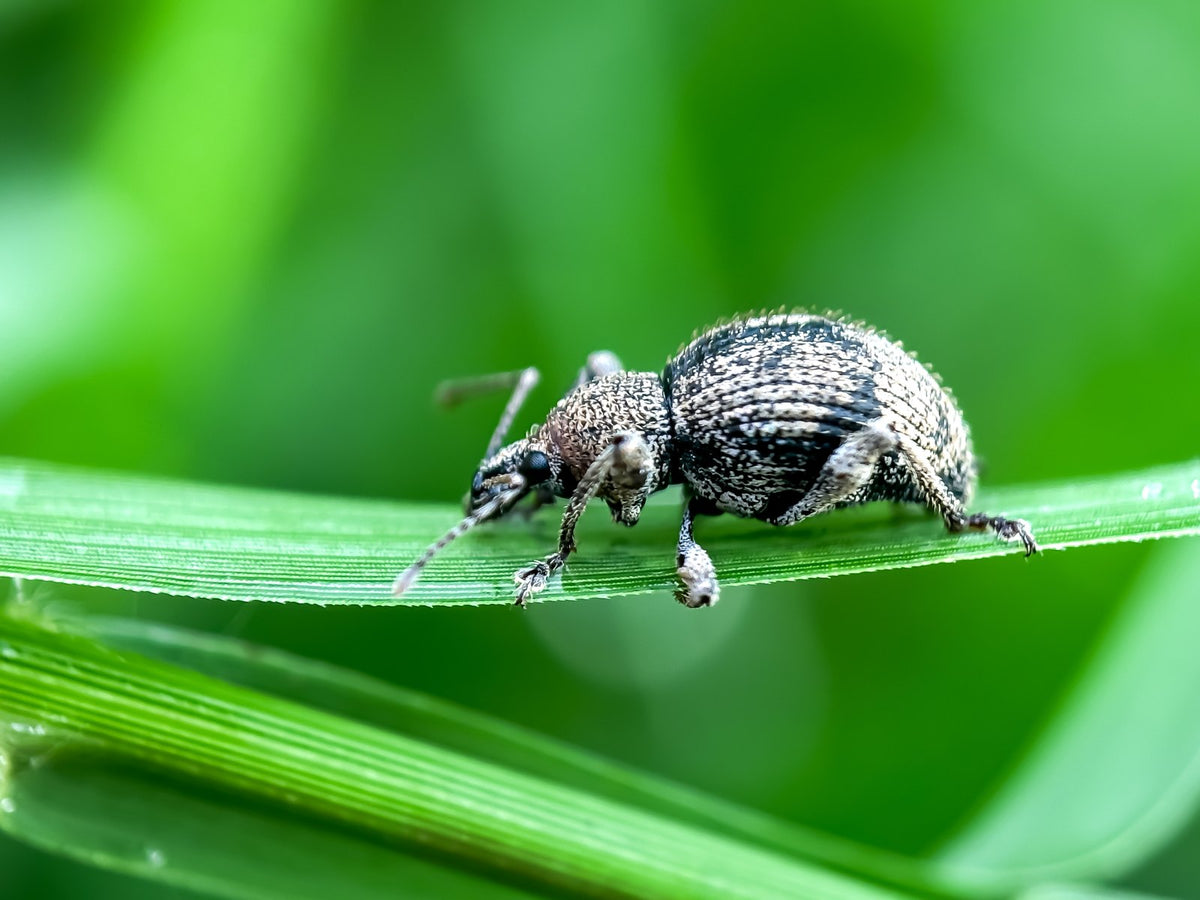
The short version: Garden weevils are small, flightless beetles that feed at night and hide by day, leaving neat scalloped notches around leaf edges, while their grubs chew roots out of sight in the soil. Because the adults cannot fly, sticky barrier bands around stems and pots work well, alongside night patrols, trap boards and clearing the daytime shelter they hide in. Broad sprays are of limited use, since the adults are hidden by day and the grubs sit in the soil.
Weevils are easy to overlook, because you rarely catch them in the act. The plants show neat notches bitten out of the leaf edges, seedlings get ringbarked, and strawberries turn up scarred, but the culprits are tucked away under mulch until dark.
Knowing that these beetles cannot fly is the key to controlling them, because it means a simple barrier can keep them off your plants.
How to spot garden weevils
Several weevils share the same habits in Australian gardens. The garden weevil (Phlyctinus callosus) is a flightless beetle about seven millimetres long, mottled grey-brown with a pale band across its rear, established across the southern states. The vegetable weevil (Listroderes difficilis) is a little larger and unusual in that both the adults and the grubs feed above ground on foliage. Whitefringed weevil is larger again, at 10 to 13 millimetres, with pale side stripes and root-feeding grubs.
The key split is between the adult and the larva. The adult beetle chews notches into leaf edges above ground, while the legless, cream to grey-white grubs live in the soil and chew roots. The adults feed at night and hide by day, and the garden weevil will drop and play dead when disturbed. Look for scalloped or notched leaf edges, ringbarked seedlings, scarred strawberries, and wilting or loss of vigour where grubs have been at the roots.
Why they are hard to catch
Most of these weevils have one generation a year. Garden weevil adults emerge in spring, around October, and feed through the warm months, laying eggs in leaf litter and soil. The grubs burrow down to chew roots, then pupate in the soil, so the damage peaks from spring into summer. The vegetable weevil runs on the opposite timing, as a cool-season pest active from autumn through early spring.
By day the adults shelter in mulch, debris, curled leaves and under loose bark, which is exactly why a contact spray so often misses them, and why the grubs in the soil are out of reach of anything sprayed on the foliage. Barriers and hygiene get around both problems.
How to control garden weevils organically
- Band the stems and pots. Because these weevils cannot fly, they must walk up to feed, so a greasy or horticultural sticky band around a trunk, stem, pot rim or pot leg stops them in their tracks. This is one of the most effective measures.
- Patrol at night. Go out with a torch and hand-collect the adults into soapy water while they are feeding.
- Set trap boards. Lay a board, rolled damp cardboard or hessian near the beds. The weevils shelter underneath by day, and you can collect and destroy them in the morning.
- Remove the daytime shelter. Clear leaf litter, debris and weeds around seedlings, and turn the soil to expose eggs and grubs to birds.
Protect seedlings with collars, keep plants vigorous and well spaced, and encourage the birds, frogs, poultry and predatory beetles that feed on weevils. Do not lean on broad foliar sprays, which reach only the exposed adults at night and do nothing for the grubs in the soil. Barriers plus hygiene do far more.
How to keep garden weevils down
- Band pots and stems before the spring emergence, so the barrier is in place when the beetles start moving.
- Keep mulch and debris clear of seedling stems, since that is where the adults shelter.
- Rotate and rest beds, and turn the soil over winter to expose grubs and pupae.
- Protect strawberries, a favourite target, with barriers and by keeping the surrounding area tidy.
Garden weevils across Australia's climate zones
- Cool and alpine (Tasmania, alpine Victoria and New South Wales): garden weevil is well established, and the cool-season vegetable weevil is active.
- Temperate (Sydney, Melbourne, coastal New South Wales and Victoria, southern South Australia): both are common, with garden weevil peaking from spring to summer.
- Mediterranean (Perth and south-west Western Australia, Adelaide and South Australia): the prime garden weevil climate of wet winters and dry summers, and a classic garden and vineyard pest.
- Subtropical (south-east Queensland, northern New South Wales): garden weevil is less dominant, and the vegetable and whitefringed weevils are more relevant.
- Tropical (far north Queensland, the Northern Territory, northern Western Australia): garden weevil is largely absent, as summer heat is lethal to its eggs, though whitefringed and vegetable weevils occur.
- Arid and semi-arid (inland areas such as Alice Springs in the Northern Territory): pressure is low and tied to irrigated beds, with vegetable weevil possible.
Frequently asked questions
What is notching my leaf edges overnight?
Adult weevils. They scallop the leaf margins after dark and hide by day, which is why you see the damage but not the beetle.
Is it a weevil, an earwig or a caterpillar?
Weevils leave clean edge notches and no droppings. Caterpillars leave frass and often chew the middle of leaves. Earwigs make ragged holes and hide in tight crevices.
Why do barriers work so well?
These weevils are flightless, so they must walk up a stem to feed, and a sticky or greasy band simply blocks the climb.
Are the grubs in my soil eating the roots?
Yes. The legless larvae chew roots, which shows up as wilting and a general loss of vigour in the plant above.
What is damaging my strawberries?
Garden weevil adults chew the fruit and crowns, and the grubs chew the roots, so strawberries can be hit both above and below ground.
Which weevil do I have?
As a rough guide, about seven millimetres and active in spring to summer is garden weevil, about eight millimetres in autumn to winter with leaf-eating grubs is vegetable weevil, and 10 to 13 millimetres with root grubs on legumes is whitefringed weevil.
Band the stems, tidy the shelter and pick a few off at night, and flightless weevils lose their easy path to your plants.
Related growing guides
Ready to plant? Browse our vegetable seeds and herb seeds for the season ahead.