
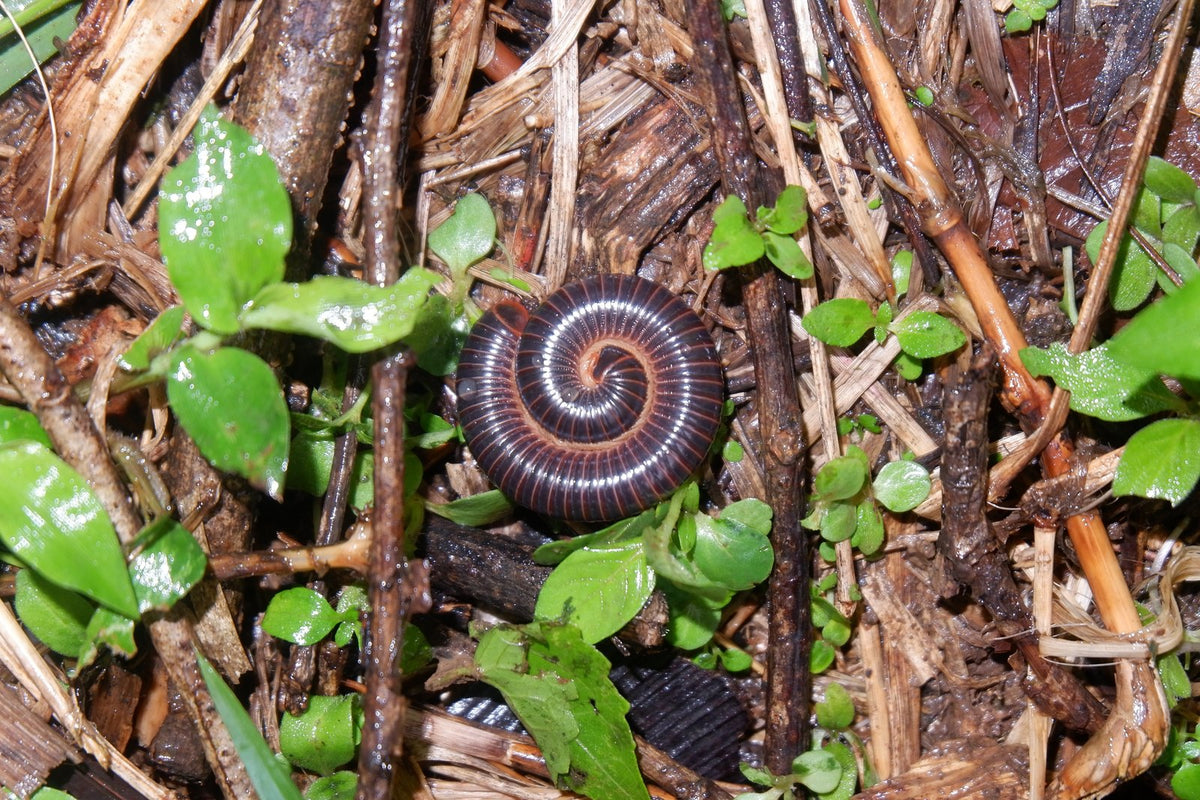
The short version: Most millipedes are slow, harmless decomposers that do good work in soil and compost, so they are not usually a garden problem. The exception is the introduced Portuguese millipede, which swarms into homes in autumn and, in large numbers, can nibble seedlings and soft fruit. Manage it by reducing damp shelter, sealing and lighting the house against invasion, and leaving the beneficial native millipedes alone. Direct damage to plants is usually minor.
Millipedes tend to alarm people more than they should. They turn up in numbers under mulch, curl into a neat spiral when disturbed, and every so often pour into a house on an autumn evening. Most of the time, though, they are quietly recycling dead leaves.
The key is telling the beneficial natives from the one introduced species that genuinely causes trouble, and then dealing with that trouble where it actually occurs, which is often the house rather than the garden bed.
How to spot the pest millipede
The one to know is the Portuguese millipede (Ommatoiulus moreleti), a smooth, glossy, dark grey to black cylinder that curls into a tight spiral when disturbed. Native millipedes, by contrast, are usually duller, often flatter or more obviously segmented, present in low numbers, and rarely glossy black. Adults are around 30 to 45 millimetres long with roughly 50 segments and many legs, moving slowly.
Do not confuse millipedes with centipedes. Centipedes are fast predators with a single pair of legs per segment and venomous fangs, while millipedes are slow, have two pairs of legs on most segments, and have no fangs. When disturbed, Portuguese millipedes release a pungent yellowish secretion that can stain and irritate the eyes and skin, so wash it off and avoid rubbing your eyes.
Why they matter, and often do not
Millipedes are mostly detritivores, feeding on leaf litter, decaying matter and fungi, which makes them genuinely useful in compost and soil. The Portuguese millipede is chiefly a nuisance because it swarms, invading homes in autumn, especially after rain, and it is strongly drawn to light. In large numbers it can graze seedlings, strawberries and soft ripe fruit, and damaged tissue, but in a home garden the direct plant damage is usually minor and secondary. They much prefer decaying matter.
They are active and breeding in the cooler, wetter months, from autumn to spring in southern Australia, sheltering in mulch, leaf litter and damp soil. The mass surface movement that leads to home invasions follows autumn rain.
How to manage Portuguese millipedes
- Reduce damp shelter. Thin heavy mulch, clear leaf litter and debris away from house walls and beds, and manage moisture so there are fewer cool, damp hiding places.
- Defend the house. Fit physical barriers such as smooth barrier rails or moat-style traps, seal gaps at doors, windows and vents, and cut outdoor lighting near entries, since light draws them in.
- Use light traps and sweep up strays. Light traps catch many, and indoor strays are best swept or vacuumed up.
- Protect at-risk plants. Remove decaying fruit, raise pots, and protect seedlings only where you can see the millipedes are actually grazing them.
Leave native millipedes alone, as they are beneficial and need no control. Broad chemical sprays are largely ineffective against a swarm and kill the beneficial creatures you want to keep, so they are not the answer.
How to keep millipede trouble down
- Keep a dry, clear strip between garden mulch and the house wall to slow autumn invasions.
- Fix leaks and improve drainage around the house and beds so the surrounds are less damp.
- Reduce or shield outdoor lighting near doors during the autumn movement, since light draws them in.
- Compost with confidence, since millipedes in the heap are doing useful work.
Millipedes across Australia's climate zones
- Tropical (far north Queensland, the Northern Territory Top End): the Portuguese millipede is essentially absent, so you will see native decomposers only.
- Subtropical (Brisbane and northern New South Wales): largely a non-issue, with mostly beneficial natives.
- Temperate (Sydney, Melbourne, Canberra, southern New South Wales): the core Portuguese millipede zone.
- Cool and alpine (Tasmania, alpine Victoria and New South Wales): cool, wet conditions suit them, and they are well established in Tasmania.
- Arid and semi-arid (inland South Australia, New South Wales and Western Australia): generally too dry for big swarms, with activity localised around irrigation and towns.
- Mediterranean (Adelaide and southern South Australia, south-west Western Australia): a classic hotspot for autumn swarms and home invasions.
Frequently asked questions
How do I tell a millipede from a centipede?
A millipede has two pairs of legs on most segments, moves slowly and is harmless. A centipede has one pair per segment, moves fast and has venomous fangs.
Are millipedes harmful to plants?
Usually only minor. They mostly eat decaying matter, though in large numbers they can nibble seedlings and soft fruit.
Why do they invade the house in autumn?
Autumn rain triggers mass surface movement, and they are drawn indoors by light.
Do they bite or sting?
No. They have no fangs or venom. They only release an irritating, smelly secretion when disturbed.
How do I tell native from Portuguese millipedes?
Natives are usually dull, few in number and beneficial. The Portuguese millipede is glossy black, swarms, and enters homes.
How do I keep them out of the house?
Use barriers and sealing, reduce outdoor light near entries, set light traps, keep the surrounds dry, and sweep or vacuum any that get in.
Sort out the damp and the lighting around the house, leave the natives to their work, and millipedes can go back to being one of the more useful things in your soil.
Related growing guides
Ready to plant? Browse our vegetable seeds and herb seeds for the season ahead.