
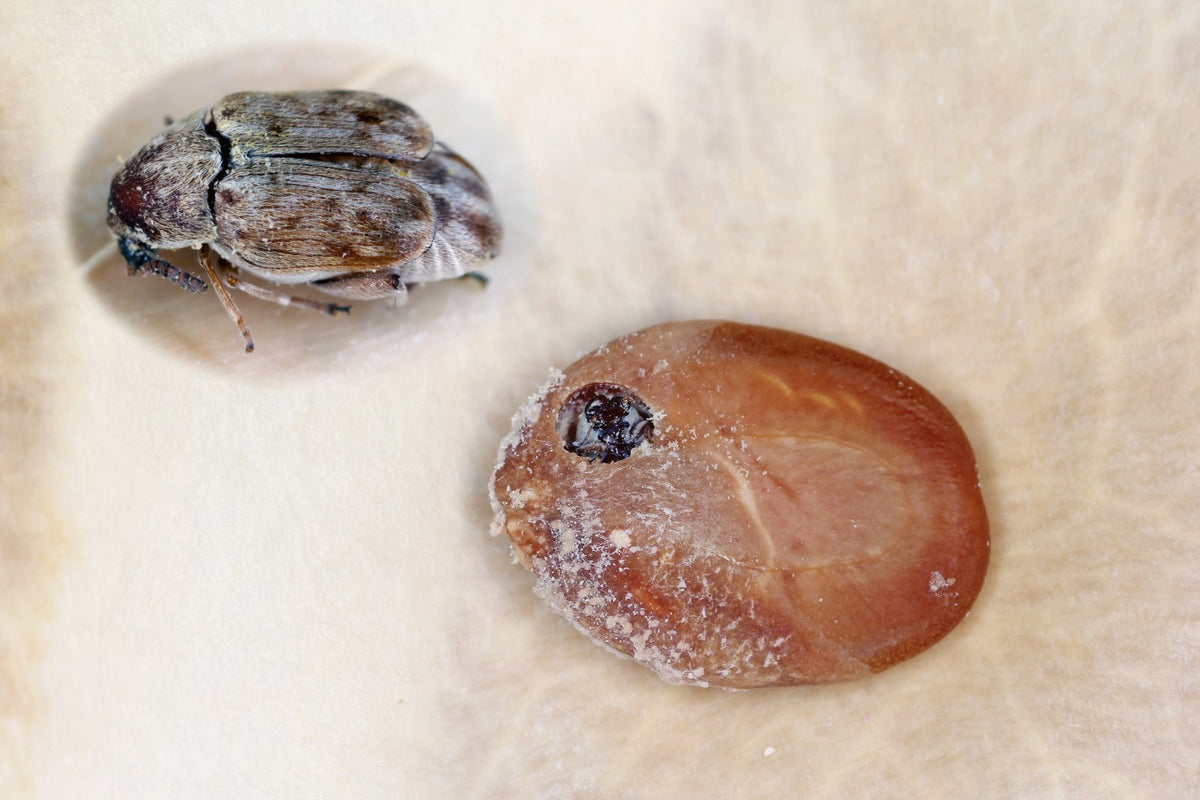
The short version: Pea weevil is a small beetle whose larvae develop hidden inside pea seeds, so the tell-tale sign is a neat round hole in a dried pea with a grub inside. It is mainly a problem for seed savers and stored peas. The practical controls are to freeze your dried and saved peas to kill any larvae, store them airtight, discard holed seed, and start with clean, certified seed. It is a pest of peas only, not broad beans.
Pea weevil is one of those pests you often discover after the fact, in the jar rather than the garden. You tip out last season's saved peas to sow, and there are neat little holes drilled through them, sometimes with a grub still inside.
The good news is that a freezer and an airtight jar handle it, and once you know the life cycle, saving your own pea seed is straightforward.
How to spot pea weevil
Despite the name, pea weevil (Bruchus pisorum) is a bruchid, or seed beetle, rather than a true weevil, and it lacks the long weevil snout. The adult is a chunky beetle about five millimetres long, brownish and flecked with white, black and grey, with a white abdomen tip marked by two black oval spots. The clearest sign, though, is the damage: neat round exit holes about three millimetres across in dried peas, and a legless cream grub curled inside infested stored or seed peas.
In the garden, the adults feed on flowers and pollen and lay small yellow, cigar-shaped eggs on young green pods, and the larva bores straight into the developing seed. Do not confuse it with the sitona, or pea leaf, weevil, which chews scalloped notches around the margins of seedling leaves and whose grubs feed on root nodules. Both can appear on peas, but they are different pests.
Why it is a seed-saver's problem
Pea weevil has just one generation a year. The adults shelter through summer, autumn and winter in sheds, in bark and in stored seed, then emerge in spring around pea flowering. The females must feed on pea pollen before they can lay, after which they lay on the young pods. The larva feeds inside a single seed for around 40 to 50 days, pupates for a couple of weeks, then chews its way out through that round exit hole.
Because the whole larval stage happens inside the seed, the pest is carried over from year to year in stored and saved peas. That is exactly why the freezer is the seed saver's best tool, and why clean seed matters so much.
How to control pea weevil
- Freeze your saved and dried peas. Dry the peas fully, seal them in an airtight container, and freeze them to kill any larvae inside. Let the sealed container return to room temperature before opening, so moisture does not condense on the seed.
- Store airtight and inspect. Keep peas in an airtight container in a cool, dark, dry spot, and discard any holed seed as you go.
- Start clean. Sow clean, certified seed, and remove volunteer and spilled peas that carry the pest over.
- Tidy the patch. Clear crop debris and destroy infested pods, and sow early so pods fill before adult numbers peak.
There is no easy home spray for pea weevil, and no biological control agent is registered for it in Australia, so the freezer, clean seed and good hygiene are the real controls. Commercial growers use border sprays before egg-lay and seed fumigation, neither of which is needed at home. For the separate sitona, or pea leaf, weevil, protect young seedlings and keep them vigorous so they grow through the cosmetic notching, and hand-collect the adults at night.
How to keep pea weevil down
- Freeze every batch of saved pea seed before you store it, as a matter of routine.
- Label and date your seed, and cull holed peas each time you handle the jar.
- Do not leave old or spilled peas lying in the garden over summer.
- Buy fresh, clean seed if you are ever unsure of a saved batch.
Pea weevil across Australia's climate zones
Peas are a cool-season crop, so the timing follows the pea season in each zone.
- Cool and alpine (Tasmania, alpine Victoria and New South Wales): a key risk zone, so always freeze saved seed.
- Temperate (coastal and inland Victoria, New South Wales, lowland South Australia): adults emerge as the spring pods form, so sow early and check saved seed.
- Mediterranean (Perth and south-west Western Australia, Adelaide and southern South Australia): well established in these grain-belt regions, so airtight storage is essential.
- Subtropical (south-east Queensland, northern New South Wales): grow peas in the cool, dry season, and still freeze saved seed.
- Arid and semi-arid (inland New South Wales, South Australia and Western Australia, central Northern Territory): low humidity limits it, but stored-seed hygiene still matters.
- Tropical (far north Queensland, the Northern Territory Top End, the Kimberley in Western Australia): peas grow only in the cool dry season or the highlands, so it is not a field pest here, but freeze any seed brought from the south.
Frequently asked questions
There are round holes and grubs in my dried peas. What is it?
Pea weevil. Each three millimetre hole means an adult has chewed its way out, and a grub still inside is a developing larva.
Is it pea weevil or pea leaf weevil?
Pea weevil bores into the seeds, so you see holes in the peas. The sitona, or pea leaf, weevil notches the leaf margins and its larvae eat root nodules. They are different pests.
Can I really freeze seed peas to kill them?
Yes. Dry the peas fully, seal them airtight, freeze them, then let the container reach room temperature before opening. Well-dried seed stays viable.
Can I eat or plant holed peas?
Holed peas are safe to eat but poor quality, so cull them. They will not germinate, so do not sow them.
Are the notches on my pea seedling leaves pea weevil?
No, that is the sitona, or pea leaf, weevil. It is usually cosmetic on healthy plants, so just protect young seedlings.
How should I store saved pea seed?
Dry it thoroughly, freeze it to kill any hidden larvae, then keep it airtight in a cool, dark, dry spot, discarding holed seed and labelling the batch.
Freeze the seed, store it airtight, and start clean, and pea weevil has little chance to carry over into next season's rows.
Related growing guides
- Garden weevils and their leaf-notching kin
- Organic pest control in Australia
- Garden hygiene to reduce pests and disease
Ready to plant? Browse our vegetable seeds, including our range of peas for the cool season.