
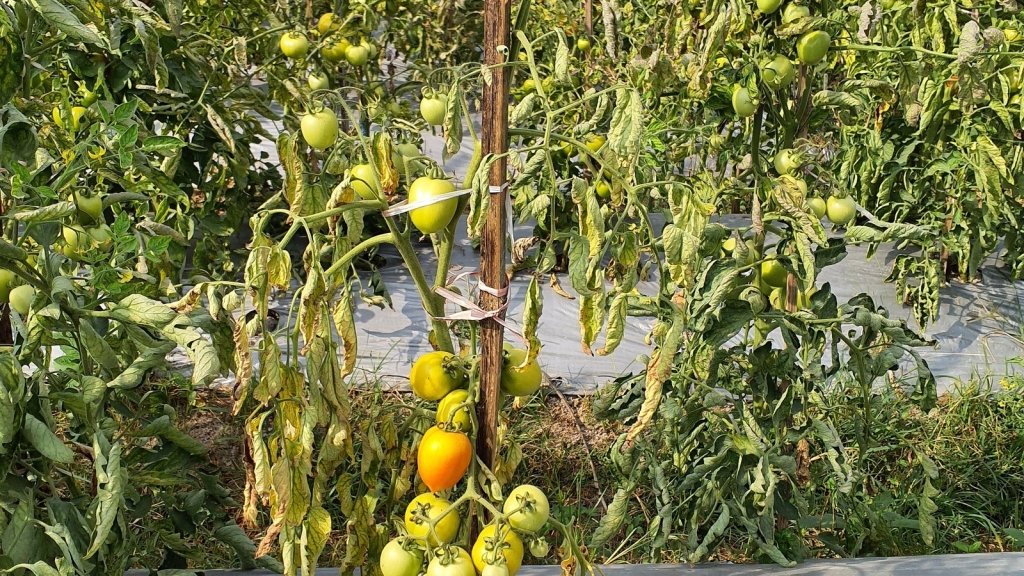
The short version: A vascular wilt is a soil pathogen blocking the plumbing inside the stem, so a healthy plant flops in the heat, recovers overnight, then collapses for good, often one branch first. Cut the stem low down: brown streaking in the water conducting tissue confirms a vascular wilt, and white threads streaming from a cut stem stood in a glass of water separate bacterial wilt from fusarium and verticillium. There is no cure. Pull the plant, keep it out of your own compost, grow the next crop in fresh mix, and give that bed a long break from the family.
A 34 degree afternoon, and the biggest tomato in the bed hangs like wet washing even though you watered that morning. By breakfast it looks fine. Three days later half the plant is yellow while the other half sets fruit, and within a fortnight it is dead with the fruit still on it. Moist soil, no leaf spots, nothing chewed. Then it happens again in the same square metre next summer, and the repeat is the clue.
Australian melon work describes it exactly: wilting can be temporary at first, with plants recovering through the night, then permanent, often starting on one side.
Three wilts, and where each one occurs
Fusarium wilt comes from Fusarium oxysporum. Business Queensland lists basil, brassicas, cucurbits, lettuce, alliums, pea, potato, snake bean, ginger and tomato among its hosts and says it can survive in the soil for decades. It has more than a hundred formae speciales, each with a short host list, so the fusarium that kills your tomatoes is not the one that kills your basil.
Verticillium wilt is mostly Verticillium dahliae, which survives for years as microsclerotia under a millimetre across, on a host list from potato and tomato to strawberry, stone fruit and nightshade weeds. It suits the cooler south: potato seed tubers from Victoria and Tasmania carried three Verticillium species, V. dahliae in 27.7 per cent of them.
Bacterial wilt has a limited range. A 2024 review by the Northern Territory and Queensland departments reports Ralstonia solanacearum present in Queensland, the Northern Territory, New South Wales, Victoria and South Australia, and not present in Western Australia or Tasmania. DPIRD says it is not known to occur in Western Australia and must be reported.
Checks you can do at the kitchen bench
- Water deeply and wait a night. A plant upright three days later was thirsty.
- Lift it and wash the roots. Knots swelling the root are root-knot nematode, and brown, soft roots in a wet bed mean root rot.
- Cut the main stem low, across and lengthways. Browning inside says a vascular wilt, not which one. Fusarium shows as a reddish brown discolouration of the water conducting tissue. Plant Health Australia, on cotton, separates them by pattern: verticillium gives dark streaks and brown flecking rather than continuous browning.
- Whatever the browning looks like, stand a washed length of base stem in a glass of clear water, because bacterial wilt discolours the same tissue. White streaks of bacterial cells flow from the cut end within three to five minutes if it is there.
- Check the collar. White cottony growth with round resting bodies is sclerotium rot, or southern blight; white fluff with black bodies on a plant that lifts out easily is sclerotinia.
Separating verticillium from fusarium by eye is guesswork, and a pathology service gives the real answer. At home the response is the same.
The look-alikes
- Waterlogging and root rot. Drowned roots cannot drink, and the stem interior stays clean.
- Sudden wilt. In capsicum and melons, Queensland blames Pythium and Fusarium plus high soil temperatures, with plastic mulch pushing soil past 35 degrees.
- Damage at the stem base. A chewed ring, or a hole with sawdust-like frass, means a caterpillar or borer.
- Virus. Mottled, distorted growth with no stem browning belongs with mosaic virus.
- Overseas advice. The beetle-borne cucumber wilt bacterium Erwinia tracheiphila is not present in Australia.
What to do now
- Accept that the plant is finished. Business Queensland is blunt about bacterial wilt: there is no treatment for the affected crop. Verticillium has no effective fungicide treatment, and a Hort Innovation funded Soil Wealth melon fact sheet notes no chemicals registered in Australia to control fusarium.
- Pull it whole on a dry day, roots and all, into a bag.
- Keep it out of your own compost. The Australian Standard sets pasteurisation at 55 degrees for three consecutive days before each of three turns, which is what destroys plant pathogens, and a backyard heap seldom holds it. Use the rubbish bin, or a council service that composts to the standard.
- Hose the soil off boots, tools, stakes and pots, disinfect blades and pots, and work that bed last, as in our garden hygiene guide.
- Pull the weeds and self-sown seedlings, because bacterial wilt carries over in residues and weed hosts, and fusarium survives on volunteers.
- Give the family a long break. Queensland advises keeping potatoes, tomatoes and other hosts off the site for two years at least, five for preference.
Bagging one plant takes ten minutes. Rebuilding the crop plan is the real cost, and with verticillium it runs to years.

What the letters on a seed packet cover
V is verticillium, F fusarium, FF the first two fusarium races, FFF three, N root-knot nematode, as the University of California explains. Each code is a claim about a named pathogen and named races, so a tomato marked FF is unprotected against a third race and says nothing about the fusarium of basil or melons. Resistance is not immunity either: the International Seed Federation defines it as the ability of a variety to restrict the growth and development of a specified pest, and says resistant varieties may still show symptoms under heavy pressure.
Races move, too. In Australian rockmelons, every New South Wales isolate tested in 2016 was race 1 and every one in 2023 was race 1.2, with no commercially resistant varieties known. The letters say nothing about bacterial wilt, sclerotinia or sclerotium rot, and no code keeps a plant alive in a soggy bed.
Why rotation alone does not beat verticillium
Rotation starves a pathogen of its host, so it works in proportion to how fussy that pathogen is. Fusarium is fussy, so an unrelated crop family is a real break even though spores persist. Bacterial wilt survives up to four years in soil and plant debris with weed hosts keeping it going, while a Pacific Pests fact sheet puts survival without a host at about nine months. Estimates vary, which is part of why Queensland advises five years.
Verticillium defeats a tidy four bed rotation: a huge host list including common weeds, and microsclerotia that wait for years. Biofumigant brassica crops and summer solarisation lower the population, as our brassica biofumigation guide explains, but lowering is not clearing, so treat crop rotation as one tool of several.
Keep cropping while the bed recovers
All three live in the soil and enter through the roots, so putting the roots somewhere else works. Grow tomatoes, capsicums, eggplants and melons in large pots, grow bags or a tub of fresh mix on the ground, in clean containers, mulched so splash does not carry old soil up. In the bed, plant what has not failed there, lean on leafy greens, alliums, corn and legumes, and keep notes.

Which wilt is likely in your climate zone
- Tropical (the Top End of the Northern Territory, far north Queensland, the Kimberley in Western Australia): bacterial wilt leads in the Territory and Queensland, fast in hot, wet weather. It is not known in Western Australia, so report a suspected case to DPIRD.
- Subtropical (south-east Queensland, the northern New South Wales coast): both bacterial and fusarium wilt occur, so treat a one-day collapse as bacterial wilt until the water test says otherwise.
- Arid and semi-arid (Alice Springs in the Northern Territory, Broken Hill in New South Wales, Mildura in Victoria, inland South Australia, Kalgoorlie in Western Australia): most midday wilting is heat and dry soil, so check water first. Where melons and tomatoes grow under irrigation, fusarium is the wilt to rule out.
- Temperate (Sydney and coastal New South Wales, Melbourne and most of Victoria, the South Australian coast): verticillium is the likelier wilt, while Ralstonia is recorded in Victoria and New South Wales mainly from potato and tomato.
- Mediterranean (Perth and the south-west of Western Australia, Adelaide and southern South Australia): Western Australia is free of bacterial wilt and it is reportable there, so suspect verticillium, diagnosed in south-west avocado orchards in 2019. South Australia has controlled potato brown rot since a 1982 incursion, and also lists fusarium wilt of tomato as a significant plant pest, keeps tomato plants from the affected Queensland regions out, and asks for suspected cases on the Exotic Plant Pest Hotline, 1800 084 881.
- Cool and alpine (Tasmania, Ballarat in Victoria, Orange and Armidale in New South Wales, Canberra and the ACT, Stanthorpe in Queensland): bacterial wilt is not reported from Tasmania, and verticillium matters most, with Tasmanian isolates among the most aggressive on potato and eggplant in testing.
The zones are broad groupings, so if you sit between two, lean on local cues such as your first and last frosts.
Frequently asked questions
Is my soil ruined?
Changed, not ruined. Bacterial wilt fades over a few years with strict weed control, another crop family gets a clean run from a host specific fusarium, and verticillium is the long one, so grow its favourites above the soil.
My compost heap gets hot. Can I compost the plants then?
Not unless the whole mass holds above 55 degrees for days, turned so nothing sits cool at the edge, which most home heaps do not manage. The bin is the safer choice.
What about grafted plants?
Grafting onto a resistant rootstock is the commercial answer, used for melons and, in the Northern Territory, for tomatoes grafted for bacterial wilt control. Seed-raised plants carry no such protection.
Losing a big healthy tomato to something you cannot see is a rotten afternoon. The bed still owes you a harvest, and a bag of fresh mix is enough to collect it.
Related growing guides
Start again with fresh tomato seeds or anything else from our vegetable seeds.