
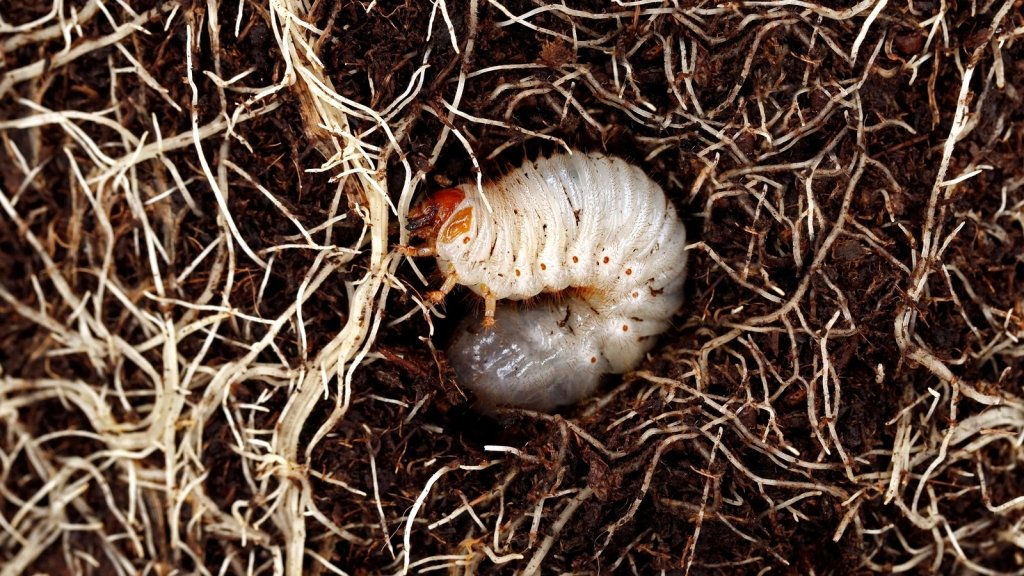
The short version: Fat white grubs with hard brown heads are scarab beetle larvae, and Australia has at least 2,300 scarab species, few of them pests. Where you found it is the clue: in compost, mulch or rotting wood it is a decomposer and can stay, while grubs among chewed roots under a dying lawn patch or a failing pot are worth acting on. Count before you act. Every product registered here against curl grubs is for lawn, turf, pots or ornamentals, not vegetable beds.
It usually starts with a pot. You tip out a sulking tomato and the mix falls apart around half a dozen creamy grubs, each curled into a tight C with a brown head. Or the lawn browns off in patches and a corner peels back like a mat.
What a curl grub actually is
A curl grub is the larva of a beetle in the family Scarabaeidae, and Australia has at least 2,300 scarab species. Cesar Australia describes three pairs of true legs near the head, a hard head capsule with visible mouthparts, and a body that holds its C at rest but straightens when the grub burrows.

The species worth knowing by name
- African black beetle (Heteronychus arator): introduced, a pest in Western Australia, South Australia, Victoria, New South Wales and Queensland, but not Tasmania. Larvae reach 25 to 30 mm, the adults damage stems too, and kikuyu sustains high numbers.
- Argentinian scarab (Cyclocephala signaticollis): an introduced turf pest, which Cesar Australia found pruning lucerne roots in Central West New South Wales after it was mistaken for a native.
- Redheaded pasture cockchafer (Adoryphorus coulonii): native to south-west and central Victoria, northern Tasmania, south-eastern South Australia and the southern tablelands of New South Wales. Larvae reach 30 mm, feed in the top 10 cm and peak from March to June.
- Yellowheaded cockchafer (Sericesthis species): sporadic in parts of New South Wales, Victoria and South Australia, damaging roots while feeding and while foraging for decayed matter.
- Blackheaded pasture cockchafer (Acrossidius tasmaniae): the odd one out, in Tasmania, Victoria, South Australia and New South Wales. Its larvae live in vertical tunnels and climb out at night to feed on foliage, so small soil mounds around holes are often the first sign.
- Christmas beetles (Anoplognathus species): native, 21 species in New South Wales, larvae feeding on grass roots and decaying organic matter for around 12 months. Sustainable Gardening Australia notes control is seldom needed now.
Root eater, decomposer, or something else entirely
Naming a garden scarab larva to species is hard: the separating features need magnification, and there is no garden equivalent of the pasture guides. Entomologists Tanya Latty and Chris Reid go by habitat and plant health instead.
- Larvae in decaying wood or mulch are wood feeders and useful composters, unlikely to harm plants.
- Larvae in a compost bin, or under plants that look healthy, can stay where they are.
- If plants are yellow or wilting and other causes are ruled out, then act.
A grub beside damage does not prove it caused the damage: Cesar Australia found yellow-headed larvae near chewed ryegrass that were actually Aphodinae dung beetles. Cutworms also curl into a C, but they are smooth caterpillars with fleshy legs down the body, and weevil grubs have no legs. Fly larvae such as the black soldier fly, Hermetia illucens, have no legs at all, and Gardening Australia rates them as a good thing to have because they eat vegetable scraps. In north Queensland a grey grub to 50 mm in compost is likely a rhinoceros beetle larva, Xylotrupes gideon.

How many is too many
No threshold has been published for home gardens, so the numbers come from pasture research. Dig a block the width of a spade, 10 to 20 cm deep, count the larvae, and repeat in 10 to 20 spots. Cesar Australia gives a handy conversion: four larvae per spade square is roughly 100 per square metre.
Control is warranted in pasture above 30 blackheaded pasture cockchafer larvae per square metre, and losses from the redheaded species begin around 70 per square metre in March. Those pasture figures work out at roughly one to three larvae per spade square averaged over a whole paddock, so one spade square proves little on its own. In a garden, read the count against the plants: a grub or two under a plant with sound roots is soil life, a dozen under a dead patch is a population, and a heavy infestation rolls back like a carpet.

What to do in a pot, a bed and a lawn
- Check the roots first, then count. Curl grub damage leaves roots pruned short or missing; if they are sound, look at dry soil, waterlogging or root-knot nematode.
- In a pot, tip it out on a tarp, pick the grubs out by hand and repot into fresh mix. Quick, complete and no product needed; our guide to pot sizes covers what goes back in.
- In a bed, fork over the top 15 cm before planting and pick out what you turn up. Cesar Australia notes birds prey on the larvae and are most valuable after cultivation, so leave the soil open for a day.
- In a lawn, decide whether you can live with patches. Watering and feeding through the damage period lets grass replace roots as it loses them, and Latty and Reid make the case for native ground covers instead.
- While numbers fall, protect the plants: larger transplants, evenly moist beds, the next round raised in fresh mix. A collar, the answer for many other pests, does nothing here.
- Give the adults less reason to stop. Several species fly at night in summer and autumn and gather around lights, and African black beetles favour grassy areas and heavy mulching.
Nematodes, neem and the milky spore question
A search of the APVMA register for curl grub as the listed pest returns 16 registered insecticides, the actives being chlorantraniliprole, imidacloprid, and one imidacloprid and bifenthrin mix. All name lawn or turf as the host, and one botanical product based on azadirachtin adds plant pots and garden ornamentals. Nothing is registered for a vegetable bed. Follow the current label. Chlorantraniliprole, the active in several of them, is registered against caterpillars as well as grubs, so it takes butterfly and moth larvae with it, and its approved label warns that it is toxic to aquatic life.
Milky spore, the bacterium Paenibacillus popilliae, was developed against Japanese beetle larvae, and Plant Health Australia's exotic pest factsheet records that beetle as present in the USA, Canada, Portugal and Russia, with a hotline for sightings here. No product containing it appears in the APVMA register.
Beneficial nematodes are missing from that register for a different reason. The APVMA's guideline for biological agricultural products puts entomopathogenic nematodes outside the definition of an agricultural chemical product, and Schedule 3 of the Agvet Code Regulations exempts predatory insects, predatory mites and macroscopic parasites. That is a matter of category, not availability. Cesar Australia lists Heterorhabditis zealandica as used against redheaded pasture cockchafer in turf and nurseries, with results turning on soil moisture, soil temperature and matching the nematode to the pest. Most scarab larvae stay below ground where they are hard to reach, the blackheaded pasture cockchafer being the exception because it surfaces to feed after rain.
Which grubs turn up where, across Australia's climate zones
- Tropical (Darwin and the Top End in the Northern Territory, Cairns and Townsville in Queensland): a very large compost grub here is usually a rhinoceros beetle larva, a decaying matter feeder. Christmas beetles occur in northern Queensland, and cane districts have their own canegrubs.
- Subtropical (Brisbane and south-east Queensland, northern New South Wales): African black beetle is recorded in both states, and Christmas beetles are commoner in coastal, higher rainfall country, with flights around lights from summer into autumn.
- Arid and semi-arid (Alice Springs in the Northern Territory, Broken Hill in New South Wales, Mildura in Victoria, Kalgoorlie in Western Australia): both pasture cockchafers are reported above roughly 480 to 500 mm annual rainfall, so they are less likely here. Watered lawns are the exception, since irrigation supplies the moisture.
- Temperate (Sydney and the New South Wales coast, Melbourne in Victoria): African black beetle is recorded in New South Wales and Victoria, the Argentinian scarab has been found pruning roots in Central West New South Wales, and redheaded pasture cockchafer reaches central Victoria. Autumn is the season to count.
- Mediterranean (Perth and the south west of Western Australia, Adelaide in South Australia): African black beetle is the usual name behind a failing kikuyu or couch lawn, and redheaded pasture cockchafer occurs in south-eastern South Australia.
- Cool and alpine (Tasmania, Ballarat in Victoria, Orange and Armidale in New South Wales, Canberra and the ACT, Stanthorpe in Queensland): African black beetle has no Tasmanian records, so a grub there is more likely redheaded pasture cockchafer, common in the north of the state and through the southern tablelands and the ACT, or blackheaded.
These zones are broad groupings. Between two of them, lean on local cues: your first and last frosts, when beetles start hitting the outside light, and what your spade square turns up.
Frequently asked questions
Should I kill every curl grub I find?
No. Scarab larvae aerate soil, mix nutrients and feed birds, and most plants cope with losing a small share of their roots. Act when plants are failing and the count is high.
Does the head colour tell me the species?
Not reliably. Cesar Australia warns that colour perception varies, and that redheaded and yellowheaded cockchafers have been mixed up in the field, so it also uses head texture and the shape of the rear opening.
My lawn lifts like a mat. Is it definitely curl grubs?
Lifting turf means the roots have gone, which points to a root feeder, though several species can be behind it. Dig a spade square at the edge of a dying patch, where grubs are usually still feeding.
Curl grubs look worse than they usually are. Turn over a spade, count, and judge by the plants.
Related growing guides
- Cutworms: how to stop them cutting down seedlings
- Garden weevils: identifying and controlling them
- Organic pest control in Australia
- Composting for beginners
Starting again in clean mix is half the fix: see our container vegetable seeds and wider vegetable seeds.