
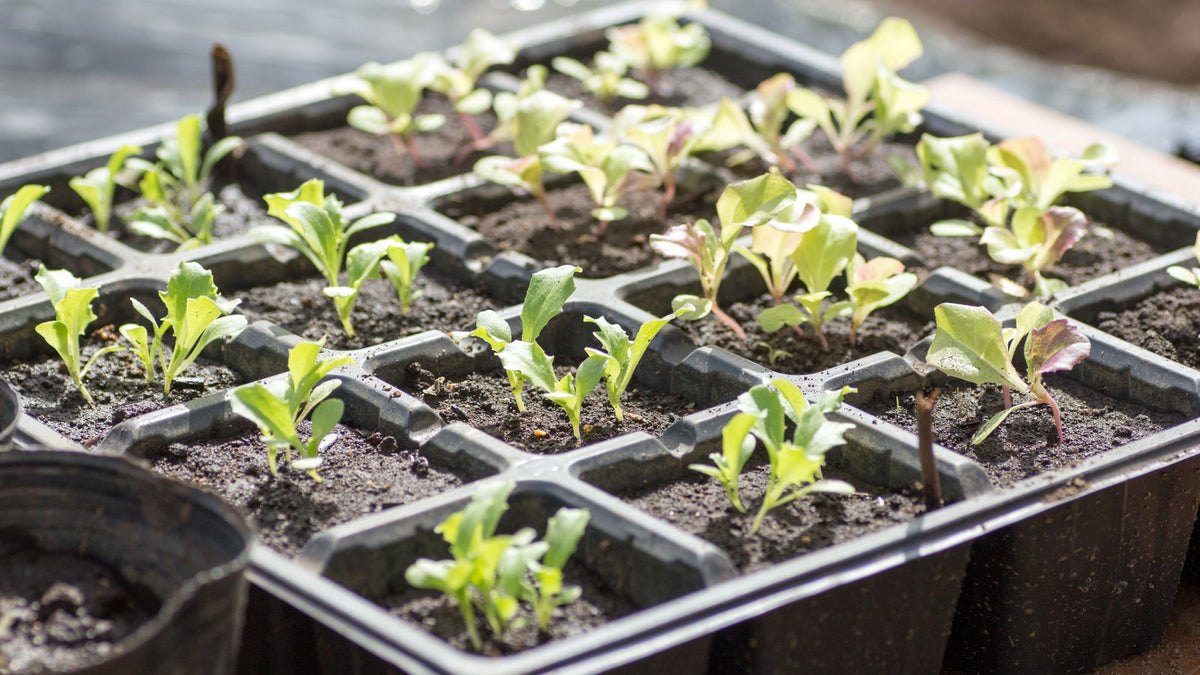

The short version: Any clean container 5 to 9 cm deep with drainage holes will raise a seedling. An open punnet raises many seedlings in little space but needs pricking out early. A cell tray gives each plant a root ball that comes out whole. Peat, coir and paper pots are planted with the seedling, but they dry out fast, and no edge may stand above the soil. Soil blocks need no pot and suit the crops that resent being moved: pumpkins, zucchini, beans, coriander and dill, which otherwise do best sown direct.
Every sowing starts with a decision that is easy to skip: what to sow into. A punnet saved from bought seedlings, a cell tray, a toilet roll tube or a pressed block of mix with no pot will each germinate a tomato. The difference shows up six weeks later, when the seedling has to move.
That move is where seedlings are lost, and the container decides how gently the roots come out, or whether they come out at all.
The open punnet: space saving, but prick out early
An open punnet is one shared block of mix with many seeds in it, the space-saving way to raise a lot of one crop. The catch is the roots. A punnet is a share house: everyone starts with a corner of their own, and within a few weeks every root is in everyone else's business.
So prick out early. Commercial growers move seedlings from open flats into cells 7 to 14 days after sowing, at the first true leaf, and the Kansas State University transplant guide says this suits tomatoes well. Loosen the mix from below, lift each seedling by a leaf rather than the stem, and give it a cell of its own.
Cell trays: one plant, one root ball
A cell tray, or multi-cell punnet, gives each seed its own small pot in a sheet. Nothing tangles, there is no pricking out, and at planting time you water the tray, press up on the base of a cell and the root ball comes out whole.
Cell size trades space for time. In a Michigan State University trial, capsicums raised in trays of 72 to 200 cells gave the same total yield, but the small cells gave less early fruit and needed closer watching for water. Kansas State adds that crops prone to becoming root-bound benefit from larger cells, and cucurbits dislike being crowded. So: small cells for lettuce and brassicas, roomy cells for tomatoes and capsicums, and a pot of their own for zucchini and pumpkin. Whatever you choose, give it 5 to 9 cm of mix.
Biodegradable pots: what the trials found
Peat, coir, pressed manure and paper pots and the humble toilet roll tube all make the same promise: plant the pot and the roots grow through it, so there is no transplant shock. A 2015 review of the United States nursery research in the journal HortTechnology found the promise rests on the pot breaking down quickly, and two things get in the way. One line first: a pot sold as compostable rather than plantable, the thick-walled fibre and bioplastic kinds, comes off at planting.
- They dry out faster. In one greenhouse trial peat pots wicked enough water from the mix to wilt marigolds and geraniums; in another, plants in peat-based pots needed about three times as much water as the same plants in plastic. Pack the pots snugly in a tray, water from below and check them daily.
- They break down slowly. In a field trial, none of five plantable pot types had broken down fully eight weeks after planting: manure pots fastest, peat moderately, coir slowest. A pot that goes into the ground dry can hold the roots back for weeks.
So water the pot well before planting, then tear off the base and rim or bury the whole pot: Iowa State and University of Maryland extension both warn that any edge above the soil acts as a wick and dries the root zone. Gardening Australia's Millie Ross gives rolled newspaper pots four to six weeks before they break down: zucchini and pumpkin, not slow germinators. Toilet roll tubes cut to 5 to 7 cm work the same way, stood tight in a tray so the mix stays put: one seed each, planted whole, every bit of cardboard below the surface.

Soil blocks: the pot is the mix
A soil block is a cube of firmly pressed seed-raising mix, usually 4 to 5 cm across, standing on a tray with a dimple for the seed. Soil blocking has been used in Europe for decades, on a large scale by Dutch commercial growers, and the Sustainable Gardening Australia guide to soil blocks is a good Australian introduction.
The point is the roots. When they reach the dry face of the block they stop, a response called air pruning, so the seedling builds a compact, branched root system instead of circling a pot wall. Sustainable Gardening Australia names pumpkins, zucchini, coriander and dill among the crops it particularly suits.
- Make a blocking mix. Ordinary seed-raising mix crumbles. Sustainable Gardening Australia's recipe is 4 parts sieved compost, 1 part worm castings and 1 part soaked coir peat, the parts measured with one scoop.
- Wet it more than feels right. Iowa State University Extension says wet concrete or peanut butter: a squeezed handful holds firmly together without dripping, or in Sustainable Gardening Australia's test lets go a few drops, not a stream.
- Press the blocks with a hand blocker, a spring-loaded press that makes four at a time and is the one real cost, or with Millie Ross's length of PVC pipe and a dowel.
- Sow one or two seeds in the dimple, cover to the packet depth with vermiculite, keep the stronger if both come up, and water from below or with a mister, tipping off what the blocks have not drunk. Water on top washes a block apart.
- Keep a gap between blocks so the sides dry and air prune, and plant out, block and all, once roots show at the sides, at about 6 to 8 cm tall.
The catches: blocks dry faster than pots, beginners find them crumbly until the mix is right, tiny seed is fiddly, and a seedling kept waiting under cover, a tomato in a cold spring, outgrows a 4 to 5 cm block and needs the 7 to 10 cm size.

Which crops hate being moved
Cornell University's horticulture section puts it plainly: beans and peas often succumb to transplant shock, and carrots, beetroot and turnips lose the taproot you were growing them for. The University of California's master gardeners add sweet corn and the cucurbits, which can be moved with care but are better off sown direct.
- Beans, peas, broad beans and sweet corn: sow direct; one seed per toilet roll tube or soil block if a cold spring forces an early start.
- Pumpkin, zucchini, cucumber and melon: sow direct into warm soil or, for an earlier crop, one seed in a paper pot or large soil block two to four weeks before planting out, the most Cornell suggests for their fragile roots.
- Carrot, parsnip, radish and turnip: sow direct. Beetroot too, though Gardening Australia moves the very small seedlings and puts bigger thinnings in a salad.
- Coriander and dill: sow direct, or a soil block.
Tomatoes, capsicums, eggplants, brassicas, lettuce, silverbeet, leeks and celery move easily and suit any container above. Our direct sowing guide gives the soil temperatures that decide when the rest go in.
Keep the containers clean and the dust down
Reused punnets, cells and pots carry last season's damping off fungi in the dried mix in the corners. Iowa State University Extension's routine: brush out loose mix, wash in soapy water, rinse, soak for at least 10 minutes in plain unscented household bleach diluted one part in nine of water, rinse and dry. Add the bleach to cold water, not the reverse, do not mix it with any other cleaner, work in fresh air, wear gloves and eye protection, follow the label, and use the solution within two hours.
Bagged mix of any kind, seed-raising, potting or compost, can hold the bacterium Legionella longbeachae, which NSW Health lists as a cause of Legionnaires' disease. Put a P2 or N95 mask and gloves on before you open the bag, open it away from your face, dampen the mix, and wash your hands with soap when you finish and before you eat, drink or smoke.
Frequently asked questions
Do roots really grow through peat and coir pots?
Yes, when the pot wall is wet and the soil around it is moist, but slowly: in the field trial above, coir was the slowest of five pot types to break down. Soak the pot and tear off the base and rim.
Can I reuse a cell tray after damping off?
Yes: brush out the old mix, wash the tray in soapy water, give it the bleach soak above, rinse and dry. The fungi survive in the dried mix, so the scrub matters as much as the soak.
Can I make soil blocks without buying a blocker?
Yes. Sustainable Gardening Australia forms them by hand, like playdough, or with a tin can or a section of polypipe, and bought a blocker once it wanted more than a few.
How long can seedlings stay in an open punnet?
Prick them out as the first true leaf develops, 7 to 14 days after sowing. Lettuce and brassicas move to the garden well but resent being teased apart, so Kansas State sows them, and the cucurbits, straight into cells. A seedling left until the punnet is a solid mat of roots stalls after the move.
Whatever you sow into, the seedling cares about one thing: how its roots come out the other end. Match the container to the crop, give it a week of hardening off, and the planting out is the easy part.
Related growing guides
- Direct sowing: which seeds go straight into the garden
- Planting out seedlings without the setback
- What goes into a good seed-raising mix
- Moss and algae on seed trays, and how to stop it
Choose the container to suit each packet from our vegetable seeds and flower seeds.