
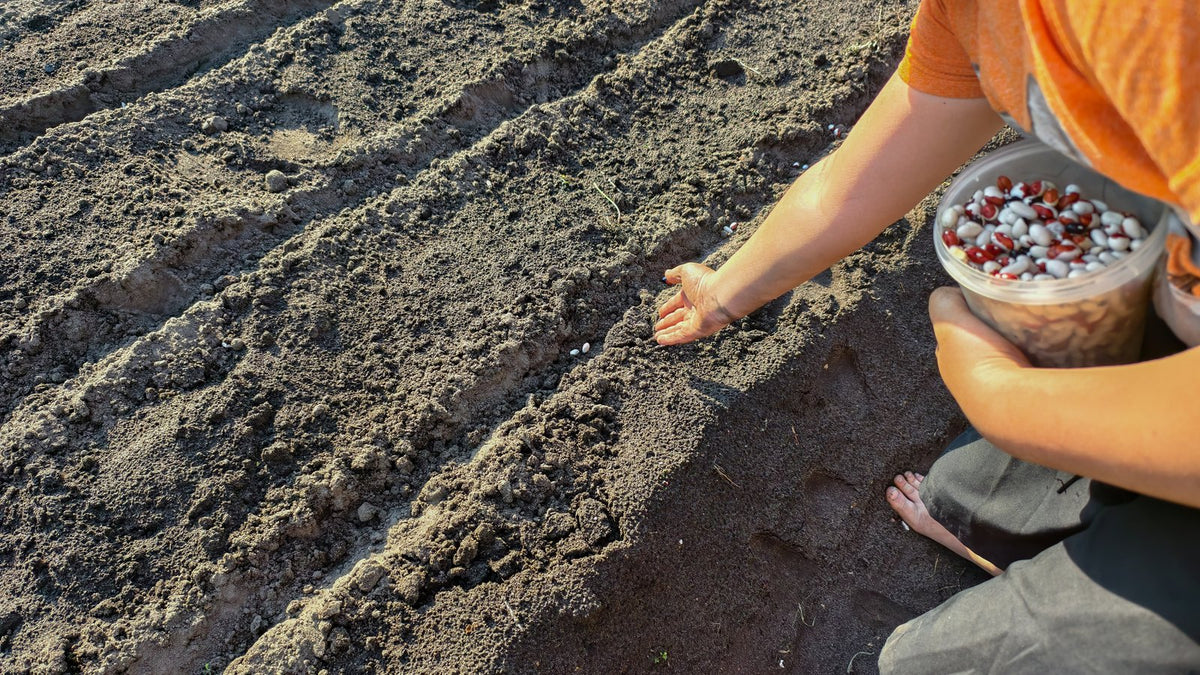

The short version: A seed senses gravity, so its root turns down and its shoot turns up whichever way you drop it in. For most seeds, orientation barely matters. For a few big ones it can mean a slower, patchier row and a crooked start. Lay bush and climbing beans flat on their side, the way they land anyway, rather than poking them in on end. Lay pumpkin, zucchini and cucumber seed flat on a broad face too. Depth, warm soil and steady moisture matter far more than which way up.
Sooner or later somebody asks it at a first sowing, often a child holding a bean between finger and thumb: which way is up? A bean has a scar on one side, a pumpkin seed has a point at one end, a corn kernel tapers to a tip, and none of them comes with an arrow.
The reassuring answer is that the seed sorts it out. The useful answer is that a big seed sown the wrong way round has to make a small U-turn underground, which costs it time, and a few seeds are worth thirty seconds of care.
How a seed knows which way is up
Underground it is dark, so a seed cannot steer by light. It uses gravity. Cells in the root tip hold tiny starch-filled grains called statoliths, which settle to the low side of each cell the way sand settles in a jar of water, and the root grows towards where they settle. The Australian National University's Plant Detectives Manual describes it this way. The shoot does the opposite and grows away from the pull, up towards where the light will be. Botanists call it gravitropism.
It works even when the seed starts upside down. A time-lapse film from Indiana University's Plants-In-Motion project, shot in darkness, follows two corn kernels in wet soil, one planted the right way up and one upside down. Both roots turn down and both shoots turn up.
So does it matter at all?
For small seeds, no. A lettuce or carrot seed is far too small to set the right way up by hand, and its root has hardly any distance to turn.
For big seeds it can matter a little, and the best evidence comes from beans. In a 1972 paper, Bowers and Hayden, two United States Department of Agriculture soil researchers, reported that beans pushed into narrow pencil holes for an earlier field trial had come up at only about half. The holes had stood the seeds on end. So they planted three kinds of dry bean, the same species as garden bush and climbing beans, in eleven different positions in greenhouse trials and counted what came up.
Beans stood on end with the root end pointing down (the end where the young root and stem lie folded) came up in smaller numbers and more slowly than beans lying flat or standing the other way. The effect was strongest where the soil had crusted, and smaller but still there where it had not. A seedling of these beans pushes its arched stem out of the soil first and drags the seed leaves up after it, so a seed buried that way round has to swing through as much as half a turn before it can climb. Runner beans leave their seed leaves underground, so the trials do not speak for them.
The recommended position was the plain one: lying flat. Dropped onto a flat-bottomed furrow, about 85 per cent of the beans landed that way anyway. The bean, it turns out, already knows how it likes to lie down.

The trials were small and run in a cool greenhouse. In a field trial published two years later, a planter that laid beans flat at an even depth got them through a crust sooner, but in the end no more of them came up. Lying flat can buy a quicker, more even start, not a crop where there would have been none.
Which way up, seed by seed
- Bush and climbing beans: lay them flat on their side. Avoid poking them in on end, which is exactly what a narrow dibber or a pencil does. Standing it root end down is no fix either: in the trials, that was among the worst ways up.
- Corn: Purdue University's corn pages put the first root near the pointed tip of the kernel, so a kernel pushed in tip down has its root aimed the right way from the start. Dropped in any old way, it still comes right, as the Indiana film shows.
- Pumpkin, zucchini and cucumber: lay the flat seeds on a broad face. Their seedlings grow a small peg low on the stem that hooks the seed coat and peels it off. A 1910 paper in the Botanical Gazette records older observations that a seed lying flat gives the peg its surest grip on the lower half of the coat, and that a seedling without that grip can come up wearing the coat like a helmet. The Royal Horticultural Society sows these seeds on their side and University of Georgia advice stands pumpkin seeds pointed end down, and either works.
- Avocado in a glass: Iowa State University's advice is that the broad end of the stone is the bottom and the pointed end the top, held by toothpicks with the bottom quarter in water, topped up to keep that level. Roots usually show first, within a few weeks.
- Sunflowers, peas, radish, beetroot and anything smaller: do not bother. Get the depth right and the root finds its own way down.

What matters far more than which way up
If a row of beans or pumpkins fails, check these before blaming the angle:
- Depth. A seed buried too deep can run out of stored food before it reaches the light. About twice the seed's width is the rule of thumb, and our sowing depth guide has the figures.
- Soil temperature. Beans, corn and the pumpkin family sit and rot in cold, wet ground. Measure the soil rather than trusting the calendar: the kitchen thermometer test shows how.
- Moisture. Damp, not soggy. A seed that has started to germinate and then dries out can die.
- Firm contact and no crust. Seed needs soil pressed around it to draw water, and a hard crust is the very condition that made badly placed beans struggle in the trials. Heavy watering can beat a surface into a crust, so use a fine rose.
Get those right and a bean sown at an awkward angle will usually come up anyway, perhaps a little behind its neighbours.
Watch it happen: the bean in a jar
This classroom experiment lets the bean answer for itself. The University of New Hampshire Extension version runs like this:
- Wet some paper towel so it is saturated but not dripping, and line a clear glass jar with it.
- Slide three or four dried beans, such as kidney or lima beans, between the towel and the glass so each one is visible.
- Stand the jar near a window and add water only when the towel starts to dry.
- Check every day, and after five or six days draw the beans again and compare.
These beans are for watching, not eating: the Food Safety Information Council warns that four or five raw kidney beans are enough to cause severe stomach ache, vomiting and diarrhoea, so keep them away from small mouths.
To make it a real experiment, set each bean a different way: one standing on each end and one lying on its side. A University of Illinois 4-H activity adds a twist. Hold the seeds snugly against damp paper towel in a clear plastic case taped shut. Two days after they sprout, turn the case a quarter turn onto its side, again every two days, and see what the roots make of it. For a classroom version, the ARC Centre of Excellence for Plant Success, an Australian research centre, has free Up or Down lessons on gravitropism.
Frequently asked questions
Will a bean grow if I plant it upside down?
Yes: its root still turns down and its shoot up. In trials, though, beans stood root end down came up fewer and later, mostly in crusted soil, so lay them flat.
Which end of a pumpkin seed goes down?
Lay it flat on a broad face and the question goes away. If you prefer to stand it up, University of Georgia advice is pointed end down.
Does it matter which way up I plant corn?
Not much. Tip down is tidy if you are placing kernels one by one, but an upside-down kernel rights itself. Soil temperature and depth matter far more.
Which way up does an avocado stone go?
Broad end down, pointed end up, with the bottom quarter in water kept topped up.
A seed has been finding its way out of the dark for a very long time. Give it the right depth and warm, damp soil, and it will forgive you for holding it the wrong way round.
Related growing guides
- What is inside a seed, and how germination works
- Sowing depth: why less soil is usually better
- Growing bush, climbing and runner beans from seed
- Growing from seed with kids
Big seeds are easy to hold, whichever way up they go in. Browse our bean seeds and pumpkin seeds.