
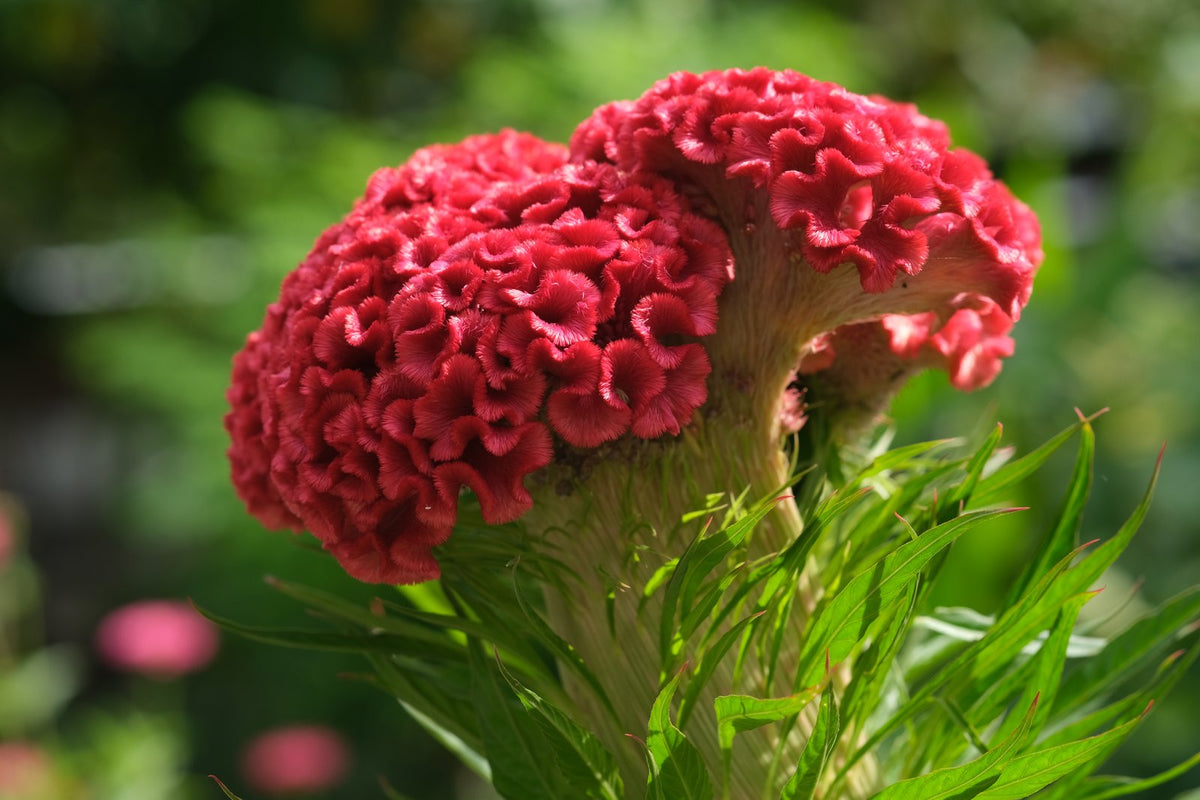

The short version: Fasciation happens when a shoot's growing tip spreads sideways into a line instead of staying a small dome, so the stem grows flat, ribbed or fan-topped and flowers come crowded or doubled. Most cases are one-offs set off by cold, injury or a random genetic slip, and the plant carries on. Cut the odd stem out or enjoy it. Bin the whole plant if it also has a dense knot of stunted shoots, or yellowing growth with flowers turned green and leafy: signs of an infection that spreads.
A sunflower comes up with a stem as wide as a ruler. An asparagus spear pushes through as flat as an ice-block stick. A strawberry ripens into a fan. Usually the plant is not sick at all.
The same quirk, fixed in the genes, gives us cockscomb celosia and the ribbed beefsteak tomato.
What happens at the growing tip
Every shoot grows from a tiny dome of dividing cells at its tip, the apical meristem, which works much like a cluster of stem cells. In a fasciated shoot that dome stretches sideways into a line, or several growing points crowd together, and everything the tip makes follows that shape. The stem comes out flat and ribbed, as if several stems had fused, and often widens into a fan or crest packed with small leaves or flowers. Occasionally the tip forms a ring, giving a hollow shoot.
The name comes from the Latin for a band. Fasciation has been recorded in hundreds of species and usually stays on one stem without lasting harm.

What sets it off
Several triggers can upset the signals that keep the tip a tidy dome, though the cause is often a mystery.
- Genes: a random change in the dividing cells, or an inherited one.
- Cold and frost: a cold snap on a forming tip is a common spring trigger.
- Injury: a knock, a broken tip, a pruning cut, even a hoe or fork working close to the plant.
- Insects and mites feeding on the growing point.
- Hormones: anything that tilts the tip's hormone balance, from an infection to a sprayed chemical.
- Bacteria: Rhodococcus fascians releases cytokinins, a group of growth hormones, and causes leafy gall. It is recorded in New South Wales, and strawberries, sweet peas, dahlias and pelargoniums are common hosts. Some viruses are implicated too.
- Phytoplasmas: tiny sap-dwelling bacteria spread mostly by leafhoppers. Overseas studies link them to fasciation in lilies, linseed and even celosia. Several groups occur in Australia, where the common brown leafhopper, a carrier of tomato big bud, is widespread.
Working out which cause you have
Look at the whole plant and its neighbours.
- One flat stem on a healthy plant: most likely a one-off from genes, a cold night or a knock.
- The same plant every year: a genetic tendency, as in forsythia, Veronicastrum and some strawberry varieties.
- Twisted, cupped or fern-like leaves on tomatoes, beans or peas: suspect a hormone-type herbicide in drift, manure, hay or bought compost; our guide to herbicide residue explains the pea test.
- A dense knot of stunted shoots, often near ground level: possibly leafy gall, though mites and phytoplasmas can cause similar bushy growth.
- Flat stems with yellowing, stunting and green, leafy flowers on most of the plant: suggests a phytoplasma. A few leafy flowers after frost or heat usually grow out.
- A fan-shaped strawberry, fully swollen with seeds spread evenly: fasciation. A lumpy berry with shrunken patches where the seeds failed is frost or poor pollination.
Plants that do it most
- Asparagus: flattened, ribbon-like spears are one of the commonest vegetable examples.
- Strawberries: fan-shaped "cockscomb" berries. Research in Japan found them worst on big, vigorous plants of a prone variety, possibly from temperature swings as the plant switches to flowering.
- The daisy family: sunflowers, coneflowers, rudbeckias and dandelions, with flat stems, doubled heads or centres stretched into a ridge.
- Foxgloves, delphiniums, lilies, primulas and euphorbias: all on the Royal Horticultural Society's list of plants commonly affected.
- Cacti and succulents: crested forms, often sold as 'Cristata', are collector plants kept going from cuttings and grafts. Crested ferns carry the same name.
- Pineapples: fan-topped fruit are familiar on Queensland farms.
Cockscomb celosia: fasciation on purpose
Crested celosia, Celosia argentea var. cristata, is fasciation fixed into a flower. The flower head that would be a feathery plume in the plumed types is flattened and folded into a velvety crest like a rooster's comb, and the trait is carried in the seed, so crested plants come up crested year after year.
Leave a plant unpinched for one large comb, or pinch it at 20 to 30 cm for several smaller ones, and give it full sun and room, because big heads can rot in wet weather. Our celosia growing guide has the sowing months for each zone, and 'Kurume Orange Red' is a tall crested type for cutting. Celosia is on our December flower list.

Why beefsteak tomatoes have so many chambers
Wild tomatoes bear small fruit with two seed chambers, or locules. A big beefsteak can have ten or more: fasciation working inside the flower.
The size of a flower's growing point sets how many carpels it makes, and each carpel becomes a chamber. Tomato geneticists have traced two inherited changes that enlarge it. Locule number (lc) is a tiny change beside the WUSCHEL gene, which tells the tip to make stem cells. Fasciated (fas) is a long stretch of DNA flipped end to end, disrupting the switch for CLAVATA3, the signal that tells WUSCHEL to slow down. With that brake weakened, the flower makes extra carpels and a bigger, lobed fruit. Lc seems to have arisen in wild relatives and fas later, during domestication, and growers kept saving seed from the giants.
An open-pollinated ribbed heirloom such as 'Costoluto Fiorentino' passes the trait on in saved seed, and its ribbing is the variety, not a fault. The fault to watch for is catfacing, a scarred, puckered blossom end from cold at flowering, explained in our guide to tomato fruit problems.

What to do about a fasciated stem
- Leave it if you like it. A flat stem does little harm, often carries extra flowers, and is prized in flower arranging.
- Or cut it out with clean secateurs, back to a normal side shoot or leaf joint.
- Bin, do not compost, anything you suspect is infected. Pull a plant with leafy gall or phytoplasma signs, roots and all, into the rubbish bin. Take no cuttings from it or its neighbours. Wash your hands, clean and disinfect your secateurs, bin any potting mix and scrub the pot, and keep nearby weeds down, since weeds can harbour phytoplasmas. Our garden hygiene guide has the detail.
Take care with euphorbias and foxgloves
Euphorbia sap is milky and poisonous and can cause severe pain and injury to the eye, so wear gloves and glasses to cut a fasciated stem. If sap gets in an eye, flush it with clean running water for 20 minutes, then call the Poisons Information Centre on 13 11 26 from anywhere in Australia, or get medical help. Every part of a foxglove is toxic and can affect the heart. The Sydney Children's Hospitals Network has a factsheet on poisonous and harmful garden plants.
Should you save seed from a fasciated plant?
A flat stem set off by cold or a knock is not in the genes, so its seed should grow ordinary plants. A genetic change can be passed on, which is how crested celosia and the beefsteak were fixed. Sow a little from the odd flower as an experiment if you like, but take your main seed from several healthy, typical plants, as our seed saving guide advises. Skip any plant with signs of infection: phytoplasmas have been reported passing through seed in some crops, tomato among them.
Frequently asked questions
Can fasciation spread to my other plants?
Not when cold, injury or genes caused it. Leafy gall bacteria travel on hands, tools, cuttings and potting mix, and phytoplasmas with leafhoppers.
Will it come back next year?
Seldom. A perennial with one flat stem usually grows normally the following season; the genetic repeaters above are the exception.
Can I eat a fasciated strawberry or asparagus spear?
Yes, if it is otherwise sound. It is the same food in an odd shape.
Is a foxglove with one huge flower on top fasciated?
No. That is peloria, a separate quirk in which the top flower forms as one large, symmetrical cup; garden forms are often named 'Monstrosa'. A flat, widened spike crowded with flowers is fasciation.
Most flat stems are a one-season curiosity: look the plant over, then leave it, cut it for the vase, or bin it if it looks infected.
Related growing guides
- Pinching out, the Chelsea chop and the summer cut-back
- Flowers to sow in December, zone by zone
- San Marzano vs Beefsteak vs Heirloom Mix: Choosing the Right Tomato for You
- Forgotten Heritage Vegetables Worth Rediscovering from Seed
- Beating the Cold: Frost Protection and Stretching Your Growing Season
Browse our celosia seeds and tomato seeds.