
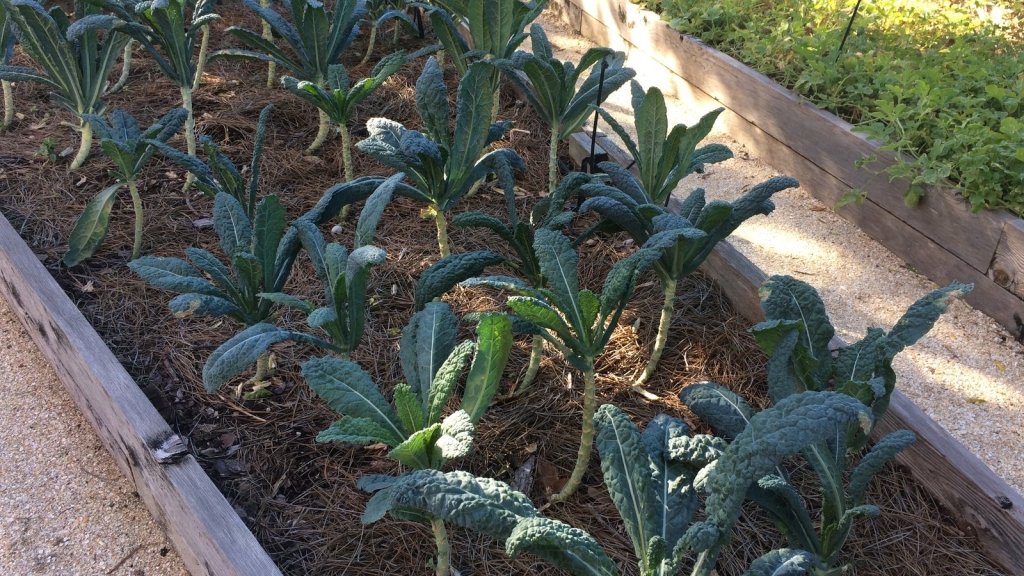

The short version: Winter growth slows for three separate reasons that are easy to confuse. The days are short, so a plant collects less light in total. The soil and air are cold, so germination, photosynthesis and root activity all run slowly. And the midday sun sits low, so a bed that bakes in December can sit in shade for most of a June day. A seed sown into cold soil is usually not a dead seed, just a slow one. Sow early enough in autumn that plants reach a usable size before the slowdown, then treat the cold months as storage rather than growing time.
A gardener sows lettuce in June, comes back six weeks later, and finds the same faint green specks. The seed gets the blame, and in most gardens it does not deserve it.
Lettuce sown into soil at 5°C takes around 15 days to appear, against about two days at 25°C, on the germination tables published by Oregon State University Extension. Once it is up, it has nine or ten hours of weak light a day to build a leaf with. Nothing is broken. The garden has changed gear, and working out which brake is on is what makes the autumn sowing dates in every growing guide stop looking arbitrary.
If a winter bed has stalled, start here
- How cold is the soil? A kitchen probe thermometer pushed about 10 cm in, read on three mornings and averaged, answers this better than a calendar. See our guide to taking a soil temperature reading.
- How short is the day? Once daylight is near ten hours, expect plants to hold their condition rather than bulk up.
- Where does the shade fall now? A fence or a neighbour's tree that cast nothing across the bed in December can shade all of it in June.
- Is this a bulker or a holder? A crop that must add weight before it is worth eating will struggle. One already close to size will sit there quietly, edible.
- Is it a perennial? Rhubarb, asparagus and a bare fruit tree are not stalled. They are dormant, which is a different thing.
Three brakes, and they are not the same thing
Day length, temperature and light intensity all fall together through autumn, which is why they get treated as one thing. They are not, and each has a different answer.
Day length: how much light arrives in total
The useful measure is not hours of daylight on their own, but the total light a plant collects in a day, which horticulturists call the daily light integral. Purdue University Extension describes it as intensity multiplied by duration, like a rain gauge that collects light instead of rain, and puts outdoor values across the United States at roughly 5 to 60 moles per square metre per day depending on latitude, season, day length and cloud. Plants grown under low daily light typically show delayed growth.
So a short day in June is not the same as a short day in a cloudy week in October. In June the day is short and the light is weak at the same time, and the two shortfalls multiply.
The ten hour rule, and how much weight to put on it
Market gardeners often work to a rule that growth slows sharply once daylight drops below about ten hours. The American grower Eliot Coleman named that window the Persephone period, and the term has stuck. Growers who use it aim to have a winter crop about three quarters grown before the ten hour line arrives, then harvest from it as it holds. Johnny's Selected Seeds, whose winter growing guide sets the rule out and credits Coleman for it, describes growth in that window as slowing "to a glacial rate for most crops".
Treat it as a grower's planning rule, not a measured constant. We could not find a published study establishing ten hours as a physiological threshold, and no plant carries a switch that flips at that number. What the rule does well is put a date on the point where daily light drops below what most leafy crops need in order to add weight.
How short the days actually get in Australia

This is where imported winter advice falls over. Daylight on 21 June 2026, the winter solstice, as reported by ABC News:
| City | Daylight at the winter solstice |
|---|---|
| Hobart | 9 hours 1 minute |
| Melbourne | 9 hours 32 minutes |
| Canberra | 9 hours 46 minutes |
| Adelaide | 9 hours 48 minutes |
| Sydney | 9 hours 54 minutes |
| Perth | 10 hours 3 minutes |
| Brisbane | 10 hours 24 minutes |
| Darwin | 11 hours 24 minutes |
The Bureau of Meteorology puts it another way. Hobart swings between roughly 9 hours of daylight in June and 15 hours in December, while Darwin moves only between about 11.5 and 12.5 hours all year. Cairns and Townsville sit between Darwin and Brisbane in latitude, so their shortest day falls between those two figures.
Hobart, Melbourne, Canberra, Adelaide and Sydney therefore drop under ten hours for part of the year, Perth sits close to the line, and Brisbane and the tropical north do not reach it. A winter guide written for Maine does not describe a Brisbane winter.
Soil temperature: the brake on germination
Soil temperature decides whether a seed comes up at all, and how long it takes about it. The germination figures reproduced by extension services around the world, published by Oregon State University Extension from data collected by J. F. Harrington at the University of California, show how steep the effect is. At 5°C, lettuce takes about 15 days to appear, onion about 31, carrot about 51 and parsnip about 57. Lift the soil to 10°C and those become roughly 7, 13, 17 and 27 days.
There is a floor as well. On the same table bean seed does not germinate at all below about 16°C, and tomato below about 10°C, where it still takes some six weeks to appear. That is why our soil temperature guide treats 16°C as the practical floor for tomatoes and beans, and why warm season crops are off the table in a cold bed however carefully they are sown. Those minimums are a property of the species rather than of a hemisphere, so the numbers travel even though the timing does not.
The practical point is that slow winter germination looks identical to failure. Six weeks of nothing from parsnip in a 5°C bed is close to what the table predicts. For the reading method and the warm season numbers, see our guide to soil temperature and when the bed is actually ready.
Air temperature: the brake on photosynthesis and on roots
Cold slows the chemistry. A review by Yamori, Hikosaka and Way puts the optimum temperature for photosynthesis generally between 20°C and 30°C, with the rate falling away below that, although plants can shift that optimum somewhat when grown in the cold. A leaf at 8°C is still working, just slowly.
Roots slow too. Work by Li and Hoch found that water uptake fell sharply as root temperature dropped from 15°C to 7°C and again to 2°C, because cold changes how water crosses root membranes, and the earlier studies they draw on put the break point for temperate species at around 10°C. Their plants were European temperate trees plus maize and sunflower rather than garden vegetables, so read it as the mechanism rather than a number for your carrots. It does explain a familiar sight: a plant wilting on a bright cold day in soil that is plainly wet.
Light intensity: the low sun, and the fence that matters in June
The third brake has nothing to do with hours. Because Earth's axis is tilted about 23.5 degrees, the midday sun in June sits far lower than in December, a swing of roughly 47 degrees of elevation across the year. The Bureau of Meteorology explains the consequence plainly: in winter, sunlight strikes the southern hemisphere at a steeper angle, so the same energy is spread over a larger area of ground.
Weak light means slower photosynthesis even at midday, and a low sun throws long shadows, so a paling fence, a brick wall, a shed or an evergreen tree that shades nothing in December can put a whole bed in shade for most of a June day. This is the brake you have the most control over. Stand in the bed at noon in midwinter, see where the light actually falls, and move the winter crops to the part of the yard that still gets it. Our guide to reading the microclimates in your own garden goes further into aspect, walls and shade.
What to do about it
Sow early enough in autumn, rather than through winter. Bring the sowing date forward so plants reach a usable size while there is still warmth and light to build with. If a crop would need to double in size after the solstice, it was probably sown too late.
Choose crops that hold rather than crops that must bulk up. Silverbeet, kale, leeks, parsnips, carrots, spring onions and the hardier lettuces sit through cold weeks in good condition. A crop that has to put on a lot of new growth before it is worth picking is asking the impossible of a nine hour day. The autumn and winter seed range is built around the crops that suit this pattern.
Use the slowdown deliberately, as living storage. A bed of mature carrots, leeks or parsnips in July is a pantry that looks after itself. The plants are not growing much, but they are holding, and most keep better in the ground than in a crisper drawer.
Warm the seed, not the garden. When you need germination while the soil is cold, do it indoors or on a heat mat and plant out seedlings. A mat lifts the temperature of the mix rather than the room, which is the variable the seed responds to. It suits a narrow set of crops though, and can make cool season seed worse, so read our note on when a seedling heat mat helps and when it does not first.
Expect the restart before it feels warm. Day length climbs again straight after the solstice, but the Bureau of Meteorology notes the coldest week in southern Australia typically falls in July, some weeks later, because the oceans hold their temperature. The light returns before the warmth does, which is why an overwintered plant can be so far ahead of anything sown in spring.
The common mistake is resowing. A gardener who sees nothing after three weeks sows again into the same cold bed, and the second sowing is exactly as slow. Take a soil temperature reading before spending more seed.
Dormancy is a different thing from a slow annual

A lettuce creeping along in July and a bare apple tree in July are doing different things, and the words get muddled. The lettuce is simply running slowly, with every process still happening at a reduced rate. Give it warmth and light and it picks up straight away.
A dormant perennial has genuinely switched off. The Australian tree fruit industry describes dormancy in deciduous fruit trees as a physiological condition regulated by plant hormones, during which no noticeable growth takes place, and which is completed once the tree has had enough hours of chilling. The common Australian measure counts hours between 0°C and 7.2°C. A variety may need a few hundred or well over a thousand, which is why low chill stone fruit exists for Queensland while high chill varieties suit Tasmania and Victoria.
Once the chilling is satisfied the tree holds in a state horticulturists call ecodormancy, and will not shoot until the weather warms. The difference matters: a warm week in July will not wake a tree that has not had its chilling, while the same week will get a lettuce moving. Herbaceous perennials such as rhubarb, asparagus and Jerusalem artichoke (Helianthus tuberosus) also go dormant and die back below ground, so a crown with no leaves in July is not a dead crown.
Across Australia's climate zones
These zones are broad groupings. If you garden between two of them, or in a hill or valley that behaves nothing like the town down the road, lean on local cues such as your own first and last frost dates and a soil temperature reading.
- Tropical (Darwin and the Top End, Cairns, Townsville and far north Queensland): day length barely moves and cold is not the brake. The Bureau of Meteorology divides the tropical year into a wet season, roughly October to April, and a dry season, roughly May to September. It is the wet that limits growing, and the dry season is the main growing window.
- Subtropical (Brisbane, the Gold Coast and Sunshine Coast, northern New South Wales to Coffs Harbour, and Toowoomba as a cooler subtropical highland): the shortest day in Brisbane is still 10 hours 24 minutes, so the ten hour line is not reached. Growth slows through winter but rarely stops.
- Arid and semi-arid (Alice Springs and central Australia, Broken Hill, Mildura, Kalgoorlie and the Western Australian goldfields): days are not especially short and the daytime sun is strong, but clear skies let the heat go overnight and frost is common. The brake is the cold night and the cold dawn soil, so a bed in full winter sun can still be far too cold at breakfast time for a seed to move.
- Temperate (Sydney, Newcastle and Wollongong, Melbourne and Geelong, with Melbourne at the cold end of the zone): the solstice day runs from about 9 hours 32 minutes in Melbourne to 9 hours 54 minutes in Sydney, so these gardens spend several weeks under the ten hour mark. This is where bringing the autumn sowing date forward does the most work.
- Mediterranean (Perth and southern Western Australia including Albany, and Adelaide and the South Australian gulfs): mild wet winters, with about 10 hours of daylight at the solstice in Perth and 9 hours 48 minutes in Adelaide. Cool season crops grow steadily through winter, and the usual brake is grey days and cold wet soil rather than frost.
- Cool and alpine (Canberra and the ACT, Hobart and Tasmania, Ballarat and the Victorian high country, Orange, Bathurst, Armidale and the southern tablelands of New South Wales, and Stanthorpe in Queensland): the shortest days in the country, down to 9 hours 1 minute in Hobart, and the coldest soil with them. Autumn sowing windows close earliest here.
Frequently asked questions
My seeds have not come up after a month. Are they dead?
Probably not. At 5°C, carrot takes around 51 days to emerge and parsnip around 57 on the Oregon State University Extension tables, so a month of nothing can be normal. Take a soil temperature reading before you resow, because a second sowing into the same cold bed will be just as slow.
Does the ten hour rule apply in Australia?
It applies where the days actually get that short, which is the southern half of the country. Hobart, Melbourne, Canberra, Adelaide and Sydney drop below ten hours around the solstice, Perth sits close to the line, and Brisbane, Darwin and the tropical north do not reach it.
Will a greenhouse or a cold frame fix a short day?
It fixes temperature, not light. A cover traps warmth and shelters plants from wind and frost, which genuinely helps, but it cannot add daylight and most covers reduce the light reaching the plant a little. Expect better condition and an earlier restart, not winter bulking.
My winter vegetables look healthy but never get any bigger. What is wrong?
Very likely nothing. A plant holding steady through the shortest weeks is behaving normally and is still perfectly edible. Treat the bed as storage and harvest from it as you need to.
Is my rhubarb or asparagus dead if there is nothing above ground?
Almost certainly not. Herbaceous perennials die back and sit the winter out below ground, so a crown with no leaves in July is normal. Leave it in place, keep the bed from going waterlogged, and it will come back as the soil warms.
Where this leaves your calendar
What this changes is the calendar rather than the technique. Once you accept that winter is holding time in most of the country, the real work moves back to autumn, where a fortnight earlier at sowing is worth more than anything you can do in July. Our guide to what is genuinely worth doing in the garden over winter picks up from there.