
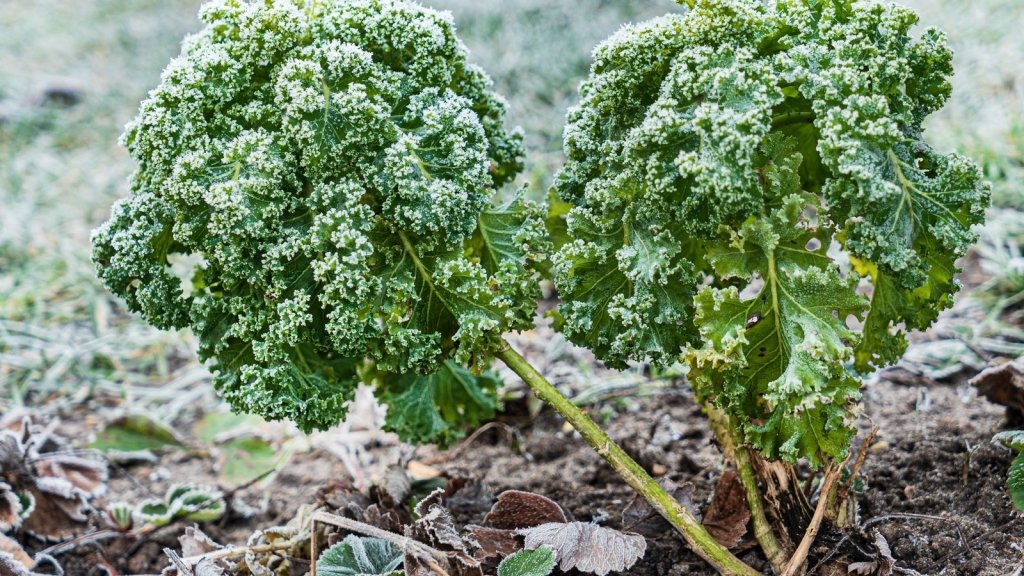

The short version: Hardy, half hardy and tender describe how a plant copes with freezing, not with cold in general. As a rough guide, tender crops such as tomato, bean and basil are finished at about 0°C, half hardy crops such as carrot, lettuce and silverbeet take a light frost near minus 2°C, and hardy crops such as kale, cabbage and Brussels sprouts come through a moderate freeze around minus 4°C. Treat every figure as indicative, because variety, plant age, how gradually the cold arrived and how long the freeze lasted all change the answer.
There are two moments when this matters. One is in autumn, with a seed packet in your hand, working out what is worth the bed space. The other is about nine on a clear July evening, when the forecast says 2 degrees and you are deciding whether to put your shoes back on.
This article answers the first question, which usually settles the second. If you have already decided a plant needs saving and want the technique, our guide to frost protection and stretching your growing season handles the covers, cloches, siting and watering. Everything below is about hardiness.
What hardy, half hardy and tender actually mean
The three words describe tolerance of freezing, not tolerance of cold. The Royal Horticultural Society's hardiness ratings put numbers on them: tender plants are "tolerant of low temperatures but will not survive being frozen", half hardy plants sit between minus 5°C and 1°C, and hardy plants start at minus 5°C to minus 10°C, with the hardiest ratings running below minus 20°C. The RHS applies the same line to flower seed, describing half hardy annuals as those that survive down to between 1°C and minus 5°C.
Two useful things follow. A plant can be thoroughly miserable at 8°C and still not be killed until the water inside it freezes, which is why a chilli stops setting fruit long before it dies. And a few plants are damaged well above freezing, which is a separate problem called chilling injury. Basil is the one most gardeners meet.
Why freezing does the damage, and why a July frost is easier than a March one
Freezing injures a plant mostly by drying it out, and a plant that has cooled gradually through autumn survives a colder night than the same plant would have survived in early autumn.
When a plant freezes, ice usually forms first in the spaces between the cells rather than inside them. That drops the water potential outside the cell, water moves out by osmosis, and the cell dehydrates. A 2026 review in Frontiers in Plant Science describes how extracellular ice formation reduces cellular water availability and promotes dehydration, and the Australian plant science textbook Plants in Action notes that membrane destabilisation from freeze-induced dehydration is a major factor in freezing injury. The ice is not really the weapon. The water leaving the cell is.
That review also notes that most temperate plants develop freezing tolerance through cold acclimation, meaning that exposure to low but non-freezing temperatures before a freeze improves their capacity to withstand it, partly by accumulating soluble sugars such as sucrose that protect membranes and proteins. Plants in Action puts it plainly: tolerance can be increased by exposing plants to progressively lower but only marginally chilling temperatures.
So an unseasonal frost in March or April does more damage than a colder night in July, because nothing has had time to harden. A seedling raised in a warm glasshouse and planted straight out has had no hardening at all, whatever the label says about the variety.

The forecast says 2 degrees. Will it frost?
Quite possibly, because the forecast minimum is an air temperature measured about 1.2 metres above the ground, and the ground is colder. The Bureau of Meteorology measures temperature in a Stevenson screen at approximately 1.2 m, and states that an observed temperature of 2.2°C at screen level indicates that the temperature at the surface is approaching 0°C.
The Bureau's own station records show how wide that gap runs. At Brisbane Aero the screen has averaged zero nights a year at or below 0°C, yet the ground minimum reaches minus 1°C or lower on about 2.3 nights a year. At Alice Springs Airport there are about 12.8 screen nights at or below 0°C against 39.5 nights with a ground minimum of minus 1°C or colder. Your plants live at ground level, not in the screen.
The other half of the answer is what kind of night it is. Almost all Australian frost is radiation frost, which the Bureau says forms most commonly under clear skies with little or no wind and low humidity, so the dangerous night is the still, clear, dry one, and the cold air drains into the low corners. Our guide to working with garden microclimates covers how to find those spots in your own yard.
The hardiness groups, and what each one tolerates
| Group | Indicative temperature | Vegetables that usually sit here |
|---|---|---|
| Very tender | Stunted, damaged or killed between 10°C and 0°C, before any ice forms | Basil is the clearest case. Cucumber, melon, capsicum and chilli stop growing well above freezing and can be damaged before any ice forms. |
| Tender | Significantly damaged or killed at or near 0°C | Tomato, capsicum, chilli, eggplant, cucumber, zucchini, pumpkin, melon, beans, sweet corn, sweet potato and potato tops. |
| Half hardy | A light frost, roughly minus 2°C to 0°C | Beetroot, carrot, cauliflower, lettuce, silverbeet, endive, radicchio, Chinese cabbage, celery, parsley, and peas before they flower. |
| Hardy | A moderate freeze, roughly minus 4°C to minus 2°C, and the toughest go colder | Broccoli, cabbage, kale, kohlrabi, Brussels sprouts, turnip, swede, collards, mustard greens, rocket, corn salad, broad beans, leek, salsify and horseradish. |
The category definitions come from Utah State University Extension, and the crop groupings from Oregon State University Extension and South Dakota State University Extension. All three publish in Fahrenheit, where 32°F is 0°C, 28°F is about minus 2°C and 24°F is about minus 4°C. No Australian department publishes an equivalent table for home garden vegetables, so these are the best figures available and they describe the plant rather than the place.
Treat them as a starting point rather than a threshold. The Bureau of Meteorology makes the same point about frost damage generally: crop type, variety, sowing date, nutrition and stage of growth all determine how badly a frost bites. A long freeze does more than a brief dip to the same temperature, and a plant that hardened through a cool autumn is in a different position from one that did not.
Where the lists disagree
Two reputable extension services put several common crops in different groups. Oregon State rates spinach, onion, garlic, radish and rhubarb as hardy enough for a heavy frost, while South Dakota State puts them in the light frost group. Parsnip and Chinese cabbage run the other way, hardy for South Dakota State and semi-hardy for Oregon State.
That is not a flaw in either list. It is the honest edge of the subject: those crops sit near a boundary, and where they land depends on variety, maturity and how the cold arrived. If one matters to you, plan for the more cautious rating.
Our frost protection guide groups silverbeet and peas with the hardy crops as a rule of thumb. The extension figures put both in the light frost group, which is the rating to plan on.
Herbs
Basil is the tender extreme. A review in Frontiers in Plant Science reports that storage below 12°C causes injury to basil leaves and below 10°C induces severe if not total injury, with leaves blackening from necrosis in as little as one day at 0°C. Basil is not really a frost question. It is a cold question.
Parsley sits in the light frost group in both extension lists, and South Dakota State puts chives there with it. The woody perennials are the hardiest of the kitchen herbs: the RHS reports that well-established rosemary survives temperatures as low as minus 8°C, while noting that harsh frost and cold wind can still cause damage and that container plants are more vulnerable. The words doing the work there are "well-established".
Annual flowers
The same three words are used on flower seed packets. The RHS describes hardy annuals as able to survive frost, naming calendula (Calendula officinalis), cornflower (Centaurea cyanus), larkspur (Consolida), love-in-a-mist (Nigella damascena), honesty (Lunaria annua) and the poppies (Papaver) among those needing no protection, and sweet pea (Lathyrus odoratus) and California poppy (Eschscholzia californica) as hardy annuals that still want some. Half hardy annuals, which cover most of the summer bedding, will not take a frost at all.

The crops that are better for a frost
Parsnip, carrot, swede, kale and Brussels sprouts are the crops gardeners deliberately leave in the ground through the cold, and the reason is sugar. As temperatures fall, these plants convert stored starch into soluble sugars that lower the freezing point inside their cells and protect membranes during freeze-induced dehydration. The plant is making antifreeze. You are eating it.
The evidence is good. An open access study in Scientia Horticulturae found that low temperature storage at 2°C dramatically decreased starch content in carrot roots and increased sucrose content, with tasting panels detecting the gain in sweetness against freshly harvested roots. In kale, a 2026 open access study in the Journal of Plant Physiology profiled 26 field-grown accessions before and after a short frost and found significant shifts in sugar profiles, notably an accumulation of sucrose acting as an osmoprotectant, with glucose falling.
Two honest caveats. The carrot result comes from roots held in cold storage after harvest, and the same study found starch falling and sucrose rising at room temperature too, by a different route, so cold is part of the story rather than all of it. And the shift is compositional, since sucrose rose while glucose fell in the kale study, which measured the change after a single short frost in the field, so "sweeter" is a real but more specific claim than "more sugar". For the practical side of carrying these crops through, see our guide to preparing the garden for winter growing.
The crops that one frost ends, and the seedling problem
Basil, tomato, capsicum, chilli, eggplant, the cucurbits and all the beans are done at about 0°C, and several are struggling long before that. No variety changes this and no amount of hardening carries them through a real frost. In a frost-prone garden they are a warm-season proposition.
The group that catches people out is the middle one, the crops that survive a light frost with visible damage. Lettuce hearts, silverbeet, celery, cauliflower curds and the softer Asian greens take minus 1°C or so and look battered rather than dead. Outer leaves go, the plant keeps going, and whether that counts as a loss depends on what you were going to do with it.
Then there is age. A hardy crop's seedling is not hardy. The Bureau of Meteorology lists stage of growth among the factors determining how badly a frost affects a crop, and the RHS qualifies rosemary's minus 8°C with "well-established". A young plant has little root, few reserves and soft tissue, and has usually had less time to acclimatise. Protect everything while it is small, then let the hardy things get on with it.
What frost damage looks like the next morning
Frosted foliage usually looks water-soaked and limp first, sometimes almost translucent, then browns or blackens over the following day or two. Leaves and flowers may drop, fruit can crack, and bacterial or fungal rots often move into the damaged tissue afterwards.
The Bureau of Meteorology also describes black frost, where the air is too dry to deposit white ice but the vegetation freezes internally and is left blackened. It is uncommon in Australia, but it is why a garden can be badly hit on a morning with no white on the lawn at all.
Whatever it looks like, leave the damaged growth alone for now. Gardening Australia advises against pruning straight away, because the damaged growth protects the green tissue underneath and because trimming stimulates delicate new growth that the next frost will take. Wait until the danger of further frost has passed, then cut back to a green node.
Frost across the six Australian climate zones
Frost risk in Australia follows elevation and distance from the coast more than it follows latitude. The Bureau of Meteorology's potential frost day maps show extensive areas of northern Australia as generally frost free, with frost potential increasing with elevation and being particularly common in the alpine regions of New South Wales, Victoria and Tasmania, mainly from late autumn to early spring. The figures below are annual averages from the Bureau's station records.
- Tropical (Darwin and the Top End of the Northern Territory, Cairns and Townsville in far north Queensland, the Kimberley in Western Australia): hardiness is not the limit here. Darwin Airport averages zero nights a year at or below 2°C, and its lowest reading since 1941 is 10.4°C. Heat and the wet season set the season instead.
- Subtropical (Brisbane, the Gold Coast and Sunshine Coast in Queensland, and northern New South Wales to Coffs Harbour): the coastal strip is close to frost free, the inland and elevated parts are not. Brisbane Aero averages no screen nights at or below 0°C yet still records about 2.3 ground frosts a year, while Applethorpe, up on the Granite Belt where the subtropics give way to the cool zone below, averages 33.8 nights at or below 0°C.
- Arid and semi-arid (Alice Springs in the Northern Territory, Broken Hill in New South Wales, Mildura in Victoria, Kalgoorlie in Western Australia, and inland South Australia and Queensland): frost is a genuine winter risk, because clear dry skies and light winds are exactly the recipe. Alice Springs Airport averages 30.8 nights at or below 2°C and 39.5 ground frosts. Hot days and freezing nights in one week are normal.
- Temperate (Sydney, Newcastle and coastal New South Wales, Melbourne and Geelong in Victoria, which sit at the cold end of this zone): the widest spread of the six. Sydney Observatory Hill averages zero nights at or below 2°C across 162 years of record, while Melbourne Airport averages 8.2 such nights. Suburb and aspect matter more here than the city name.
- Mediterranean (Perth and the south west of Western Australia, Adelaide and the dry summer parts of South Australia): mild wet winters with occasional frost, mostly inland and in valleys. Perth Airport averages 2.5 nights a year at or below 2°C, with a record low of minus 1.3°C. Coastal gardens can usually carry half hardy crops through winter uncovered.
- Cool and alpine (Hobart and the Tasmanian highlands, the Australian Capital Territory, the southern tablelands and central west of New South Wales including Orange, Bathurst and Armidale, Ballarat and the Victorian high country, and Stanthorpe on the Queensland Granite Belt): the hardest frosts in the country. Canberra Airport averages 59.7 nights a year at or below 0°C since 2008 and has recorded a below-zero night in every month from April to December. Hardy crops are not a preference here, they are the list.
These are broad groupings. If you garden between two of them, or in a frost hollow, a coastal pocket or a valley that behaves nothing like the town up the road, work from your own first and last frost dates and from what happened in your garden last winter.
Common questions
Does a hardy crop survive any frost?
No. Hardy means it will usually come through a moderate freeze of roughly minus 4°C to minus 2°C, not that it is unkillable. A long freeze, a hard unseasonal one, or a plant that has not hardened can all change the result, and a hardy crop's seedlings are not hardy.
My forecast says 3 degrees. Am I safe?
Probably, but not certainly. The forecast minimum is measured about 1.2 metres up, and the Bureau of Meteorology puts the surface near 0°C when the screen reads 2.2°C. On a still, clear, dry night with a low of 3°C, tender plants in an open low-lying bed are worth covering.
Which vegetables actually taste better after frost?
Parsnip, carrot, swede, kale and Brussels sprouts are the usual list. Cold shifts stored starch into soluble sugars that protect the plant's cells, and the effect has been measured in stored carrot roots and in field-grown kale after a short frost. Variety and how long the roots or leaves have sat in the cold both change how much you taste.
Where to start
The useful version of all this is short. Work out roughly how cold your garden gets at ground level, keep the tender crops in the warm season, fill the cold months from the hardy list, and treat the half hardy group as a gamble you can price. Our guide to cool-season vegetables across Australia covers what to actually plant, and the autumn and winter seeds collection is where the hardy end of the list lives.