


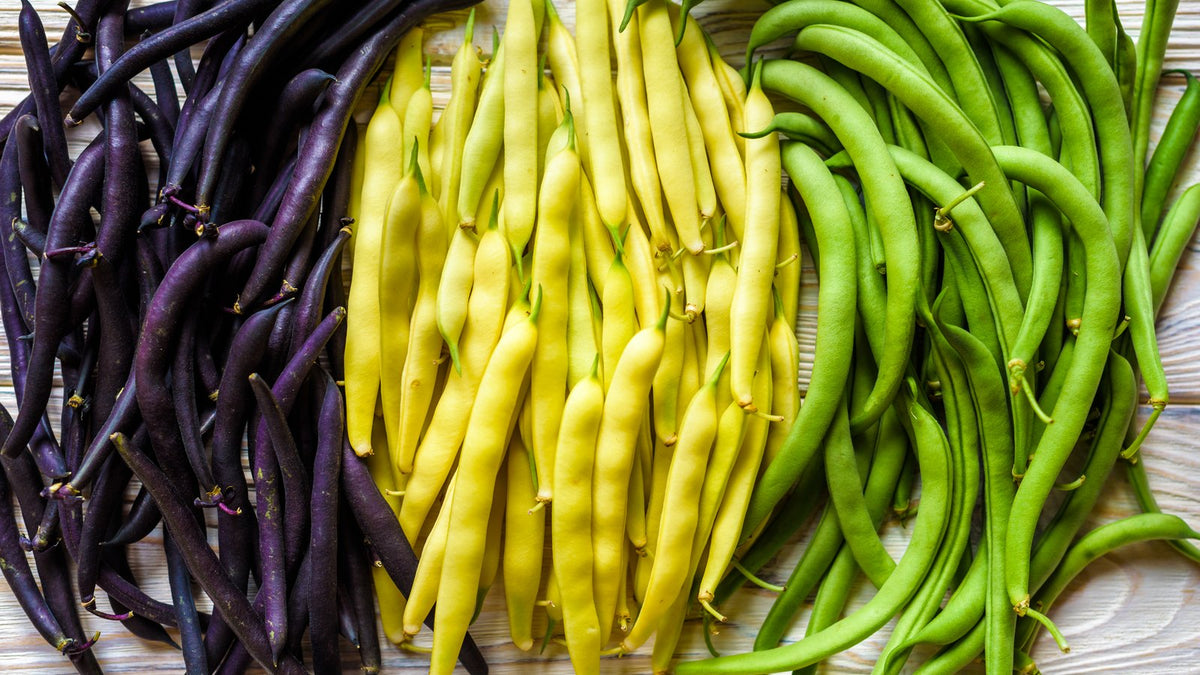

The short version: Most garden beans are one species, the common bean, grown as a knee-high bush that crops in a burst or as a climber that needs a 2 metre support and keeps picking for longer. Then you choose by what you want to eat: green, yellow, purple or flat pods, shelling beans such as borlotti, or dried beans. Runner, lima, snake, winged and rice beans are separate species with their own climates. All are warm-season, frost-tender crops; broad beans are the cool-season one.
A bean packet leads with the pod, but the plant behind it matters as much: the bush bean sits politely at knee height while its climbing cousin heads for the gutter.
Two decisions hide in every bean choice: how the plant grows, and which part of it ends up in the kitchen. Settle them and the list gets short.
Bush or climbing: the first decision
Both are the common bean, Phaseolus vulgaris. The difference is the shape of the harvest.
- Bush or dwarf beans grow to about 45 cm and stand without support. The Northern Territory Government's Top End notes put the first pick at about 45 days, with picking carrying on for a month or more, a burst that suits the freezer.
- Climbing beans run to 2 or 3 metres and need a frame at least 2 metres tall, put up before you sow. The same notes give about 70 days to the first pick, but a climber keeps flowering for longer and needs less ground than bush beans for a similar crop. A hot spell costs it a few pods, then it carries on.
Wind matters too: laden plants are easily damaged in strong wind, and climbers should not shade other crops. So:
- Pots, a small bed or an exposed site: bush, in a pot at least 30 cm deep.
- One big pick for preserving: bush, sown as short rows every two or three weeks.
- A sunny fence and a steady handful for dinner: climbing, on a support built to hold it.

Then choose by what you want to eat
The common bean is grown for green pods, fresh shelled seed or dry seed, and some varieties do all three.
- Green beans, also called French or snap beans, are picked while the seeds are still small.
- Yellow wax beans have pale yellow pods and are often sold here as butter beans.
- Purple beans turn dark green as they cook. It is the nearest thing to a magic trick in the vegetable patch, and it ruins the purple salad you had planned.
- Flat beans, such as Roma II and Redlands Pioneer, have broad, flattened pods.
- Shelling beans such as borlotti are picked when the pods have begun to dry and turn fibrous, with the seeds full size but still soft.
- Dried beans stay on the plant until pods and seeds are fully dry and the beans rattle; if autumn rain or frost arrives first, pull the plants and hang them under cover to finish. Haricot, the white soup bean, is the classic.
The main types at a glance
| Type | How it grows | What you eat | Climate it suits | Examples from our range |
|---|---|---|---|---|
| Green bush bean | Bush, about 45 cm | Young pods | Every zone in its frost-free window | Provider, Jade, Redlands Greenleaf |
| Green climbing bean | Climber, 2 to 3 m | Young pods, over a longer season | Every zone in its frost-free window | Blue Lake, Kentucky Wonder (Brown Seeded) |
| Yellow wax or butter bean | Bush or climber | Yellow pods | As for green beans | Cherokee Wax, Top Notch Golden Wax, Kentucky Wonder Wax |
| Purple bean | Bush or climber | Purple pods that cook green | As for green beans | Royal Burgundy, Purple King |
| Flat bean | Mostly bush | Broad flat pods | As for green beans | Roma II, Redlands Pioneer |
| Borlotti and shelling | Bush or climber | Young pods, or plump fresh seed to cook | As for green beans, with longer on the plant | Borlotti Rooster, Tongue of Fire, Frost (Organic) |
| Dried bean | Bush or climber | Dry seed, soaked and boiled | As for green beans, with weeks to dry on the plant | Haricot (Organic), Cherokee Trail of Tears |
| Runner bean | Tall climber | Young pods, fresh or dried seed | Mild summers, cool and temperate zones | Scarlet Emperor Runner |
| Lima bean | Bush or climber | Fresh or dried seed, always cooked | Long, warm, frost-free seasons | Madagascar (Lima) |
| Snake bean | Tall climber | Long pods | Tropical, subtropical, hot summers | Red Noodle |
| Winged and rice beans | Climbers | Young pods and leaves; dry seed, cooked | Tropical and subtropical | Winged, Rice |
Runner beans are a different plant
Runner beans are Phaseolus coccineus, a separate species from the common bean: a tender perennial from the mountains of Mexico and Central America, with scarlet or sometimes white flowers that are edible and taste of bean.
Heat is the catch. Pod set suffers in hot, dry weather and stops altogether at high temperatures with low humidity, so the best crops come in cooler summers and in autumn. In mild districts the tuberous roots can live on and reshoot after frost has killed the tops. Our Scarlet Emperor Runner listing says it tolerates part shade and cool conditions better than other beans. Pick the pods young and slice them, as they are tougher than common beans.

Lima, snake, winged and rice beans: for warm gardens
Lima beans (Phaseolus lunatus) do not tolerate frost and grow best between 16 and 27°C. Our climbing Madagascar (Lima) listing gives 24 to 26 weeks to harvest.
Snake beans (Vigna unguiculata subsp. sesquipedalis) are tall climbing annuals with pods 30 to 120 cm long, grown mainly around Darwin and in central and north Queensland. They like warm, humid weather and dislike frost. Red Noodle has deep red pods.
Winged beans (Psophocarpus tetragonolobus) carry four-winged pods, and most are short-day plants, needing days of around 12 hours to start flowering, with nights above 18°C ideal. Rice beans (Vigna umbellata) are short-day plants of the humid tropics too. Long southern summer days hold back their flowering, so both are beans for the north.
Broad beans only share the name: Vicia faba is a cool-season crop sown in autumn and winter. Our article on growing broad beans and the broad bean grow guide cover them.

When to sow common beans across the climate zones
Apart from broad beans, all these beans are frost tender. Common beans want soil of about 16°C at sowing depth, and the tropical types are happier warmer still. The zones below are broad groupings and their months, for common beans, come from different guides, so treat them as a guide and let your last frost and a soil thermometer decide.
- Tropical (Darwin and the Top End, Northern Territory; Cairns and Townsville, Queensland): the Top End notes give April to August, the dry season, for French beans, and warn that bean fly can be a serious pest on small plants. Snake beans can keep growing through the Wet if the soil drains.
- Subtropical (Brisbane and south-east Queensland, northern New South Wales): our bean grow guide gives August to March once frost has gone, skipping the most humid weeks, when bean fly is worst. In a frost-free garden they grow through winter too, as Gardening Australia shows in Brisbane. The long warm season suits snake and lima beans.
- Arid and semi-arid (Alice Springs, Northern Territory; Broken Hill, New South Wales; Mildura, Victoria; Kalgoorlie, Western Australia): the Northern Territory Government's Alice Springs notes give September to February for bush beans and September to January for climbers, probably best sown in November and December so they crop as it cools. Hot, dry weather causes poor pollination and dropped pods.
- Temperate (Sydney and the New South Wales coast, Melbourne in Victoria): our grow guide gives October to February, once frost has passed and the soil has warmed, starting earlier in Sydney than in Melbourne. Runner beans are worth trying out of the harshest afternoon sun.
- Mediterranean (Perth and the south of Western Australia, Adelaide in South Australia): our grow guide gives September to February, and a Waste Authority of Western Australia school garden guide for Perth runs bush beans from August to March. Hot, dry summers are hard on runner beans, so lean on common beans.
- Cool and alpine (Canberra and the ACT; Tasmania; Ballarat, Victoria; Orange and Armidale, New South Wales; Stanthorpe, Queensland): Canberra Organic Growers sows from mid-October to early November, after frost, and our grow guide runs November to January. Quick bush beans and runner beans suit the short season. Lima, snake, winged and rice beans are a long shot.
Cook dried beans properly
The Food Safety Information Council says many beans contain toxins called lectins, with the highest levels in kidney beans, especially red kidney beans, and that four or five raw beans are enough to cause severe stomach ache, vomiting and diarrhoea. Health Canada names the lectin in red kidney beans as phytohaemagglutinin.
- The council's advice on kidney beans is to soak dried beans for five hours or more, then drain them and keep them at a brisk boil in fresh water for 10 minutes or more. That includes beans dried from your own plants.
- Do not rely on low-temperature cooking such as a slow cooker, which may not destroy the toxin. Undercooked beans can be more toxic than raw ones. Tinned beans can be used without further cooking.
- Do not eat lima beans raw: the University of Minnesota Extension says they may contain small amounts of toxic glucosides, which cooking removes.
- Some seed sold for sowing, including several of our bush beans, is treated with a fungicide. Those listings say so: that seed is for the garden only, never the kitchen, and is kept away from children and animals.
Frequently asked questions
Are butter beans and wax beans the same thing?
In Australian gardens, often yes: butter bean is an everyday name for a yellow-podded common bean. In many overseas recipes it means the lima bean, a different species that is always cooked, so check which one a recipe means.
Which bean gives the most from a small garden?
A climbing bean on a fence or a sturdy frame, because it crops for longer from a narrow strip of ground. On a windy balcony, a bush bean in a deep pot is the steadier choice.
Why are my runner beans all flowers and no beans?
Usually hot, dry weather. Runner beans are shallow rooted and need visiting insects to set pods, so water deeply through flowering and mulch to hold the moisture. They often pick up as autumn cools; where it is too warm for a good crop, they are often grown for the flowers.
Can I grow snake beans in Melbourne or Hobart?
They need warmth and dislike frost, so it is a stretch. Wait until late spring, once the nights have warmed, and use the warmest, most sheltered corner you have.
Pick the habit for your space and the pod for your kitchen, and let the weather settle the rest.
Related growing guides
- Sowing, watering and picking beans
- Snake beans, okra and bitter melon from seed
- Checking soil temperature before you sow
- Climbing beans with corn and squash
Browse the full range of bean seeds, or the tropical vegetable seeds for snake and winged beans.