
How to Grow Tillage Radish in Australia
Tillage radish is a daikon-type radish grown as a cover crop to open up compacted soil. Sow it from late summer into autumn, when the soil sits between 10°C and 20°C. Scatter 2 g per square metre and rake it 10 to 20 mm deep. Cut the tops as the first flower stalk rises, leave them as mulch, and leave the roots in the ground to rot.
| Sun | Full sun |
|---|---|
| Water | Moist to establish, then deep weekly soaks |
| Soil | Free-draining, pH 5.5 to 7.5 |
| Feed | Minimal; on poor soil, compost, seaweed or granular |
| Spacing | 2 g per square metre |
| Depth | 10 to 20 mm |
| Germination | 4 to 8 days; soil 10°C to 20°C |
| Harvest | Cut before flowering, 6 to 12 weeks |
| Container | Not suited to pots |
| Frost | Tolerates frost; hard, repeated frosts kill it |
| Use | Cover crop; roots left to rot in place |
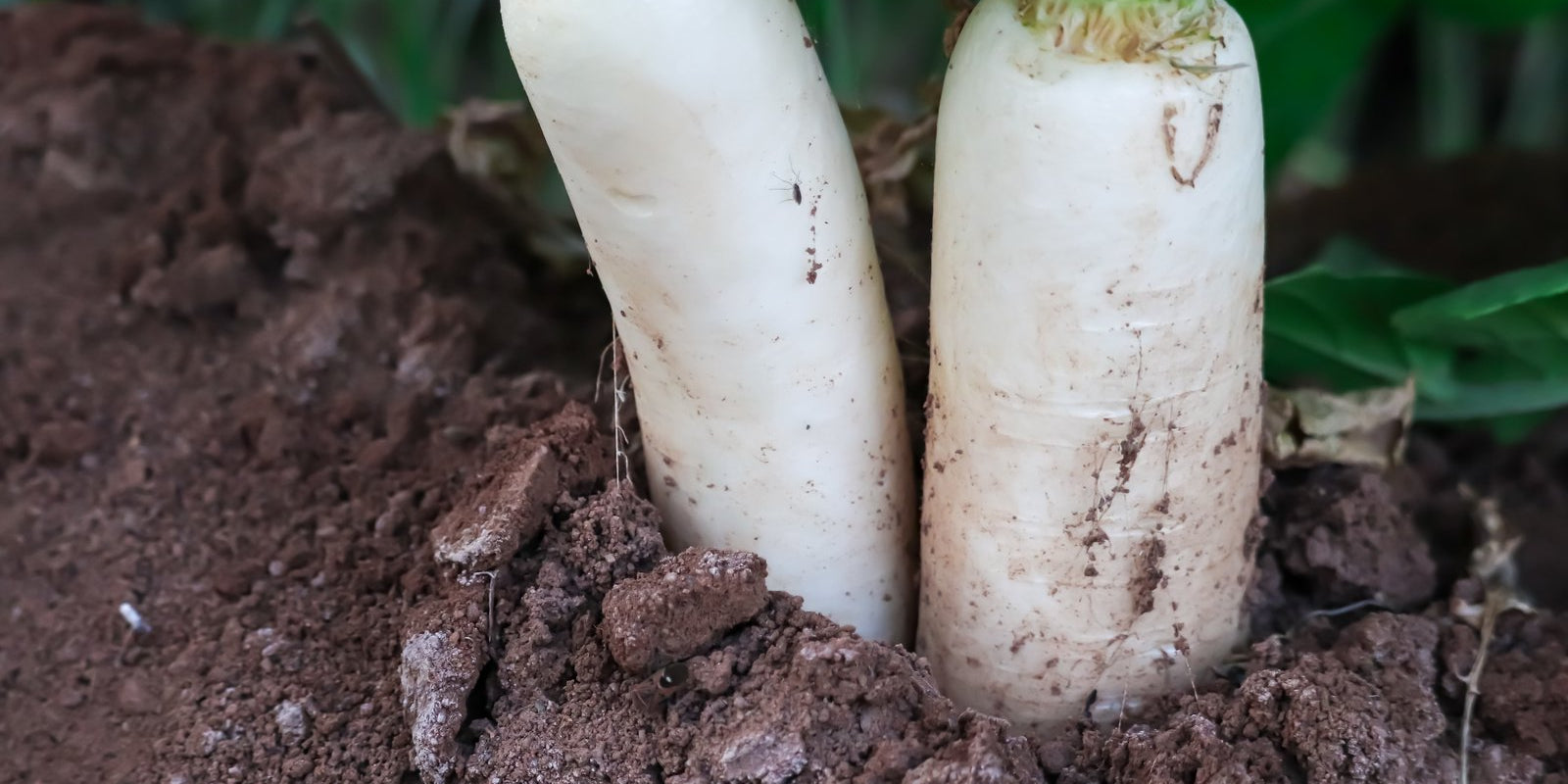
Tillage radish (Raphanus sativus, cabbage family, Brassicaceae) is a daikon-type radish grown as a cover crop. Its long taproot pushes down into hard, compacted soil and is left there to rot. It covers bare ground fast, smothers winter weeds and draws up nutrients that would otherwise wash out of reach.
Three mistakes that matter
- Letting it flower. Once a flower stalk rises, the plant spends soil water on making seed. Any seed that falls can come up for several seasons. Cut the crop as the first flower stalk appears, as Ending the Crop describes.
- Sowing into summer heat. A radish sown into hot weather, or late in spring, bolts (runs to flower early) before its root has grown. Sow as the heat goes out of late summer and into autumn, in the windows When to plant gives.
- Digging the roots out. The channels a rotting root leaves behind are what let water and the next crop's roots through hard ground. Pulling the roots, or digging the bed over, throws that work away. Cut the tops and leave the roots in place.
When to plant
Sow once the worst heat has passed and the soil sits between about 10°C and 20°C. In the cool zone and the far south, a late summer sowing makes the most leaf and root before winter. In warmer zones, wait for the months the calendar gives. Autumn sowings also root well, while spring sowings grow fast but flower quickly. One sowing covers a bed for a season.
| Zone | Example cities | Sow | Harvest | Notes |
|---|---|---|---|---|
| Tropical | Darwin, Katherine NT; Cairns, Townsville QLD; Broome WA | Apr-Jul | Jun-Oct | Sow in the dry season and water steadily; wet season heat makes it flower before the root forms. |
| Subtropical | Brisbane, Bundaberg, Rockhampton QLD; Coffs Harbour, Lismore NSW | Mar-Jun and Aug | May-Oct | Sow as the summer heat eases. An August sowing grows fast but flowers early, so check it weekly. |
| Arid and semi-arid | Alice Springs NT; Broken Hill, Dubbo NSW; Mildura VIC; Kalgoorlie WA | Feb-Apr and Aug-Sep | May-Oct | Needs watering to establish in dry soil. It usually survives inland winter frosts, so cut it before spring flowering. |
| Temperate | Sydney, Newcastle, Wollongong NSW; Melbourne, Geelong VIC | Feb-May and Aug-Sep | May-Nov | Late summer sowings grow the biggest roots. In Melbourne, the cold end, sow by April before growth slows. |
| Mediterranean | Perth, Bunbury WA; Adelaide and the SA coast | Feb-May and Aug | Jun-Oct | Sow with the autumn rains, or earlier with watering. Spring sowings meet dry heat early and flower fast. |
| Cool and alpine | Hobart, Launceston TAS; Canberra ACT; Ballarat VIC; Orange NSW | Jan-Mar and Sep-Oct | May-Jun and Nov-Dec | Sow early so roots size up before frost. Hard frosts may kill it; otherwise cut it before flowering. |
At the hot edge of a window, water the bed a day before sowing and give the seedlings afternoon shade. At the cold edge, sow early, because growth slows sharply in the coldest weeks of winter.
Site, soil and setup
Choose the bed that most needs opening up: a heavy patch, a path turned into garden, or ground packed down by machinery. Breaking the hard layer is the crop's job, so deep digging beforehand is not needed.
| Factor | Setup |
|---|---|
| Light | Full sun in autumn and spring; a little afternoon shade helps a late summer sowing |
| Soil | Most garden soils, from sand to compacted clay; growth is poor where sandy soil holds little moisture |
| pH | 5.5 to 7.5; below 5.5, rake in garden lime at 100 to 200 g per square metre, 4 weeks before sowing |
| Drainage | It does not tolerate very wet soil, so skip low spots where water lies after rain |
| Bed preparation | Slash or pull weeds and rake the surface fine; on poor soil, spread a 5 cm layer of compost first |
| Rotation | Keep it out of beds used for cabbage-family vegetables, which share its pests and clubroot (Plasmodiophora brassicae) |
Sowing Seeds
Sow Tillage Radish seeds straight into the bed where the crop will stand, because the taproot is the whole point and it resents being moved. The seed is sold under a variety licence, so read its terms before opening the bag, and never save seed from the crop.
Sowing direct
- Rake the bed to a fine, even surface and water it if the soil is dry.
- Scatter the seed at 100 g per 50 square metres, which is 2 g per square metre.
- Rake it in 10 to 20 mm deep, a little deeper in dry soil, and firm the surface with the back of the rake.
- Water in gently and keep the surface moist until the seedlings show.
- Expect seedlings in 4 to 8 days, and sooner in warm soil.
There is no need to thin the seedlings. Sowing thicker than this rate gives smaller, weaker roots, so resist adding extra seed to a hard bed.
Care by growth stage
Water in the first month decides this crop. Once the taproot is down it reaches moisture well below the surface, and it needs almost no feeding.
| Stage | Water | Feed | Watch for |
|---|---|---|---|
| Germination, week 0 to 1 | Keep the top 2 cm moist; do not let a crust form | None | Seedlings cut off at ground level overnight (cutworms) |
| Seedlings, weeks 1 to 4 | Water deeply whenever the surface dries | Seaweed solution at half strength, 15 mL per 9 L, fortnightly, only on poor sandy soil | Holes chewed by caterpillars, grey aphid colonies under leaves |
| Rosette and root, weeks 4 to 8 | A deep soak once a week in dry spells | None | White blisters under leaves (white rust); roots pushing up out of the soil |
| Full size to cutting, week 8 on | Keep watering steady right up to cutting, so the tops stay lush and break down fast | None | A flower stalk rising from the centre of the rosette |
Nitrogen shortage can hold plants back on sandy or unmanured soil, most of all straight after corn. If growth stalls there, scratch in all-purpose controlled release granular (NPK around 14-5-10) once, at half the label rate.
Companion planting
Tillage radish pairs well with a grass or a legume sown in the same bed, and badly with its own family.
Grows well with
- Oats, a grass that covers the soil as fast as the radish and leaves a longer-lasting mulch.
- Field peas or vetch, legumes that add nitrogen. In a mix, sow a quarter to half the radish rate; a quarter still smothered weeds in trials.
- Corn, as the crop before it: radish fits well into the bed once the corn comes out.
Keep apart
- Cabbage, broccoli and other brassica vegetables, which share its caterpillars, aphids and clubroot.
- Radishes grown to eat, for the same reasons.
- Biofumigant mustard, another brassica cover crop; grow one or the other in a bed, not both in turn.
Ending the Crop
Cut the crop down when the first flower stalk starts to rise from the centre, or sooner if the bed is needed. That is often 6 to 12 weeks after sowing, though autumn sowings in the south usually hold until late winter or spring.
- Slash or mow the tops close to the ground.
- Slice through the crown just below soil level with a sharp spade, because a plant with its growing point left intact can regrow.
- Leave the roots in the soil to rot, unless they are swollen with clubroot (see Pests and diseases).
- Spread the cut tops over the bed as mulch.
- Plant seedlings or sow seed straight away, pulling the mulch back from seed rows.
- Pull any plant that regrows before it flowers.
A hard frost can finish the crop in the coldest gardens, but it takes several nights colder than minus 5°C. Most Australian winters only slow it down, so plan to cut it rather than wait for frost.
Weed lists, state by state
Tillage radish is the same species as garden radish. Its weedy relative, wild radish (Raphanus raphanistrum), grows wild in every state and the ACT and is a major weed of winter crops. Neither appears on a state or territory declared weed list, and cutting before flowering keeps seed out of the soil.
| State or territory | List checked | What it says |
|---|---|---|
| Queensland | Prohibited and restricted invasive plants | Neither listed; wild radish naturalised, garden radish formerly naturalised |
| New South Wales | State and regional priority weeds, all 12 regions | Neither listed; wild radish carries only the general biosecurity duty that covers every plant; garden radish doubtfully naturalised |
| Victoria | Declared noxious weeds | Neither listed; both naturalised |
| South Australia | Declared plants | Neither listed; both naturalised |
| Western Australia | Declared plants | Wild radish not declared and a major crop weed; garden radish naturalised around Perth and Carnarvon |
| Tasmania, NT and ACT | Declared weeds; declared weeds; declared pests | Neither listed; wild radish naturalised in Tasmania and the ACT |
Common problems
Flowering within weeks. Heat, drought or a late spring sowing makes the crop bolt early (see Three mistakes that matter). Cut it at once and resow in the windows When to plant gives.
Patchy seedlings. Seed left on a dry surface, raked in too deep or sown into a crusted bed often fails to come up. Resow the gaps while the soil is still above 10°C, and check for cutworms (see Pests and diseases).
Short, thin roots. Very dry soil or a waterlogged patch holds the taproot back. Water deeply through the first month, and choose a bed that drains, as Site, soil and setup describes.
A smell of rotten eggs. Cut tops and roots can smell of rotten eggs as they rot, most noticeably in a warm spell. The smell fades as they break down, so leave them in place.
Pests and diseases
As a brassica, tillage radish draws the same pests as cabbages, and they are worst in warm autumn and spring weather.
Cabbage white butterfly (Pieris rapae). White butterflies lay eggs under the leaves, and velvety green caterpillars chew ragged holes. A cover crop can carry some damage, so pick off caterpillars on seedlings and leave older plants be. Read more
Diamondback moth (Plutella xylostella). Small pale green caterpillars, up to 10 mm long, wriggle hard when touched and leave windows in the leaves. The moth resists many sprays and small parasitic wasps keep it in check, so avoid broad insecticides. Wild radish nearby carries it between crops. Read more
Cabbage aphid (Brevicoryne brassicae). Grey-green aphids up to 3 mm long form colonies coated in white powder, mostly under the leaves. Hose them off with a firm jet of water. Read more
Cutworms (Agrotis species). Fat, smooth caterpillars hide in the soil by day and cut seedlings off at ground level at night. Dig gently around a felled seedling to find and remove them. Read more
White rust (Albugo candida). Shiny white blisters form under the leaves and burst into powder, and badly hit leaves twist and die. Pull and bin the worst plants rather than leaving them on the bed as mulch.
Clubroot (Plasmodiophora brassicae). Roots swell into firm white galls, and badly hit plants stall. There is no cure, and rotting galls release spores that last in soil for many years. Dig affected plants out with the soil on their roots, then bag and bin them.
Prevention first
- Clear wild radish, wild turnip and other brassica weeds from around the bed before sowing.
- Check seedlings twice a week for chewed leaves, aphid colonies and cut stems.
- Rotate so no brassica has grown in the bed for the past three years.
- Do not overwater, because clubroot thrives in warm, wet, acid soil.
Tips
- Before cutting, lift one plant with a fork to see how far the root has gone. The thick top of the root often sits several centimetres proud of the soil.
- Sow it straight after a summer crop comes out, so the bed is less likely to sit bare over winter.
- Plant the next crop's seedlings along the old radish rows, where their roots can follow the channels down.
Questions
Does tillage radish die over winter in Australia?
Rarely. It takes several nights colder than minus 5°C to kill it, and most Australian winters only slow it down. Plan to cut it yourself as the first flower stalk appears, slicing through the crown just below the soil so it cannot regrow.
How much tillage radish seed do I need per square metre?
Sow 100 g over about 50 square metres, which is 2 g per square metre. Rake it in 10 to 20 mm deep. Sowing thicker gives smaller, weaker roots, not better cover.
When should I sow tillage radish?
Sow as the heat goes out of late summer and into autumn, when the soil sits between about 10°C and 20°C. In the cool zone and the far south, late summer sowings grow the most root. Spring sowings grow fast but flower quickly, and in the tropics it suits the dry season.
Do I dig tillage radish into the soil?
No. Cut the tops and leave them as mulch, and leave the roots in the ground to rot. The channels they leave let water and the next crop's roots through hard soil. Plant seedlings or sow seed straight away, pulling the mulch back from seed rows.
Is tillage radish a weed in Australia?
It is not on any state or territory declared weed list. It is the same species as garden radish, and its relative wild radish is a major weed of winter crops. Cut the crop before it flowers so no seed reaches the soil.
Can I save seed from my tillage radish?
No. The seed is sold under a variety licence that forbids letting the crop set seed or passing seed on. Read the licence terms before opening the bag, and cut the crop before it flowers.
Grow it
Tap Add beside a size to put it in your cart. You stay on this page.
- Tillage Radish seedsFrom $2.99

More cover crops to sow in October
All cover cropsBiofumigant Mustard
How to grow biofumigant mustard as a cover crop in Australia: when to sow, how to chop and dig it in at first flower, what it can do, and the state weed lists.
| Position | Full sun; tolerates part shade |
|---|---|
| Depth | 5 to 10 mm |
| Spacing | Broadcast, rate per blend |
| First pick | When a quarter flower, about 5 to 16 weeks |
Chicken Forage Mix
Grow a chicken forage patch in Australia: when and how to sow the mix, keeping hens off until it roots, rotational grazing and which plants need a safety check.
| Position | Full sun to part shade |
|---|---|
| Depth | 5 to 10 mm |
| Spacing | 2 to 3 g per square metre |
| First pick | First graze 8 to 14 weeks |
Cover Crop Mixes
How to grow cover crop mixes in Australia: choosing a mix by season and soil temperature, sowing rates, when to cut and dig in, and state weed list status.
| Position | Full sun, 6 hours or more |
|---|---|
| Depth | 1 to 2 cm; 2 to 3 for cereals |
| Spacing | Broadcast; rate varies by mix |
| First pick | 6 to 16 weeks, at flowering |
Lablab
How to grow lablab as a summer cover crop in Australia: sowing rate, depth and inoculant, when to slash and dig it in, and where it stands on state weed lists.
| Position | Full sun |
|---|---|
| Depth | 30 to 50 mm |
| Spacing | 2 g per square metre |
| First pick | At first flower buds or before frost |