
How to Grow Sweet Potatoes in Australia
Sweet potato is a frost-tender vine grown from slips, the rooted shoots sprouted from a seed tuber. Plant slips 7 to 10 cm deep and 30 to 40 cm apart in loose, free-draining soil once it holds 17°C. Go easy on nitrogen and keep moisture even. Lift the tubers 16 to 22 weeks later as the leaves yellow, then cure them before storing.
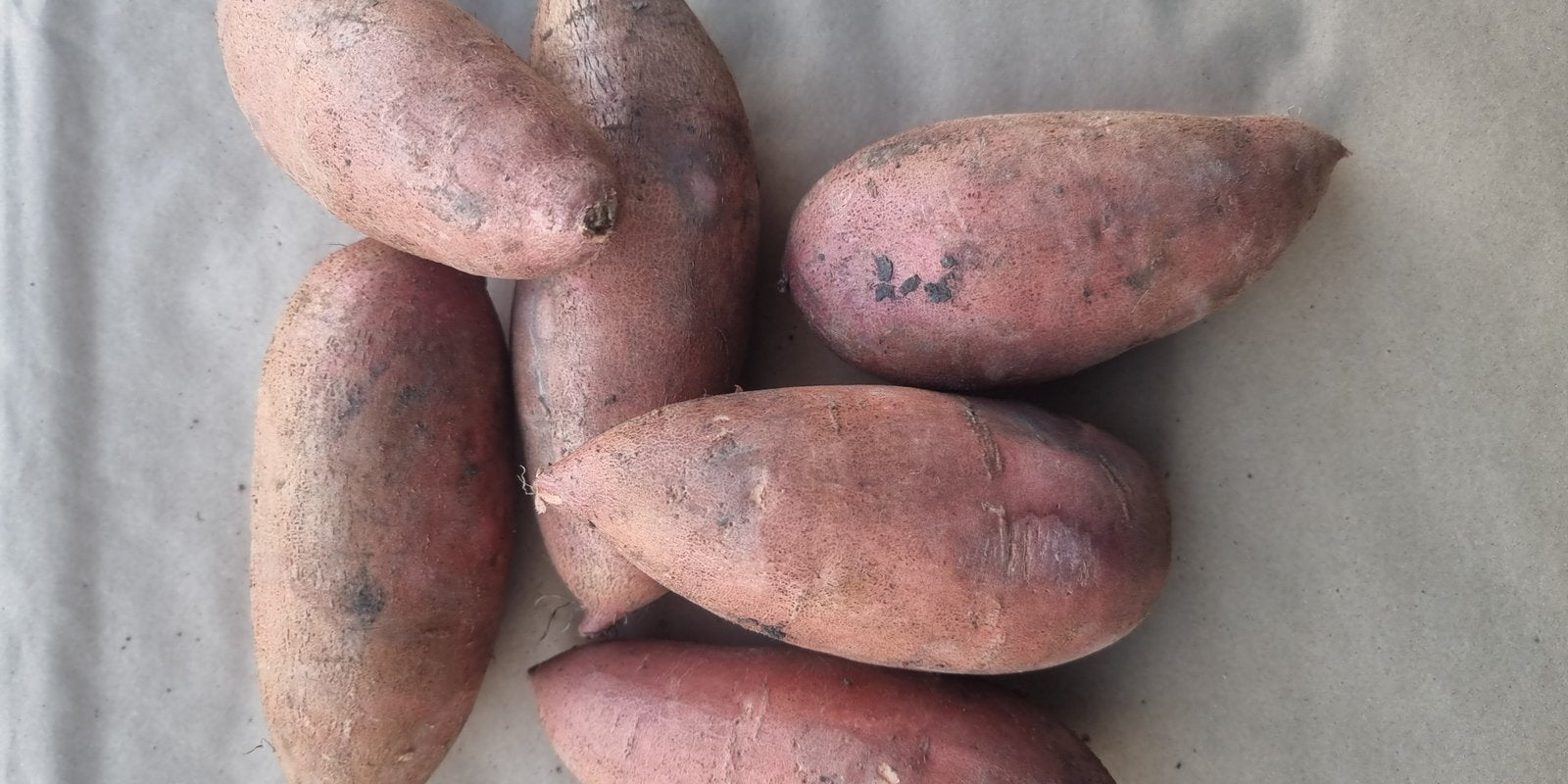
| Sun | Full sun, warmest spot |
|---|---|
| Water | Even moisture; reduce before harvest |
| Soil | Loose, free-draining sandy loam, pH 5.5 to 6.5 |
| Feed | Light; compost, go easy on nitrogen |
| Spacing | 30 to 40 cm |
| Depth | Slips 7 to 10 cm |
| Germination | Not from seed; cut slips root in a week |
| Harvest | 16 to 22 weeks |
| Container | Not suited to pots |
| Frost | Frost tender; plant after the last frost |
| Use | Roasted, mashed or baked; shoot tips cooked as greens |
Sweet potato (Ipomoea batatas) is a trailing vine in the morning glory family, Convolvulaceae, grown for its sweet storage roots and edible shoot tips. It is not a true potato, and it is a different plant again from yacon and Jerusalem artichoke. With four to five frost-free months, a few slips can fill a bed; the usual mistake is overfeeding, which grows vines instead of tubers.
Three mistakes that matter
- Planting slips into cold soil. Below about 15°C at night the plants stop growing, and a cold, wet bed rots young slips. Wait for the soil temperature in When to plant, usually well after the last frost.
- Feeding for leaves. Nitrogen-rich manure or fertiliser before the tubers form makes lush vines and few, small tubers. Dig in compost at bed preparation, give only the light feeds in Care by growth stage, and never side-dress with nitrogen.
- Storing tubers in the fridge. Sweet potatoes suffer chilling injury below about 13°C, and the flesh turns pale, spongy and pitted. Cure them first, then store them as Harvesting Tubers describes.
When to plant
Plant rooted slips once the soil holds at least 17°C and nights stay warm, as Three mistakes that matter explains. In Melbourne and cooler districts, Melbourne Cup weekend is a sound marker. One planting a season is usual, from a tuber sprouted weeks ahead, as Planting Slips describes.
| Zone | Example cities | Plant | Harvest | Notes |
|---|---|---|---|---|
| Tropical | Darwin, Katherine NT; Cairns, Townsville QLD | Apr-Jun and Nov-Dec | Aug-Nov and Mar-Jun | Grows year round. Plant early in the dry with steady water, or as the wet begins, on mounds. |
| Subtropical | Brisbane, Bundaberg, Rockhampton QLD; Coffs Harbour, Lismore NSW | Sep-Jan | Jan-Jun | Coastal gardens can plant again in December or January. Inland valleys wait until frost has passed. |
| Arid and semi-arid | Alice Springs NT; Broken Hill, Dubbo NSW; Mildura VIC | Oct-Nov | Feb-Apr | Plant after the last inland frost. Mulch deeply and water steadily through the hot, dry summer. |
| Temperate | Sydney, Newcastle NSW; Melbourne, Geelong VIC | Oct-Dec | Feb-May | Sydney plants from October. Melbourne waits for Melbourne Cup weekend and uses its warmest bed. |
| Mediterranean | Perth, Bunbury WA; Adelaide and the SA coast | Oct-Dec | Feb-May | Plant once spring rain eases and the soil warms. Mulch and water deeply through the dry summer. |
| Cool and alpine | Canberra ACT; Ballarat VIC; Orange NSW; Hobart TAS | Nov | Mar-Apr | Marginal. Plant 'Northern Star' four weeks after the last frost, in the warmest, most sheltered bed. |
Late in a window, choose 'Northern Star', the earliest of the three varieties, so the crop can be lifted before autumn frost. In the tropics, plant on mounds if the crop will sit through wet-season rain.
Site, soil and setup
| Get the bed right | What to do |
|---|---|
| Sun | Full sun and the warmest spot in the garden; in cool districts, a sheltered bed facing north |
| Soil | Loose, deep, free-draining sandy loam, at least 30 cm deep; heavy clay leads to rot and misshapen tubers |
| pH | 5.5 to 6.5, with 5.5 to 6.0 the optimum; below 5.5, dig in dolomite lime at 100 to 200 g per square metre, 4 weeks before planting. Do not over-lime, because scurf (Monilochaetes infuscans) and pox (Streptomyces ipomoeae), two root diseases, favour neutral to alkaline soil |
| Mounds | On clay or in wet-season gardens, plant into ridges or mounds 20 to 30 cm high so the tubers never sit wet |
| Bed preparation | Dig in a 5 cm layer of compost; on poor sandy soil, add pelletised chicken manure at 100 g per square metre at planting. No fresh manure |
| Room | Stems run up to 4 m, so give the crop a bed of its own |
Plant each year in a bed that did not grow sweet potato the year before, because weevils, nematodes and soil diseases build up.
Planting Slips
Gardeners grow sweet potato from slips (rooted shoots) sprouted from a seed tuber; true seed is kept for breeding. Due to quarantine restrictions and our shipping policy, we cannot send sweet potato tubers to Western Australia or Tasmania.
Choosing a variety
| Variety | Skin and flesh | Best for | What changes |
|---|---|---|---|
| 'Beauregard' | Rose gold skin; deep orange, moist, sweet flesh | Most gardens; the standard orange type | Susceptible to root-knot nematode, so avoid beds where it has galled earlier crops |
| 'Northern Star' | Red to purple skin; firm, drier white flesh | Cool districts and short seasons, because it matures earliest | Keep watering even, since it can turn bumpy or ribbed in difficult conditions |
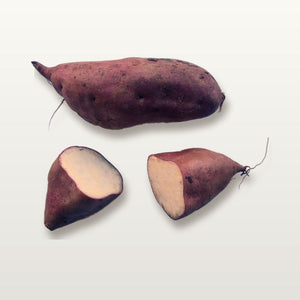
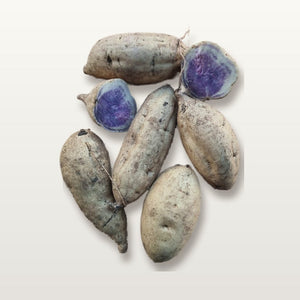
| 'Eclipse' | White to cream skin; purple flesh, dense and mildly sweet | Tropical, subtropical and warm temperate gardens | Plant early in the window for a full warm season; the depth of purple varies between tubers |
Growing slips
Start the tuber four to six weeks before planting, and until then hold it somewhere airy and above 13°C, never in the fridge. Half-bury it on its side in a tray of moist potting mix, in a warm, bright spot such as a sunny windowsill. Shoots appear in two to four weeks. Planting the whole tuber instead gives one plant, not eight or ten.
Snap each shoot off at 15 to 20 cm, strip the lowest leaves and stand it in water; roots usually appear within a week. How to sprout sweet potato slips covers the jar method and what to do if nothing happens.
Planting out
- Harden off rooted slips (accustom them to outdoor sun and wind) over a few days, starting in a sheltered, shady spot and adding morning sun.
- Plant in the late afternoon, laying each slip at a slant with two thirds of the stem buried, 7 to 10 cm deep.
- Bury at least three nodes (the joints where leaves grew), because the tubers form from those nodes.
- Space slips 30 to 40 cm apart, in rows 75 cm to 1 m apart.
- Expect slips to wilt for a day or two after planting; they recover once rooted.
- Mulch with straw once the slips stand up again.
Care by growth stage
Once rooted, sweet potato needs warmth, even moisture and restraint with feed. Storage roots start forming five to eight weeks after planting.
| Stage | Water | Feed | Watch for |
|---|---|---|---|
| Establishing, weeks 1 to 3 | Daily for the first week, then less often as the slips take hold | Seaweed solution at 30 mL per 9 L at planting and again a fortnight later | Cold nights, which stall new growth |
| Vine running, weeks 4 to 8 | A deep soak about once a week in dry weather | Nothing more; the bed preparation carries the crop | Weeds, which are hard to reach once vines cover the bed; runners rooting at their nodes |
| Tubers swelling, weeks 8 to 18 | Deep and even; a dry spell followed by a soaking cracks tubers | Sulphate of potash at 30 to 50 g per square metre, once, watered in | Soil cracks, where weevils reach tubers; hawk moth caterpillars on the leaves |
| Maturing, the last 2 weeks | Reduce watering 1 to 2 weeks before cutting the vines, without letting the soil crack; water lightly before digging if it is dry | Nothing | Yellowing leaves, the sign to dig; frost forecasts in cool zones |
Every few weeks, lift the runners and lay them back down, so they do not root along their length and set many small tubers. If growth stalls in poor soil, a light dose of all-purpose controlled release granular (NPK around 14-5-10) scratched into the soil can help.
Companion planting
The vines smother anything low beside them, so companions work best under taller plants or before the vines run.
Grows well with
- Fruit trees in frost-free gardens, where the vines make a living groundcover beneath the canopy.
- Lettuce, sown between young slips and cut before the vines close over.
Keep apart
- Morning glory and other wild Ipomoea vines, relatives that host sweetpotato weevil.
- Small, low crops such as herbs and bush beans, which the running vines shade out.
Harvesting Tubers
Lift sweet potatoes 16 to 22 weeks after planting, when the leaves start to yellow, and before the first frost. To check, cut a tuber: sap that dries white means it is ready, while sap that dries dark or green means it needs longer.
- Cut the vines off five to ten days before digging, so the skins toughen.
- Fork gently from the edge of the bed, well back from the stems, because the skins bruise easily.
- Lift the tubers by hand and brush off the soil; do not wash them.
- Set damaged tubers aside to eat first, since wounds let rot in.
- Keep a few sound, medium tubers from healthy plants to sprout next spring.
Curing
Curing heals skin wounds, cuts storage losses and turns some starch to sugar, so cured tubers taste sweeter. Start straight after digging, with the tubers unwashed.
| Method | Conditions | Time |
|---|---|---|
| At home | A warm, humid spot out of the sun, with tubers in a single layer, for example in a plastic bag with holes cut for air | 1 to 2 weeks |
| Ideal | 30°C, very high humidity and fresh air | 4 days in warm weather, up to 7 days when it is cooler |
Store cured tubers dark and airy at 13 to 16°C, wrapped in paper or in a single layer. They usually keep for four to five months. Roast, mash or bake them, and steam or roast 'Eclipse' rather than boiling, which leaches out the purple.
Common problems
Tuber rots instead of sprouting. A tuber kept cold and wet goes soft and smells; start a fresh one somewhere warmer, since slow sprouting usually means too cold.
Many small tubers along the runners. Runners that root at their nodes set small tubers of their own and split the crop; lift them as Care by growth stage describes.
All vine and few tubers. Nitrogen fed early, as Three mistakes that matter warns, or a bed kept wet in hot weather grows leaves at the expense of storage roots. Once the vines run, keep to the weekly deep soak in Care by growth stage.
Cracked tubers. A dry spell followed by heavy rain or a deep soak splits swelling tubers along their length; keep moisture even from week eight.
Ribbed or knobbly tubers. Cold soil while tubers first form, uneven watering or nematodes misshape them, and 'Northern Star' is prone to it; plant into warm soil.
Tubers rot in storage. Digging wounds and warm, humid storage above 20°C let rot in; cure first, and see Three mistakes that matter for chilling.
Holes chewed into tubers. Curl grubs (Heteronyx and Heteronychus spp.), the white, C-shaped larvae of scarab beetles, chew large holes that let rot in. True wireworms (Elateridae) and false wireworms (Gonocephalum and Pterohelaeus spp.) leave smaller holes. Fork over the top 15 cm before planting and pick out any larvae you turn up. Read more
Tubers dug up or gnawed. Rats, bandicoots, brush turkeys and wallabies all eat sweet potatoes, and native animals are protected. Fence the bed or cover it with wildlife-safe netting (white, taut, with mesh too small for a finger). Read more
Pests and diseases
Most leaf-chewers do little lasting harm, but the weevil can spoil a crop, particularly in tropical and subtropical gardens.
Sweetpotato weevil (Cylas formicarius). This slender, ant-like weevil, up to about 7 mm long, has a blue-black head and abdomen with an orange thorax and legs. Its grubs tunnel through tubers and stems, and even light feeding leaves the flesh bitter. Dig promptly once the crop is ready, because damage grows the longer infested tubers sit.
Root-knot nematode (Meloidogyne spp.). These microscopic soil worms blister, crack and roughen the roots, and the plants yellow and wilt easily. Damage is worst in sandy soil and warm weather. Rotate beds as Site, soil and setup describes, and note from Choosing a variety that 'Beauregard' is susceptible. Read more
Scab (Sphaceloma batatas). Brown, scabby lesions form on stems and leaf veins in wet weather, and the leaves cup and deform. Spores spread in rain splash and on planting material, so never take slips or tip cuttings from an affected plant.
Sweet potato feathery mottle virus (a potyvirus). Aphids and infected planting material spread this common virus. Leaves show mottled spots or feathery yellowing along the veins, and tubers grow thin and long, sometimes covered in fine cracks. Never sprout slips from a plant that showed these symptoms.
Convolvulus hawk moth (Agrius convolvuli). Its caterpillars, green at first and later olive or brown, grow up to 120 mm long and chew the leaves. They are most common in the northern wet season and in summer in NSW and Victoria. Pick them off by hand.
Silverleaf whitefly (Bemisia tabaci). Tiny white adults and flat nymphs suck sap under the leaves, causing yellow or purplish stippling, though the effect on the crop is usually minor. Avoid routine spraying, because this whitefly resists many common insecticides. Read more
Prevention first
- Sprout slips from clean seed tubers, not supermarket stock, and renew your own saved line every few years.
- Keep the soil moist and hilled over the tubers, so weevils cannot reach them through cracks.
- Clear away vines and missed tubers after harvest, since they carry weevils into the next season.
- Hose aphids off young shoots, because they spread feathery mottle virus.
Tips
- Pick young shoot tips as a green vegetable, cooked like spinach in stir-fries, soups and curries. A light picking costs the tubers little.
- For a few early tubers, find a thickened stem at ground level, feel beneath it and lift one, leaving the plant to grow on.
- Fill gaps or start a second bed with 20 to 30 cm tip cuttings from the vines, which root and grow like slips.
- Tubers dug in autumn are often reluctant to sprout, so give saved seed tubers extra time and warmth when you start them in spring.
Questions
Can I grow sweet potatoes from a supermarket sweet potato?
You can try, but shop sweet potatoes are held in cool storage, which keeps sprouting down, so they can be slow and unreliable to shoot. Our seed tubers are supplied clean, with no post-harvest treatments, so they shoot readily.
How long do sweet potatoes take to grow?
Usually 16 to 22 weeks from planting slips, and longer in cool districts. Lift when the leaves start to yellow, and before the first frost. Of the three varieties the store sells, 'Northern Star' matures earliest, so it suits short seasons.
Can you grow sweet potatoes in Canberra or Melbourne?
Yes, as a summer crop, though Canberra is marginal. Plant well-rooted slips in November into the warmest, most sheltered bed, once frost has passed and the soil has warmed. Choose 'Northern Star', and lift the crop before autumn frost. Expect smaller tubers than in warmer districts.
Are sweet potato leaves edible?
Yes. The young leaves and shoot tips are eaten cooked, steamed or stir-fried like spinach, or added to soups and curries. Pick lightly, because a few tips cost the crop little, while stripping the vines hard reduces the tubers.
Is sweet potato the same as kumara or yam?
Kumara is the Maori name for sweet potato, so they are the same plant. True yams are Dioscorea species in a different family, and the potato is Solanum tuberosum, in the nightshade family. Sweet potato belongs to the morning glory family.
Grow it

More edible produce guides
All edible produce
Asparagus
How to grow asparagus from seed in Australia: raising seedlings, planting crowns, a bed of its own, when to start picking spears and cutting back the fern.
| Position | Full sun |
|---|---|
| Depth | Seed 1 to 2 cm |
| Spacing | 30 to 40 cm |
| First pick | Third spring from sowing |
Elephant garlic
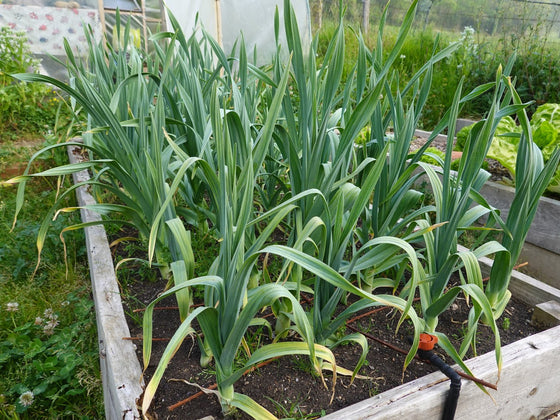
Also sold as Russian garlic. Plant the large cloves in April or May, keep the bed weeded and watered, and use the finger test to judge when the bulbs are ready.
| Position | Full sun, 6 hours or more |
|---|---|
| Depth | 5 cm of soil over tip |
| Spacing | 20 to 30 cm |
| First pick | 6 to 8 months |
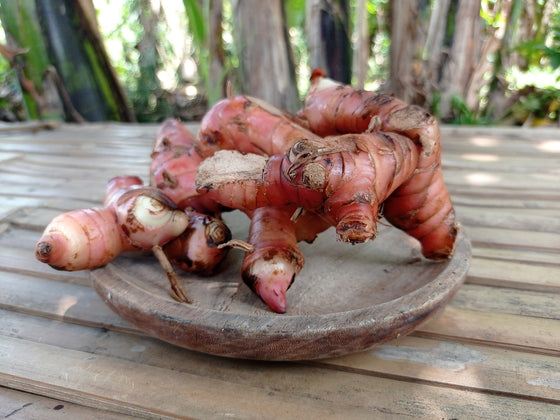
Galangal
Grow Thai red and lesser galangal from rhizomes in Australia: planting months for six zones, pre-sprouting, pots for frosty areas, feeding, pests and harvest.
| Position | Morning sun, afternoon shade |
|---|---|
| Depth | 5 to 7 cm, buds up |
| Spacing | 30 to 45 cm |
| First pick | 17 to 43 weeks |
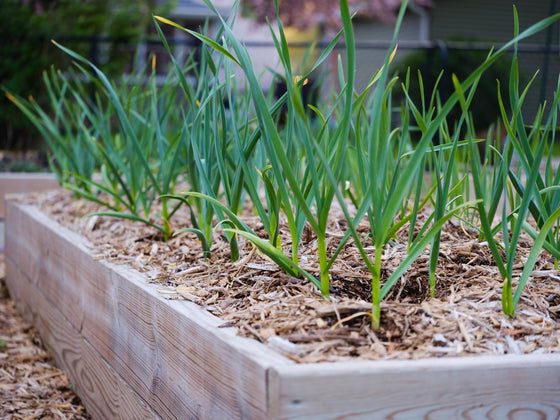
Garlic
When to plant garlic in each Australian climate zone, how deep and how far apart, feeding through winter, and how to tell when the bulbs are ready to lift and cure.
| Position | Full sun, 6 hours or more |
|---|---|
| Depth | Tip 2 to 5 cm deep |
| Spacing | 10 to 15 cm |
| First pick | 22 to 39 weeks |