
How to Grow Motherwort in Australia
Motherwort is a hardy perennial of the mint family that grows to about 1 m in sun or part shade. Sow the seed on the surface, covered no deeper than 3 mm, in warm weather, or chill it for 8 to 12 weeks first. Space plants 50 cm apart, keep the soil moist, and cut the flowering stems before the seed ripens.
| Sun | Full sun to part shade |
|---|---|
| Water | Keep moist; never let it dry out |
| Soil | Most soils, mildly acid to mildly alkaline |
| Feed | Light; compost and half-strength feeds only |
| Spacing | 50 cm apart |
| Depth | Surface, covered to 3 mm |
| Germination | 1 to 2 weeks warm; chill for cool sowing |
| Harvest | Flowering stems in summer, from 70 to 80 days |
| Container | Yes; 30 cm pot, about 13.5 L |
| Frost | Frost hardy perennial |
| Use | Herb garden, bees, olive-green dye |
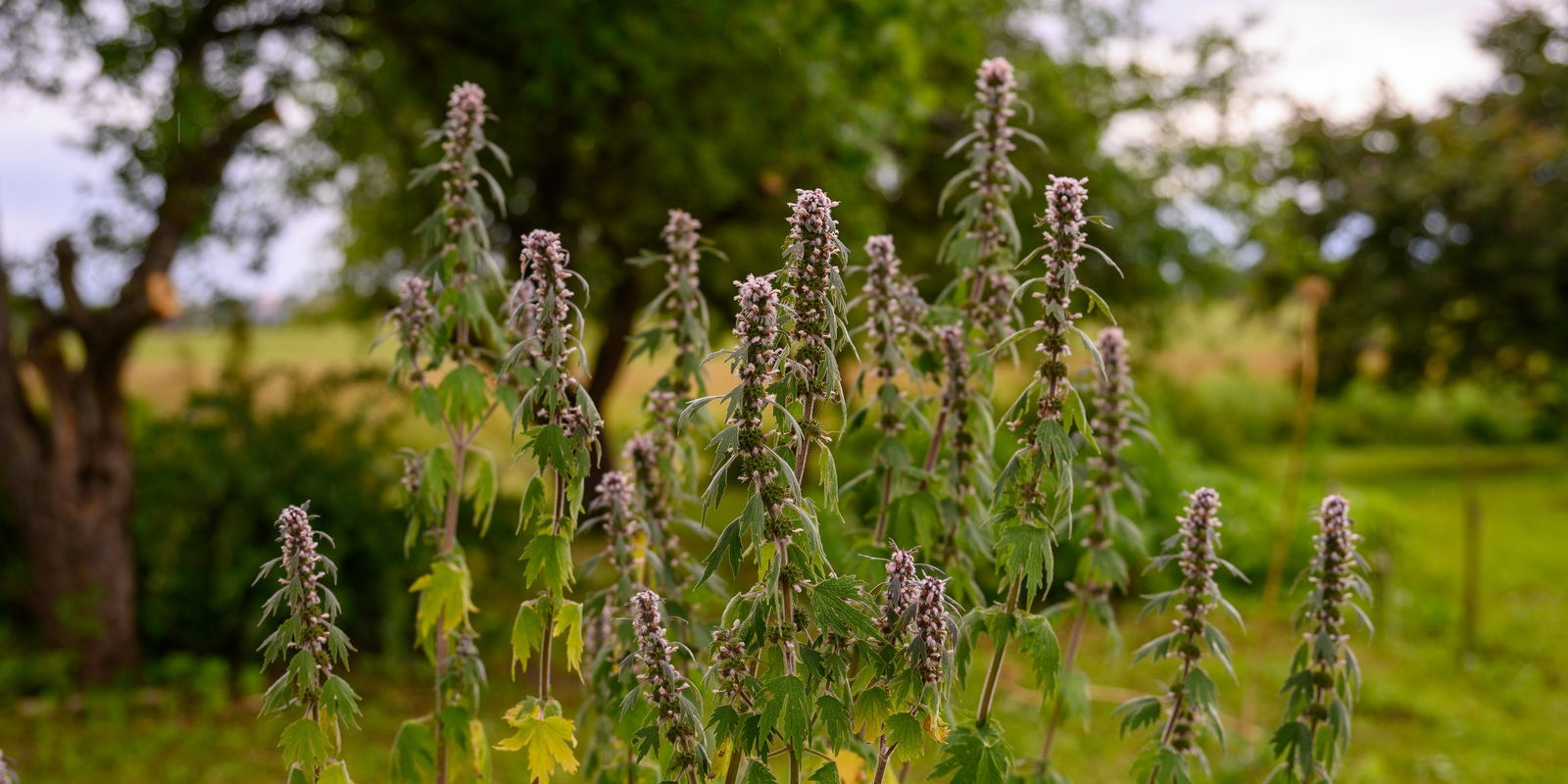
Motherwort (Leonurus cardiaca) is a hardy perennial of the mint family, Lamiaceae, grown in herb gardens for its lobed leaves and bee-friendly pink flowers. It reaches about 1 m, takes frost and part shade, and puts up with poor soil. What most growers get wrong is the seed: sown too deep it barely comes up, and left on the plant it spreads everywhere.
Three mistakes that matter
- Burying the seed. In one trial, seed left on the surface came up two to three times as well as seed covered by 1 cm of mix. Press it onto the mix and cover it no deeper than 3 mm.
- Sowing untreated seed into cold soil. Fresh seed comes up poorly, or not at all, in cool weather, even though it is still alive. Wait for the warmth that When to plant describes, or chill the seed first, as Germinating the seed explains.
- Letting the flowers set seed. Each flower leaves four small nutlets, and the prickly calyces can cling to fur and clothing, so seedlings can turn up far from the bed. Cut the flowering stems before the seed ripens, as Deadheading explains.
When to plant
Untreated seed germinates best when days reach about 25°C and nights stay near 15°C. It usually emerges in 1 to 2 weeks at 18 to 24°C. Below that it waits, so cool-season sowings need seed that has been chilled or left outdoors through winter. One sowing is enough, because the plant returns every year.
| Zone | Example cities | Sow | Harvest | Notes |
|---|---|---|---|---|
| Tropical | Darwin NT; Cairns, Townsville QLD; Broome WA | Apr-Jun | Jul-Sep | Marginal for a temperate perennial. Sow as the dry season starts; plants may struggle in the wet. |
| Subtropical | Brisbane, Gold Coast, Sunshine Coast QLD; Coffs Harbour, Lismore NSW | Mar-May and Aug-Sep | Oct-Jan | Grow in part shade with steady water; humid summers may shorten its life. Chill seed for August sowings. |
| Arid and semi-arid | Alice Springs NT; Broken Hill, Dubbo NSW; Mildura VIC; Kalgoorlie WA | Mar-Apr and Sep-Oct | Nov-Feb | Give afternoon shade, mulch and regular water; dry soil drops the lower leaves. Chill seed for September sowings. |
| Temperate | Sydney, Newcastle, Wollongong NSW; Melbourne, Geelong VIC | Oct-Dec and Feb-Mar | Dec-Mar | Chill seed for October sowings; in Melbourne, chill it or wait until November. Autumn sowings settle in before winter. |
| Mediterranean | Perth, Bunbury WA; Adelaide and the SA coast | Oct-Dec and Mar-Apr | Dec-Mar | Summer heat arrives dry and early: mulch, water steadily and give afternoon shade. Chill seed for October sowings. |
| Cool and alpine | Hobart, Launceston TAS; Canberra ACT; Ballarat VIC; Orange NSW | Nov-Jan | Jan-Mar | Sow chilled seed after the last frost, or sow in pots left outdoors from late autumn. |
In southern gardens, untreated seed seldom takes before Melbourne Cup weekend, so chill it or wait. Autumn sowings should be up before Anzac Day, and every tray needs shade and steady damp, because even slight dryness cuts germination sharply.
Site, soil and setup
Wild motherwort grows on hedge banks, roadsides and disturbed ground, so a garden bed need not be rich. It needs moisture more than fertility: in dry soil the lower leaves drop, and the whole plant can wilt and die.
| Get the bed right | What to do |
|---|---|
| Light | Full sun to part shade; in hot inland and Mediterranean summers, a spot with afternoon shade |
| Soil | Sandy, loamy or clay soil that holds some moisture; dig in a 5 cm layer of compost before planting |
| pH | Mildly acid to mildly alkaline; below pH 6.0, garden lime at 100 to 200 g per square metre 4 weeks before sowing or planting |
| Water | Mulch with a 5 cm layer of compost and water in dry spells, so the soil never dries right out |
| Placement | The back of a herb or flower bed, 50 cm between plants, where 1 m stems do not shade lower plants |
| Rotation | None: it stays for years, so keep it out of vegetable beds that are dug and rotated each season |
Container growing
A pot keeps motherwort's short, spreading rhizomes (underground stems that send up new shoots) in one place. Give one plant a pot at least 30 cm wide, about 13.5 L; a 40 cm pot, about 28 L, holds a fuller clump. Fill it with a premium potting mix that holds moisture. The store sells a single form rather than compact varieties, so shelter a tall potted plant from strong wind.
- Water: whenever the top 2 cm of mix is dry, until water runs from the drainage holes; daily in hot spells.
- Feed: worm casting liquid diluted to weak tea colour, fortnightly from spring to late summer.
- Position: morning sun and afternoon shade in hot districts, out of the wind.
- Seed heads: cut them off before they ripen, because a pot does not stop seed spreading.
Germinating the seed
Motherwort seed has a shallow physiological dormancy (a temporary block inside the seed, not a hard coat). Fresh seed germinates only in warmth. A spell of cold, moist storage lifts the block, so chilled seed also comes up in cooler weather. Light makes no difference, and the seed does not need soaking or scratching.
This is not a difficult seed. In warm laboratory tests, 65 to 73 per cent of fresh seed germinated within 21 days. Sown on potting mix, only 36 to 51 per cent came up. Sow three seeds for every plant wanted. Gibberellic acid, which nurseries sometimes use on slow seed, made no difference to motherwort in an older trial.
| Treatment | How | How long | Temperature | What success looks like |
|---|---|---|---|---|
| None needed (warm sowing) | Press fresh seed onto moist seed-raising mix and dust it with fine vermiculite, no deeper than 3 mm | Seedlings usually in 1 to 2 weeks; allow up to 4 weeks | Warm, as When to plant describes | Pairs of rounded seed leaves, then lobed true leaves |
| Cold moist stratification (chilling seed in a damp material) | Mix the seed with a spoonful of damp vermiculite or sand in a sealed, labelled bag in the fridge; check weekly that it is damp, not wet | 8 to 12 weeks; 12 to 16 weeks for sowing into cold spring conditions | About 4°C in the fridge, then sow in cool spring weather | Seedlings in cool weather that would keep untreated seed dormant; sow at once any seed showing a white root tip |
| Winter outdoors | Sow on the surface of a pot of mix in late autumn, cover it with fine mesh against birds, and leave it outside, kept damp | Through winter until the weather warms | Natural winter cold | Seedlings appearing as spring warms |
When nothing comes up
- Sown too deep: seed under 1 cm of mix emerges poorly and under 5 cm hardly at all. Resow on the surface.
- Too cold: untreated seed stays dormant in cool weather. Wait for warmth, or chill it for 8 to 12 weeks.
- Too dry: in one trial, mild dryness cut germination from about 70 per cent to under 10. Cover the tray with glass or clear plastic and never let the surface dry.
- Stratification bag dried out or went mouldy: use material that is damp but not dripping, and check it weekly.
- Old or badly stored seed: keep spare seed in a tightly sealed jar somewhere cool and dry.
- Given up too soon: wait four weeks before resowing. Leave the pot outdoors, because seed that sits through winter can still come up in spring.
Sowing Seeds
Start motherwort in a punnet or where it is to grow, with untreated seed in warm weather or chilled seed in cool weather. Germinating the seed explains which to use.
Starting in trays
- Fill a punnet with seed-raising mix, water it and let it drain.
- Sow the seed on the surface, with the light cover Germinating the seed describes.
- Cover the punnet with glass or clear plastic and keep it out of direct sun.
- Prick out seedlings into their own small pots once they are large enough to handle.
Sowing direct
Where seed is plentiful, sow it straight onto a raked, damp bed in warm weather, pressed in and barely covered. Thin the seedlings to 50 cm apart, and keep the surface damp until they are growing strongly.
Planting out
- Start once seedlings have at least two sets of true leaves and stand about 10 cm tall.
- Harden off seedlings (accustom them to outdoor sun and wind a little more each day) for a week, up to two.
- Plant them 50 cm apart, at the depth they grew in the pot.
- Water them in and mulch with compost, kept clear of the stems.
Care by growth stage
Steady moisture decides how well motherwort grows, and feeding matters little. It grows in nutritionally poor soil, so feed lightly, at half strength at most.
| Stage | Water | Feed | Watch for |
|---|---|---|---|
| Seedlings, weeks 1 to 6 | Keep the mix damp, never soggy; water from below | Seaweed solution at half strength, 15 mL per 9 L, fortnightly from the first true leaves | Seedlings collapsing at soil level; common garden snail (Cornu aspersum) |
| Establishing, weeks 6 to 10 | Deeply, whenever the soil a finger's depth down feels dry | None; the compost dug in at planting is enough | Wilting in hot, dry spells |
| Flowering and harvest, summer | Keep the soil evenly moist, right through harvest | Worm casting liquid diluted to weak tea colour, fortnightly, only if leaves are pale | Two-spotted mite (Tetranychus urticae) in hot, dry weather; seed heads forming |
| Autumn and winter | Only in long dry spells | None | Stems browning and sprawling; seedlings around the clump |
| Each spring after | Water in dry spells as new shoots appear | A 5 cm layer of compost around the clump as mulch | The clump creeping outwards |
If growth stalls in very poor soil, scratch a light application of all-purpose controlled release granular (NPK around 14-5-10) around the clump in spring.

Deadheading
Deadheading here means cutting the flowering stems before their seed ripens, and it is the one job motherwort cannot go without. A plant flowers for about two months, and seed ripens on the first flowers while later ones are still opening.
- Cut each stem as its lowest whorls finish flowering, before the calyces turn brown.
- Wear gloves and long sleeves, because the calyx teeth are sharp and prickle bare skin.
- Bag the cut heads and put them in the rubbish bin rather than the compost.
- Cut the whole clump back near the ground once the stems brown and sprawl in autumn.
- Lift and divide a crowded clump in spring or autumn, and pot up small pieces until they root well.
Companion planting
Motherwort sits best beside tall, tough plants that like the same moist ground, and worst beside low herbs it would shade or crowd.
Grows well with
- Fruit trees and large shrubs, at the edge of whose canopy it finds the part shade and moist soil it likes.
- Comfrey, another large, long-lived perennial for the back of a bed that holds its own beside it.
Keep apart
- Thyme and oregano, low sun-lovers that 1 m stems would shade.
- Mint, whose runners tangle with motherwort's rhizomes into one clump that is hard to separate.
- Vegetable beds that are dug and resown, where its self-sown seedlings become weeds.
Harvesting Stems
Cut stems in full flower in summer, usually from about 70 to 80 days after a spring sowing, and each summer after. The part gathered is the flowering top of each stem.
- Pick on a dry day, once any dew or rain has dried off the leaves.
- Cut the flowering top of each stem with secateurs, gloved as Deadheading describes.
- Cut before the lowest flowers set seed, so the harvest doubles as deadheading.
- Shake off insects and strip any yellow or mite-damaged leaves.
- Tie the stems into small bunches, because large ones can go mouldy as they dry.
Hang the bunches upside down indoors, in a dry, airy place, or inside paper bags with holes torn in the sides. They are dry when the leaves are crisp and crumble easily. Store the dried stems in labelled airtight jars in a cool, dry, dark cupboard, out of reach of children.
Traditional use and history
Motherwort is native from Europe to Iran, where it grows wild along roadsides, hedge banks and waste ground. Settlers carried it as a herb, and it has since naturalised across much of North America and in New Zealand.
In European herbal tradition, herb doctors used motherwort for a range of women's complaints, which is how it came by its English name. The same tradition used it as a heart stimulant for palpitations, which gave it the Latin epithet cardiaca. What was gathered was the flowering top, cut and dried while the plant was in flower. Its use across Europe is documented from herbals of the seventeenth century onwards.
| Language or tradition | Name | What the name records |
|---|---|---|
| Botanical Latin | Leonurus cardiaca | Greek leon, lion, and oura, tail, for the shape of the flowering stem; cardiaca for its former use for the heart |
| English | Motherwort | Its old use by herb doctors for women's complaints |
| English folk names | Throw-wort, lion's ear, lion's tail | Lion's tail follows the botanical name |
| German | Herzgespannkraut | Herz, heart, as in the Latin epithet |
| Dutch | Hartgespan, hartkruid | Hart, heart, again |
| Italian | Cardiaca comune | Common cardiaca, from the Latin |
The European Medicines Agency's herbal committee has recorded the European tradition on the strength of long use alone, not on proof that it works. In traditional Chinese medicine, the herb called yi mu cao comes from a different species, Leonurus japonicus, which is not the plant sold here. Old herb lore also credited motherwort with warding off wicked spirits, and its leaves give a dark olive-green dye.
Safety
Motherwort is sold as seed for growing. Nothing here is advice to eat or take any part of the plant. Anyone thinking of using a plant should first seek advice from a qualified health practitioner.
| Topic | What the sources say |
|---|---|
| Toxicity | LiverTox, the United States liver injury database, has no entry for motherwort. The European monograph lists no known undesirable effects, while one product label cited in its review warns of rare allergic reactions and stomach upsets. The review found no digitalis-like heart glycosides, despite older reports. |
| Pregnancy and breastfeeding | The European monograph says it must not be used in pregnancy, because of its traditional use to stimulate the womb. Its safety while breastfeeding has not been established. |
| Medicines | The European review documents no interactions. It traces warnings about blood thinners to a mistaken belief that the plant holds coumarins, yet says the question deserves careful consideration. It notes one older report that motherwort adds to the effect of sleeping and pain medicines, and the monograph warns it may impair driving. |
| Allergy and skin | Sources differ: the European review found no reported case of allergy, including contact allergy, while a plant database says skin contact can cause dermatitis in susceptible people and its essential oil can make skin sun-sensitive. The sharp calyx teeth prickle bare hands. |
| Pets and livestock | The ASPCA's plant lists for dogs, cats and horses do not include motherwort, and the ASPCA says they are not complete, so its effect on pets is uncertain. The calyx teeth can injure grazing animals' mouths. Grazing animals tend to avoid the bitter leaves, which one source suggests may be slightly toxic. |
| Look-alikes and names | No toxic look-alike is recorded. Lion's tail (Leonotis nepetifolia), an orange-flowered weed of the same family that shares the names lion's tail and lion's ear, is a different plant. |
| Legal status | No state or territory declares motherwort a weed: it is absent from the declared lists of NSW, Victoria, Queensland, South Australia, Tasmania, the Northern Territory and the ACT, and Western Australia's organism list records it as permitted. It has been recorded once as naturalised in Australia, in pasture in the Molong area of central-west NSW. Lion's tail is declared in the NT and WA. The store's listing carries no shipping restriction. |
Common problems
Lower leaves yellow and drop. The soil has dried out, and a thirsty plant sheds its lower leaves before it wilts. Water deeply, mulch, and add afternoon shade in hot districts. Read more
Stems flop and sprawl in late summer. Older stems lean over toward the end of the season and the plant looks ragged. Cut the clump back once the stems brown, as Deadheading describes.
The clump creeps outwards. Short rhizomes push up new shoots around the parent, and plants can form colonies. Lift and divide the clump, or grow it in a pot. Read more
Pests and diseases
Motherwort has no serious pest or disease problems, and the few below mostly strike seedlings or plants stressed by heat and dry soil.
Two-spotted mite (Tetranychus urticae). These tiny mites feed on many garden plants across Australia and are worst in hot, dry weather. They feed under the leaves, turning them yellow or bronzed under fine webbing. Hose the undersides of the leaves and keep the soil moist. Read more
Common garden snail (Cornu aspersum). Snails shelter in damp places and can damage young seedlings in trays and beds. Hand-pick them after dark, and protect seedlings with cloches cut from plastic bottles. Take the caps off in warm weather, and lift the cloche if the seedlings wilt or grow leggy. Read more
Damping off (Pythium species and Rhizoctonia solani). Seedlings rot at soil level and fall over, most often in wet mix during cool weather. Remove affected seedlings and let the surface dry a little between waterings. Read more
Prevention first
- Sow into fresh seed-raising mix in clean trays.
- Water seedlings from below, so the surface does not stay wet.
- Mulch and water established plants through hot, dry spells, when mites build up.
- Check under the leaves weekly in summer, and around trays at night for snails.
Tips
- Learn the seedling: its deeply lobed leaves look like a small maple leaf, which makes strays easy to spot and pull.
- Plant it where you can watch the bees work its flowers.
- Push a stake beside the clump in winter, when it dies back, so it is not dug up by mistake.
Questions
Why is my motherwort seed not coming up?
Usually it was sown too deep, into cold soil, or allowed to dry out. Press the seed onto the surface and cover it no deeper than 3 mm. Sow in warm weather, or chill the seed for 8 to 12 weeks first. Keep the surface damp, and wait four weeks before sowing again.
How long does motherwort take to grow from seed?
Seedlings usually appear in 1 to 2 weeks in warm conditions. Plants sown in spring can flower from about 70 to 80 days later, in summer, and a plant flowers for about two months. As a perennial it comes back each spring.
Can I grow motherwort in Queensland or the tropics?
It is a temperate plant, native from Europe to Iran, so it is marginal in the tropics and humid subtropics. In Brisbane, sow in autumn or late winter and grow it in part shade with steady water. In the far north, sow at the start of the dry season.
Is motherwort safe to grow around dogs and cats?
Its effect on pets is uncertain. It is not on the ASPCA plant lists for dogs, cats and horses, which the ASPCA says are not complete. Its prickly calyces can injure grazing animals' mouths, and grazing animals tend to avoid its bitter leaves. Keep cut and dried stems out of reach of pets.
Is motherwort a declared weed in Australia?
No state or territory declares it. It self-sows freely, though, so cut the flowering stems before the seed ripens. Lion's tail, Leonotis nepetifolia, is a different plant sharing the name lion's tail, and it is declared in the Northern Territory and Western Australia.
Does motherwort come back every year?
Yes. It is a hardy perennial that returns from the base each spring and spreads slowly by short rhizomes. Divide a crowded clump in spring or autumn.
Grow it
More herb guides
All herbs
Agrimony
How to grow agrimony in Australia from seed: chilling the burrs, sowing months for six climate zones, sun and soil, cutting back, harvest, history and safety.
| Position | Full sun, light shade tolerated |
|---|---|
| Depth | 5 mm |
| Spacing | 30 cm apart |
| First pick | Summer; 12 to 18 weeks from spring sowing |

Angelica
How to grow angelica in Australia from seed: fresh or chilled seed sown on the surface, part shade, months for six climate zones, stems, history and safety.
| Position | Part shade, morning sun |
|---|---|
| Depth | Surface; press in, uncovered |
| Spacing | 50 to 90 cm |
| First pick | Stems at about 18 months |

Ashwagandha
Grow ashwagandha from seed in Australia: warm germination, sowing, site, care and root harvest, with its history and safety, for all six climate zones.
| Position | Full sun |
|---|---|
| Depth | 5 mm |
| Spacing | 45 to 60 cm apart |
| First pick | Roots 21 to 26 weeks |

Astragalus
How to grow astragalus (huang qi) in Australia from hard-coated seed: rubbing and soaking, sowing months for six zones, care, pests and lifting the taproot.
| Position | Full sun |
|---|---|
| Depth | 5 mm |
| Spacing | 20 to 45 cm apart |
| First pick | Roots after 2 to 3 years |