
How to Grow Lady's Mantle in Australia
Lady's mantle grows from tiny seed that needs light and, usually, a cold spell. Chill a moist, surface-sown tray in the refrigerator for 2 to 4 weeks, then keep it at 16 to 25°C. Seedlings usually follow in 4 to 5 weeks. Plant 30 to 45 cm apart in moist soil with afternoon shade, and cut the flowers before they seed.
| Sun | Morning sun, afternoon shade |
|---|---|
| Water | Evenly moist, never waterlogged |
| Soil | Moist but free-draining; most soils, any pH |
| Feed | Minimal; compost mulch, half-strength seaweed |
| Spacing | 30 to 45 cm |
| Depth | Surface, 3 mm at most |
| Germination | 4 to 5 weeks after a cold, moist spell |
| Harvest | Flowers in the second year or later |
| Container | Yes; 30 cm pot, about 13.5 L |
| Frost | Very frost hardy; dies back in winter |
| Use | Edging, ground cover, fresh and dried flowers |
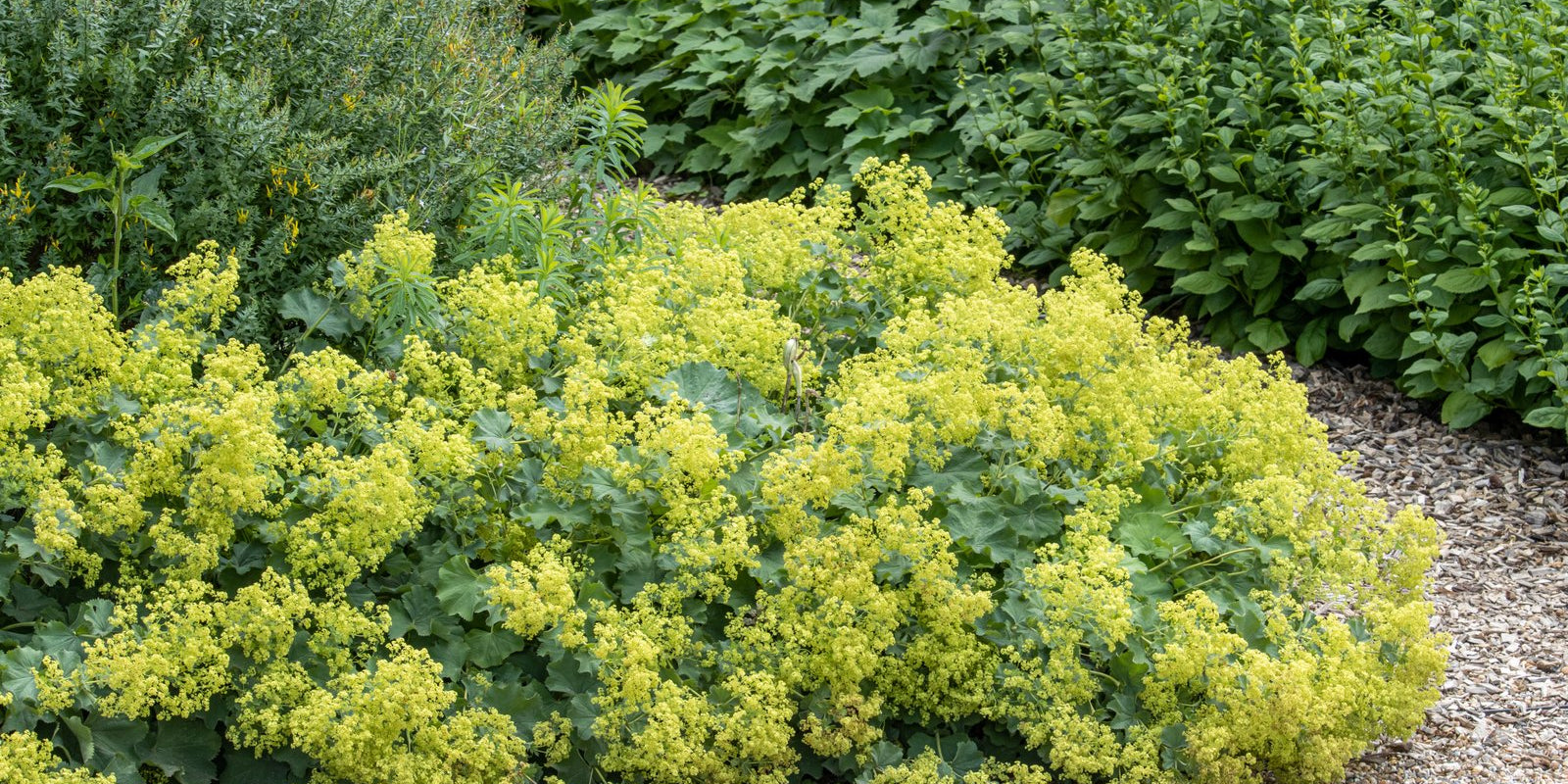
Lady's mantle (Alchemilla mollis) is a clump-forming perennial of the rose family, Rosaceae, grown for its soft, scalloped leaves and froth of lime-green flowers. After rain or a heavy dew, the downy leaves hold water in round, silver beads. It suits the cooler south best; the mistake most likely to cost a whole tray is burying its slow, uneven seed, which needs light.
Three mistakes that matter
- Burying the seed. The seed is tiny and needs light to germinate, so seed sown deep in the mix usually never appears. Press it onto the surface and cover it by no more than 3 mm, as Germinating the seed describes.
- Planting it in hot afternoon sun. In hot, dry weather, or when the soil dries out, the leaf edges scorch and turn brown. Give it morning sun and afternoon shade in warm districts, in soil that stays moist.
- Letting every flower set seed. One clump can scatter seedlings through paths, beds and lawn, and overseas it has escaped from gardens into grassland. Cut the flowers before the seed ripens, as Cutting Back describes.
When to plant
Sow when days are mild, because the seed germinates best between about 16 and 25°C once it has had a spell of cold. Late winter and early spring suit most southern gardens. An early autumn sowing of fresh seed can stand outdoors in pots and take its cold naturally. One sowing gives plants that last for years, so there is no need to sow again.
| Zone | Example cities | Sow | Harvest | Notes |
|---|---|---|---|---|
| Tropical | Darwin NT; Cairns, Townsville QLD; Broome WA | Not recommended | Not recommended | Year-round heat and humid wet seasons rot the crowns, and there is no winter cold for flowering. |
| Subtropical | Brisbane, Gold Coast QLD; Coffs Harbour, Lismore NSW | Apr-Jun | Aug-Nov | Marginal. Sow in the cool months, grow in pots in shade, and expect leaves more than flowers. |
| Arid and semi-arid | Alice Springs NT; Broken Hill, Dubbo NSW; Mildura VIC; Kalgoorlie WA | Mar-Apr and Aug-Sep | Sep-Dec | Grow in afternoon shade with mulch and regular water; dry summer heat scorches the leaves. |
| Temperate | Sydney, Newcastle, Wollongong NSW; Melbourne, Geelong VIC | Mar-Apr and Aug-Oct | Oct-Feb | Melbourne is the better end of the zone. In humid Sydney summers, give afternoon shade and water at the base. |
| Mediterranean | Perth, Bunbury WA; Adelaide and the SA coast | Mar-May and Aug-Sep | Sep-Jan | Sow with the autumn rains so roots settle before the long, dry summer; shade and water it then. |
| Cool and alpine | Hobart, Launceston TAS; Canberra ACT; Ballarat VIC; Orange NSW | Mar-Apr and Sep-Nov | Nov-Mar | Suits it best. Autumn pots can winter outdoors for their cold spell; plant out after the last frost. |
In warm districts, time spring sowings so seedlings are planted out and settled before summer heat arrives. In frosty districts, plant out after the last frost.
Site, soil and setup
Lady's mantle comes from the mountains of south-eastern Europe, Türkiye and the Caucasus. In an Australian garden, copy the cool roots and steady moisture of that home, and keep the crown out of standing water.
| Get the bed right | What to do |
|---|---|
| Light | Full sun in cool districts such as Hobart or Ballarat; morning sun and afternoon shade anywhere summers are hot; it also grows under trees and shrubs |
| Soil | Most soils, clay included, that stay moist but drain; avoid waterlogged or very dry ground |
| pH | Not critical: it grows in acid, neutral and alkaline soils, so no lime or sulphur is needed |
| Bed preparation | Dig in a 5 cm layer of compost before planting, or 5 to 10 cm of well-rotted cow or horse manure 4 to 6 weeks ahead |
| Mulch | A 5 cm layer of compost in spring, with a small gap around each crown so it does not rot |
| Spacing | 30 to 45 cm apart; each clump grows 30 to 45 cm high and wide |
Rotation does not apply to a perennial that stays put for years, but replant divided pieces into freshly composted ground rather than the old hole.
Container growing
A pot suits lady's mantle in warmer districts, because it can move into shade for summer. Give one plant a pot at least 30 cm wide, about 13.5 L, with drainage holes. Fill it with a premium potting mix that holds moisture but drains freely.
- Water: often and deeply through the first growing season, and through every hot, dry spell after that.
- Feed: worm casting liquid diluted to weak tea colour, fortnightly from spring to late summer.
- Position: morning sun and afternoon shade, moved into full shade during heatwaves.
- Renewal: lift and divide the clump every few years, when it fills the pot to the rim.
Germinating the seed
Lady's mantle seed is tiny, at roughly 2,600 seeds to the gram, and it needs light to germinate. Many seed lots also sit dormant until they have had a few weeks of cold and moisture. That is why the store and seed specialists recommend a spell in the refrigerator. The seed is also short-lived, so sow a fresh packet within the season you buy it.
Expect slow and uneven, rather than hard. Warm seed usually starts to appear after 3 to 4 weeks, and chilled seed within 4 to 5 weeks of coming out of the refrigerator. No source gives a germination rate for this seed, so sow two or three seeds for each plant wanted. A packet of Ladies Mantle seeds holds 25 seeds, enough for a tray.
| Treatment | How | How long | Temperature | What success looks like |
|---|---|---|---|---|
| Cold moist spell in the tray | Scatter seed on moist seed-raising mix, press it in, cover the tray with cling wrap pricked with a few air holes, and refrigerate | 2 to 4 weeks in the refrigerator, then move to warmth | 0 to 4°C, then 16 to 25°C | First leaves in the tray within 4 to 5 weeks of warming |
| Cold moist spell in a bag | Mix seed with a spoonful of damp sand in a sealed bag, refrigerate, then scatter the sand and seed over a tray | 3 to 4 weeks | 0 to 4°C, then 16 to 25°C | Seedlings in the tray 3 to 5 weeks after sowing |
| Warm first, then cold | Sow the tray and keep it warm; if nothing appears, bag the whole tray with plenty of air and refrigerate, then return it to a bright spot | 2 to 5 weeks warm, 4 weeks cold | 16 to 21°C, then 0 to 4°C, then 4 to 21°C | Seedlings in the weeks after chilling |
| A winter outdoors | Sow fresh seed in pots in early autumn and stand them in a sheltered spot outside through winter | Early autumn to early spring | Outdoor winter temperatures | Seedlings in early spring, once days warm above about 10°C |
| None needed | Sow seed collected ripe from your own plants straight away | Sow within days of collecting | Outdoors in a sheltered spot, or 16 to 25°C | Seedlings in the pot once conditions suit, often without a cold spell |
For the general method behind each treatment, see Soaking, scarification and cold stratification.
When nothing comes up
- Sown too deep. Seed covered by more than 3 mm of mix stays in the dark; sow a fresh tray on the surface.
- Mix dried out or went mouldy in the refrigerator. Keep the surface just moist with a mister, and leave air holes in the wrap.
- Too warm. Every source keeps the tray at 25°C or below. A covered tray in direct sun runs hotter, so move it somewhere bright but shaded.
- Not enough cold. Give the tray a further 4 weeks in the refrigerator, then return it to warmth.
- Old seed. The seed is short-lived; store packets cool, dry and sealed, and sow fresh seed each year.
- Given up too soon. Keep a tray for at least 12 weeks: 4 to 5 weeks warm, 4 weeks cold, then 4 to 5 weeks warm again.
Sowing Seeds
Start lady's mantle in a tray under cover, then plant the seedlings out. Begin with seed that has had its cold spell, as Germinating the seed describes.
Starting under cover
- Use fine, moist seed-raising mix in a clean tray; the sand trick for tiny seeds spreads them evenly.
- Press the seed onto the surface and cover it with no more than 3 mm of mix or vermiculite.
- Keep it at the last temperature your treatment in Germinating the seed gives, in bright light out of direct sun. Mist the surface rather than pouring water on.
- Take off the cling wrap or bag once most seedlings are up, so air moves around them.
- Prick out seedlings into 8 cm pots once they are large enough to handle, and grow them on somewhere cool.
Planting out
- Harden off the young plants first (a week or so of gradually longer spells outdoors so they adjust to sun and wind); see hardening off.
- Plant 30 to 45 cm apart, with the crown level with the soil surface.
- Water in well and keep the soil moist through the first summer.
- Sowing direct also works in cool districts, 2 to 3 weeks before the last frost, but a tray is easier to watch.
Care by growth stage
Steady moisture and shelter from afternoon heat decide how well lady's mantle grows. It needs little feeding, and established clumps in composted soil usually need none.
| Stage | Water | Feed | Watch for |
|---|---|---|---|
| Seedlings, weeks 1 to 8 after emergence | Keep the mix just moist; water from below or with a mister | Seaweed solution at half strength, 15 mL per 9 L, fortnightly from the first true leaves | Damping off; snails on trays left outdoors |
| First summer after planting out | Regularly and deeply, so the soil around the roots never dries | None beyond the compost dug in at planting | Scorched leaf edges in afternoon sun |
| Hot spells, any year | In the morning, at the base, keeping water out of the crown | Seaweed solution at half strength, 15 mL per 9 L, fortnightly for heat stress | Leaves browning; soft, rotting crowns after hot, wet nights |
| Winter dormancy | Only in long dry spells; never soggy | None | Leaves dying back, which is normal in cool districts |
| Spring growth and flowering, second year on | Steady moisture right through flowering and leaf picking, with a deep soak in dry spells | A 5 cm compost mulch around, not over, the crowns | Self-sown seedlings; flower stems flopping after heavy rain |
If growth stalls in poor, sandy soil, scratch in a light application of all-purpose controlled release granular (NPK around 14-5-10) in spring.
Cutting Back
Cut lady's mantle back after flowering, both to stop it seeding and to replace tired summer leaves with fresh ones.
- Snip off faded flower stems before the seed ripens, while the flower heads are still green rather than brown and papery.
- Once flowering ends and the leaves look tatty, cut the whole plant to the base, then water well; fresh leaves soon follow.
- In autumn, cut off dying foliage, or leave it as winter shelter for insects and clear it before new leaves appear.
- Divide clumps every few years in early spring or autumn, keeping young pieces about 15 cm across from the edge; see dividing perennials.
- Pull unwanted seedlings while small; they are easy to spot by their scalloped leaves.
Companion planting
Lady's mantle is a classic edging and ground cover, and it grows well beside plants that like the same moist, part-shaded ground.
Grows well with
- Roses, whose bare lower stems the leafy clumps cover.
- Foxgloves and sweet william, which share its part-shaded, moist cottage border.
- Salvia, iris and ferns, whose upright shapes contrast with its low mound.
Keep apart
- Catmint and hardy geraniums, which need cutting back at the same time and leave a double gap together.
Harvesting Leaves
Pick leaves for arrangements once a clump has formed a full mound, in the morning after the dew has dried. Flower sprays are ready at the peak of flowering, when most of the tiny flowers are open.
- Cut single leaves with their stalks at the base, taking a few from each clump at a time.
- Cut flower stems at the base with clean secateurs.
- Choose clean, unmarked leaves, and leave any with spots or scorched edges.
- Bundle a few stems together loosely, so air moves between them.
- Hang bundles upside down in a cool, dark, airy room until crisp.
Store dried stems somewhere dry and dark, loosely wrapped in paper. The dried flowers resist shattering and last longer than many other dried flowers.
Use the sprays as a filler in fresh and dried flower arrangements, where the lime-green froth suits almost any colour.
Traditional use and history
Two different plants share the name. The garden lady's mantle, Alchemilla mollis, is the one sold as seed here. The lady's mantle of European herbal tradition is Alchemilla vulgaris and its close relatives. They are a group of small, similar species of northern meadows and hills. Some authorities hold that A. mollis itself has no recorded history of herbal use, and that the two have been confused. The herbal tradition described here is recorded for common lady's mantle.
| Plant | Where it comes from | What the record shows |
|---|---|---|
| Garden lady's mantle (A. mollis) | The Carpathians, the Caucasus and Türkiye | An ornamental grown in British gardens since the late nineteenth century; now naturalised in Britain |
| Common lady's mantle (A. vulgaris group) | Northern Europe and Asia, on high and cold ground | A plant of European herbal tradition, recorded in old English herbals |
Dyers have used the leaves of the garden species on wool, although the sources differ on the shade they give. In Bulgaria, part of its native range, it has been assessed as critically endangered in the wild. In Britain, where it escaped from gardens, it can outcompete rare native lady's mantles in dry grassland.
The common name comes from the Middle Ages, when the plant was linked with the Virgin Mary. Its scalloped leaf was likened to the edge of her cloak. A sixteenth-century German botanist, Jerome Bock, known as Tragus, fixed the name in its German form, and Linnaeus adopted it.
| Old name | Language | Where it comes from |
|---|---|---|
| Leontopodium | Medieval Latin | Lion's foot, probably from the spreading lower leaves |
| Pied-de-lion | French | The same lion's foot, carried into modern French |
| Lion's foot, bear's foot | English country names | The same image of a broad, spreading paw |
| Nine hooks | English country name | The nine shallow, toothed lobes of the leaf |
The genus name Alchemilla is usually traced to an Arabic word for alchemy. Alchemists held the dew beads on the leaves to be the purest form of water. They used it in their attempts to turn base metal into gold.
In European herbal tradition, common lady's mantle was counted among the wound herbs. The seventeenth-century English herbalist Nicholas Culpeper praised it as one of them. The plant was also woven into wreaths for Corpus Christi celebrations.
Safety
Lady's mantle is sold as seed for growing, and nothing here is advice to eat or take any part of the plant. Anyone thinking of using a plant should first seek advice from a qualified health practitioner.
| Topic | What the sources say |
|---|---|
| Toxicity | Information on toxicity is limited. A clinical natural products monograph, which names the garden species among the plants it covers, notes that the tannin content of concentrated extracts may be toxic in large amounts. LiverTox, the United States liver injury database, has no record for it, and the NIH herb fact sheets and MedlinePlus carry no entry. Limited data is not evidence that it is harmless. |
| Pregnancy and breastfeeding | The same monograph advises avoiding use in pregnancy and breastfeeding, because information on safety is lacking. |
| Interactions with medicines | The same monograph lists no well documented interactions; that reflects a lack of study, not proof of none. |
| Allergy and skin | No source records allergy or skin reactions. The leaves are soft and downy. |
| Pets and livestock | The ASPCA's dog, cat and horse plant lists do not include lady's mantle, as toxic or non-toxic. Maud Grieve's herbal records sheep and cattle eating the leaves of common lady's mantle; nothing is recorded for the garden species. If a pet eats some and seems unwell, call a vet or the Animal Poisons Helpline. |
| Look-alikes | The sources name no poisonous look-alike. The usual confusion is between the garden plant and the lady's mantles of tradition. |
| Legal status | No state or territory declares it a weed: it appears on none of the declared plant lists of New South Wales, Victoria, Queensland, Western Australia, South Australia, Tasmania, the Northern Territory or the ACT. Overseas it is listed as invasive in Oregon and Alaska. |
In gardens that border bushland, cut the flowers before they seed, as Cutting Back describes, and never dump clippings or divisions there. A wild lady's mantle, Alchemilla xanthochlora, grows along streams in the Victorian and New South Wales Alps and is listed as endangered in Victoria. Keep garden plants and clippings well away from high-country bushland.
Common problems
No flowers in the first year. Plants raised from seed usually take two years to flower. In mild winters they may flower lightly, because flowering follows a spell of winter cold.
Tatty, faded leaves by midsummer. The leaves tire after flowering, especially in heat; renew them as Cutting Back describes.
Flower stems sprawling across the path. Heavy rain weighs down the frothy heads; prop them with twiggy sticks or cut them for the vase.
A clump dying out in the middle. Old clumps turn woody at the centre; lift and divide them as Cutting Back describes.
Pests and diseases
Established lady's mantle has few pests, because its downy leaves put off most of them, slugs and snails included. The risks fall on seedlings, and on crowns in wet heat.
Common garden snail (Cornu aspersum) and grey field slug (Deroceras reticulatum). In damp springs they chew seedlings and tender new leaves, although older leaves are rarely touched. Hand-pick them after dark and keep trays off the ground. Read more
Damping off (Pythium and Rhizoctonia species). Seedlings collapse at soil level, a real risk while slow seed sits in damp mix for weeks. Use clean trays and fresh mix, and water from below. Read more
Crown rot and fungal leaf spots (various fungi). Where hot nights follow rain or watering, water sits in the cupped leaves and crowns, and fungi rot them. Crowded, damp clumps also develop small leaf spots. Water in the morning at the base, and thin crowded plants.
Prevention first
- Sow in clean trays with fresh seed-raising mix.
- Water at the base in the morning, so leaves and crowns dry by night.
- Space plants 30 to 45 cm apart, and divide crowded clumps.
- Check seedlings for snails and slugs after rain.
Tips
- For a few new plants without sowing, leave the flowers on one clump to seed and cut the rest.
- Lift the self-sown seedlings in spring and move them where you want a new clump.
- Where rabbits raid the garden, use lady's mantle as edging: rabbits tend to leave it alone.
Questions
Why are my lady's mantle seeds not germinating?
The usual causes are seed buried too deep, no cold spell, or giving up too soon. The seed needs light, so cover it by 3 mm at most. Chill the moist tray in the refrigerator for 2 to 4 weeks, then keep it at 16 to 25°C and wait 4 to 5 weeks.
How long does lady's mantle take to flower from seed?
Usually two years or more. Seedlings make a clump of leaves in their first season and flower from the second year or later, in late spring and early summer. Plants in warm districts with mild winters may flower lightly.
Does lady's mantle grow in Queensland or the tropics?
It struggles in heat and humidity. In the tropics it is not recommended, because wet heat rots the crowns. In subtropical gardens such as Brisbane, grow it in a pot in shade and expect leaves more than flowers. Stanthorpe and other cool districts suit it much better.
Is lady's mantle a weed in Australia?
No state or territory declares it a weed. It does self-seed freely, and it has escaped into grassland overseas. Cut the flowers before the seed ripens, especially near bushland, and never dump clippings.
Is lady's mantle safe around dogs and cats?
Its safety for pets is unknown. The ASPCA plant lists for dogs, cats and horses do not include it, as toxic or non-toxic, and no other source checked records a poisoning. Discourage pets from chewing garden plants, and if one eats some and seems unwell, call a vet or the Animal Poisons Helpline.
Is garden lady's mantle the same as the herbal lady's mantle?
No. The plant sold as garden lady's mantle is Alchemilla mollis, an ornamental from the Carpathians and the Caucasus. The lady's mantle of European herbal tradition is Alchemilla vulgaris and its close relatives.
Grow it
More herb guides
All herbs
Agrimony
How to grow agrimony in Australia from seed: chilling the burrs, sowing months for six climate zones, sun and soil, cutting back, harvest, history and safety.
| Position | Full sun, light shade tolerated |
|---|---|
| Depth | 5 mm |
| Spacing | 30 cm apart |
| First pick | Summer; 12 to 18 weeks from spring sowing |

Angelica
How to grow angelica in Australia from seed: fresh or chilled seed sown on the surface, part shade, months for six climate zones, stems, history and safety.
| Position | Part shade, morning sun |
|---|---|
| Depth | Surface; press in, uncovered |
| Spacing | 50 to 90 cm |
| First pick | Stems at about 18 months |

Ashwagandha
Grow ashwagandha from seed in Australia: warm germination, sowing, site, care and root harvest, with its history and safety, for all six climate zones.
| Position | Full sun |
|---|---|
| Depth | 5 mm |
| Spacing | 45 to 60 cm apart |
| First pick | Roots 21 to 26 weeks |

Astragalus
How to grow astragalus (huang qi) in Australia from hard-coated seed: rubbing and soaking, sowing months for six zones, care, pests and lifting the taproot.
| Position | Full sun |
|---|---|
| Depth | 5 mm |
| Spacing | 20 to 45 cm apart |
| First pick | Roots after 2 to 3 years |