
How to Grow Agrimony in Australia
Agrimony is a hardy perennial grown from burr-cased seed that germinates far better after a cold spell. Chill the seed in damp vermiculite in the fridge for 2 to 4 weeks, or sow in autumn and let winter do it. Sow 5 mm deep at 13 to 18°C and plant out 30 cm apart in full sun and free-draining soil. Cut flowering stems in summer.
| Sun | Full sun, light shade tolerated |
|---|---|
| Water | Only once the topsoil dries |
| Soil | Lean, free-draining, pH 6.0 to 8.0 |
| Feed | Minimal; compost mulch in spring |
| Spacing | 30 cm apart |
| Depth | 5 mm |
| Germination | 2 to 6 weeks, after chilling the seed |
| Harvest | Summer; 12 to 18 weeks from spring sowing |
| Container | Yes; 30 cm pot, about 13.5 L |
| Frost | Hardy; dies back over winter |
| Use | Herb garden, cut and dried stems, bees |
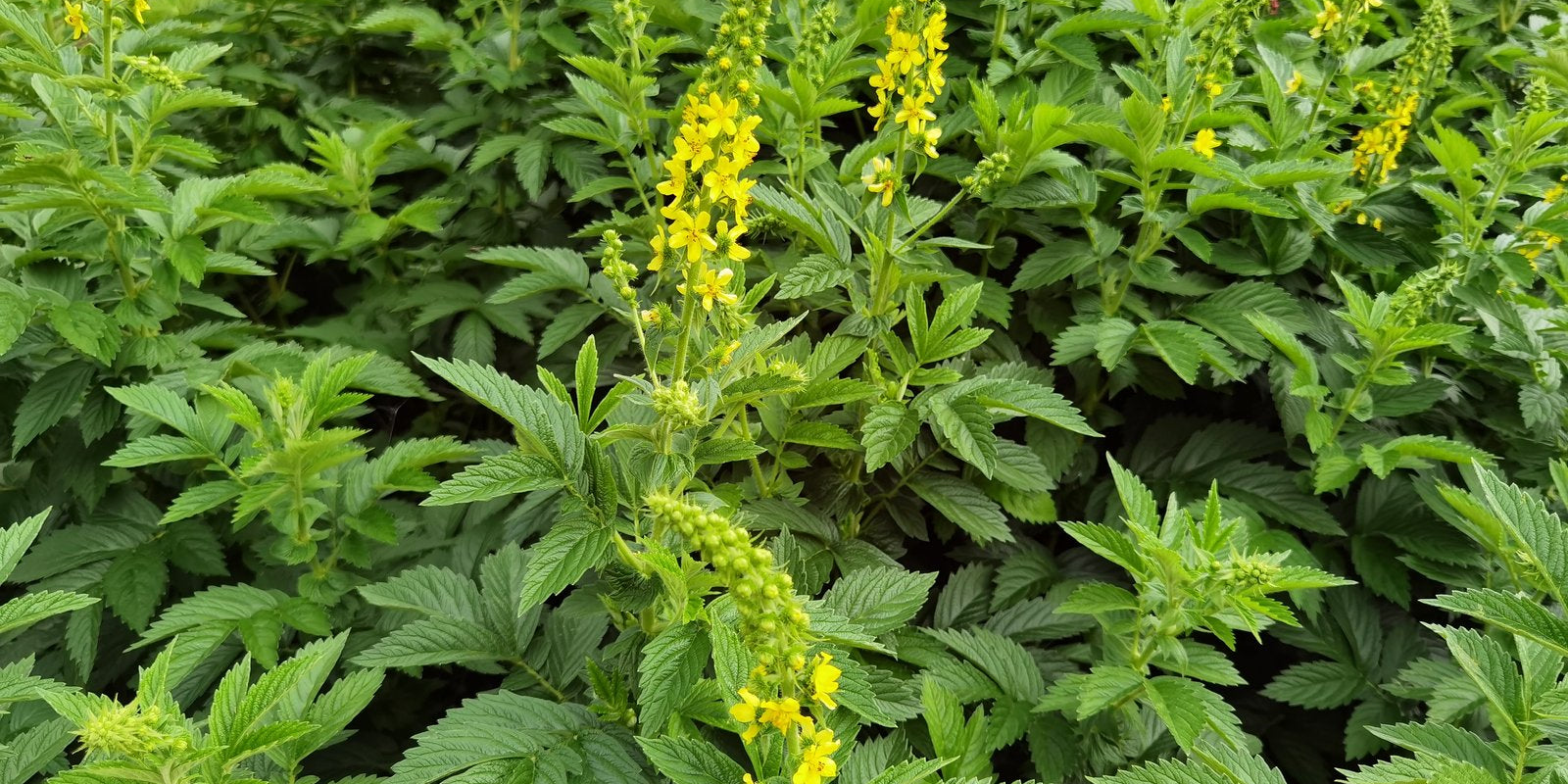
Agrimony (Agrimonia eupatoria), of the rose family Rosaceae, is a hardy perennial grown for its tall spikes of small yellow flowers. It has a long place in the herb garden, copes with dry, lean ground and has gone wild in northern New South Wales and Queensland. The seed is where most gardeners come unstuck: sown warm and unchilled, it often sits in the tray for weeks and is thrown out.
Three mistakes that matter
- Sowing the seed straight from the packet into a warm tray. The seed is dormant, and in one laboratory trial only about one seed in ten germinated without a cold spell. Chill it first, as Germinating the seed explains.
- Planting in wet or shaded ground. Agrimony is a plant of dry, sunny banks and field edges. In deep shade or wet, acid soil it struggles, and roots left standing in water rot. Give it the sunniest, best-drained spot you have.
- Letting every flower spike ripen. Each flower becomes a hooked burr that clings to socks and pet coats, and plants self-sow freely. Cut spent spikes before the burrs turn brown, keeping only the few you want for seed.
When to plant
Agrimony germinates in mild conditions, around 13 to 18°C, and far better once the seed has had a spell of cold. Sow in autumn and let winter do the chilling outdoors, or chill the seed in the fridge and sow in early spring. One planting lives for years, so a single sowing is usually enough.
| Zone | Example cities | Sow | Harvest | Notes |
|---|---|---|---|---|
| Tropical | Darwin NT; Cairns, Townsville QLD; Broome WA | Not recommended | Not recommended | A plant of temperate climates whose known range stops short of the tropics, so it is untried there. |
| Subtropical | Brisbane, Sunshine Coast QLD; Coffs Harbour, Lismore NSW | Mar-May and Aug-Sep | Nov-Feb | Chill seed in the fridge first. It has gone wild on the NSW north coast; plant in free-draining soil. |
| Arid and semi-arid | Alice Springs NT; Broken Hill, Dubbo NSW; Mildura VIC; Kalgoorlie WA | Mar-Apr and Aug-Sep | Nov-Feb | Frosty inland winters chill autumn sowings if the pot stays moist. Mulch and water deeply in summer. |
| Temperate | Sydney, Newcastle, Wollongong NSW; Melbourne, Geelong VIC | Mar-May and Aug-Oct | Dec-Mar | Leave autumn pots outdoors to chill over winter; chill seed in the fridge for spring sowing. |
| Mediterranean | Perth, Bunbury WA; Adelaide and the SA coast | Apr-May and Aug-Sep | Nov-Feb | Sow with the autumn rains so roots settle before the long dry summer, then mulch. |
| Cool and alpine | Hobart, Launceston TAS; Canberra ACT; Ballarat VIC; Armidale NSW | Mar-Apr and Sep-Nov | Dec-Mar | Winter chills autumn sowings outdoors. Plant spring seedlings out after the last frost. |
A late autumn sowing in a frosty district may sit through winter before anything shows. Leave the pot outside, keep it just moist, and expect seedlings as the soil warms.
Site, soil and setup
In Europe agrimony grows wild on hedge banks, roadsides and the edges of fields, usually on alkaline, chalky soils.
| Get the bed right | What to do |
|---|---|
| Light | Full sun is best; light, dappled shade is tolerated |
| Soil | Sandy, loamy or clay soil, as long as it drains freely; it does not need rich ground |
| pH | 6.0 to 8.0, and alkaline soil suits it; below 6.0, garden lime at 100 to 200 g per square metre, 4 weeks before planting |
| Preparation | On very poor sand or heavy clay only, dig in a 5 cm layer of compost; no manure is needed |
| Drainage | A raised bed, mound or pot wherever water lies after rain |
| Room | Plants reach about 60 cm to 1.2 m tall in flower and about 50 cm across |
Agrimony is a perennial that stays in one spot for years, so it sits outside the vegie patch rotation.
Container growing
A pot suits agrimony where garden soil is heavy or stays wet, and it keeps the burrs where you can see them. Use one plant to a pot at least 30 cm wide, about 13.5 L. Fill it with a free-draining potting mix that still holds some moisture. Common agrimony is sold as the plain species, so there are no compact varieties to choose between.
- Water: only once the top few centimetres of mix are dry, then until water runs from the drainage holes.
- Feed: worm casting liquid diluted to weak tea colour, fortnightly in spring only.
- Position: full sun, on pot feet so the base never sits in water.
- Dividing: when the clump fills the pot, split it in autumn and repot the pieces.
Germinating the seed
Each agrimony seed in the packet is a small, woody burr about 7 to 10 mm long. It is the hardened base of the old flower, holding one or two true seeds. That seed has physiological dormancy: most embryos rest until they have had a spell of cold. Chilling breaks it quickly, and trials found 10 days to a month of cold enough.
Agrimony is slow and uneven rather than truly hard. In a laboratory trial at 18°C, unchilled seed gave about 10 per cent germination in three weeks. Chilled seed gave about 45 to 57 per cent. In the garden, seedlings usually appear 2 to 6 weeks after sowing, and stored seed comes up less well. Sow two or three burrs for every plant you want, so a packet of 10 gives about three to five plants.
| Treatment | How | How long | Temperature | What success looks like |
|---|---|---|---|---|
| Cold moist stratification (chilling the damp seed) | Mix the burrs with an equal volume of just-damp vermiculite or sand, or lay them on damp paper towel. Seal them in a labelled bag in the fridge crisper, check weekly and pot up any burr that sprouts early | 2 to 4 weeks; trials worked from 10 days | About 1 to 5°C | A white root tip in the bag, or first leaves in the tray within 2 to 6 weeks of sowing |
| Chilling the sown pot | Sow the burrs 5 mm deep in moist seed raising mix, slip the pot into a plastic bag and stand it in the fridge, then bring it out to a mild spot | About a month | Fridge, then about 13 to 18°C | Seedlings in the pot a few weeks after it comes out |
| Winter outdoors | Sow in a pot or straight into the bed in autumn and leave it outside through winter, kept just moist | Autumn to spring | Outdoor winter cold | Seedlings as the soil warms in spring |
| Dry chill | Keep the dry burrs in a sealed packet in the fridge, then sow as usual | 10 to 30 days | About 2°C in the trial | In one trial, as good a result as moist chilling |
| None needed | Sow fresh seed in spring and keep the tray mild and moist | 2 to 6 weeks, often longer | About 13 to 18°C | A few seedlings, far fewer than from chilled seed |
Laboratories use gibberellic acid, a plant growth hormone, on this seed. In one trial it did less than chilling, so chilling is the method to use at home.
When nothing comes up
- No cold spell. Unchilled seed often stays dormant. Bag the whole pot and chill it in the fridge for 2 to 4 weeks, then bring it out again.
- The bag dried out or went mouldy. A moist chill needs the mix kept just damp. Bin soft or mouldy burrs, rinse the rest and re-dampen the vermiculite.
- Sown too deep. A burr needs only about 5 mm of cover. Resow at that depth rather than burying it.
- Old or warm-stored seed. Stored seed loses vigour. Keep burrs cool and dry, and sow saved seed the following autumn.
- Given up too soon. Seedlings come up in dribs and drabs over weeks. Keep the pot moist for at least 8 weeks, past the usual 6, before sowing again.
Sowing Seeds
Start agrimony from seed chilled as Germinating the seed describes, in pots or direct in autumn; the guide to seed treatments covers the fridge.
Starting under cover
- Sow chilled burrs 5 mm deep in pots or a tray of seed raising mix, two or three per pot.
- Keep the mix just moist, at the temperature When to plant gives.
- Expect seedlings in 2 to 6 weeks, sometimes longer.
- Prick out the seedlings when they are large enough to handle, one to a pot.
Sowing direct
In autumn, sow three burrs 5 mm deep at each spot where a plant is wanted, 30 cm apart, and mark each one. Winter chills the seed in the soil, and seedlings appear as it warms. Thin each spot to the strongest seedling.
Transplanting
- Harden off seedlings first (move them outside for a little longer each day for a week or two), as the hardening off guide describes.
- Plant out in late spring in frosty districts, and in autumn or spring elsewhere.
- Space plants 30 cm apart, at the depth they sat in the pot.
- Water well for the first few weeks, until new growth shows the roots have taken.
Care by growth stage
Once its roots are down, agrimony needs very little: sun, drainage and a light hand with water and feed. Rich feeding is unnecessary for this herb.
| Stage | Water | Feed | Watch for |
|---|---|---|---|
| Seedlings, sowing to planting out | Keep the mix just moist; water trays from below | Seaweed solution at half strength, 15 mL per 9 L, fortnightly once true leaves show | Damping off; snails and slugs |
| Establishing, planting out until new growth shows | Every few days without rain, so the root ball never dries | None | Wilting between waterings |
| Spring growth | Only when the top few centimetres of soil are dry | A 5 cm layer of compost as mulch in early spring, kept clear of the crown | Aphids on the shoot tips |
| Flowering and harvest, summer | A deep soak in long dry spells, kept the same right through harvest | None | Powdery mildew in humid, still weather; ripening burrs |
If growth stalls in very poor soil, a light application of all-purpose controlled release granular (NPK around 14-5-10), scratched in once in spring, can help. In frosty districts the leaves die back over winter and regrow from the root in spring.

Cutting Back
Cut agrimony back for two reasons: to stop the burrs spreading, and to tidy the clump when it dies down.
- Cut spent flower spikes off at the base, as Three mistakes that matter describes.
- Leave a few spikes to ripen only if you want seed; Harvesting Stems covers collecting it.
- Cut the old stems to the ground once they die back in late autumn.
- Divide crowded clumps in autumn and plant the pieces straight into their new spots, as dividing perennials explains.
- Pull unwanted self-sown seedlings while they are small.
Companion planting
Agrimony sits best among herbs that also want sun, lean soil and little water.
Grows well with
- Thyme, which wants the same full sun and sharply drained, lean soil.
- Oregano, another lean-soil herb happy to dry out between waterings.
- Lavender, which likes full sun and does well in alkaline soil.
Keep apart
- Mint, whose runners take over a bed and which wants richer, moister soil.
- Comfrey, a large clump that regrows from any root piece and crowds smaller plants.
Harvesting Stems
Cut stems when the spikes flower in summer, 12 to 18 weeks after a spring sowing or the summer after an autumn one. Pick on a dry morning once the dew has gone.
- Wear gloves and long sleeves (see Safety), and cut each stem 2.5 to 5 cm above the ground with clean secateurs.
- Tie the stems into small, loose bunches so air reaches every one.
- Hang the bunches out of direct sun, somewhere warm with good air movement.
- Once leaves and flowers are crisp, strip them from the stems without crushing them.
- For seed, let a few spikes turn brown on the plant, then cut them and dry the burrs on paper for 3 to 6 weeks.
Store the dried material in airtight jars in a dark cupboard, labelled with the name and the date. Home-dried herbs generally keep about 12 months, and light fades them faster. Keep spare burrs in a paper envelope somewhere cool and dry, and sow them the next autumn.
Traditional use and history
Agrimony is native to Europe, North Africa and western Asia, reaching east to Afghanistan and Xinjiang in western China. In England it was a common plant of hedge banks and field sides.
Maud Grieve's A Modern Herbal records church steeples, for the tall flower spikes. Cockeburr, sticklewort and stickwort refer to the burrs that cling to passers-by. The Anglo-Saxons called it garclive, and in Chaucer's time it was written egrimoyne. The genus name is traced to argemone, a Greek name for plants used on the eyes. The species name honours Mithridates Eupator, who ruled Pontus and was credited in old accounts with bringing in many herbal mixtures.
| Tradition | Part | What the record says |
|---|---|---|
| Anglo-Saxon and medieval English herbals | Herb | Counted among the best-known wound herbs, and also used against snake bite and warts |
| Fifteenth-century Europe | Herb | One of the ingredients of arquebusade water, a lotion made for wounds from the hand-gun, named in an account of the battle of Morat |
| Old English folklore | A sprig | A rhyme in an old English medical manuscript held that agrimony laid under a sleeper's head kept them asleep until it was taken away |
| European herbal tradition | Flowering tops | Listed in English herbals from at least the 1700s; the European Medicines Agency records it as a traditional herbal medicine on the basis of long-standing use alone |
| Country dyeing | Whole plant | A yellow dye, pale when gathered in early autumn and deeper later in the year, strong enough to dye wool deep yellow |
| Leather work | Whole plant | Once recommended for dressing leather |
In China and some other countries, the herb known as agrimony comes from a different species, Agrimonia pilosa. It is not the common agrimony sold as seed here.
Safety
Agrimony is sold as seed for growing, and nothing here is advice to eat or take any part of the plant. Anyone thinking of using a plant should first seek advice from a qualified health practitioner.
| Topic | What the sources say |
|---|---|
| Toxicity | The leaves and flowering tops hold tannins, about 4 to 10 per cent of the plant above ground, and large amounts can upset digestion. The European Medicines Agency records no reported side effects, but tests for genetic damage, cancer and harm to reproduction have not been done. LiverTox, the United States liver injury database, has no entry for agrimony |
| Pregnancy and breastfeeding | The European Medicines Agency says safety has not been established and use is not recommended; a drug reference advises avoiding it |
| Children | The European Medicines Agency does not recommend use under 12 years, for lack of data |
| Interactions with medicines | None reported by the European Medicines Agency, and none well documented in a drug reference |
| Allergy and skin | People sensitive to the plant, or to the rose family, are advised against using it. Photodermatitis (a skin reaction triggered by sunlight) has been reported, and Safe Work Australia lists agrimony among plants that can cause it through skin contact with the plant or its juices, so wear gloves and long sleeves when cutting it. The hooked burrs catch on skin, socks and clothing |
| Pets and livestock | The USDA plant database GRIN classes agrimony as poisonous to mammals, citing a handbook of poisonous plants, but gives no details; keep pets and stock from browsing it. An old herbal records sheep and goats eating it while cattle, horses and pigs leave it alone. Burrs tangle in dog and animal coats |
| Look-alikes | Hemp agrimony (Eupatorium cannabinum), a different plant that shares the name; see the caution below |
| Legal status | Not declared or listed as a priority weed in New South Wales, Victoria, Queensland, South Australia, Tasmania, the Northern Territory or the ACT. Western Australia names the species on its Western Australian Organism List; check its status there with the Department of Primary Industries and Regional Development |
Common problems
Seedlings collapse at soil level. Damping off, a rot of young stems caused by soil fungi and water moulds, thrives in wet, crowded, airless trays. Water from below and sow thinly. Read more
Fewer flowers from an old clump. Perennials that have sat for three to five years often flower less as the clump crowds itself. Divide it in autumn, as Cutting Back describes.
Young plants wilting in their first summer. Roots have not reached down yet, so water every few days until new growth shows. Sparse growth in shade or wet soil is a site problem; see Three mistakes that matter.
Pests and diseases
Agrimony is rarely troubled, and most problems come from wet soil or humid, crowded planting.
Aphids (family Aphididae). Colonies on shoot tips and flower spikes suck sap and leave sticky honeydew, on which black sooty mould grows. Knock them off with a firm jet of water, or spray insecticidal soap. Read more
Powdery mildew (Erysiphales fungi). A white, powdery coating spreads over the leaves, worst in humid, still air around crowded plants. Water at the base and spray 1 part full-cream milk to 10 parts water at the first sign. Read more
Root rot (soil fungi and water moulds). Plants yellow, wilt and die in soggy, poorly drained soil, and affected plants seldom recover. Lift and bin them, then replant in a raised bed or pot.
Prevention first
- Remove the worst mildewed leaves as they appear, and clear badly affected stems when the clump dies back.
- Water at the base, and let the surface dry between waterings.
- Space plants 30 cm apart so air moves through the leaves.
- Check shoot tips and flower spikes weekly in spring for aphids.
Tips
- Write the date in and the date due out on every stratification bag, so seed is not forgotten in the fridge.
- Plant agrimony beside a path, where the faint apricot scent of the flower spikes can be enjoyed.
- Let a clump flower near the vegie patch, because bees and flies visit the flowers.
Questions
Why are my agrimony seeds not germinating?
Most seed stays dormant until it has had a spell of cold. Unchilled seed often sits for weeks, and in one trial only about one in ten came up. Chill the burrs in damp vermiculite in the fridge for 2 to 4 weeks. Sow them 5 mm deep and keep the pot moist for at least 8 weeks.
How long does agrimony seed take to come up?
Usually 2 to 6 weeks after chilled seed is sown at about 13 to 18°C, and sometimes longer. Seedlings appear unevenly, so keep the pot moist. Seed sown outdoors in autumn often waits until the soil warms in spring.
Can I grow agrimony in Queensland?
Yes in the subtropical south-east, where it has gone wild in parts of the state, and in cool Stanthorpe. Chill the seed first and give it full sun and free-draining soil. In the tropical north it is not recommended: it is a plant of temperate climates, untried in the tropics.
Is agrimony safe to grow around dogs and cats?
The USDA plant database GRIN classes agrimony as poisonous to mammals, though it gives no details, so keep pets from chewing it. The hooked burrs also tangle in fur, so cut spent flower spikes before they ripen.
Is agrimony a declared weed in Australia?
It is not declared in New South Wales, Victoria, Queensland, South Australia, Tasmania, the Northern Territory or the ACT. Western Australia names the species on its Western Australian Organism List, so check its status there. It self-sows freely, so cut the flower spikes before the burrs ripen.
Is hemp agrimony the same plant as agrimony?
No. Hemp agrimony, Eupatorium cannabinum, is a daisy-family plant that shares the name and contains toxic pyrrolizidine alkaloids. Common agrimony is Agrimonia eupatoria, a rose-family perennial with yellow flower spikes. Check the botanical name before growing either.
Grow it
More herb guides
All herbs
Angelica
How to grow angelica in Australia from seed: fresh or chilled seed sown on the surface, part shade, months for six climate zones, stems, history and safety.
| Position | Part shade, morning sun |
|---|---|
| Depth | Surface; press in, uncovered |
| Spacing | 50 to 90 cm |
| First pick | Stems at about 18 months |

Ashwagandha
Grow ashwagandha from seed in Australia: warm germination, sowing, site, care and root harvest, with its history and safety, for all six climate zones.
| Position | Full sun |
|---|---|
| Depth | 5 mm |
| Spacing | 45 to 60 cm apart |
| First pick | Roots 21 to 26 weeks |

Astragalus
How to grow astragalus (huang qi) in Australia from hard-coated seed: rubbing and soaking, sowing months for six zones, care, pests and lifting the taproot.
| Position | Full sun |
|---|---|
| Depth | 5 mm |
| Spacing | 20 to 45 cm apart |
| First pick | Roots after 2 to 3 years |
Basil
Sowing basil once the nights are mild, spacing and watering, pinching for bushy plants, and picking so the crop keeps coming until the first cold snap.
| Position | Full sun, 6 hours minimum |
|---|---|
| Depth | 2 to 6 mm |
| Spacing | 20 to 30 cm |
| First pick | 6 to 12 weeks |