
How to Grow Astragalus in Australia
Astragalus is a hardy perennial legume grown from hard-coated seed. Rub the seed on sandpaper and soak it overnight, then sow it 5 mm deep in autumn or spring, when conditions are cool to mild. Give it full sun and deep, free-draining soil, water steadily until established, then sparingly. Lift the taproot in autumn after two or three years.

| Sun | Full sun |
|---|---|
| Water | Steady until established, then sparingly |
| Soil | Deep, sandy, free-draining; pH 6.5 to 8 |
| Feed | Minimal; compost, then potash in year three |
| Spacing | 20 to 45 cm apart |
| Depth | 5 mm |
| Germination | 3 to 10 days after rubbing and soaking |
| Harvest | Roots after 2 to 3 years |
| Container | Not suited to pots |
| Frost | Hardy to at least minus 15°C; tops die back |
| Use | Herb garden, bee flowers, dried roots |
Astragalus (Astragalus mongholicus, long sold as A. membranaceus) is a hardy perennial of the pea family, Fabaceae, grown for its yellow taproot and flowers. Also called huang qi, it comes from sunny steppe and mountain slopes from Siberia to northern China, so it suits Australia's drier, frost-touched gardens. Most failures happen before the first leaf: the hard-coated seed rarely comes up unless the coat is broken first.
Three mistakes that matter
- Sowing the seed as it comes. The seed coat keeps water out, so untreated seed can sit in damp soil for weeks without swelling, or never come up at all. Rub and soak every seed first, as Germinating the seed describes.
- Planting into wet, heavy soil. Astragalus roots rot in soil that stays wet, and root rot is the main cause of losses where summers are warm and humid. Grow it in deep, free-draining soil or a raised bed, and water less once plants are established.
- Moving it too late. The seedlings resent root disturbance, and a taproot damaged at transplanting often grows short and branched. Sow where the plant is to grow, or plant out from a deep tube while the seedling is still small.
When to plant
Treated seed germinates best in cool to mild conditions, roughly 10 to 20°C, and poorly at 30°C. Sow in autumn or spring, and keep trays out of summer heat. One sowing is enough, because each plant stays in the ground for two or three years.
| Zone | Example cities | Sow | Harvest | Notes |
|---|---|---|---|---|
| Tropical | Darwin NT; Cairns, Townsville QLD; Broome WA | Not recommended | Not recommended | A cold-winter steppe plant: year-round heat and wet-season humidity rot the roots. |
| Subtropical | Brisbane, Gold Coast, Sunshine Coast QLD; Coffs Harbour, Lismore NSW | Apr-Jun | May-Jul | Marginal. Sow as the heat eases, in a raised sandy bed, before humid summer storms bring root rot. |
| Arid and semi-arid | Alice Springs NT; Broken Hill, Dubbo NSW; Mildura VIC; Kalgoorlie WA | Apr and Aug-Sep | Apr-Jun | Sow once days fall below about 30°C. Water seedlings through their first summer and shelter them from wind. |
| Temperate | Sydney, Newcastle, Wollongong NSW; Melbourne, Geelong VIC | Mar-May and Aug-Oct | Apr-Jun | Sydney's humid summers call for a raised bed. Melbourne, the cooler end, suits spring sowing best. |
| Mediterranean | Perth, Bunbury WA; Adelaide and the SA coast | Mar-May and Aug-Sep | Apr-Jun | Adelaide can sow from March, Perth from April with the first autumn rain. Water seedlings deeply through their first summer. |
| Cool and alpine | Hobart, Launceston TAS; Canberra ACT; Ballarat VIC; Orange NSW | Sep-Nov | Apr-Jun | Sow after hard frosts pass. Established plants die back in winter and regrow in spring. |
In frosty districts, sow in spring once hard frosts have passed, so small seedlings are not caught by their first winter. Where summers turn hot and humid, sow in autumn so roots are down before the storms arrive.
Site, soil and setup
Wild astragalus grows in sunny grassland and thickets on dry mountain slopes, where snow falls in winter and the soil drains fast. Copy that in the garden: full sun, deep loose soil, and nothing that holds water around the crown.
| Get the bed right | What to do |
|---|---|
| Light | Full sun for most of the day; astragalus does not grow well in shade |
| Soil | Sandy loam, loam or loamy sand, loosened to about 50 cm so the taproot can run straight down |
| pH | 6.5 to 8; below 6.5, dig in garden lime at 100 to 200 g per square metre 4 weeks before sowing |
| Drainage | Free-draining; in clay or high-rainfall gardens, build a raised bed of loose, sandy soil |
| Bed preparation | Dig a 5 cm layer of compost through the top of the bed before sowing, and add nothing richer |
| Rotation | A bed that has not grown lucerne, clover or beans lately, because those crops build up whitefringed weevil grubs |
Germinating the seed
Astragalus seed has physical dormancy (a seed coat that water cannot get through). The coat is built of tightly packed cell layers, so a dry seed can lie in moist soil without taking up water. Break or soften that coat and the seed swells within a day, then usually germinates in 3 to 10 days.
Treated fresh seed is not hard to raise. In a field trial in Alabama, soaked seed of the best line reached about 90 per cent emergence within a week. A Chinese study got about 88 per cent from seed that was warmed in water, rubbed and sown in sand. Old seed is another matter: one lot, probably stored too long, managed 4 per cent. Sow two or three seeds for each plant you want, and use the freshest seed you have.
| Treatment | How | How long | Temperature | What success looks like |
|---|---|---|---|---|
| Rub and soak | Rub the seeds lightly between two sheets of medium or fine sandpaper, then drop them into a cup of warm water | Soak overnight, 12 to 24 hours | Warm water left to cool to room temperature | Seeds swollen and plump, clearly larger than dry seed |
| Hot-water soak | Pour just-boiled water over the seeds, stir for 60 seconds, then add cold water until it is lukewarm and leave them in it | 60 seconds hot, then overnight | Just-boiled, cooled at once to lukewarm | Most seeds swollen by morning |
| Nick and soak again | Take any seed that has not swollen, nick the coat with nail clippers or prick it with a needle without cutting deep, and soak it again | 24 hours more | Room temperature | The last hard seeds swell |
| Smoke water | After rubbing, soak the seeds in a commercial smoke water product diluted as its label directs | As the label directs | Room temperature | More seedlings, coming up more evenly |
| Cold, moist spell for stored seed | After soaking, mix the seed into damp sand or vermiculite in a sealed bag in the fridge, then sow cool | About 3 weeks | About 1 to 5°C | White root tips in the bag; sow them at once |
Most gardeners need only the first row, with the third as a follow-up for stubborn seed. Our article on soaking, scarification and cold stratification explains why hard seed behaves this way.
When nothing comes up
- The seed never swelled. The coat was not broken, so nick and soak any hard seed before sowing again.
- It was sown too deep. Seedlings struggle up through deep soil, so sow again at the depth under Sowing Seeds.
- The tray was too hot. Germination falls away in heat, so move trays to a cool, bright spot or wait for autumn.
- The seed rotted. Fungi such as Fusarium rot swollen seed in cold, soggy mix, so use a free-draining seed raising mix and keep it just moist.
- The seed was old. Stored seed loses vigour, so buy or save fresh seed and keep it cool and dry until sowing.
- You gave up too soon. Treated seed sown cool, at about 13°C, can take 4 to 9 weeks or more. Wait at least 9 weeks before sowing that tray again.
Sowing Seeds
Start astragalus from treated seed, sown straight into the bed or into deep tubes that go out while the seedlings are small.
Sowing direct
- Sow two or three treated seeds together at 5 mm deep, and never deeper than 7 mm.
- Space each group 20 to 45 cm apart, in rows 30 to 45 cm apart.
- Keep the surface just moist until the seedlings are up.
- Thin each group to its strongest seedling once plants reach 10 to 15 cm, snipping the others at soil level.
Starting in tubes
- Sow one or two seeds in each deep tube or small individual pot of seed raising mix.
- Stand the tubes in a cool, bright spot out of hot afternoon sun.
- Harden off the seedlings (stand them outside for longer each day over about a week) before planting.
- Plant out as soon as they are large enough to handle, sliding the whole root ball into the hole.
- Seed raising mix can carry Legionella bacteria, so wet it down, wear gloves and a P2 mask, and wash your hands afterwards.
The hardening off article sets out a week of half days that suits these seedlings.
Care by growth stage
Steady water while the seedlings establish, then a drier routine, decides the crop more than feeding does. Feed sparingly: compost before sowing, one potassium feed in the third spring, and the light granular feed below only if growth stalls.
| Stage | Water | Feed | Watch for |
|---|---|---|---|
| Seedlings, weeks 1 to 8 | Keep the top few centimetres just moist; water lightly and often | Seaweed solution at half strength, 15 mL per 9 L, once at thinning or planting out | Seedlings collapsing at soil level; weeds crowding the seedlings |
| Establishing, months 2 to 5 | Once plants reach 10 to 15 cm, water deeply once a week without rain, and less as they grow | None | Aphids on shoot tips; notched leaf edges |
| First summer | Water only when the top 5 cm is dry; never keep the soil wet | None | Sudden wilting in humid heat; white powder on leaves |
| Winter dormancy | Little or none; rain is usually enough | None | Tops dying back after frost, which is normal |
| Second and third springs | Deep water in dry spells only | In the third spring only, sulphate of potash at 30 to 50 g per square metre, scratched in | Weevil notches on leaves; stunted plants |
| Autumn before lifting | Keep the same light routine right up to lifting | None | Tops yellowing, the sign that roots are ready |
If growth stalls in very poor, sandy soil, a light application of all-purpose controlled release granular (NPK around 14-5-10) scratched into the soil can help. Like other legumes, astragalus can fix nitrogen, but only with the right root bacteria. One field trial found no nodules at all until the seed was treated with bacteria matched to Astragalus. Do not count on the plant feeding itself.
Cutting Back
In frosty districts the tops die each winter and the plant regrows from its crown in spring, so cutting back is mostly tidying.
- Cut frosted, blackened stems down to just above the crown in winter.
- Leave green stems standing through the growing season, since the leaves feed the root.
- Remove leaves badly marked with powdery mildew, and put them in the bin, not the compost.
- Cut out stems snapped by wind or chewed through by weevils; new shoots grow from the crown.
Companion planting
Astragalus is happiest beside other sun-loving plants that like lean, dry soil, and away from the legumes that share its pests.
Grows well with
- Thyme, which wants the same full sun and sharp drainage.
- Lavender, which also dislikes wet feet and rich feeding.
- Oregano, a low, dry-soil perennial that leaves room for the taller stems.
Keep apart
- Lucerne and clover, which host whitefringed weevil grubs and cowpea aphids.
- Beans, legumes that share the same weevil and aphid.
- Lettuce and other thirsty leafy crops, whose frequent watering keeps the soil too wet for astragalus roots.
Harvesting Roots
Lift the roots in autumn of the second or third year, once cooler weather or the first frost has turned the tops yellow and brown.
- Cut the dead tops back first so you can see the crown.
- Dig down beside the plant with a garden fork or spade to at least 30 cm, since a good taproot runs longer than that.
- Lever the soil away and ease the root out whole, rather than pulling on the crown.
- Shake off the soil and rinse the root in cold water.
- Leave one plant in the bed to flower and set seed for the next sowing.
Dry the roots whole in an airy place out of strong sun, or in gentle warmth below 50°C. In one Japanese trial, hot-air drying above 50°C changed what the dried roots contained. When they are fully dry, store them in an airtight jar in a cool, dark cupboard.
Traditional use and history
In traditional Chinese medicine, the dried root is known as huang qi. It has been used in China for more than 2,000 years, usually combined with other herbs. It was first recorded in the Shennong Ben Cao Jing, a classic herbal of the Han dynasty, which ranked it among its high-grade herbs. Centuries later, Li Shizhen's Compendium of Materia Medica, written in the Ming dynasty, listed huang qi first among the herbs it called tonics.
| Language | Name | Note |
|---|---|---|
| Chinese | huang qi | Huang means yellow, for the colour of the root |
| Korean | hwanggi | The same root, in Korean tradition |
| Japanese | ogi | The same root, in Japanese tradition |
| English | membranous milkvetch, astragalus root | Membranaceus refers to the thin, papery pods |
The Pharmacopoeia of the People's Republic of China records the herb as the dried root of Astragalus membranaceus and of its variety mongholicus. Botanists now treat the two as one species, Astragalus mongholicus. Beyond China, the root has a long history as a folk herb in Korea, Mongolia, Kazakhstan and Russia.
The plant was domesticated in northern China, Korea and Japan, where it is grown on a large scale. It has also been introduced to fields in Germany, Poland and Turkey. Chinese tradition regards roots from Shanxi province as di dao material. Overharvesting has made wild stands scarce, and the plant is listed as vulnerable on the Red List of Endangered Plants in China.
Safety
Happy Valley Seeds sells astragalus as seed for growing, and nothing here is advice to eat or take any part of the plant. Anyone thinking of using a plant should first seek advice from a qualified health practitioner.
| Topic | What the sources say |
|---|---|
| Toxicity | A thorough safety evaluation has not been done. LiverTox finds no reports of liver injury in the medical literature and gives it likelihood score E, an unlikely cause. Large amounts can cause stomach upset, diarrhoea, nausea and vomiting. |
| Pregnancy and breastfeeding | Little is known. Some animal studies point to harm to an unborn baby, and the store's listing says it is not for anyone pregnant or breastfeeding. |
| Medicines and conditions | It may interact with immunosuppressant medicines, and it might worsen the symptoms of autoimmune diseases. In laboratory studies it slowed several of the liver enzymes that break down medicines, so it could change how other medicines act, though no such interaction has been reported. |
| Allergy and skin | The safety sources record no allergy or skin reaction from growing or handling it; they are silent rather than reassuring. |
| Pets and livestock | No poisoning by this species is recorded in dogs, cats or stock, and its safety in pets has not been studied. Many other Astragalus species, the locoweeds, poison horses, cattle, sheep and goats. |
| Look-alikes | Many Astragalus species share its pea flowers and feathery leaves, so never assume a wild or self-sown Astragalus is this plant. |
| Legal status | No state or territory declares it a weed. It is absent from the declared plant lists of NSW, Victoria, Queensland, SA, Tasmania, the NT and the ACT, and the Western Australian Organism List classes it as permitted. Western Australia does prohibit three other Astragalus species, one of them a locoweed, and any species not on its list is prohibited entry, so grow only seed sold under this species' name. |
The store's seed carries no shipping restriction to any state. For weed rules in your area, check your state's biosecurity or primary industries department.
Common problems
Seedlings collapse at soil level. Damping off (a rot of very young seedlings caused by soil fungi and water moulds) strikes in cold, wet mix. Sow into free-draining mix and water only when the surface dries. Read more
The plant vanishes in winter. Frost kills the tops of astragalus, but the crown survives and sends up new shoots in spring, as Cutting Back describes.
Short, branched roots. A hard layer close under the topsoil stops the taproot going down, so it splits sideways. Loosen the next bed to the depth given in Site, soil and setup.
Pale, slow plants. Without the right root bacteria, no nitrogen-fixing nodules form, and the plant runs short of nitrogen. Look for pink-centred nodules on a lifted seedling, and give the light granular feed from Care by growth stage where none appear.
Pests and diseases
Astragalus shares its pests with lucerne and clover, and its diseases with any plant left in wet soil.
Whitefringed weevil (Naupactus leucoloma). Legless cream grubs feed on the roots, mostly of legumes, and can kill seedlings; the flightless grey-brown adults notch leaf edges. Naupactus grubs did serious damage to seedling roots in one astragalus trial, so pick adults off at night and rotate beds. Read more
Cowpea aphid (Aphis craccivora). Aphids are among the main pests of astragalus where it is farmed, and this shiny black aphid of legumes is common across Australia. Dense colonies gather on shoot tips, yellowing the leaf veins and twisting the stems. A firm jet of water or insecticidal soap knocks them back. Read more
Powdery mildew (Erysiphe species). A white powder spreads over the leaves in mild, humid weather. Remove the worst leaves, space plants for airflow and water at the base. Read more
Root and crown rot (Pythium, Phytophthora and Fusarium species). Plants wilt suddenly and the roots turn brown and soft, most often where soil stays wet in warm weather. Lift and bin affected plants, and fix the drainage before replanting.
Prevention first
- Drainage, sparing water and a bed away from other legumes, as Site, soil and setup describes, prevent most root rot and weevil trouble.
- Where weevil grubs have been bad, grow a cereal or grass there for a season before astragalus goes in.
- Dig an infested bed over in September or October, when the grubs are mature or pupating.
- Check shoot tips for aphids and leaf edges for weevil notches every week.
Tips
- Push a stake in beside each plant, because the tops vanish in winter and a fork can find the crown by accident.
- Plant it where you can watch the bees, which work the pale yellow pea flowers through summer.
- Pick pods once they dry and turn papery, keep the seed cool and dry, and sow it in the next autumn or spring.
- Sow a small second patch a year after the first, so one batch of roots comes ready each autumn.
Questions
Why is my astragalus seed not germinating?
The seed has a hard coat that keeps water out. Rub it lightly on sandpaper and soak it overnight in warm water until it swells, then sow it 5 mm deep. Treated fresh seed usually comes up in 3 to 10 days. Old seed germinates poorly, so sow the freshest seed you have.
How long does astragalus take before you can dig the roots?
Allow two or three years. Lift the roots in autumn, once cooler weather or the first frost turns the tops yellow and brown. Dig deep beside the plant, because a good taproot runs longer than 30 cm.
Can you grow astragalus in Queensland or the tropics?
It is marginal in the subtropics and not recommended in the tropics. Astragalus comes from cold-winter steppe country, and wet, humid heat rots its roots. In Brisbane or on the NSW north coast, sow in autumn in a raised bed of sandy, free-draining soil.
Is astragalus safe around pets and livestock?
No poisoning by this species is recorded in dogs, cats or stock, which is not the same as safe. Many other Astragalus species, the locoweeds, poison horses, cattle, sheep and goats. Keep grazing animals away from any Astragalus planting.
Is astragalus a declared weed anywhere in Australia?
No. No state or territory declares it a weed, and Western Australia lists it as permitted, though three other Astragalus species are prohibited there. The seed carries no shipping restriction. For local weed rules, check with your state's biosecurity or primary industries department.
Does astragalus fix nitrogen like other legumes?
Only with the right root bacteria. One field trial found no nodules on astragalus roots until the seed was treated with bacteria matched to Astragalus. Do not count on the plant feeding itself, and look for pink-centred nodules on a lifted seedling.
Grow it

More herb guides
All herbs
Agrimony
How to grow agrimony in Australia from seed: chilling the burrs, sowing months for six climate zones, sun and soil, cutting back, harvest, history and safety.
| Position | Full sun, light shade tolerated |
|---|---|
| Depth | 5 mm |
| Spacing | 30 cm apart |
| First pick | Summer; 12 to 18 weeks from spring sowing |

Angelica
How to grow angelica in Australia from seed: fresh or chilled seed sown on the surface, part shade, months for six climate zones, stems, history and safety.
| Position | Part shade, morning sun |
|---|---|
| Depth | Surface; press in, uncovered |
| Spacing | 50 to 90 cm |
| First pick | Stems at about 18 months |

Ashwagandha
Grow ashwagandha from seed in Australia: warm germination, sowing, site, care and root harvest, with its history and safety, for all six climate zones.
| Position | Full sun |
|---|---|
| Depth | 5 mm |
| Spacing | 45 to 60 cm apart |
| First pick | Roots 21 to 26 weeks |
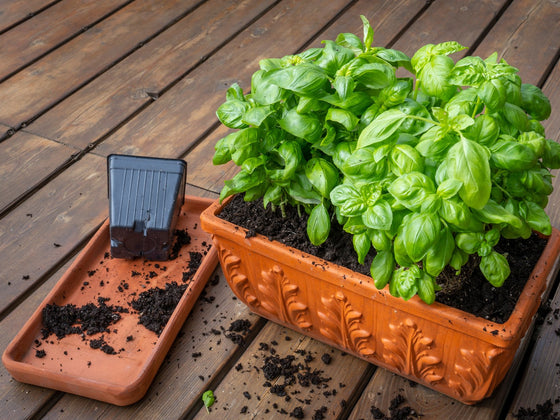
Basil
Sowing basil once the nights are mild, spacing and watering, pinching for bushy plants, and picking so the crop keeps coming until the first cold snap.
| Position | Full sun, 6 hours minimum |
|---|---|
| Depth | 2 to 6 mm |
| Spacing | 20 to 30 cm |
| First pick | 6 to 12 weeks |