
How to Grow Chinese Liquorice in Australia
Chinese liquorice is a hardy perennial legume grown from hard seed. Rub each seed on sandpaper and soak it overnight, then sow it 5 mm deep at 20 to 30°C. Plant out once nights stay above 10°C, 60 to 120 cm apart, in full sun and free-draining soil. Contain the runners, and lift the roots in autumn after three years.
| Sun | Full sun or light shade |
|---|---|
| Water | Deep, occasional; never waterlogged |
| Soil | Deep, sandy or loamy, pH 6.0 to 8.0 |
| Feed | Minimal; a legume that fixes nitrogen |
| Spacing | 60 to 120 cm apart |
| Depth | 5 mm, scarified seed |
| Germination | 7 to 14 days, scarified, at 20 to 30°C |
| Harvest | Roots after three years |
| Container | Yes; 50 cm pot, about 50 L |
| Frost | Hardy to at least minus 15°C when dormant |
| Use | Herb garden roots; flowers for pollinators |
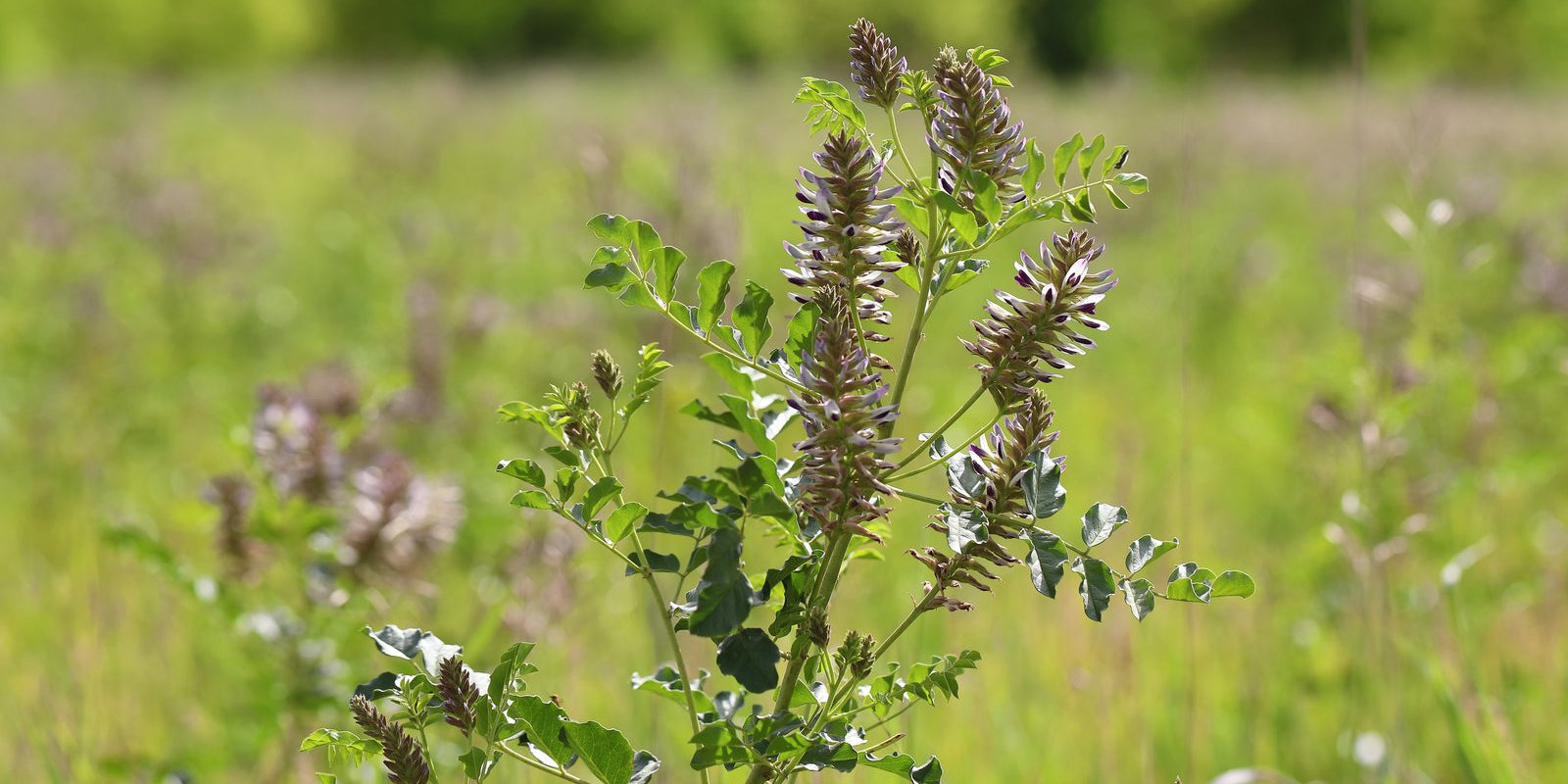
Chinese liquorice (Glycyrrhiza uralensis), sold as Chinese Licorice, is a perennial legume of the pea family, Fabaceae. It is grown for its sweet roots and dense spikes of purple, sometimes white, pea flowers. It dies back each winter, spreads by underground runners and asks little of the soil. A sunny, free-draining corner of the herb garden suits it in most of Australia. The step many gardeners miss is the seed: its hard coat keeps water out until it is scuffed.
Three mistakes that matter
- Sowing the seed straight from the packet. Most seeds carry a waterproof coat and sit in the mix for weeks. Rub each seed on sandpaper and soak it overnight before sowing, as Germinating the seed describes.
- Planting it loose in a vegetable bed. Once settled, the runners travel sideways under the soil and come up among other crops. Give it a bed of its own, edged with a buried barrier, or a large pot.
- Digging the roots too early. A one- or two-year-old plant has only thin roots to show for the wait. Leave it for at least three growing seasons and lift the roots in autumn, as Harvesting Roots describes.
When to plant
Warmth decides sowing: treated seed comes up best at 20 to 30°C. Start it in spring once days are reliably warm, or earlier indoors on a heat mat. Plant seedlings out once nights stay above 10°C.
| Zone | Example cities | Sow | Harvest | Notes |
|---|---|---|---|---|
| Tropical | Darwin NT; Cairns, Townsville QLD; Broome WA | Not recommended | Not recommended | A temperate plant that goes dormant in winter. No source covers the tropics; trial it only in a free-draining pot. |
| Subtropical | Brisbane, Gold Coast, Sunshine Coast QLD; Coffs Harbour, Lismore NSW | Aug-Oct | May-Jul | Grow in a raised bed or large pot of free-draining mix, because humid summer rain on heavy soil rots roots. |
| Arid and semi-arid | Alice Springs NT; Broken Hill, Dubbo NSW; Mildura VIC; Kalgoorlie WA | Sep-Oct | Apr-Jun | Suits dry, alkaline inland soils. Sow early, plant out before summer heat, water deeply and edge the bed. |
| Temperate | Sydney, Newcastle, Wollongong NSW; Melbourne, Geelong VIC | Sep-Nov | Apr-Jun | Start seed indoors in spring and plant out once nights stay above 10°C, around Melbourne Cup weekend in Melbourne. |
| Mediterranean | Perth, Bunbury WA; Adelaide and the SA coast | Sep-Nov | Apr-Jun | Water deeply through the long, dry summer. Dormant roots need drainage when winter rain arrives. |
| Cool and alpine | Hobart, Launceston TAS; Canberra ACT; Ballarat VIC; Orange NSW | Oct-Dec | Mar-May | Dormant roots survive hard frost. Raise seed indoors with bottom heat and plant out after the last frost. |
A late start in summer still works if seedlings have a few months to settle before the tops die back. In autumn, hold small seedlings in pots in a sheltered, sunny spot and plant them out the next spring.
Site, soil and setup
In the wild, Chinese liquorice grows in arid country from eastern European Russia across Siberia, Mongolia and northern China to Pakistan. Copy that in the garden with sun, deep loose soil and good drainage, and choose a spot it can hold for three or more years.
| Get the bed right | What to do |
|---|---|
| Light | Full sun, or light shade for part of the day |
| Soil | Deep, loose, sandy or loamy soil that drains freely; heavy clay stunts the roots. Dig in a 5 cm layer of compost before planting |
| pH | 6.0 to 8.0, with slightly alkaline soil best; below 6.5, spread garden lime at 100 to 200 g per square metre 4 weeks before planting |
| Containment | A bed of its own, edged with a buried root barrier, or a large pot. The runners spread and deep roots are hard to remove |
| Rotation | None needed: it stays in place for years, so keep it away from beds you dig and rotate |
As a legume, liquorice can fix nitrogen from the air through bacteria in its root nodules, so it needs no rich bed. European liquorice has escaped from old plantings in northern Victoria and is naturalised in South Australia and New South Wales. That is reason enough to keep the runners in check.

Container growing
A pot keeps the runners in bounds and suits small gardens and wet subtropical soils. Choose a pot about 50 cm across, around 50 L and as deep as you can find, because the roots run long. Fill it with a free-draining potting mix, and top-dress the surface with fine grit or pumice so the crown stays dry. The store sells one form, so there is no compact variety to choose.
- Water: when the top few centimetres of mix are dry, until water runs from the base; far less once the tops die back in winter.
- Feed: worm casting liquid diluted to weak tea colour, fortnightly from spring to late summer.
- Position: full sun, raised on pot feet so the drainage holes never sit in water.
- Repotting: lift the whole plant in its third or fourth autumn, harvest the outer roots and replant the crown in fresh mix.
Germinating the seed
Chinese liquorice has physical dormancy: a hard, waterproof seed coat that stops water reaching the embryo. In one seed study, 70 to 90 per cent of seeds were hard and would not swell or germinate until the coat was broken. A seed grading study rated the best seed lots as more than 85 per cent hard seed. Hard seed is the rule, not a fault.
Once the coat lets water in, germination is quick. In a Chinese seed grading study, seed with its coat broken was kept at 26°C and counted over eight days. The best lots reached 85 per cent or more, and second-grade lots 30 per cent or more. Growers of European liquorice expect shoots in 7 to 14 days. Allow two or three treated seeds for each plant you want, and sow the whole packet.
| Treatment | How | How long | Temperature | What success looks like |
|---|---|---|---|---|
| Scarify, then soak | Rub each seed on medium-grit sandpaper until a patch of coat looks dull, or nick the coat away from the scar with nail clippers. Then soak it overnight in water | A few strokes per seed; soak 12 to 24 hours | Soak in room-temperature water; germinate at 20 to 30°C | Seeds visibly plumper after the soak, then a white root tip within 7 to 14 days |
| Hot-water soak | Pour water at about 60°C over the seed in a cup and leave it to cool and stand | Overnight, and up to about a week | About 60°C at the start, then room temperature | Some seeds swell; sow those and give the hard ones the scarify-and-soak treatment |
| Warm soak only | Soak untreated seed in warm water | 24 hours | Warm to the touch | Only the few seeds without a hard coat swell; most stay small and hard |
| No treatment | Seed sown straight from the packet | Weeks, often with nothing | 20 to 30°C | Little or no germination, because most seed is hard |
Seed laboratories and large growers also break the coat with strong acid, a method that is not for the kitchen. For how these treatments work across other seeds, see soaking, scarification and cold stratification. Cold stratification is not needed for this seed.
When nothing comes up
- The coat was never broken. Seeds that stay small and hard in the mix are still sealed. Lift them out, scuff them again and resoak.
- Too cool. Below about 20°C, treated seed is slow and uneven. Move the tray to a warm spot or a seedling heat mat.
- The mix dried out. A scuffed seed that takes up water and then dries can die before it roots. Keep the mix evenly damp, not wet.
- The mix stayed soggy. Swollen seeds and young seedlings rot in wet, airless mix. Use a free-draining mix and water from below.
- A poor seed lot. Some lots hold many seeds that swell but never grow, whatever the treatment.
- Given up too soon. If nothing shows after three weeks in warmth, sort out the unswollen seeds, treat them again and resow.
Sowing Seeds
Start with scarified, soaked seed from Germinating the seed. Raise it in small pots rather than sowing direct, because the seedlings grow slowly at first.
Starting under cover
- Sow one treated seed per cell or small pot of free-draining seed-raising mix.
- Cover it 5 mm deep and water it in gently.
- Keep the tray warm, as Germinating the seed describes, until the seedlings show.
- Move each seedling into a 9 cm pot once it is large enough to handle.
- Grow the seedlings on in a sunny, sheltered spot until roots fill the pot.
Transplanting
Harden seedlings off before planting out (hardening off means a week or so of gradually longer spells outdoors, so they adjust to sun and wind). See hardening off seedlings for a day-by-day routine.
- Plant out once nights stay above 10°C.
- Space plants 60 to 120 cm apart, the wider spacing where you plan to dig roots.
- Set each plant at the depth it grew in its pot, and firm the soil gently.
- Water in well, then keep the soil just moist while the plant settles.
Care by growth stage
Drainage and patience decide this crop more than feeding. Liquorice is a legume that fixes its own nitrogen, so feed lightly.
| Stage | Water | Feed | Watch for |
|---|---|---|---|
| Seedlings in pots, until planting out | Keep the mix evenly moist, never soggy | Seaweed solution at half strength, 15 mL per 9 L, fortnightly from the first true leaves | Damping off; snails and slugs; mix drying out |
| First season in the ground | A deep soak about once a week in dry weather | None; a 5 cm layer of compost as mulch, kept clear of the stems | Weeds crowding young plants; spider mites in hot, dry spells |
| Autumn and winter dormancy | Only in long dry spells; roots rot in cold, wet soil | None | Tops yellowing and dying back, which is normal |
| Spring regrowth, years 2 and 3 | Deep and infrequent once growth starts | A fresh 5 cm layer of compost each spring | Runners coming up beyond the barrier; flower stems |
| Harvest year, year 3 onwards | Keep watering as usual right up to lifting | None | Leaves yellowing in autumn, the sign to dig |
If growth stalls in very poor, sandy soil, scratch in all-purpose controlled release granular (NPK around 14-5-10) once in spring. Use half the label rate. Established plants cope with short dry spells, but the roots grow best with steady moisture in soil that drains.

Cutting Back
Cut back once a year when the plant is dormant, and trim runners through the growing season to keep the clump where it belongs. Commercial growers stop plants flowering so that more growth goes to the roots.
- Cut dead stems to ground level once they brown off in late autumn or winter.
- Pinch or cut off flower spikes before they open, unless you want to save seed.
- Slice through runners at the edge of the bed with a sharp spade each spring and summer.
- Pull up any shoots that appear outside the bed while they are small.
- Clear the dead stems away rather than leaving them to rot on the crown.
Companion planting
Liquorice gets on best with low plants that stay at its feet and away from other plants that spread by roots.
Grows well with
- Lettuce planted around the base, which uses the space before the liquorice fills out.
- Spinach, another short leafy crop for the gaps in the first year.
Keep apart
- Mint, whose runners tangle with liquorice runners and make both hard to control.
- Comfrey and horseradish, deep-rooted spreaders that compete for the same ground and are hard to dig out.
Harvesting Roots
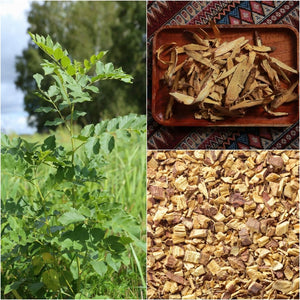
Lift roots in autumn from the third year onwards, once flowering is over and the leaves are yellowing and dying back.
- Loosen the soil with a garden fork from one side of the clump, working well out from the stems.
- Take the side runners and some thick outer roots.
- Leave the main root and a few large roots in place, set the plant back in its hole, refill and water it in.
- Scrub the roots clean with a vegetable brush.
- Leave thin roots whole and slice thick roots lengthwise so they dry faster.
Dry the pieces on a tray in the oven at its lowest setting, door ajar, for 6 to 8 hours. They are ready when hard and brittle. Seal them in a jar for about a week and check for moisture on the glass; if any appears, dry them again. Store the dry roots in an airtight container in a cool, dark, dry place.
The roots contain glycyrrhizin, the sweet compound behind their flavour; read Safety before handling or keeping them.
Traditional use and history
The genus name Glycyrrhiza comes from the Greek glykys, sweet, and rhiza, root. In Chinese, the plant is called gan cao, which means sweet grass. Liquorice root was recorded in the Shennong classic of materia medica during the Han dynasty, and it appears in every later Chinese herbal text.
The same sweetness made the root a flavouring well beyond medicine. Extracts of the root sweeten and flavour confectionery, other foods and tobacco. The root's main sweet compound is 50 to 170 times sweeter than sugar. In the United States, many sweets sold as liquorice contain none of the root and take their taste from anise oil instead.
| Tradition | Name | Part used | What the record says |
|---|---|---|---|
| Traditional Chinese medicine | Gan cao, sweet grass; also guo lao, the national elder | Dried root and rhizome (underground stem) | Classed as a harmonising herb, added to formulas to balance the other ingredients. That role earned it the title national elder, and a saying held that nine of ten prescriptions contained it |
| Japanese and Chinese pharmacopoeias | Glycyrrhizae Radix | Dried root | Listed as an official material, with a minimum content of its main sweet compound set for it |
| Mongolian medicine | Shi-he-ri-wu-bu-si or Xing-a-ri | Root | Listed in the National Pharmacopoeia of Mongolia under these names |
| Ancient Middle East, Mediterranean and India | Liquorice, mostly European liquorice (Glycyrrhiza glabra) | Root | Records of use reach back to Assyrian, Egyptian, Greek, Arab, Tibetan and Indian cultures |
Demand has cost the wild plant dearly. Overharvesting has depleted wild stands of Chinese liquorice, and China has brought in export regulations to conserve it. Its deep roots also hold sandy soil against desertification, which is part of the reason given. Growing it from seed takes nothing from the wild.
Australia has its own relative. Native liquorice (Glycyrrhiza acanthocarpa) is a shrub found in every mainland state and territory. Its leaves smell strongly of liquorice when crushed, and its burr-like pods cling to wool.
Safety
Happy Valley Seeds sells Chinese liquorice as seed for growing. Nothing here is advice to eat or take any part of the plant. Anyone considering using a plant should first seek advice from a qualified health practitioner.
| Topic | What the sources say |
|---|---|
| Toxicity | The roots are the poisonous part. Liquorice root is 4 to 12 per cent glycyrrhizin. In large or long-term intake it can cause high blood pressure, low potassium, fluid retention, muscle weakness, paralysis and irregular heartbeat. Deaths have been reported. Even small amounts have been linked to severe effects in people with high blood pressure, heart or kidney disease, or a high-salt diet. LiverTox, the United States liver injury database, gives a likelihood score of E: an unlikely cause of liver injury, with none reported. |
| Pregnancy and breastfeeding | The sources advise against use in pregnancy: large amounts have been linked to earlier delivery, and LiverTox records effects that can harm the unborn child. Little is known about breastfeeding, so the sources are silent rather than reassuring. |
| Interactions with medicines | Reported with digoxin, and with diuretics that remove potassium, where low potassium can upset heart rhythm. Also reported with blood pressure medicines, and with warfarin, which may work less well. The sources also name corticosteroids, oestrogens, the cancer drugs paclitaxel and cisplatin, and possibly MAO inhibitor antidepressants. |
| Allergy and skin | Liquorice applied to the skin can cause irritation in some people. No source consulted records a reaction from handling the growing plant. |
| Pets and livestock | Glycyrrhizin has known toxic effects in animals as well as people, and one university extension service lists the roots as poisonous. No veterinary poisons listing for the garden plant was found, and no record of stock poisoning. |
| Legal status | No state or territory lists Chinese or European liquorice as a declared or prohibited plant. The lists checked are those of New South Wales, Victoria, Queensland, South Australia, Western Australia, Tasmania, the Northern Territory and the ACT. The Western Australian Organism List records both species as permitted. European liquorice is recorded as naturalised in South Australia, northern Victoria and New South Wales. The store has no shipping restriction on this seed. |
Call triple zero (000) if someone collapses, stops breathing, has a seizure or has a severe allergic reaction. For any other suspected poisoning, call the Poisons Information Line on 13 11 26, anywhere in Australia.
Common problems
Plants rot or collapse in winter. Dormant roots sitting in cold, waterlogged soil rot, most often in clay or a pot standing in a saucer. Lift the plant into a raised bed or free-draining pot. Read more
The plant disappears in autumn. The tops yellow and die back each year as the plant goes dormant. Mark the spot, cut the dead stems away, and expect new shoots in spring.
Liquorice shoots come up well away from the clump. Runners have travelled under a path or out of an unedged bed. Dig the stray shoots out with their runner and sink a barrier along that edge.
Thin roots at harvest. Heavy clay, a plant lifted too young, or flowers left to set seed each year all hold the roots back. See Three mistakes that matter and Cutting Back.
Pale, weak growth in acid soil. Liquorice prefers neutral to slightly alkaline soil, so a very acid bed holds it back. Test the pH and lime the bed as Site, soil and setup describes. Read more
Pests and diseases
No Australian source names a pest peculiar to liquorice, and seedlings are the most vulnerable stage.
Damping off (Pythium and Rhizoctonia species). Seedlings collapse at soil level, pinched and water-soaked, most often in wet, crowded trays. Sow in fresh seed-raising mix, water from below and give seedlings air. Read more
Common garden snail (Cornu aspersum) and grey field slug (Deroceras reticulatum). They chew young leaves and can strip a seedling overnight in damp weather. Check pots and new plantings after dark and hand-pick them. Read more
Two-spotted mite (Tetranychus urticae). Fine pale speckling on the leaves, and webbing underneath in bad cases, appears in hot, dry weather. Hose the undersides of the leaves and keep plants watered. Read more
Prevention first
- Raise seedlings in clean pots and fresh mix, one seed per pot.
- Plant into free-draining soil and never leave pots in full saucers.
- Check seedlings for snails and slugs at night for the first few weeks.
- Water deeply in hot, dry spells so plants are not stressed.
Tips
- Scarify seeds on sandpaper held flat on the bench, pressing each seed down with a fingertip so it does not fly off.
- Label the spot with a stake in autumn, so the dormant crown is not dug up by mistake in winter.
- Replant a few runner pieces, each with a bud, in a spare pot at harvest to keep a second plant coming on.
Questions
Why are my Chinese liquorice seeds not germinating?
Most liquorice seed has a hard coat that keeps water out, so untreated seed can sit in the mix for weeks. Rub each seed on medium-grit sandpaper, soak it overnight, then sow it 5 mm deep and keep it at 20 to 30°C. Treated seed usually shows a root within 7 to 14 days.
How long does liquorice take to grow before you can dig the roots?
Allow at least three growing seasons. Lift the roots in autumn, once flowering is over and the leaves are yellowing. Take the outer roots and runners, then replant the crown so the same plant keeps producing.
Does liquorice spread in the garden?
Yes. Once established, it sends runners sideways under the soil, and its deep roots are hard to remove. Grow it in a bed of its own edged with a buried barrier, or in a pot about 50 cm across. Slice off runners at the bed edge each spring and summer.
Can I grow Chinese liquorice in a pot?
Yes, and a pot keeps the runners in bounds. Use a pot about 50 cm across, around 50 L and as deep as you can find, filled with free-draining potting mix. Stand it in full sun on pot feet, and water when the top few centimetres are dry.
Is liquorice safe to grow around dogs and cats?
The roots contain glycyrrhizin, which has known toxic effects in animals as well as people. No veterinary poisons listing for the garden plant was found. Store dug roots in a sealed jar out of reach, and call a vet if a pet chews them.
Is liquorice a declared weed anywhere in Australia?
No state or territory lists Chinese or European liquorice as a declared or prohibited plant, and the Western Australian Organism List records both as permitted. European liquorice has naturalised in parts of South Australia, New South Wales and northern Victoria, so keep the runners contained.
Grow it
More herb guides
All herbs
Agrimony
How to grow agrimony in Australia from seed: chilling the burrs, sowing months for six climate zones, sun and soil, cutting back, harvest, history and safety.
| Position | Full sun, light shade tolerated |
|---|---|
| Depth | 5 mm |
| Spacing | 30 cm apart |
| First pick | Summer; 12 to 18 weeks from spring sowing |

Angelica
How to grow angelica in Australia from seed: fresh or chilled seed sown on the surface, part shade, months for six climate zones, stems, history and safety.
| Position | Part shade, morning sun |
|---|---|
| Depth | Surface; press in, uncovered |
| Spacing | 50 to 90 cm |
| First pick | Stems at about 18 months |

Ashwagandha
Grow ashwagandha from seed in Australia: warm germination, sowing, site, care and root harvest, with its history and safety, for all six climate zones.
| Position | Full sun |
|---|---|
| Depth | 5 mm |
| Spacing | 45 to 60 cm apart |
| First pick | Roots 21 to 26 weeks |

Astragalus
How to grow astragalus (huang qi) in Australia from hard-coated seed: rubbing and soaking, sowing months for six zones, care, pests and lifting the taproot.
| Position | Full sun |
|---|---|
| Depth | 5 mm |
| Spacing | 20 to 45 cm apart |
| First pick | Roots after 2 to 3 years |