
How to Grow Dang Shen in Australia
Dang shen is a twining perennial vine grown for its green bell flowers and long root. Sow the tiny seed on the surface at about 18 to 25°C in early spring, chilling stored seed for two to four weeks first. Plant out 40 cm apart beside a trellis after frost. Keep it moist in summer and nearly dry in winter, and lift roots after two to three years.
| Sun | Sun to part shade |
|---|---|
| Water | Moist in summer; nearly dry when dormant |
| Soil | Light, fertile, free-draining; mildly acid to neutral |
| Feed | Minimal; compost and half-strength feeds |
| Spacing | About 40 cm apart |
| Depth | On the surface, uncovered |
| Germination | 1 to 6 weeks; chill older seed first |
| Harvest | Roots after 2 to 3 years |
| Container | Yes; 40 cm pot, about 28 L, deep |
| Frost | Root very hardy; spring shoots frost-tender |
| Support | Trellis, strings or a shrub, about 2 m |
| Use | Ornamental climber; bell flowers; herb garden root |
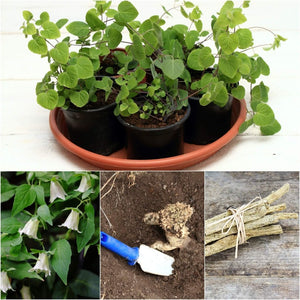
Dang shen (Codonopsis pilosula) is a twining perennial vine of the bellflower family, Campanulaceae, grown for its nodding green bells and its fleshy root. It is sold as Dang Shen seed. The step to get right comes first: the tiny seed germinates best in light, so it belongs on the surface, not under soil.
Three mistakes that matter
- Burying the seed. The seed germinates best in light, so seed pushed under the mix often does nothing. Press it onto the surface, as Germinating the seed describes.
- Leaving the root wet through winter. The dormant root rots easily in cold, soggy soil. Grow it in a free-draining bed, a mound or a pot, and water very little once the tops die down.
- Losing the spring shoots to slugs and snails. Kew's growers found new shoots are often eaten before they have a chance. Protect every plant from the moment shoots appear, as Pests and diseases sets out.
When to plant
Sow when the seed raising mix holds about 18 to 25°C, which in most districts means early spring under cover. Fresh seed can come up at any time of year, but a spring sowing gives seedlings a full season before their first dormancy.
| Zone | Example cities | Sow | Harvest | Notes |
|---|---|---|---|---|
| Tropical | Darwin NT; Cairns, Townsville QLD; Broome WA | Not recommended | Not recommended | No cool dormant season, and wet-season rain rots the root. A temperate vine; try only a shaded pot. |
| Subtropical | Brisbane, Sunshine Coast, Bundaberg QLD; Coffs Harbour, Lismore NSW | Mar-Apr and Aug-Sep | May-Jul | Marginal. Sow as the autumn heat eases or in early spring; give afternoon shade and a raised, free-draining bed. |
| Arid and semi-arid | Alice Springs NT; Broken Hill, Dubbo NSW; Mildura VIC; Kalgoorlie WA | Sep-Oct | Apr-Jun | Sow after the last frost. Shade, mulch and deep summer watering are essential; a pot eases winter drainage. |
| Temperate | Sydney, Newcastle, Wollongong NSW; Melbourne, Geelong VIC | Sep-Nov | Apr-Jun | Sow under cover once the mix holds 18°C; afternoon shade in hot spells. Chill stored seed in the fridge. |
| Mediterranean | Perth, Bunbury WA; Adelaide and the SA coast | Aug-Oct | Apr-Jun | Sow as winter rain eases. Dry summers need steady water and afternoon shade; wet winters need a free-draining bed. |
| Cool and alpine | Hobart, Launceston TAS; Canberra ACT; Ballarat VIC; Orange NSW | Sep-Nov | Apr-May | Suits the cold. Sow under cover or outdoors in late autumn; plant out after the last frost. |
In frosty districts, raise seedlings under cover and plant out after the last frost. The dormant root is very hardy, but young spring shoots are frost-tender. Where winters are cold, a tray sown in late autumn and left outdoors lets winter supply the chill that older seed needs.
Site, soil and setup
Dang shen likes its roots cool and its head in the light, the way it grows through shrubs at a forest edge. In hot gardens, give it morning sun and afternoon shade: strong sun scorches the leaves, and the vine wilts fast on hot days.
| Need | What dang shen wants |
|---|---|
| Wild home | Forests, thickets, meadows and scrub at forest margins in northern and central China, from about 900 to 3,900 m |
| Light | Full sun to part shade; full sun only where the soil stays moist in summer |
| Soil | Light to medium, fertile, free-draining; sandy or loamy soils suit it |
| pH | Mildly acid to neutral; in China it is also farmed on mildly alkaline soil |
| Water | Moist in summer, not drought tolerant; nearly dry in winter |
| Height and habit | Twining stems 1 to 2 m long, dying back each autumn; a carrot-shaped root 15 to 30 cm long |
| Support | A trellis, fence, strings or a shrub to twine through |
Dig in a 5 cm layer of compost before planting. Where the ground stays wet after rain, build a mound or raised bed so winter water drains away from the root. Do not replant dang shen where it grew before: its roots release compounds that hold back its own seedlings and young plants.
Container growing
A pot keeps the root dry in winter, and Kew grows its plants in pots partly to keep slugs and snails away. Depth matters most, because the root spirals in a shallow pot. Use a pot at least 40 cm across and 32 cm deep, which holds about 28 L, for one plant. Use quality potting mix with about one part perlite to four parts mix.
- Water: lightly while shoots are young, deeply in full summer growth, and hardly at all once the tops die back.
- Feed: worm casting liquid diluted to weak tea colour, fortnightly from spring to midsummer.
- Position: morning sun and afternoon shade; move the pot under shelter in a wet winter.
- Support: a tripod of stakes about 1.5 m tall, or strings to a railing, set in at potting time.
- Saucer: remove it in winter, so the mix never sits wet.
Germinating the seed
Dang shen seed is small, about 1 mm long and red-brown to dark brown. Like many small seeds of the bellflower family it germinates best in light, so it is sown on the surface. Fresh seed needs no treatment: Kew's growers sow it on moist seed compost under a light covering of vermiculite, and seedlings appear within a month. Kew finds older seed comes up better after a short spell of cold, so chill seed that is not fresh. Chilling cannot revive dead seed, though, and Chinese growers find year-old seed often fails.
This is not a hard seed. Growers report seedlings in 7 to 21 days, and up to six weeks at 20°C. In two Chinese trials, about 80 to 90 per cent of seed germinated at 15 to 25°C, and fewer at 10°C. One found none at 5°C. Seed lots vary widely, so treat that as a best case. A 25-seed packet allows two or three seeds per plant wanted, with some left for a second sowing.
| Treatment | How | How long | Temperature | What success looks like |
|---|---|---|---|---|
| None needed (fresh seed) | Press the seed onto moist seed raising mix and add at most a dusting of fine vermiculite; cover with a clear lid | 1 to 4 weeks to emergence, sometimes 6 | About 18 to 25°C | Tiny paired seed leaves across the tray |
| Short cold, moist stratification (stored seed, or seed of unknown age) | Mix the seed with a little just-damp sand or vermiculite, or fold it into a damp paper towel, and seal it in a labelled bag in the fridge, not the freezer | About 2 to 4 weeks | About 1 to 5°C in the fridge, then sow into 18 to 25°C | Plump, clean seed with no mould; sow any seed showing a white root tip at once |
| Winter outdoors (cool and inland districts) | Sow onto a tray of seed raising mix in late autumn or early winter and leave it in a sheltered spot outside, under fine mesh | Through winter; seedlings as spring warms | Winter nights near fridge temperature; coastal winters are often too mild | Seed leaves across the tray in spring |
More on these methods is in Soaking, Scarification and Cold Stratification.
When nothing comes up
- Covered too deeply. Seed under soil stays in the dark; sow again on the surface and press it in.
- Too cold. Germination slows and falls in cool mix and stops near 5°C, so move the tray indoors or onto a seedling heat mat.
- Surface dried out. Surface-sown seed fails if the mix dries out, so keep the lid on and water from below.
- Old or warm-stored seed. Germination falls as seed ages, and year-old seed kept warm may not come up at all. Sow fresh seed, and keep packets sealed in the fridge.
- Stratification bag dried out or went mouldy. Start again with sand that holds together when squeezed but drips no water.
- Given up too soon. If nothing shows after three or four weeks in warmth, chill the tray in the fridge for two to four weeks, then warm it again. Leave an outdoor tray through winter, since late seed may still come up in spring.
Sowing Seeds
Start dang shen in deep cells under cover, because the seedlings are tiny and the long root resents being moved.
Starting under cover
- Fill deep cells or tubes with fine seed raising mix and water them first.
- Sow two or three seeds per cell, press them onto the surface, and leave them uncovered or barely dusted.
- Keep the cells at the warmth When to plant gives, in bright light out of direct sun, under a clear lid.
- Lift the lid once seedlings show, and keep watering from below.
- Snip off all but the strongest seedling in each cell, rather than pulling, to spare its root.
Mixing the seed with a little dry sand makes it easier to spread (see How to Sow Tiny Seeds).
Sowing direct
Sowing into fine, weed-free soil at the foot of the support is possible after the last frost, but it is a gamble. Seedlings this small dry out quickly and make an easy meal for slugs.
Transplanting
Plant out after the last frost, once seedlings are about 10 cm tall. First harden them off (get them used to outdoor sun and wind over about a week), as hardening off seedlings describes. Set each plant about 40 cm from the next, at the foot of its support, at the depth it grew in the cell. Slide the root ball out whole, water it in with seaweed solution at half strength, and put slug protection in place the same day.
Care by growth stage
Water decides this crop: plenty while the vine is in full growth, then a nearly dry root through winter. Feed lightly, since the aim is a sound root rather than a mass of leaves.
| Stage | Water | Feed | Watch for |
|---|---|---|---|
| Seedlings, from sowing until planted out at about 10 cm | Keep the mix evenly moist; water from below | Seaweed solution at half strength, 15 mL per 9 L, fortnightly once true leaves show | Seedlings collapsing at soil level; slugs and snails |
| Establishing, first spring and summer | Lightly while shoots are young, then deeply as growth speeds up; mulch the root zone | Worm casting liquid diluted to weak tea colour, fortnightly | Shoots tangling or wandering off the support; aphids on soft tips |
| Full growth and flowering, summer | Deeply and often in hot weather; never let the soil dry out | None needed in a bed prepared with compost | Wilting and scorched leaves in hot sun; fine speckling from mites in dry heat |
| Dieback and dormancy, autumn and winter | Cut back slowly as seed sets and the tops yellow, then keep the soil only just damp | None | Waterlogged soil around the crown; mice or rats digging for the root |
| Second and later springs | Water again once new shoots appear | Pelletised chicken manure at 50 g per square metre, half the usual rate, once in early spring | Slugs and snails on the new shoots; late frost on young growth |
| Before harvest, second or third autumn | Keep to the same light dormant-season watering right up to lifting; do not dry the bed out or soak it | None | Tops fully died down, the sign the root is ready |
If growth stalls in poor soil, a light application of all-purpose controlled release granular (NPK around 14-5-10) scratched into the soil in spring can help.
New shoots climb fast, twining around anything nearby. Guide them onto the support every few days in spring, before they tangle with their neighbours.
Cutting Back
Dang shen needs little cutting: the vine dies back to the root every autumn and regrows in spring.
- Clear the dead stems at ground level once the tops have died back completely.
- Mark each crown with a labelled stake, so the dormant plant is not dug up or weeded out.
- Divide only with care, teasing small pieces from the side of the clump while it is dormant; see Dividing Perennials.
Companion planting
Pair dang shen with plants that shade its roots without smothering it.
Grows well with
- A light, open shrub it can twine through, as it does at a forest edge.
- Chives, whose low, slim clumps shade the root zone without climbing into the vine.
- Sorrel, which suits the same moist soil and part shade.
Keep apart
- Mint, whose runners crowd a young plant and compete for the same moist soil.
- Comfrey, whose big leaves smother a slow-starting seedling.
- Lavender, which wants hot, dry, lean ground that would starve dang shen of summer water.
Harvesting Roots
Lift the roots in the second or third autumn, once the tops have died down completely and the plant is dormant.
- Choose plants at least two, and better three, seasons old.
- Clear the dead stems and loosen the soil with a garden fork, working well out from the crown.
- Ease the root out whole, since it can run 15 to 30 cm deep and snaps easily.
- Cut off a piece of crown carrying buds and replant it for a later harvest.
- Wash and scrub off the soil, then slice the root.
- Dry the slices on a rack at about 40°C for 12 to 18 hours.
The dried root is rich in sugars, so it draws insects and mould in storage. Store the slices in airtight, labelled jars in a cool, dark cupboard. Before anyone thinks of using the root, read Safety.
Traditional use and history
The Chinese name, dang shen, is a shortened form of Shangdang dang shen. Shangdang was a commandery (an administrative district) under the Qin dynasty, in present-day Shanxi province. When the district was renamed Luzhou under the Tang dynasty, the root became Lu dang shen, a name still in use. Historical herbals placed the finest roots in the hills around Pingshun, Huguan and Lingchuan, near the city of Changzhi.
Its place in Chinese tradition
Dang shen was first used in place of ginseng, and English-speaking sellers know it as poor man's ginseng. The Qing dynasty scholar Wu Yiluo gave it an entry in his Ben Cao Cong Xin, writing that roots from Shangdang were the best. In the terms of traditional Chinese medicine, the dried root was classed as tonifying the middle qi and was linked with the spleen and lungs. The Chinese Pharmacopoeia has listed it since the second half of the twentieth century. It accepts the roots of this species, its variety modesta and the close relative Codonopsis tangshen under one name.
Collectors and growers
Adrien Franchet described the species from a specimen Père David collected in the hills near Beijing, where David reported it was cultivated for medicine. Augustine Henry, collecting its close relative in Hubei, found the root traded around Ichang as a substitute for ginseng, though rated below it. Wild stands have grown scarce, so cultivated roots make up most of the trade. Farmers in Wenxian in Gansu and Pingshun in Shanxi developed their own traditional way of drying the root, known as rubbing and sweating. China lists the dang shen growing system around Changzhi among its Important Agricultural Heritage Systems.
Safety
Dang shen is sold as seed for growing, and nothing here is advice to eat or take any part of the plant. Anyone thinking of using a plant should first seek advice from a qualified health practitioner.
| Topic | What the sources say |
|---|---|
| Toxicity | A review of the genus found almost no toxicity or side effects recorded for Codonopsis. LiverTox, the United States liver injury database, has no entry for it, so no likelihood score exists. Few recorded problems are not the same as proof of safety. |
| Pregnancy and breastfeeding | There is not enough reliable information on its safety in pregnancy or breastfeeding. The natural medicines reference RxList advises avoiding it. |
| Interactions with medicines | RxList rates the interaction with medicines that slow blood clotting, such as warfarin, aspirin, clopidogrel and heparin, as moderate, because it might slow clotting. For the same reason it flags bleeding disorders and advises stopping at least two weeks before surgery. |
| Allergy and skin | No allergy or skin reaction from handling the growing plant is recorded in the sources read. The leaves are described as acrid when bruised. |
| Pets and livestock | The ASPCA toxic and non-toxic plant lists for dogs and cats have no entry for dang shen, so its safety for pets is not established. In China the stems and leaves have been tried as feed for chickens and pigs. |
| Legal status | No state or territory declares it a weed or prohibited plant. It is not on NSW WeedWise, Agriculture Victoria's noxious weeds list or Biosecurity Queensland's prohibited and restricted plant lists. Nor is it on the PIRSA declared plants list, NRE Tasmania's declared weeds index, the ACT pest plants declaration or the NT Government's weed list. The Western Australian Organism List marks it as permitted. |
| Look-alikes | No toxic look-alike is recorded. The close relative Codonopsis tangshen is sold under its own name or as Codonopsis pilosula, so check the botanical name on any plant or root. |
Common problems
Root rots over winter. Cold, wet soil around the dormant root is the usual cause, so move survivors to a mound or pot. Read more
Leaves scorch and the vine wilts by afternoon. Hot sun and dry soil stress a plant of forest edges, so water deeply, mulch, and give it afternoon shade.
Spindly, pale seedlings. Too little light after germination stretches the stems, so move the tray to bright light at once. Read more
No flowers in the first year. Plants often wait until their second summer to flower, though an early spring sowing may flower by late summer, so give it time.
Pests and diseases
Kew's growers find disease is rarely a concern in cultivation; the damage growers report comes from animals that eat the shoots or the sweet root.
Garden snail (Cornu aspersum). Snails, and slugs with them, feed at night and can eat new spring shoots to the ground. Hand-pick them after dark, set beer traps, ring pots with copper strips, or scatter iron-based snail pellets thinly at the label rate. Read more
Aphids (Aphididae). Small green or yellow sap-suckers cluster on soft tips, leaving malformed new growth and sticky honeydew. Knock them off with a strong jet of water, or spray insecticidal soap at the label rate on the undersides of leaves. Read more
Two-spotted mite (Tetranychus urticae). Tiny mites feed under the leaves in hot, dry weather, leaving pale speckles and fine webbing. Keep the plant well watered in dry spells, and spare the predatory mites and small black ladybirds that eat them. Read more
Damping off (Pythium species and Rhizoctonia solani). Seedlings rot before they emerge or collapse at soil level soon after. Use fresh mix and clean trays, avoid overwatering, and thin crowded seedlings. Read more
House mouse (Mus musculus). Mice and rats dig for the sweet root. Grow the plant in a pot or a wire-lined raised bed. Trap only once you are sure the digger is not a protected native animal, using covered snap traps checked daily rather than poison baits. Read more
Prevention first
- Check for snails and slugs after dark from the moment spring shoots appear.
- Line a bed with wire mesh, or grow in pots, where mice are about.
- Water deeply in hot, dry spells, so mites and wilting do not take hold.
- Start seed in clean trays of fresh mix, and water from below.
Tips
- Label every stratification bag with the date it went into the fridge.
- Sow a few plants in successive springs, so one is ready to lift each autumn and the rest keep growing.
- Collect seed from ripe seed heads in autumn, dry it thoroughly, and store it in a sealed jar in the fridge.
Questions
Why are my dang shen seeds not germinating?
Check the depth first. The seed germinates best in light, so press it onto the surface and add no more than a dusting of vermiculite. Keep the mix at about 18 to 25°C and never let it dry. Chill stored seed in a damp, sealed bag in the fridge for two to four weeks before sowing.
Does dang shen seed need cold stratification?
Fresh seed usually does not: Kew's growers sow it untreated and see seedlings within a month. Older seed germinates better after a short cold, moist spell, so chill seed that is not fresh for about two to four weeks. Chilling cannot revive dead seed.
How long before a dang shen root is ready to dig?
Allow two to three growing seasons. Lift the root in autumn once the tops have died down completely. It can be 15 to 30 cm long and snaps easily, so loosen the soil well out from the crown first.
Can I grow dang shen in Brisbane or the tropics?
In Brisbane and the subtropics it is marginal: give it afternoon shade and a raised, free-draining bed so summer rain drains away. In the tropics it is not recommended, because there is no cool dormant season and wet-season rain rots the root.
Is dang shen safe around dogs and cats?
The ASPCA plant lists for dogs and cats have no entry for dang shen, so its safety for pets is not established. Keep dried roots in sealed jars out of reach of pets and children.
Can I grow dang shen in Western Australia?
Yes. The Western Australian Organism List marks Codonopsis pilosula as permitted, and no Australian state or territory declares it a weed.
Grow it
More herb guides
All herbs
Agrimony
How to grow agrimony in Australia from seed: chilling the burrs, sowing months for six climate zones, sun and soil, cutting back, harvest, history and safety.
| Position | Full sun, light shade tolerated |
|---|---|
| Depth | 5 mm |
| Spacing | 30 cm apart |
| First pick | Summer; 12 to 18 weeks from spring sowing |

Angelica
How to grow angelica in Australia from seed: fresh or chilled seed sown on the surface, part shade, months for six climate zones, stems, history and safety.
| Position | Part shade, morning sun |
|---|---|
| Depth | Surface; press in, uncovered |
| Spacing | 50 to 90 cm |
| First pick | Stems at about 18 months |

Ashwagandha
Grow ashwagandha from seed in Australia: warm germination, sowing, site, care and root harvest, with its history and safety, for all six climate zones.
| Position | Full sun |
|---|---|
| Depth | 5 mm |
| Spacing | 45 to 60 cm apart |
| First pick | Roots 21 to 26 weeks |

Astragalus
How to grow astragalus (huang qi) in Australia from hard-coated seed: rubbing and soaking, sowing months for six zones, care, pests and lifting the taproot.
| Position | Full sun |
|---|---|
| Depth | 5 mm |
| Spacing | 20 to 45 cm apart |
| First pick | Roots after 2 to 3 years |