
How to Grow Yellow Gentian in Australia
Yellow gentian is a slow, long-lived alpine perennial for cool gardens. Chill the seed in damp sand at 0 to 2°C for about 90 days, or sow pots outdoors in autumn. Seedlings come up between 10 and 20°C. Plant out young, 60 cm apart, in deep, moist soil shaded from the hottest sun. Flowering takes several years.

| Sun | Sun, shaded from hottest sun |
|---|---|
| Water | Evenly moist; never dry or waterlogged |
| Soil | Deep, moist, humus-rich loam near neutral pH |
| Feed | Minimal; compost mulch and half-strength feeds |
| Spacing | 60 cm apart |
| Depth | Surface, or a very light dressing |
| Germination | Spring, after 60 to 90 days near 0°C |
| Harvest | Roots from about year five |
| Container | Not suited to pots |
| Frost | Very hardy; dies back each winter |
| Use | Tall yellow flowers, bees, herb garden history |
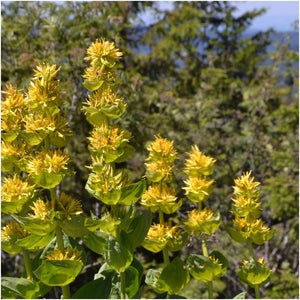
Yellow gentian (Gentiana lutea, family Gentianaceae) is a perennial grown for its tall stems of starry yellow flowers and its thick, bitter taproot. In cool Australian gardens it builds into a stately clump that can live for decades. First, though, its seed needs months of cold, the step most growers miss. The small blue gentians of rockeries are separate plants with different needs.
Three mistakes that matter
- Sowing without a long cold spell. This is the commonest failure. Seed sown into warm mix, or chilled for only a few weeks, gives little or nothing. Give it about three months of moist cold near freezing first, as Germinating the seed describes.
- Planting it somewhere hot and dry. Yellow gentian comes from cool, damp mountain pasture and will not tolerate drought or waterlogging. In a sun-baked, exposed bed it scorches and stalls, so give it deep, moist soil and shade from the hottest sun.
- Moving it once the taproot is down. The root heads deep and resents disturbance, so an older plant dug up and shifted often sulks or dies. Choose its permanent spot early and plant it out young, with the root ball intact.
When to plant
Cold, not warmth, decides when to sow. The seed needs at least 60 and ideally 90 days of moist cold near freezing, at about 0 to 2°C. It then sprouts best with the mix between 10 and 20°C, and falls away at 25°C and above. Sow in autumn for a winter outdoors, or chill the seed in the fridge and sow in late winter.
| Zone | Example cities | Sow | Harvest | Notes |
|---|---|---|---|---|
| Tropical | Darwin NT; Cairns, Townsville QLD; Broome WA | Not recommended | Not recommended | No winter cold to wake the seed, and year-round heat the plant cannot take. |
| Subtropical | Brisbane, Gold Coast, Sunshine Coast QLD; Coffs Harbour, Lismore NSW | Not recommended | Not recommended | Mild winters give too little chill, and humid summer heat stresses this mountain plant. |
| Arid and semi-arid | Alice Springs NT; Broken Hill, Dubbo NSW; Mildura VIC; Kalgoorlie WA | Not recommended | Not recommended | Frosty nights help the seed, but hot, dry summers and high evaporation scorch the plant. |
| Temperate | Sydney, Newcastle, Wollongong NSW; Melbourne, Geelong VIC | Aug-Sep | Apr-May | Marginal. Fridge-chill seed about 90 days first. Melbourne suits best; give afternoon shade and summer water. |
| Mediterranean | Perth, Bunbury WA; Adelaide and the SA coast | Not recommended | Not recommended | Long, hot, dry summers outlast this alpine plant; only cool hills gardens with summer water might try. |
| Cool and alpine | Hobart, Launceston TAS; Canberra ACT; Ballarat VIC; Orange, Armidale NSW; Stanthorpe QLD | Apr-Jun and Aug-Sep | Mar-May | Best zone. Outdoor pots need frosty winters, as in Canberra; in milder Hobart, sow fridge-chilled seed in late winter. |
Pots left outdoors need weeks of frosty nights, as in Canberra. In Hobart and other mild coastal gardens, where July nights average about 5°C, use the fridge. For a late-winter sowing, start chilling in May or June, about three months ahead.
Site, soil and setup
In the wild, yellow gentian grows in grassy alpine and subalpine pasture, usually on limy soils. Its main root can pass a metre in length. Copy that in the garden: an open, cool spot with deep, moist soil that neither bakes dry in summer nor lies wet in winter.
| Get the bed right | What to do |
|---|---|
| Light | Full sun or part shade in cool districts; in warmer gardens, shade during the hottest part of the day |
| Soil | Deep, humus-rich loam that stays moist but drains; any good garden soil deep enough for the root |
| pH | Mildly acid to mildly alkaline, ideally near neutral; on strongly acid soil, garden lime at 100 to 200 g per square metre 4 weeks ahead |
| Preparation | Dig a full spade deep, then work in a 5 cm layer of compost, or 5 to 10 cm of well-rotted cow or horse manure 4 to 6 weeks before planting |
| Drainage | Raise or mound heavy clay that stays wet after winter rain |
| Room | 60 cm between plants, and headroom for flower stems 1 to 1.5 m tall |
| Rotation | None: it is a permanent planting, so give it ground outside the vegie patch that it can keep for decades |
Germinating the seed
Yellow gentian seed is dormant when it falls. Its embryo is small and underdeveloped, and it grows only after a long, moist spell near freezing, like a winter under mountain snow. In one trial, fresh seed chilled for 90 days at about 1°C germinated at over 80 per cent in mild warmth (see When to plant). After 60 days of cold it gave about 40 to 65 per cent, and after 30 days, about a third at best.
The temperature of the cold matters as much as its length. In a second trial, seed held for three months at 5°C did not germinate at all. A Spanish trial chilling at 4°C also gave poor results. No source gives a home-garden rate. A packet holds eight seeds: sow them all, expect only a few seedlings, and keep the strongest.
| Treatment | How | How long | Temperature | What success looks like |
|---|---|---|---|---|
| Cold moist stratification in the fridge | Mix the seed with a handful of damp, not wet, washed sand or vermiculite in a labelled, sealed bag on the coldest shelf, checked with a fridge thermometer; check weekly and re-dampen | About 90 days; at least 60 | About 0 to 2°C; 4 to 5°C gave poor or no germination in trials | Seed plump; sow at once any seed that shows a white root tip in the bag |
| A winter outdoors | Sow into clay pots in autumn, keep them at about 10°C for a few days while the seed takes up water, then stand them outside in the cold | Autumn to spring, including at least 5 to 6 weeks of frosty weather | Nights falling to between 0 and minus 5°C | First leaves in the pots as they warm in spring |
| Fresh seed from your own plant | Sow ripe seed straight into pots outdoors as soon as the seed pods brown in late summer | The following winter | Natural winter cold | Seedlings the next spring |
| No chilling | Seed sown straight into warm mix | Up to 90 days | Mild spring warmth | Usually little or nothing: under 20 per cent in trials |
Researchers also break the dormancy with gibberellic acid, a plant hormone, and high rates of it give weak, off-type seedlings. For how chilling works in general, see soaking, scarification and cold stratification.
When nothing comes up
- Too little cold. Under 60 days of chilling rarely works, and nor does a fridge at 4 to 5°C. Return the seed to near 0°C for another month or two.
- Too warm after chilling. A warm sill or a hot greenhouse stops germination (see When to plant), so move pots into cool shade.
- The bag dried out or went mouldy. Seed that dries during chilling stalls, and soggy sand grows mould. Keep the sand just damp and open the bag weekly.
- Buried or smothered. Seed buried deeper than a light dressing can stall, and moss stops germination in constantly wet pots, so scrape it off.
- Old or warm-stored seed. The seed loses viability quickly in storage, and older seed comes up slowly and unevenly. Sow soon after buying.
- Given up too soon. Keep an empty pot moist and outdoors through a second winter before tipping it out, because slow seed can still come up the following spring.
Sowing Seeds
Start yellow gentian in pots and plant it out young. Fridge-chilled seed goes straight into the pot. Pots sown in autumn for a winter outdoors stay put until seedlings appear. Germinating the seed covers both routes.
Sowing in pots
- Fill a clay pot with fresh seed raising mix; clay drains more freely than plastic and grows less moss.
- Press the seed onto the surface and cover it with only a very light dressing of fine mix or washed sand.
- Stand the pot somewhere cool and bright, out of afternoon sun, and keep the mix evenly moist.
- Expect seedlings over several weeks as the mix warms in spring; stragglers can take up to three months.
- Raise pots off the ground, where snails graze tiny seedlings overnight.
Sources disagree about light and depth. The store's listing says the seed germinates best in the dark under 2 to 3 cm of compost. One British plant database also says to keep pots dark, but to sow on the surface or under a very light dressing. Laboratory trials germinated the seed well on damp paper under a daily light cycle, so light does not stop it. A very light cover suits both views.
Pricking out and planting out
- Pot each seedling into its own deep pot once it is big enough to handle, lifting it with the whole root.
- Grow seedlings on in light shade through their first winter; a small rosette after a year is normal.
- Harden off before planting out (leave the pot outdoors a little longer each day for a week or two, so it adjusts).
- Plant out in autumn or early spring of the second year, before the root circles the pot, with the crown level with the soil.
- Water each plant in well; Site, soil and setup gives the spacing.
More on the move from pot to garden is in hardening off seedlings before planting out.
Care by growth stage
Steady moisture and a cool root run decide how well yellow gentian grows, far more than feeding. It comes from unimproved mountain pasture, so feed lightly and at half strength at most.
| Stage | Water | Feed | Watch for |
|---|---|---|---|
| Seedling, first year in pots | Keep the mix evenly moist, never soggy; water from below in warm weather | Seaweed solution at half strength, 15 mL per 9 L, fortnightly from the first true leaves | Damping off; snails; moss on the mix |
| Establishing, years two and three | A deep soak whenever the top few centimetres dry out, so water reaches the taproot | A 5 cm layer of compost as mulch each spring, kept clear of the crown | Scorched leaf edges in heat; slugs on young rosettes |
| Mature, flowering summers from 2 to 7 years after sowing | Deep, regular water through summer; mulch keeps the soil cool | Worm casting liquid diluted to weak tea colour, fortnightly in spring only if leaves look pale | Wilting on hot afternoons; wind rocking tall stems |
| Autumn dieback | Water less as the leaves yellow | None | Leaves yellowing and collapsing, which is normal |
| Winter dormancy | Moist but not wet; check drainage after heavy rain | None | Water lying over the crown; losing track of where the crown is |
| The season before lifting a root, year five on | Keep watering as usual right up to digging | None | Leaves dying back, the sign the root is ready to lift |
If growth stalls in poor soil, a light application of all-purpose controlled release granular (NPK around 14-5-10) scratched in each spring can help. Keep weeds and grass pulled from around young rosettes, which compete poorly.
Cutting Back
Yellow gentian dies back to the ground each autumn, so the only regular jobs are tidying spent stems and old leaves.
- Leave a flower stem standing if you want seed, and cut it once the seed pods turn brown in late summer.
- Otherwise cut spent flower stems at the base when flowering ends.
- Remove yellowed leaves in autumn once they collapse, without cutting into the crown.
- Mark the crown with a stake, because nothing shows above ground in winter.
- Leave green leaves alone through summer, because they feed the root.
Companion planting
Choose neighbours that share cool, moist soil but stay small or shallow-rooted, so the slow rosette is never shaded or crowded.
Grows well with
- Aquilegia, which likes the same cool, moist, part-shaded ground and flowers earlier in the year.
- Chives, a small clump whose shallow roots leave the deep root zone to the gentian.
Keep apart
- Mint and comfrey, whose spreading roots and big leaves crowd and shade a slow seedling.
- False hellebore (Veratrum species), a poisonous plant whose leaves look like young gentian; see Safety.
Harvesting Roots
Lift a root in autumn, once the leaves have yellowed and died back, and only from a plant about five years old or more. The root takes years to size up, so a younger plant gives little for the digging.
- Dig a trench on one side of the clump, a little way out from the crown.
- Loosen the soil with a garden fork and work down steadily, since the main root runs deep.
- Wash off the soil and slice thick roots lengthways so they dry evenly.
- Start drying the same day in a dry, airy, shaded place, because roots left damp ferment and discolour.
- Dry until the pieces snap cleanly rather than bend.
Slow drying darkens the root, while sliced pieces dried quickly stay paler. Store dry pieces in a sealed glass jar in a cool, dark cupboard, labelled with the botanical name and the day they were lifted. Read Safety before any other use of the root.
Traditional use and history
The plant's name goes back to Rome. Pliny the Elder wrote that Gentius, who ruled Illyria in the second century BC, found the plant. The genus Gentiana still carries his name. Pliny also recorded that it grew most plentifully in subalpine mountains, and that its root and juice were the parts used.
In England, the herbalist John Gerard grew plants sent to him from Burgundy in his London garden. Grieve's herbal later called it one of the most stately hardy perennials for a border.
| Tradition | Name | Part | What the tradition recorded |
|---|---|---|---|
| Roman natural history | Gentiana, after King Gentius | Root and juice | A plant of the subalpine mountains, credited to an Illyrian ruler |
| European herbal tradition | Gentian root; Gentianae radix in the pharmacopoeias | Dried root and rhizome | Classed by the pharmacopoeias among the bitters; herbals recorded its use for poor appetite and digestive complaints, and older ones for fevers |
| Traditional Chinese medicine | Long dan and qin jiao | Roots of other gentian species | Related Asian gentians, not yellow gentian |
| Brewing and distilling | Gentian, as a flavouring | Root | Bittered beer before hops; bitter liqueurs and aperitifs of the Alps; the American soft drink Moxie |
Home-made gentian liqueur is still widely made in northern and central Italy and across the Alpine regions of France, Switzerland, Germany, Austria and Slovenia. Every bottle needs large roots from plants at least five years old, and wild stands recover extremely slowly. Collection from the wild is regulated under the European Union's Habitats Directive, and the plant is protected in several European countries.
Because the wild plant is protected, it is farmed for its root, mostly in Germany and France. In the Cantabrian mountains of north-west Spain, an orange-flowered form, var. aurantiaca, has been heavily dug. Researchers there are working out how to grow it from seed. Garden plants raised from seed take nothing from those wild populations.
Safety
Happy Valley Seeds sells yellow gentian as seed for growing. Nothing here is advice to eat or take any part of the plant. Anyone considering using a plant should first seek advice from a qualified health practitioner.
| Topic | What the sources say |
|---|---|
| Toxicity | The European Medicines Agency lists no known side effects from the root, but calls the safety data scarce. In laboratory bacterial tests, xanthones isolated from the root showed possible mutagenic activity, and reproductive and cancer studies have not been done. LiverTox, the United States liver injury database, has no entry for gentian, so it gives no likelihood score. |
| Pregnancy and breastfeeding | Safety has not been established, and European regulators advise against use during pregnancy and breastfeeding. Use by children and teenagers under 18 has not been established either. |
| Interactions with medicines | None reported, but no interaction studies have been done, so the sources are silent rather than reassuring. |
| Allergy and skin | Hypersensitivity to the root is listed as a reason not to use it. No source consulted records skin irritation from handling the plant. |
| Pets and livestock | No veterinary poisoning record was found for yellow gentian. In its native pastures grazing cattle leave it untouched. The look-alike below is the real danger. |
| Legal status | Not on the declared or prohibited weed lists of New South Wales, Victoria, Queensland, South Australia, Tasmania, the Northern Territory or the ACT. In Western Australia it is listed as a permitted organism on the Western Australian Organism List, so seed must meet any import requirements. The store has no shipping restriction on this seed. |
If someone collapses, stops breathing or has a seizure, call triple zero (000). For any suspected poisoning, call the Poisons Information Centre on 13 11 26 without waiting for symptoms.
Common problems
No seedlings. Usually too little cold or too much warmth after chilling; see Germinating the seed and its list, When nothing comes up.
A tiny rosette after a whole year. This is normal (see Pricking out and planting out). Keep it moist and weeded rather than feeding it harder.
No flowers after several years. Plants take about 2 to 7 years from seed to flower, and longer in dry or shallow soil. Deep, moist soil and good light in a cool district bring flowering on sooner.
Scorched, browning leaves in summer. Heat and dry soil stress this mountain plant. Mulch, water deeply and give it shade during the hottest part of the day.
A plant that dies after moving. The deep taproot resents disturbance; see Three mistakes that matter.
Pests and diseases
Few pests trouble an established clump; seedlings and wet roots carry most of the risk.
Common garden snail (Cornu aspersum) and grey field slug (Deroceras reticulatum). Both graze seedlings and young rosettes at night in damp weather. Hand-pick them after dark, including from under pot rims. Where that is not enough, scatter an iron-based snail bait thinly around the pots, as the label directs. Read more
Damping off (Pythium species and Rhizoctonia solani). Seedlings rot at soil level and collapse, most often in wet mix. Use fresh seed raising mix and clean pots. Read more
Root and crown rot (Pythium and Phytophthora species). In soil that stays wet, roots blacken, the crown softens and the plant wilts and collapses. Remove badly affected plants with the soil around their roots, clean the tools, and plant a healthy seedling only in raised, free-draining ground.
Prevention first
- Keep seed pots clear of rain and hose splash, which spread damping off.
- Scrub tools before reuse and store unused mix covered, off the ground.
- Avoid overwatering pots through cool, wet weather.
- Clear leaf litter, boards and loose pots from around seedlings, where snails shelter.
Tips
- Sow a few seeds each year for the first two or three years. Plants flower at different ages, and a spread of ages gives flowers, seed and a root to lift in turn.
- Keep a spare seedling or two in deep pots for another year, to replace any plant lost to rot or snails.
- Plant it where the flower stems show from a distance: they stand above most perennials, and bees, flies and beetles visit the flowers.
Questions
Why will my yellow gentian seed not germinate?
It needs a long, moist cold spell near freezing first. Chill it in damp sand on the fridge's coldest shelf, at 0 to 2°C, for about 90 days; 5°C is too warm. Or sow pots outdoors where winter nights freeze. Then keep it between 10 and 20°C, because germination falls away at 25°C and above.
How long does yellow gentian take to flower from seed?
Usually about 2 to 7 years, depending on soil, moisture and climate. Seedlings grow slowly and stay small in their first year. Once settled, a clump can live for decades, and roots are lifted from plants about five years old or more.
Can I grow yellow gentian in Brisbane, Perth or Sydney?
It does best in cool and alpine districts such as Canberra, Tasmania, Ballarat and Stanthorpe. Melbourne is marginal but possible with fridge-chilled seed, deep moist soil and afternoon shade, and Sydney only in a cool, shaded spot. Brisbane, Perth and hotter areas are too warm for it.
Is yellow gentian safe around dogs and cats?
No veterinary poisoning record for yellow gentian was found in the sources consulted. The real danger is white hellebore, a poisonous look-alike, so grow gentian only from labelled seed. If a pet chews any plant and seems unwell, call your vet.
Is yellow gentian legal to grow in Australia?
It is not on the declared weed lists of New South Wales, Victoria, Queensland, South Australia, Tasmania, the Northern Territory or the ACT. In Western Australia it is listed as a permitted organism on the Western Australian Organism List.
Is yellow gentian the same as the blue alpine gentians?
No. Yellow gentian is a tall border perennial, up to 1.5 m, with whorls of yellow flowers and a deep taproot. The small blue gentians grown in rockeries are different species, with soil needs that vary from acid to limy.
Grow it
More herb guides
All herbs
Agrimony
How to grow agrimony in Australia from seed: chilling the burrs, sowing months for six climate zones, sun and soil, cutting back, harvest, history and safety.
| Position | Full sun, light shade tolerated |
|---|---|
| Depth | 5 mm |
| Spacing | 30 cm apart |
| First pick | Summer; 12 to 18 weeks from spring sowing |

Angelica
How to grow angelica in Australia from seed: fresh or chilled seed sown on the surface, part shade, months for six climate zones, stems, history and safety.
| Position | Part shade, morning sun |
|---|---|
| Depth | Surface; press in, uncovered |
| Spacing | 50 to 90 cm |
| First pick | Stems at about 18 months |

Ashwagandha
Grow ashwagandha from seed in Australia: warm germination, sowing, site, care and root harvest, with its history and safety, for all six climate zones.
| Position | Full sun |
|---|---|
| Depth | 5 mm |
| Spacing | 45 to 60 cm apart |
| First pick | Roots 21 to 26 weeks |

Astragalus
How to grow astragalus (huang qi) in Australia from hard-coated seed: rubbing and soaking, sowing months for six zones, care, pests and lifting the taproot.
| Position | Full sun |
|---|---|
| Depth | 5 mm |
| Spacing | 20 to 45 cm apart |
| First pick | Roots after 2 to 3 years |