
How to Grow Loganberries in Australia
Plant dormant bare-root loganberry canes in winter beside a wire trellis, 1.5 to 2.5 m apart in rich, well-drained, slightly acid soil. Give full sun in cool districts and afternoon shade where summers are hot, and keep the soil steadily moist. Loganberries fruit in early summer on canes that grew the season before, so cut out only the canes that have fruited.
| Sun | Sun, afternoon shade if hot |
|---|---|
| Water | Steady moisture, deep watering while fruiting |
| Soil | Rich, well drained, pH 6.3 to 6.8 |
| Feed | Medium; potash from flowering, little nitrogen |
| Spacing | 1.5 to 2.5 m apart |
| Depth | At the old soil mark |
| Germination | Not from seed: plant dormant bare-root canes |
| Harvest | From the second summer |
| Container | Not suited to pots |
| Frost | Frost hardy while dormant |
| Support | Wire trellis, three to five wires |
| Use | Fresh, jam, pies, crumbles and freezing |
Loganberry (Rubus x loganobaccus) is a trailing cane fruit in the rose family, Rosaceae, grown for its tangy, dark red berries. It is a cross between a blackberry and a raspberry, and it copes with warmer springs and summers better than raspberry does. The mistake most gardeners make is cutting out the young canes that carry next summer's fruit.
Three mistakes that matter
- Cutting out the new canes. Loganberry fruits on canes that grew the season before, so pruning away the young green canes removes next summer's crop. Cut out only the canes that have already fruited, as Pruning and Training shows.
- Planting in wet ground. In soil that stays wet, Phytophthora root rot (Phytophthora species) attacks the fine feeder roots, and new canes wilt and die back from the tips. Where drainage is poor, plant on a mound or in a raised bed.
- Letting the soil dry out. Without a steady supply of moisture from spring, the berries stay small and lack flavour. Mulch the row well and water deeply through flowering and picking, as Care by growth stage sets out.
When to plant
Plant bare-root canes in winter, while they are dormant and leafless, and plant them as soon as they arrive. One planting crops for many years, so there is nothing to plant in succession. Like most brambles, loganberry crops best after a cool winter, so it does not suit the tropics and is a gamble on the subtropical coast.
| Zone | Example cities | Plant | Harvest | Notes |
|---|---|---|---|---|
| Tropical | Darwin, Katherine NT; Cairns, Townsville QLD; Broome WA | Not recommended | Not recommended | No cool winter to set a crop, and wet-season heat and humidity bring fungal rot to the canes. |
| Subtropical | Brisbane, Sunshine Coast, Gold Coast QLD; Coffs Harbour, Lismore NSW | Jun-Jul | Nov-Dec | Marginal: mild winters give little chill. Cooler, elevated gardens do best; give afternoon shade and steady water. |
| Arid and semi-arid | Alice Springs NT; Mildura VIC; Broken Hill, Dubbo NSW | Jun-Aug | Nov-Dec | Only with reliable water. Shelter from hot winds, mulch deeply and shade fruit from afternoon sun. |
| Temperate | Sydney, Newcastle, Wollongong NSW; Melbourne, Geelong VIC | Jun-Aug | Nov-Jan | Melbourne and the nearby Dandenong Ranges suit loganberries well; in Sydney, give afternoon shade in summer. |
| Mediterranean | Perth, Bunbury WA; Adelaide and the SA coast | Jun-Aug | Nov-Jan | Plant with the winter rain, then water steadily from October, when the dry summer arrives early. |
| Cool and alpine | Hobart, Launceston TAS; Canberra ACT; Ballarat VIC; Orange NSW | Jun-Sep | Dec-Jan | Plant whenever the soil can be dug; dormant canes take frost. In Tasmania, fruit is often ripe by Christmas. |
Dormant canes are frost hardy, so frosty districts can plant whenever the soil can be dug. Canes planted late, in early spring, still establish if they go in at once and are kept moist.
Site, soil and setup
| Get the row right | What to do |
|---|---|
| Sun | Full sun in cool districts; where summers are hot, morning sun with shade from the afternoon sun, which scorches leaves and fruit |
| Shelter | Out of hot north and west winds, and open to the north-east |
| Soil | Deep, fertile and well drained, rich in organic matter; on heavy clay, mound the soil or build a raised bed |
| pH | 6.3 to 6.8, slightly acid; below that, dig in dolomite lime at 100 to 200 g per square metre, 4 weeks ahead; above it, elemental sulphur at 25 to 50 g per square metre, 3 months ahead. See soil pH |
| Bed preparation | A 5 cm layer of compost and 5 to 10 cm of well-rotted cow or horse manure, dug in 4 to 6 weeks before planting |
| Mulch | Straw, hay, lucerne or sugarcane mulch; not woodchip |
| Rows | 1.5 to 2 m between rows, so you can walk, pick and prune |
Avoid beds that grew tomato, potato, eggplant, capsicum or strawberries in the past three years, because of Verticillium wilt (Verticillium dahliae).
Planting Canes
Loganberries start from a dormant bare-root cane, planted beside a trellis that is already standing. Due to quarantine restrictions and our shipping policy, we cannot send loganberry canes to Western Australia or Tasmania.
Bare-root preparation
A healthy bare-root cane has a firm stem, a mass of fibrous roots and plump buds or green shoots near the base. Keep the roots moist from the moment the pack is opened, because roots that dry out die. Soak them in a bucket of water for one to two hours before planting, and no longer, or they may rot.
Building the trellis
- Set a strong post at each end of the row, with a post or star picket every 3 to 4 m between.
- Run three to five wires, the lowest about 45 cm above the ground and the rest 30 to 45 cm apart.
- Keep the top wire at about shoulder height, so every cane is in reach.
- Along a boundary fence, fix the wires to brackets that hold them out from the fence.
- Build the trellis before planting, so posts and wires never disturb the roots.
Planting
Space plants 1.5 to 2.5 m apart along the trellis, giving vigorous plants the full distance.
- Dig a hole about 30 cm deep and twice as wide as the roots, and build a low mound in the base.
- Sit the cane on the mound and spread the roots evenly down its sides.
- Set the cane at its old soil mark, or up to 3 to 5 cm deeper to help it through dry spells. Any deeper invites collar rot.
- Backfill, firm gently and water in with seaweed solution at 30 mL per 9 L.
- Cut the cane back to 20 to 25 cm above the ground to push strong new canes from the base.
- Mulch the row, keeping the mulch a hand's width clear of the cane.
Care by growth stage
Steady water and a feed that leans towards potassium decide the crop. Heavy nitrogen feeds soft, leafy growth that invites grey mould (Botrytis cinerea).
| Stage | Water | Feed | Watch for |
|---|---|---|---|
| Settling in, planting to budburst | Water in, then keep the soil just moist, never soggy | Seaweed solution at 30 mL per 9 L, fortnightly; nothing else yet | Water pooling around the cane after rain; soil sinking and exposing the roots |
| New canes, budburst to first flowers | Water deeply whenever the top 5 cm of soil is dry, at the base of the plant | Pelletised chicken manure at 100 g per square metre at budburst, then fish and seaweed blend at 25 mL per 9 L, fortnightly; or a controlled release granular (NPK around 14-5-10) at the label rate, once | New canes to tie in; two-spotted mite (Tetranychus urticae) in hot, dry weather; suckers away from the row |
| Flowering | Steady moisture; keep water off the flowers | Sulphate of potash at 30 to 50 g per square metre once, at first flowers, then liquid potash at the label rate, fortnightly; or a fruiting and flowering soluble (NPK around 15-4-26) at the label rate, fortnightly | Grey mould on flowers in humid, wet weather |
| Fruiting and picking | Keep watering steady right through picking, daily in hot weather; a drip line helps | Liquid potash at the label rate, or fish and seaweed blend at 25 mL per 9 L, fortnightly; or keep up the fruiting and flowering soluble (NPK around 15-4-26) at the label rate, fortnightly, in place of the organic feeds | Birds, possums and fruit fly at ripe fruit; scorched berries on hot days |
| After harvest to winter | Keep new canes watered through dry autumn weather | A 5 cm layer of compost around the base after pruning; on sandy soil, sulphate of potash (a high potassium feed, NPK 0-0-41) at 30 to 50 g per square metre in winter | Old canes still to cut out; reddish-brown streaks of cane blight (Paraconiothyrium fuckelii) on wounded canes |
Once the berries start to colour, net the row with white, wildlife-safe netting held taut on a frame above the canes. Choose mesh too small to push a finger through; in Victoria, household netting must be 5 mm or finer at full stretch. On hot days, drape shade cloth over the row as well to save the fruit from scorching.
Pruning and Training
A loganberry crown sends up new canes every spring, grows them for one season, then fruits on them the next summer before they die. Pruning removes the spent canes and keeps the new ones clear of the fruiting ones.
| Cane | How to tell | Its job |
|---|---|---|
| New cane (primocane, a cane in its first season) | Green, pliable and leafy, rising from the base in spring and summer, with no flowers | Grows through the season and fruits the following summer |
| Fruiting cane (floricane, a cane in its second season) | Browner and stiffer, with side shoots carrying flowers or fruit | Crops once, then dies back |
| Spent cane | Brittle and dull, with old fruit stalks; it snaps when bent | None: it only shades and crowds the new canes |
| Sucker or rooted tip | A shoot rising away from the row, or a cane tip rooted in the soil | A new plant, wanted or not |
- Straight after the last picking, cut every fruited cane at ground level and take the prunings away.
- Keep six to ten of the strongest new canes and cut weaker or crowded ones at the base.
- Untie the kept canes and spread them along the lower wires, weaving long ones back along the row.
- Through spring and summer, tie new canes loosely in a bundle on the top wire, clear of the fruiting canes.
- Where a cane outgrows the trellis in winter, shorten it or train it sideways along a wire.
- Keep cane tips off the ground, and dig out suckers that come up away from the row.
Most loganberries carry fine, sharp prickles, so wear thick leather gloves to prune, tie and pick. Thornless forms are easier to handle, though they tend to crop less.
Companion planting
Loganberry needs its row to itself, with open air on both sides, so keep companions low and at the edges.
Grows well with
- Alyssum, whose small nectar-rich flowers feed hoverflies, lacewings and tiny parasitic wasps without shading the canes.
Keep apart
- Tomato, capsicum, eggplant and potato, which host Verticillium wilt, a soil fungus that survives more than 10 years and can infect brambles.
- Strawberries, which share Verticillium wilt and grey mould.
- Raspberry, blackberry and other brambles close by, including wild blackberry, which can pass on cane diseases and viruses.
- Blueberries, which need a far more acid soil, around pH 4 to 5.5.
Harvesting Fruit
Pick loganberries in early summer, once they turn a deep purple-red and feel slightly soft. Unlike a raspberry, the core comes away inside the berry.
- Pick every three to four days, because berries on the same cane ripen at different times.
- Lift the leaves to find the fruit hidden beneath them.
- Pull each berry gently from the plant, taking only ripe ones, since they do not ripen further once picked.
- Lay the berries two or three deep in a shallow container so the lower ones are not crushed.
- Remove mouldy or damaged berries as you go, rather than leaving them on the plant.
The soft berries bruise easily and keep poorly, so refrigerate them unwashed in a shallow container and use them soon. For longer keeping, freeze them or cook them into jam, where their high pectin helps the jam set. Eat them fresh, or bake them into pies and crumbles.
Common problems
No fruit in the first summer. A cane cut back at planting spends its first season growing new canes, which fruit the summer after; see Planting Canes.
Shrivelled, bleached or scorched berries. Hot sun burns loganberry fruit and leaves more readily than most brambles, so shade the row on hot days as Care by growth stage describes.
Fruit eaten before you pick it. Birds and possums both take ripe berries, so net the row as Care by growth stage describes. Read more
Canes collapsing in wet ground. Root rot sets in where soil stays waterlogged; see Three mistakes. Read more
Plants spreading beyond the row. Cane tips root where they touch the soil and roots send up suckers, so follow the tip and sucker steps in Pruning and Training.
Pests and diseases
Wet weather on crowded canes brings on grey mould and cane diseases, while hot weather brings fruit fly and mites.
Queensland fruit fly (Bactrocera tryoni). Loganberry is a listed host. Females lay eggs in ripening fruit and the larvae rot it from the inside, so pick promptly. Where fruit fly is active, drape fine insect-proof mesh over a frame once flowering ends, sealed at the base and held clear of the fruit. Bird netting is too coarse to stop it. Seal fallen or stung fruit in a plastic bag and freeze it for two days, or boil or microwave it, before binning it. Read more
Mediterranean fruit fly (Ceratitis capitata). Found in Australia only in Western Australia, where it attacks loganberry; net and clear fruit as for Queensland fruit fly.
Two-spotted mite (Tetranychus urticae). These mites, about 0.6 mm long, feed under the leaves in hot, dry weather, leaving pale speckling that turns bronze, often with fine webbing. Keep plants watered, and avoid broad-spectrum sprays, which kill the predatory mites and beetles that keep them in check. Read more
Grey mould (Botrytis cinerea). Flowers turn brown after a few humid days, then fuzzy grey mould spreads to the developing berries. Thin crowded canes for airflow, go easy on nitrogen in spring and remove mouldy fruit.
Cane blight (Paraconiothyrium fuckelii). This fungus enters wounds, often where canes rub on each other or on the wire, and forms reddish-brown streaks that can kill the cane above. Tie canes so they cannot rub, and cut out affected canes and remove them from the garden.
Cane spot (Elsinoe veneta). Small purple spots on young canes grow and turn grey in the centre, with a purple edge. Start with clean canes, space them for airflow and weed the row.
Prevention first
- Start with healthy, disease-free canes.
- Water the soil, not the plant, early in the day so the leaves stay dry.
- Check leaf undersides, flowers and ripening fruit every week from spring.
- Clear fallen fruit and old prunings from under the row after every picking.
Tips
- Tie a strip of soft wool around each cane as it fruits, so the canes to cut out are easy to find after picking.
- Train fruiting canes along waist-high wires, as some Tasmanian berry growers do, so ripe fruit sits at an easy picking height.
- To raise a new plant, push the tip of a new cane into a pot of potting mix while it is still attached. Once it roots, cut it free. See layering.
Questions
When do you plant loganberry canes in Australia?
Plant bare-root canes in winter, while they are dormant and leafless, usually June to August, and up to September in cold districts. Plant them as soon as they arrive, beside a trellis that is already built. Loganberries are not suited to the tropics and are marginal on the subtropical coast.
How do you prune loganberries after fruiting?
Straight after the last picking, cut every cane that fruited at ground level. Keep six to ten of the strongest new canes, cut weaker or crowded ones at the base, and tie the kept canes along the wires. Those young canes carry next summer's crop, so thin them rather than clear them.
How far apart should loganberries be planted?
Space plants 1.5 to 2.5 m apart along a wire trellis, giving vigorous plants the full distance. Leave 1.5 to 2 m between rows so you can walk, pick and prune.
How do I know when loganberries are ripe?
A ripe loganberry turns deep purple-red and feels slightly soft, and it pulls away with its core inside. Berries ripen unevenly, so pick every three to four days. They do not ripen further once picked.
Why did my loganberry not fruit in its first year?
A new cane is cut back at planting, so it spends its first season growing new canes. Those canes fruit the following summer. Pruning out young green canes has the same effect, because they carry the next crop.
How long does a loganberry plant keep producing?
A healthy loganberry can keep cropping for ten years or more. Each year it replaces its fruited canes with new ones. Cutting out the old canes and keeping the soil well drained help it stay productive.
More edible produce guides
All edible produce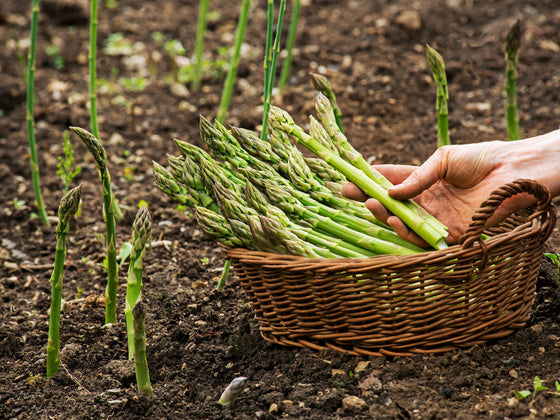
Asparagus
How to grow asparagus from seed in Australia: raising seedlings, planting crowns, a bed of its own, when to start picking spears and cutting back the fern.
| Position | Full sun |
|---|---|
| Depth | Seed 1 to 2 cm |
| Spacing | 30 to 40 cm |
| First pick | Third spring from sowing |
Blackberry
Grow thornless blackberries in Australia: each state's weed rules, planting bare-root canes in winter, trellis training, pruning, feeding and picking the fruit.
| Position | Full sun, afternoon shade inland |
|---|---|
| Depth | Old soil mark, or 3 to 5 cm deeper |
| Spacing | 150 to 180 cm apart |
| First pick | Second summer after planting |
Boysenberry
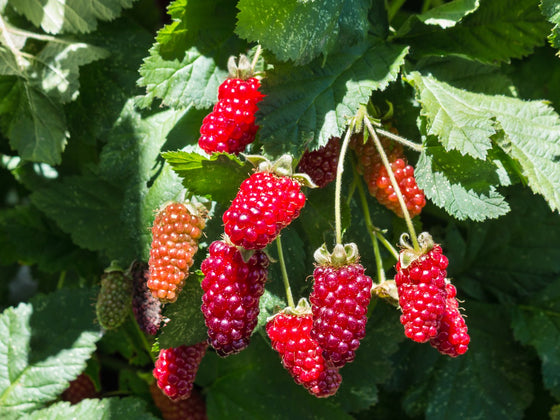
Grow boysenberries in Australia from bare-root canes: winter planting by climate zone, building a wire trellis, feeding, pruning fruited canes and picking.
| Position | Sun; afternoon shade where hot |
|---|---|
| Depth | Stem base level with soil |
| Spacing | 1.5 to 2 m apart |
| First pick | Early summer, from year two |
Elephant garlic
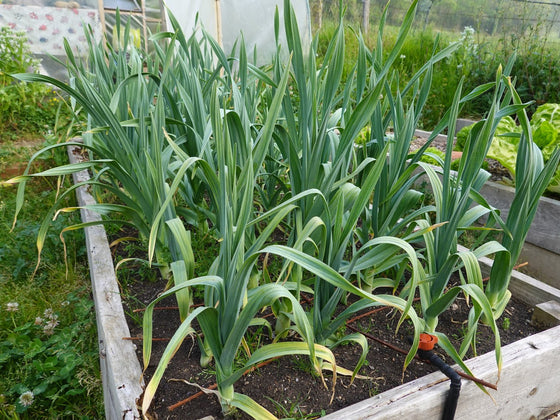
Also sold as Russian garlic. Plant the large cloves in April or May, keep the bed weeded and watered, and use the finger test to judge when the bulbs are ready.
| Position | Full sun, 6 hours or more |
|---|---|
| Depth | 5 cm of soil over tip |
| Spacing | 20 to 30 cm |
| First pick | 6 to 8 months |