
How to Grow Soapwort in Australia
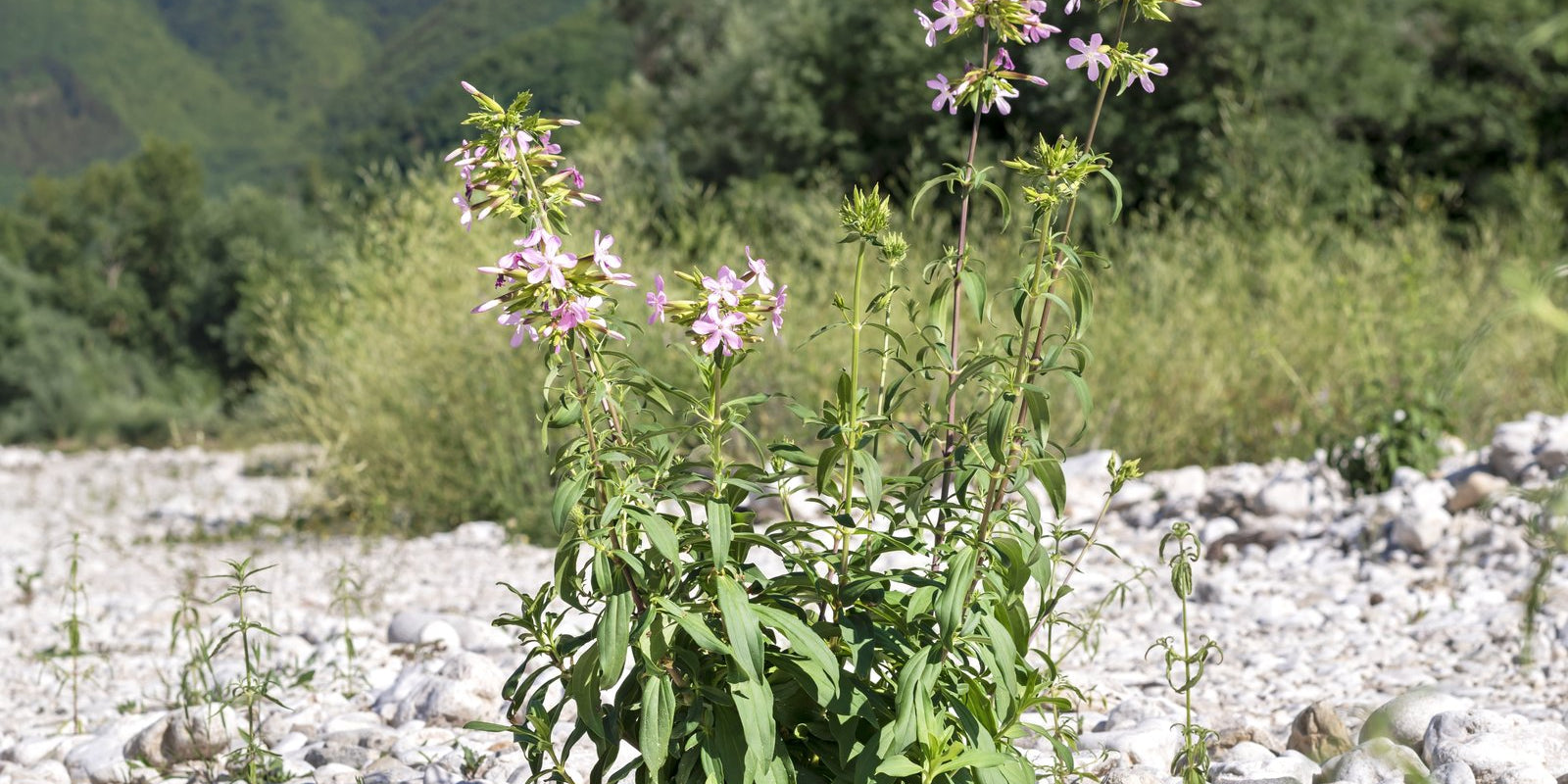
Soapwort is a tough, spreading perennial of the carnation family grown for clove-scented pink or white summer flowers. Soak the seed, chill it in the fridge for about four weeks, then sow it 1 cm deep where nights are cooler than days. Plant it 60 cm to 1 m apart in full sun, contain its runners, and keep it well away from fish ponds.
| Sun | Full sun or light shade |
|---|---|
| Water | Moderate; drought tolerant once established |
| Soil | Well drained, neutral to alkaline; poor soil suits |
| Feed | Minimal; compost and half-strength feeds only |
| Spacing | 60 cm to 1 m |
| Depth | About 1 cm, covered |
| Germination | 1 to 4 weeks after soaking and chilling |
| Harvest | Flowers summer into autumn |
| Container | Yes; at least 30 L, 40 cm wide |
| Frost | Very frost hardy; dies back in winter |
| Use | Cottage borders, scented flowers, moths and butterflies |
Soapwort, or bouncing bet (Saponaria officinalis, carnation family, Caryophyllaceae), is a vigorous perennial grown for its clove-scented pink or white flowers. Moths and butterflies visit its loose flower clusters in a cottage border from summer into autumn. The store sells soapwort seeds of the species, which reaches 60 cm to 1 m and spreads by creeping underground stems. Two things trip gardeners up: seed that sulks in a steady warm tray, and a plant that will not stay where it was put.
Three mistakes that matter
- Sowing untreated seed on a heat mat. This is the commonest failure. Fresh seed is dormant, and in one laboratory test only 0.5 to 3 per cent came up at a steady 20 or 25°C. Chill it or give it cool nights, as Germinating the seed explains.
- Planting it loose in a mixed bed. Stout rhizomes (underground stems) and long surface runners carry soapwort well beyond its patch. Plant it in a sunken bottomless pot, a container or a bed edged with a barrier, as Cutting Back and Containing describes.
- Growing it beside a fish pond. The plant is highly poisonous to fish, and stems trailing into water are enough to cause harm. Keep it well away from ponds, dams and creeks.
When to plant
A swing between warm days and cool nights decides when soapwort seed wakes. In one study, unchilled seed came up well only when the temperature swung between 20 and 30°C. Spring and autumn suit it, and winter in warm zones. One sowing is enough, because plants are long-lived and spread by themselves.
| Zone | Example cities | Sow | Harvest | Notes |
|---|---|---|---|---|
| Tropical | Darwin NT; Cairns, Townsville QLD; Broome WA | Not recommended | Not recommended | A cold-hardy European perennial with no Australian records north of NSW; wet-season heat likely defeats it. |
| Subtropical | Brisbane, Gold Coast, Sunshine Coast QLD; Coffs Harbour, Lismore NSW | May-Aug | Nov-Mar | Sow in the cool months, when nights fall well below days; sharp drainage helps plants through humid summers. |
| Arid and semi-arid | Alice Springs NT; Broken Hill, Dubbo NSW; Mildura VIC; Kalgoorlie WA | Mar-May and Aug-Sep | Dec-Mar | Water seedlings through the first summer, shelter them from hot wind and keep plants well away from creeks. |
| Temperate | Sydney, Newcastle, Wollongong NSW; Melbourne, Geelong VIC | Jun-Oct | Dec-Apr | Sow pots outdoors in winter for a natural chill, or sow fridge-chilled seed in spring. |
| Mediterranean | Perth, Bunbury WA; Adelaide and the SA coast | May-Sep | Dec-Apr | Winter-sown pots chill on cold nights; established plants tolerate the long, dry summers. |
| Cool and alpine | Hobart, Launceston TAS; Canberra ACT; Ballarat VIC; Orange, Armidale NSW; Stanthorpe QLD | Apr-Jun and Sep-Nov | Jan-Apr | Leave autumn pots outside through winter for spring seedlings; naturalised around Canberra, so contain it. |
At the hot edge of a window, sow where nights cool: chilling did nothing for seed held at a steady 25°C. In cool districts, pots sown in autumn can sit outdoors all winter and come up in spring.
Site, soil and setup
Soapwort comes from Europe and western Asia, where it grows wild on streamsides and in damp woods on river soils. In Australia it has escaped to roadsides, waste ground and creek banks in New South Wales, the ACT, Victoria and Tasmania.
| Get the bed right | What to do |
|---|---|
| Light | Full sun for upright stems and most flowers; light shade is tolerated |
| Soil | Any well-drained soil, from sand to loam and shallow, rocky ground; poor soil keeps it compact |
| pH | Neutral to alkaline is best; on acid soil below about 6, dig in dolomite lime at 100 to 200 g per square metre 4 weeks before planting |
| Preparation | On very poor sand, dig in a 5 cm layer of compost; no manure, which makes stems flop |
| Containment | A bottomless pot or a root barrier sunk to the rim, or a bed bounded by paving or a path |
| Keep clear of | Ponds, dams, creek lines, stormwater drains, bushland edges and paddocks where stock graze |
| Rotation | None: a permanent perennial for a border or herb garden, never the vegie rotation |
Container growing
A pot is the surest way to keep soapwort in bounds, and it suits a courtyard or a small garden. Give one plant a pot of at least 30 L and 40 cm across, filled with a premium potting mix. Stems that flop over the rim can root where they touch the ground, so keep the pot off bare soil.
- Watering: water when the top 3 to 5 cm of mix is dry, more often in hot, windy weather.
- Feeding: fish and seaweed blend at half strength, about 12 mL per 9 L, fortnightly in spring and summer, only if leaves turn pale.
- Position: full sun or light shade, turned now and then so the stems grow evenly.
- Renewal: once the pot is crowded, tip the plant out, cut the root ball in half and replant one piece in fresh mix.
Germinating the seed
Soapwort seed is dormant when it ripens, held back by its coat until a spell of wet, cold or both. In a study of river gravel banks, many seeds gave seedlings the spring after they were shed, and soaking mattered more than cold. In one laboratory test, 96 per cent of the seed was alive. Yet only 0.5 to 3 per cent germinated in 28 days at a steady 20 or 25°C.
Treated well, it is not hard. In the same test, chilled seed reached 85 per cent at 20°C. Under a daily swing between 20 and 30°C it reached 97 per cent, taking about eight days on average. Seed also did better in darkness than in light, so cover it. At home, sow two or three seeds for each plant you want.
| Treatment | How | How long | Temperature | What success looks like |
|---|---|---|---|---|
| Soak, then chill | Soak the seed in room-temperature water, drain, mix it with a spoonful of damp vermiculite or sand in a sealed, labelled bag and put it in the fridge | Soak 12 hours; chill about 4 weeks | About 4°C in the fridge; then about 20°C, better with cooler nights | Seedlings from about 8 days in the laboratory, usually within 4 weeks in a tray; a few seeds may show a white root tip in the bag |
| Day and night swing, no chill | Sow covered in a tray kept outdoors in a sheltered, bright spot, or in a greenhouse that cools at night | About 10 days in the laboratory; 2 to 4 weeks in a home tray, up to 8 | Warm days near 25 to 30°C and nights 10 or more degrees cooler | An uneven but good stand; about three in four seeds in the laboratory |
| A winter outdoors | Sow in a pot in autumn or early winter and leave it outside, watered by rain, in a spot safe from snails | Through winter | Winter cold, then spring warmth | Seedlings in spring as days lengthen and warm |
| Nicking the coat | Under a magnifier, nick only the coat with a fine blade, on the side away from the root tip so the embryo is not cut; fiddly, because about 700 seeds weigh 1 g. If unsure, soak and chill instead | A few minutes | Not given in the study; sow as in the rows above | Swollen seed and a root within days; 99 per cent by day two in a Chinese laboratory |
No source names a chemical treatment for this species, and none is needed. For seed treatments in general, see soaking, scarification and cold stratification.
When nothing comes up
- Too warm and too steady. A heat mat or a warm room holds untreated seed back. Chill the seed, or move the tray outdoors where nights cool.
- Left in the light. In the laboratory, seed given light germinated worse than seed kept dark. Cover it with about 1 cm of mix.
- Bag dried out or went mouldy. The vermiculite should feel damp, not wet. Remix with fresh, barely damp vermiculite and restart the chill.
- Old seed, stored warm. Keep packets cool and dry, and sow fresh seed where you can.
- Given up too soon. Some seed takes up to 60 days. After eight weeks, leave the pot outdoors through winter for a spring flush.
Sowing Seeds
Start soapwort in pots or trays from soaked and chilled seed, as Germinating the seed describes, or sow outdoors in autumn in cool districts. Pots are the better choice, because they let you place each plant exactly where it can be contained.
Starting in trays
- Fill a punnet or cell tray with fresh seed raising mix, firm it lightly and water it well.
- Sow two or three treated seeds to a cell, about 1 cm deep, and cover them.
- Stand the tray in bright light where nights cool, as When to plant explains, and keep the mix just moist.
- Thin each cell to the strongest seedling once true leaves appear.
- Pot seedlings on into their own small pots when they are large enough to handle.
Sowing direct
Direct sowing suits cool districts in autumn, inside the barrier or bed you have prepared for it. Rake the soil fine, sow thinly about 1 cm deep, and mark the row, because seedlings may not appear until spring. Thin them to 60 cm to 1 m apart once they have several leaves.
Planting out
- Plant out when seedlings stand 5 to 8 cm tall with several pairs of leaves.
- Harden off first (stand the pots outdoors a little longer each day for a week, so they adjust to sun and wind).
- Space plants 60 cm to 1 m apart, inside the barrier, at the same depth as in the pot.
- Water in with seaweed solution at half strength, 15 mL per 9 L.
- Water twice a week until new growth shows, then in dry spells.
More on that step is in hardening off seedlings before planting out.
Care by growth stage
Lean soil and restraint keep soapwort upright and flowering. Rich soil and feeding make the stems flop open, so feed at half strength at most and only when growth looks pale.
| Stage | Water | Feed | Watch for |
|---|---|---|---|
| Seedling, in the tray until large enough to handle | Keep the mix just moist; water from below | Seaweed solution at half strength, 15 mL per 9 L, fortnightly from the first true leaves | Damping off (seedlings rotting at soil level); snails; drying out |
| Young plant, from planting out until settled | Deep water twice a week, then when the top few centimetres are dry | A handful of worm castings in each planting hole | Snails and slugs grazing new shoots at night |
| Spring, as shoots emerge | A deep soak in dry spells | A 5 cm compost mulch on poor sand, kept clear of the stems | Runners crossing the barrier; aphids on soft tips |
| Summer and autumn, in flower | Water in long dry spells; drought tolerant once established | None | Floppy stems in rich soil; seed heads forming |
| Winter | Little or none; rain is usually enough | None | Stems dying back; soggy soil in pots |
| The weeks before cutting flowers | Keep watering as usual right up to cutting | None | The first flowers opening in each cluster |
If growth stalls in very poor sand, a light application of all-purpose controlled release granular (NPK around 14-5-10) scratched in each spring can help.
Cutting Back and Containing
Soapwort needs little pruning: deadheading keeps it flowering and stops seed, and a firm edge each spring keeps its runners in check.
- Cut spent flower clusters back to the next pair of leaves to prolong flowering and stop self-sowing.
- Cut all stems to near ground level once they brown off in late autumn or winter.
- Each spring, slice a spade down along the edge of the patch and lift any runners beyond it.
- Pull surface runners that root where they touch the soil, following each back to the plant.
- Lift and divide crowded clumps in spring or autumn, and replant one piece.
- Bag rhizome pieces and seed heads for the general waste bin, never the compost, the bush or a drain.
For a sunken barrier, cut the base off a large plastic pot and sink it with the rim level with the soil. Gardening Australia contains mint the same way. For lifting and splitting a clump, see dividing perennials.
Companion planting
Pair soapwort with tough, sun-loving plants that hold their own, and keep it apart from anything it could swamp or poison.
Grows well with
- Yarrow, a sturdy perennial for the same sunny, lean border.
- Catmint, a low, drought-tolerant edge in front of the taller stems.
- Lavender, which likes the same sun, drainage and neutral to alkaline soil.
Keep apart
- Vegie beds and rock garden plants, which its runners overrun.
- Paddocks and chook runs, where stock or birds could eat the plant or its seed.
Harvesting Flowers and Stems
Cut flowering stems for the vase once the first few flowers in a cluster have opened, from summer into autumn.
- Cut in the cool of the morning or evening.
- Take stems just above a pair of leaves, so side shoots follow.
- Strip leaves that would sit below the water line, and stand stems in cool water straight away.
- Keep sap and cut ends away from your eyes, and wash your hands afterwards.
- Leave some flowers on the plant for moths and butterflies.
Keep cut stems in a cool room, change the vase water whenever it clouds and recut the ends. The roots, leaves and seeds carry saponins: see Safety.
Traditional use and history
The genus name comes from the Latin sapo, soap, because the plant raises a froth in water. John Harvey's study of medieval gardens, drawn mostly from monastic records, first lists it in the eleventh century and again in the twelfth. Britain counts it an ancient introduction, and it reached Australia late in the nineteenth century.
| Tradition | Name | What the tradition recorded |
|---|---|---|
| English herbals | Saponary, borith, crowsope | Named in The Grete Herball early in the sixteenth century, and described again in John Gerard's herbal at the end of it |
| Cloth trades of Britain and France | Fuller's herb (herba fullonum), herbe à foulon | Used in fulling, taking stains from woollen cloth and thickening it; in France, planted beside textile mills |
| Syria and the Swiss Alps | Soapwort | Used for laundering woollens in Syria, and as a sheep wash before shearing in the Alps |
| European settlers in North America | Bouncing bet, lady by the gate | Taken across by settlers, who used the sap of its stems and roots as a soap; it later spread along roadsides |
| Churches and museums | Soapwort | Used on church vestments and old tapestries, and by the Victoria and Albert Museum on fragile fabrics late in the twentieth century |
Bouncing bet is an old English name for a washerwoman, Bet being short for Bess, according to the Missouri Botanical Garden. The Botanical Society of Scotland links it to the reflexed petals of the double flowers. The Botanical Society of Britain and Ireland links it to the plant's vigour. Another old name, mock gilliflower, suggests its spicy scent once stood in for cloves or pinks in flavouring wine.
The species name, officinalis, marks a plant once sold in the apothecary's shop. Maud Grieve's A Modern Herbal lists it among the medicines of her day, with a warning to use it very cautiously. Soapwort is also believed, though not proven, to have been used on the Shroud of Turin.
Safety
Happy Valley Seeds sells soapwort as seed for growing, as an ornamental. Nothing here is advice to eat or take any part of the plant. Anyone considering using a plant should first seek advice from a qualified health practitioner.
| Topic | What the sources say |
|---|---|
| Toxicity | All parts contain saponins, most in the roots, flowers and seeds and much less in the leaves. North Carolina State University rates the poison severity low, naming the roots and seeds and the symptoms nausea, vomiting and diarrhoea. The Botanical Society of Scotland calls it mildly poisonous and warns against eating it as a salad. LiverTox, the United States liver injury database, has no entry for soapwort, so it gives no likelihood score. |
| Pregnancy and breastfeeding | No clinical data were found. A consumer drug reference says there is not enough information on the safety of swallowing it while pregnant or breastfeeding, and advises avoiding it. A British plant database also says to avoid it in pregnancy. |
| Interactions with medicines | The same drug reference lists no known interactions, which reflects an absence of study rather than evidence of safety. Anyone taking medicines should ask a doctor or pharmacist before using any plant. |
| Skin, eyes and allergy | North Carolina State University records that it does not cause contact dermatitis. The drug reference notes it may irritate skin and mucous membranes, and the plant database records eye irritation from its lather. No source read records an allergy to it. |
| Pets, livestock and fish | A veterinary guide rates poisoning very unlikely in dogs and cats; the seeds pose the greatest risk and can harm birds. Stock that eat large amounts can go off their feed, drool, bloat and scour. The ASPCA plant lists do not include it. It is highly poisonous to fish, and has been used as a fish poison. |
| Legal status | Not declared or prohibited anywhere: it is absent from the lists of NSW WeedWise (NSW Department of Primary Industries), Agriculture Victoria, Biosecurity Queensland, Primary Industries and Regions SA, NRE Tasmania, the Northern Territory Government and the ACT's biosecurity declarations. The Western Australian Organism List (DPIRD) gives it as permitted. Victoria's advisory list of environmental weeds, from the Arthur Rylah Institute, rates it moderately invasive with extensive potential for further spread. It is naturalised as a weed of roadsides, waste ground and streams in New South Wales, the ACT, Victoria and Tasmania. The store has no shipping restriction on this seed. |
Rock soapwort (Saponaria ocymoides) is a different, low trailing plant. Soapwort also shares the name wild sweet William with sweet William (Dianthus barbatus), a garden pink, so check the botanical name. If someone collapses or stops breathing, call triple zero (000). For any suspected poisoning, call the Poisons Information Centre on 13 11 26.
Common problems
No seedlings. Usually untreated seed kept too warm and steady, or left uncovered in light; see Germinating the seed and its list, When nothing comes up.
Plants spreading where they are not wanted. Runners and rhizome pieces start new plants, so edge the patch each spring; see Cutting Back and Containing.
Tall stems falling open. Rich soil and feeding make soapwort flop, so stop feeding, grow it in full sun and cut it back after flowering.
Seedlings popping up nearby. Flowers left to ripen shed seed; pull seedlings while small and see Cutting Back and Containing.
Tall, pale seedlings. Low light on a windowsill stretches them, so move trays into brighter light outdoors. Read more
Pests and diseases
Soapwort has no serious pest or disease problems, so trouble is most likely at the seedling stage.
Common garden snail (Cornu aspersum) and grey field slug (Deroceras reticulatum). Both graze seedlings and soft young shoots at night in damp weather. Hand-pick them after dark, or scatter an iron-based snail bait thinly as the label directs. Read more
Green peach aphid (Myzus persicae). A world catalogue of aphids lists soapwort among its hosts, and it is widespread in Australia. Hose colonies off soft tips with a strong jet of water. Read more
Damping off (Pythium species and Rhizoctonia solani). Seedlings rot at soil level and collapse, most often in wet, crowded trays. Use fresh seed raising mix, avoid overwatering and thin for air flow. Read more
Prevention first
- Keep seed trays clear of rain and hose splash, which spread damping off.
- Water the soil, not the leaves, and let established plants dry out between waterings.
- Check soft shoot tips weekly through spring.
- Clear boards, leaf litter and loose pots from around seedlings, where snails shelter.
Tips
- Plant it near a window or a path you use at dusk, when the clove scent is strongest.
- Take a torch out on a warm summer evening: moths, including hawkmoths, may be feeding at the flowers.
- Label the pot or bed with the botanical name, so nobody mistakes it for rock soapwort or sweet William.
Questions
Why are my soapwort seeds not germinating?
Usually they were kept at a steady warm temperature. Fresh seed is dormant, and one laboratory test found almost none came up at a constant 20 or 25°C. Soak the seed for 12 hours and chill it in the fridge for about four weeks. Then sow it about 1 cm deep where nights are cooler than days.
Do soapwort seeds need cold stratification?
They germinate far better with it. In one test, chilled seed reached 85 per cent at a steady 20°C. With warm days and cool nights it reached 97 per cent in about eight days. Unchilled seed can still come up where days and nights differ by about 10 degrees, or in spring from pots left outdoors over winter.
Is soapwort a declared weed in Australia?
No state or territory declares it, and the Western Australian Organism List gives it as permitted. Victoria's advisory list of environmental weeds rates it moderately invasive. It has naturalised along roadsides, waste ground and streams in New South Wales, the ACT, Victoria and Tasmania. Grow it contained, deadhead it, and put rhizome pieces in the general waste bin.
How do I stop soapwort spreading through the garden?
Grow it in a pot, or in a bottomless pot or root barrier sunk to the rim. Each spring, slice along the edge of the patch with a spade and lift runners beyond it. Cut off spent flowers before seed ripens.
Is soapwort poisonous to dogs, cats or fish?
A veterinary guide rates poisoning very unlikely in dogs and cats, though the seeds pose the greatest risk and can harm birds. It is highly poisonous to fish, so never plant it where stems can trail into a pond. Call your vet if an animal eats it.
Is soapwort the same plant as rock soapwort?
No. Soapwort is Saponaria officinalis, an upright plant 60 cm to 1 m tall. Rock soapwort, Saponaria ocymoides, is a different, low trailing species. Check the botanical name on any seed or plant you buy.
Grow it
Choose a size to add it to your cart. You stay on this page.
- Soapwort seedsFrom $2.99

More herbs to sow in September
All herbs
Agrimony
How to grow agrimony in Australia from seed: chilling the burrs, sowing months for six climate zones, sun and soil, cutting back, harvest, history and safety.
| Position | Full sun, light shade tolerated |
|---|---|
| Depth | 5 mm |
| Spacing | 30 cm apart |
| First pick | Summer; 12 to 18 weeks from spring sowing |

Angelica
How to grow angelica in Australia from seed: fresh or chilled seed sown on the surface, part shade, months for six climate zones, stems, history and safety.
| Position | Part shade, morning sun |
|---|---|
| Depth | Surface; press in, uncovered |
| Spacing | 50 to 90 cm |
| First pick | Stems at about 18 months |
Anise Hyssop
How to grow anise hyssop in Australia from seed: surface sowing, free-draining soil, sowing months for six zones, cutting back, and picking leaves and flowers.
| Position | Full sun or light shade |
|---|---|
| Depth | Surface, or 1 mm |
| Spacing | 30 to 40 cm apart |
| First pick | Leaves from about 10 weeks |
Anise
How to grow anise in Australia: when to sow in all six climate zones, sowing where it grows, spacing and watering, then harvesting and drying seed and leaves.
| Position | Full sun, sheltered from wind |
|---|---|
| Depth | 6 to 10 mm |
| Spacing | 25 to 30 cm apart |
| First pick | Seed 17 to 20 weeks from sowing |