
How to Grow Wormwood in Australia
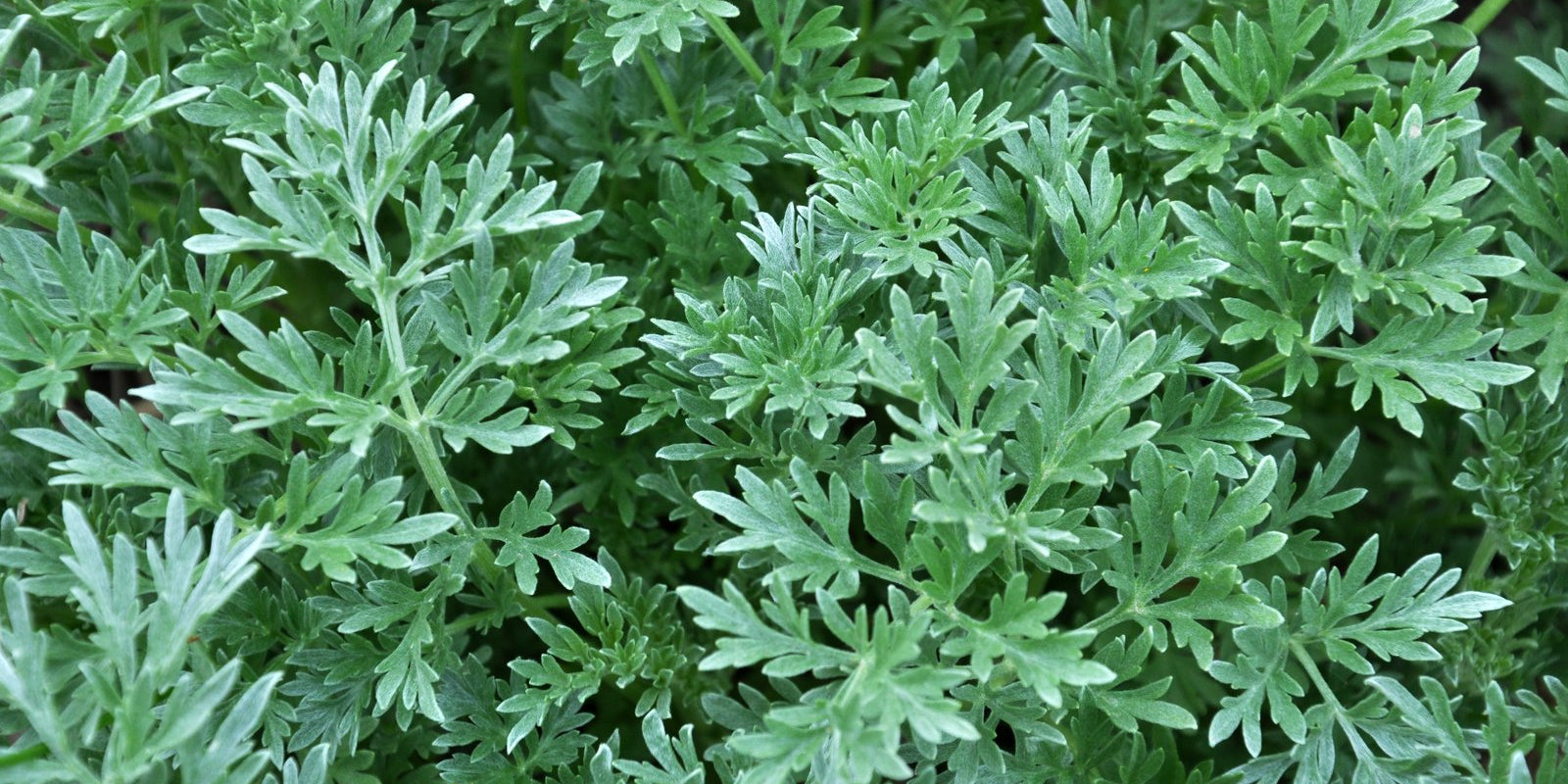
Wormwood is a shrubby, frost-hardy perennial grown for its feathery, silver-grey foliage. Press the dust-fine seed onto damp mix without covering it, because it needs light, and keep it at 15 to 25°C. Plant out 60 cm apart in full sun and lean, free-draining soil. Feed little, prune each spring, wear gloves, and do not eat it.
| Sun | Full sun |
|---|---|
| Water | Low once established; deep soak in long drought |
| Soil | Lean, free-draining; any pH |
| Feed | Minimal; compost and half-strength feeds only |
| Spacing | 60 cm apart |
| Depth | Surface; press in, do not cover |
| Germination | 2 to 5 weeks, 15 to 25°C, in light |
| Harvest | Foliage from about 12 weeks |
| Container | Yes; at least 30 L, 40 cm wide |
| Frost | Very frost hardy once established |
| Use | Silver foliage, dry borders, cut and dried stems |
Wormwood (Artemisia absinthium, family Asteraceae) is a shrubby, frost-hardy perennial grown for its feathery, silver-grey foliage and its cut stems. The store sells wormwood seeds of the common species, which grows to about 1 m tall. It suits dry, sunny beds from Hobart to Alice Springs, given a deep soak in a long drought. The step to get right is leaving the seed uncovered, because it needs light to germinate.
Three mistakes that matter
- Covering the seed. Kept in the dark, about two-thirds of wormwood seed fails to germinate, so a layer of mix on top can leave a tray bare. Press it onto the surface instead, as Germinating the seed describes.
- Rich, wet soil. Wormwood rots at the roots in soil that stays wet, and grows leggy and floppy in rich soil. Plant it in lean, free-draining ground in full sun, and skip the manure.
- Planting it among the kitchen herbs. Its leaves are not for eating, and neighbours crowded against it often struggle. Give it a spot of its own in a border or dry bed, well away from anything you pick to eat.
When to plant
Seed germinates best with the mix between about 15 and 25°C, and it stalls below about 5°C. That suits spring and early autumn in most zones, and the dry season in the north. Sowings in the height of summer tend to come up more slowly and dry out faster.
| Zone | Example cities | Sow | Harvest | Notes |
|---|---|---|---|---|
| Tropical | Darwin NT; Cairns, Townsville QLD; Broome WA | Apr-Jun | Jul-Oct | Grow it through the dry season in a raised bed or pot; wet-season rain and humidity can rot it. |
| Subtropical | Brisbane, Gold Coast, Sunshine Coast QLD; Coffs Harbour, Lismore NSW | Mar-May and Aug-Sep | Oct-Apr | Sow as the mix cools in autumn or before spring warms; sharp drainage carries it through humid summers. |
| Arid and semi-arid | Alice Springs NT; Broken Hill, Dubbo NSW; Mildura VIC; Kalgoorlie WA | Mar-Apr and Aug-Sep | Oct-Apr | Suited once settled, with deep soaks in long droughts; water seedlings through summer and shelter them from hot wind. |
| Temperate | Sydney, Newcastle, Wollongong NSW; Melbourne, Geelong VIC | Sep-Nov and Mar-Apr | Nov-Apr | Sow once trays hold 15°C in spring, or in early autumn so plants settle before winter. |
| Mediterranean | Perth, Bunbury WA; Adelaide and the SA coast | Mar-May and Sep-Oct | Oct-Apr | Autumn sowings establish on winter rain; established plants need little summer water. |
| Cool and alpine | Hobart, Launceston TAS; Canberra ACT; Ballarat VIC; Orange, Armidale NSW; Stanthorpe QLD | Sep-Nov and Feb-Mar | Dec-Apr | Start spring seed indoors in the warmth; established plants die back in winter and reshoot. |
At the cold edge of a window, start seed indoors on a bright windowsill or a heat mat. In frosty districts, autumn seedlings overwinter as small rosettes, and sharp drainage matters more to them than warmth.
Site, soil and setup
Wormwood grows wild on dry, stony, waste ground, and it does best in the garden when you treat it the same way. Silver-leaved plants reflect the sun and lose less water, so it earns a place in the hottest, driest corner.
| Get the bed right | What to do |
|---|---|
| Light | Full sun for the most silver, compact growth; part sun makes it leggy |
| Soil | Sandy, loamy or chalky soil; gravelly or poor soil is fine |
| pH | Acid, neutral or alkaline; no correction needed |
| Preparation | Dig in a 5 cm layer of compost on very poor sand; no manure |
| Drainage | Build a mound or raised bed on clay that stays wet after rain |
| Room | 60 cm between plants; about 80 cm to 1 m tall |
| Rotation | None: a long-lived perennial for a border, dry garden or rockery, not the vegie rotation |
Container growing
Wormwood grows well in a large pot, which also keeps its roots and fallen leaves away from other plants. Give one plant a pot of at least 30 L and 40 cm across, filled with a premium potting mix. A heavy terracotta pot stops a 1 m plant blowing over.
- Watering: water when the top 3 to 5 cm of mix is dry, and let the pot drain freely, never standing in a saucer.
- Feeding: a fish and seaweed blend at half strength, about 12 mL per 9 L, fortnightly in spring and summer, only if leaves look pale.
- Position: full sun, with some afternoon shade in hot inland districts, where pots dry out fast.
- Renewal: pot a plant on, or replace it with a rooted cutting, once it fills the pot with roots.
Germinating the seed
Wormwood seed has no deep dormancy to break. It needs light, moisture and mild warmth. In seed bank tests at the Royal Botanic Gardens, Kew, seed gave 95 to 100 per cent at 20 to 26°C in daily light. At a steady 15°C the rate fell to 67 per cent over five weeks.
Light matters most: in a Canadian study, about two-thirds of the seed failed in constant darkness, yet germinated normally once moved into light. In the same study, 2 weeks of cold, damp storage at about 2°C lifted germination. Two seed lots rose from 87 and 78 per cent to 97 and 96 per cent. The seed is dust-fine, roughly 10,000 to the gram, so sow a pinch of four or five seeds for each plant you want. At home, seedlings usually show in 2 to 5 weeks.
| Treatment | How | How long | Temperature | What success looks like |
|---|---|---|---|---|
| None needed: surface sow in light | Press the seed onto damp seed raising mix without covering it; mist or water from below; bright light but no hot direct sun | Usually 2 to 5 weeks | 15 to 25°C | Green specks, then pairs of tiny rounded seed leaves |
| Optional short chill | Mix the seed into a teaspoon of damp sand in a sealed bag in the fridge, then scatter the sand and seed onto the tray | 2 weeks in the fridge | About 2°C in the fridge; then 15 to 25°C | A fuller, more even stand than unchilled seed |
For more on handling seed this small, see how to sow tiny seeds without losing them.
When nothing comes up
- Buried or shaded. Seed under a layer of mix, or in a dark corner, often stays put. Sow again on the surface in bright light.
- Dried out. Surface seed dries fast. Cover the tray with clear plastic or glass until the first leaves show.
- Too hot or too cold. A summer glasshouse or a cold winter sill slows it; keep the tray within the temperature range in the treatment table.
- Old seed. Seed stays viable for about 3 to 4 years; kept warm on a shelf, it loses vigour sooner. Store it cool and dry.
- Given up too soon. Keep the tray moist and in the light for six weeks before sowing again. Seed shed onto soil can still come up years later.
Sowing Seeds
Start wormwood in trays for the most even stand, or scatter it where it is to grow. Both routes begin with seed pressed onto the surface, as Germinating the seed explains.
Starting in trays
- Fill a punnet or cell tray with fresh seed raising mix, firm it lightly and water it well.
- Scatter a pinch of seed per cell, press it on with a flat board, and do not cover it.
- Stand the tray in bright, indirect light and keep the surface just moist with a mister.
- Thin each cell to the strongest seedling once the first feathery true leaves appear.
- Start trays 6 to 8 weeks before you plan to plant out.
Sowing direct
Rake the bed fine and level, water it, then mix the seed with a little dry sand and scatter it thinly. Tamp it onto the surface with the back of a rake and mist daily until seedlings show. Thin them to 60 cm apart once they are big enough to handle.
Planting out
- Plant out when seedlings stand 5 to 8 cm tall with several true leaves.
- Harden off first (stand the pots outdoors a little longer each day for a week, so they adjust to sun and wind).
- Plant at the same depth as in the pot, 60 cm apart, and water in with seaweed solution at half strength.
- Water twice a week until new growth shows, then only in long dry spells.
More on the move from pot to garden is in hardening off seedlings before planting out.
Care by growth stage
Drainage and restraint decide how well wormwood grows. Over-feeding reduces the essential oils that give wormwood its aroma and makes it soft and leggy, so feed at half strength at most.
| Stage | Water | Feed | Watch for |
|---|---|---|---|
| Seedling, weeks 0 to 8 in the tray | Keep the mix just moist; mist or water from below | Seaweed solution at half strength, 15 mL per 9 L, fortnightly from the first true leaves | Damping off (seedlings rotting at soil level); drying out; stretching in low light |
| Young plant, from planting out until settled | Water deeply twice a week until settled, then when the top few centimetres are dry | A handful of worm castings in each planting hole | Snails and slugs at night; wilting in hot wind |
| First summer | A deep soak only when the soil is dry well below the surface | None | Aphids on soft tips; floppy growth in rich soil |
| Autumn and winter | Little or none; rain is usually enough | None | Soggy soil and root rot; dieback to the crown in cold districts |
| Established plant, each spring | Occasional deep water in long dry spells | A 5 cm compost mulch, kept clear of the stems | New shoots at the base, the cue to prune |
| The weeks before cutting | Keep watering as usual right up to cutting | None | Dusty or insect-damaged leaves; cut clean growth |
If growth stalls in very poor sand, a light application of all-purpose controlled release granular (NPK around 14-5-10) scratched in each spring can help.
Pruning
A spring cut keeps wormwood dense, and removing spent flower stems stops it seeding across the garden. Wear gloves and long sleeves, as Safety explains.
- Cut back in spring to the lowest new shoots near the base, once they show.
- Pinch the tips of young plants in spring for shorter, bushier growth.
- Cut off the flower stems as the yellow flowers fade, before seed ripens.
- In frosty districts, leave the old stems over winter and cut them away once new shoots appear.
- Lift any stem that has rooted where it touched the ground, and replant it.
Rooted stems are a form of layering, and greenwood tips taken in early summer also root: see how to take cuttings.
Companion planting
Choose neighbours that share its love of sun and dry, lean soil, and keep them at arm's length.
Grows well with
- Lavender, another grey-leaved plant that takes heat and drought.
- Sage, which wants the same sun and free-draining soil.
- Yarrow, which takes dry soil and draws the insects that eat aphids.
Keep apart
- Vegetables and kitchen herbs, since compounds from wormwood may hold back their growth and its leaves must not be mixed with a harvest.
- Tarragon, a related kitchen herb, so cuttings of the two are never confused.
Whether wormwood truly poisons its neighbours is debated. Extracts of its leaves hold back seedlings in laboratory tests, while field studies suggest its roots simply take a large share of soil nitrogen.
Harvesting Foliage
Cut foliage for the vase once a plant is bushy, usually from about 12 weeks after sowing. For drying, cut the leafy flowering tops in summer, just as the tiny yellow flowers open.
- Wear gloves, and cut on a dry day once dew has dried.
- Take no more than a third of a plant at one cutting.
- Cut the upper green stems with secateurs, and discard discoloured or insect-eaten leaves.
- Tie loose bunches of about six stems and hang them in an airy, half-shaded place, out of full sun.
- Dry until the leaves are crisp and the stems snap.
Store dried bunches in a closed, labelled box in a cool, dry, dark place, apart from kitchen herbs. Fresh stems make a long-lasting silver filler in bouquets, and dried ones suit wreaths. The leaves and flowering tops carry thujone and the intensely bitter absinthin, so read Safety before any other use.
Traditional use and history
Wormwood is native to temperate Europe, Asia and North Africa, where it grows wild on dry, stony and waste ground. Its genus is named either after Artemis, the Greek goddess, or after Queen Artemisia of Caria. Grieve's A Modern Herbal calls "as bitter as wormwood" a very old proverb. Other common names recorded by the Royal Horticultural Society include green ginger, old woman and warmot. In German the plant is Wermut.
| Tradition | Name | Part | What the tradition recorded |
|---|---|---|---|
| Ancient Egypt and Greece | Absinthium | Leaves and flowering tops | A plant of this or a close relative appears in the Ebers Papyrus; Hippocrates and Dioscorides both wrote about it |
| European herbals | Wormwood; Absinthii herba in the pharmacopoeias | Leaves and flowering tops | Recorded by Hildegard von Bingen and later herbalists as a bitter for appetite and digestion, and against intestinal worms |
| English households | Wormwood, green ginger | Dried stems and leaves | Strewn on floors against fleas, as Tusser's sixteenth-century farming verse advised, and laid among clothes and furs against moths |
| Brewing and distilling | Wermut; absinthe | Leaves and flowering tops | Used by brewers in place of hops, and the bitter base of the spirit absinthe |
Absinthe, the green spirit flavoured with wormwood, was popular in France, Britain and the United States in the nineteenth century. Fears over its effects, its very high alcohol and the toxic colourings some makers added led to bans. Switzerland, the United States and France banned it early in the twentieth century. It is sold legally again within limits on thujone in the European Union, and the United States has since lifted its ban.
The same herbal gathers the folklore. She records that the Mexicans wore garlands of wormwood at a festival of the goddess of salt. She also gives an English love charm for St Luke's Day that paired it with marigold, marjoram and thyme.
Safety
Happy Valley Seeds sells wormwood as seed for growing, as an ornamental. Nothing here is advice to eat or take any part of the plant. Anyone considering using a plant should first seek advice from a qualified health practitioner.
| Topic | What the sources say |
|---|---|
| Toxicity | All parts are poisonous if eaten. The leaves and flowering tops carry thujone, a nerve poison, in their essential oil, and the bitter absinthin. Eating large amounts can cause nervousness, stupor and convulsions, and can be fatal. Severe poisonings, with seizures, have followed swallowing the essential oil. LiverTox, the United States liver injury database, has no entry for wormwood, so it gives no likelihood score. |
| Pregnancy and breastfeeding | Avoid it altogether when pregnant or breastfeeding, as the store's own listing says. European regulators do not recommend it in either. Thujone is known to stimulate the uterus, and in rats a wormwood extract reduced implantation and the number of pups born. Australia's medicines regulator, the TGA, warns that products containing Artemisia species, wormwood among them, may carry a risk in pregnancy, highest in the early weeks, including before a pregnancy is known. |
| Interactions with medicines | European regulators report no known interactions with medicines. They advise against it for anyone with liver disease or a blocked bile duct. Anyone taking medicines should ask a doctor or pharmacist before using any plant. |
| Allergy and skin | A daisy family plant: people allergic to its relatives may react to it. Handling it can cause contact dermatitis, and handling the flowers has, very rarely, caused a widespread red rash. It is wind pollinated and sheds a great deal of pollen, which can trouble people with hay fever or asthma. Wear gloves and long sleeves when cutting it. |
| Pets and livestock | Veterinary sources describe no signs of poisoning in dogs, cats or horses, and the ASPCA's list of plants toxic to dogs does not include it. Cattle avoid it by choice, but it taints their milk when eaten in hay. Keep pets from chewing it, and call your vet if one does. |
| Legal status | Not on the declared or prohibited weed lists of New South Wales, Victoria, Queensland, South Australia, Tasmania, the Northern Territory or the ACT. The Western Australian Organism List gives it as permitted. It is a declared noxious weed in parts of North America and has been recorded naturalised in a Canberra road reserve, so deadhead it. The store has no shipping restriction on this seed. |
If someone collapses, stops breathing, has a seizure or has a severe allergic reaction, call triple zero (000). For any suspected poisoning, call the Poisons Information Centre on 13 11 26 without waiting for symptoms.
Common problems
No seedlings. Usually seed buried too deep, kept in the dark or allowed to dry out; see Germinating the seed and its list, When nothing comes up.
Tall, pale, floppy seedlings. Too little light on a windowsill stretches them. Move trays to brighter light and turn them daily. Read more
Plants that rot or die back in winter. Stems dying back to their woody bases each winter is normal, and new shoots follow in spring. A plant that fails to reshoot from wet, heavy soil has usually rotted; see Three mistakes that matter.
Leggy, sprawling plants. Part shade and rich soil both make wormwood open and floppy. Move it into full sun, stop feeding, and cut it back hard in spring.
Plants that sulk in humid summers. Long, steamy spells can soften growth and rot the base on the coast. Sharp drainage, full sun and good air flow usually carry it through.
Seedlings everywhere. Each plant sheds thousands of tiny seeds, carried by wind and water; see Pruning.
Pests and diseases
Wormwood has few serious pests, though some aphids, moths and grasshoppers feed on it.
Aphids (family Aphididae). Small, soft green or yellow insects cluster on soft shoot tips and leave sticky honeydew and sooty mould. Squash small colonies, hose them off with a strong jet, or spray insecticidal soap under the leaves as the label directs. Read more
Common garden snail (Cornu aspersum) and grey field slug (Deroceras reticulatum). Both graze seedlings at night in damp weather. Hand-pick them after dark, or scatter an iron-based snail bait thinly as the label directs. Read more
Damping off (Pythium species and Rhizoctonia solani). Seedlings rot at soil level and collapse, most often in wet mix. Use fresh seed raising mix and clean trays, and avoid overwatering. Read more
Prevention first
- Keep seed trays clear of rain and hose splash, which spread damping off.
- Water the soil, not the leaves, and let established plants dry out between waterings.
- Check shoot tips weekly through spring and summer.
- Clear leaf litter, boards and loose pots from around seedlings, where snails shelter.
Tips
- Plant wormwood beside strong reds, oranges and purples: its silver foliage softens bright colours and makes darker leaves stand out.
- Grow it where rabbits and deer browse, since its aromatic leaves generally put them off.
- Plant flowering herbs nearby if you want bees: insects visit wormwood only for pollen and shelter.
Questions
Why did my wormwood seeds not come up?
Check first whether they were buried. Wormwood seed needs light, and about two-thirds of it fails in the dark. Press it onto damp seed raising mix without covering it, keep the surface moist with a mister, and hold the tray at 15 to 25°C. Seedlings usually show in 2 to 5 weeks.
How long does wormwood take to grow from seed?
Seedlings are usually ready to plant out 6 to 8 weeks after sowing, once they stand 5 to 8 cm tall with several true leaves. Light cuts of foliage can usually start from about 12 weeks. Plants from seed often make a leafy clump in the first season and flower more strongly from the second summer.
Is wormwood the same as mugwort or southernwood?
No. Wormwood (Artemisia absinthium), mugwort (Artemisia vulgaris) and southernwood (Artemisia abrotanum) are different species in the same genus. Mugwort is often listed as a wormwood look-alike, so check the botanical name on any seed or plant you buy, and label your plants.
Is wormwood safe around dogs, cats and horses?
All parts are poisonous if eaten, and its essential oil holds thujone, a nerve poison. Veterinary sources describe no signs of poisoning in pets, and cattle avoid it by choice. Keep pets from chewing it, keep cut stems out of reach, and call your vet if one does eat it.
Will wormwood stop other plants growing near it?
It may. Leaf extracts hold back seedlings in laboratory tests, and its roots take a large share of soil nitrogen, though field trials are less clear. Give it about 60 cm of clear ground and keep it out of vegetable and kitchen herb beds.
Is wormwood a declared weed anywhere in Australia?
No state or territory declares it, and the Western Australian Organism List gives it as permitted. It is a noxious weed in parts of North America. It has naturalised in a Canberra road reserve, so cut off the flower stems before the seed ripens.
Grow it
Choose a size to add it to your cart. You stay on this page.
- Wormwood seedsFrom $2.99

More herbs to sow in September
All herbs
Agrimony
How to grow agrimony in Australia from seed: chilling the burrs, sowing months for six climate zones, sun and soil, cutting back, harvest, history and safety.
| Position | Full sun, light shade tolerated |
|---|---|
| Depth | 5 mm |
| Spacing | 30 cm apart |
| First pick | Summer; 12 to 18 weeks from spring sowing |

Angelica
How to grow angelica in Australia from seed: fresh or chilled seed sown on the surface, part shade, months for six climate zones, stems, history and safety.
| Position | Part shade, morning sun |
|---|---|
| Depth | Surface; press in, uncovered |
| Spacing | 50 to 90 cm |
| First pick | Stems at about 18 months |
Anise Hyssop
How to grow anise hyssop in Australia from seed: surface sowing, free-draining soil, sowing months for six zones, cutting back, and picking leaves and flowers.
| Position | Full sun or light shade |
|---|---|
| Depth | Surface, or 1 mm |
| Spacing | 30 to 40 cm apart |
| First pick | Leaves from about 10 weeks |
Anise
How to grow anise in Australia: when to sow in all six climate zones, sowing where it grows, spacing and watering, then harvesting and drying seed and leaves.
| Position | Full sun, sheltered from wind |
|---|---|
| Depth | 6 to 10 mm |
| Spacing | 25 to 30 cm apart |
| First pick | Seed 17 to 20 weeks from sowing |